Awake Brain Surgery Explained: Costs, Safety, and Top Hospitals in China
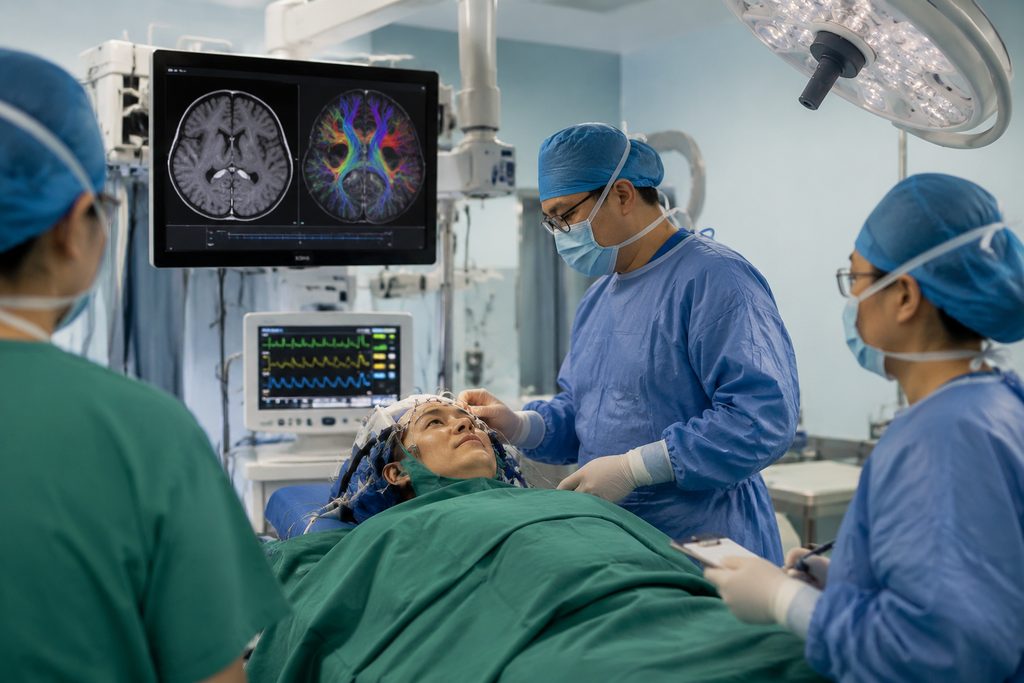
When 47-year-old Daniel heard the words “awake craniotomy” from his neurologist in Manchester, his first thought was not about survival rates or surgical margins. It was about being conscious while someone operated inside his skull. The second thought, two weeks later, was about the £38,000 quote from a private London hospital. Daniel’s tumor was in the left frontal lobe, dangerously close to the speech center. His UK surgeon recommended an awake procedure to map language function in real time. But the cost, combined with a 9-week wait, pushed him to search for alternatives. That search led him to a question many patients eventually ask: what does awake brain surgery cost China compared to Western options — and is the quality comparable?
Key Takeaways
- Awake craniotomy in top Chinese hospitals costs $18,000–$35,000, versus $60,000–$150,000 in the US and £35,000–£70,000 in the UK.
- Major Chinese neurosurgery centers perform 150–400 awake craniotomies annually, with published complication rates comparable to Western benchmarks.
- Language mapping during awake surgery is performed in English at international departments in Shanghai and Beijing, but coordination requires advance planning.
- You cannot book an awake craniotomy remotely. A formal in-person consultation with imaging review is required before any surgical scheduling.
The Problem: Awake Brain Surgery Is Expensive and Hard to Access in Western Systems
Gliomas — the tumor type most commonly treated with awake craniotomy — affect approximately 6 per 100,000 people annually across North America and Europe. For patients whose tumors sit near eloquent cortex (regions controlling speech, movement, or vision), awake mapping is not a luxury. It is the standard of care. The technique allows the surgical team to stimulate cortical tissue while the patient speaks or moves, identifying functional areas that must be preserved. Without this mapping, the risk of permanent neurological deficit rises sharply.
But access is uneven. In the United States, the average cash price for an awake craniotomy with tumor resection ranges from $60,000 to $150,000 depending on hospital, length of stay, and insurance status. Even insured patients face deductibles of $5,000–$10,000 and out-of-network surprises. In the UK, NHS waiting times for non-emergency brain tumor surgery have stretched past 62 days in several trusts, and private care at a London teaching hospital starts around £35,000. Canada’s median wait from specialist referral to neurosurgery exceeds 30 days, and awake craniotomy is only offered at a handful of academic centers.
For patients without top-tier insurance, the numbers are brutal. A 2023 survey by the American Brain Tumor Association found that 41% of patients reported delaying care due to cost. Delays with gliomas are dangerous. High-grade tumors can progress measurably within weeks.
Why China’s Neurosurgery Centers Deliver Comparable Outcomes at a Fraction of the Price
Clinical Volume Creates Repetition and Refinement
Volume matters in neurosurgery. A surgeon who performs 50 awake craniotomies a year simply has better intraoperative judgment than one who performs 5. At hospitals like Huashan Hospital in Shanghai (affiliated with Fudan University) and Beijing Tiantan Hospital, neurosurgery departments handle over 10,000 brain tumor surgeries annually combined. Awake craniotomy is a routine procedure in these centers, not a rare event. Published data from Huashan’s glioma center shows awake craniotomy cases exceeding 200 per year, with gross total resection rates above 80% for low-grade gliomas — a figure consistent with MD Anderson and UCSF benchmarks.
Intraoperative Technology Is Standard, Not an Add-On
A common misconception is that lower cost means older equipment. In Chinese top-tier public hospitals, the opposite is often true. Awake craniotomy suites at the Shanghai and Beijing flagship hospitals include intraoperative MRI, neuronavigation, and cortical stimulation mapping as standard components. The reason costs stay low is structural: neurosurgeons are salaried, hospital beds are high-turnover, and equipment is amortized across enormous case volumes. One intraoperative MRI machine at Tiantan might scan more patients in a month than a comparable US machine scans in a quarter.
Cost Advantage Without Quality Compromise
The awake brain surgery cost in China reflects labor economics, not quality discounting. A senior neurosurgeon at a Fudan-ranked hospital earns a fraction of a US neurosurgeon’s $700,000–$900,000 annual compensation. Nursing costs, anesthesia fees, and facility charges all scale down. But the clinical protocols — awake asleep-awake anesthesia, speech mapping with a neuropsychologist, cortical stimulation with a dedicated intraoperative monitoring team — mirror international standards. The neurosurgery departments at these hospitals publish in the same journals as Western centers and participate in multinational glioma trials.
How Awake Craniotomy Actually Works in a Chinese Hospital: A Step-by-Step Timeline
Understanding the process removes much of the fear. Here is what a patient should expect, based on standard protocols at major Chinese neurosurgery centers.
Days 1–2: Admission and Preoperative Mapping
You arrive at the international ward. A functional MRI (fMRI) is performed to identify language and motor regions. A neuropsychologist conducts baseline testing in English — naming objects, reading sentences, counting. This baseline is critical because it establishes your personal linguistic map before surgery.
Day 3: The Surgery Itself
The procedure typically lasts 4–6 hours. You are sedated but conscious during the mapping phase. The anesthesiologist uses a technique called asleep-awake-asleep: you are asleep for the craniotomy (opening the skull), awake for cortical mapping and tumor resection, then asleep again for closure. During the awake phase, the surgical team asks you to speak, name pictures, and move your fingers. A probe delivers tiny electrical currents to the brain surface. If your speech stops or slurs when a specific area is stimulated, that area is marked as functional and spared during resection.
Days 4–7: Postoperative Monitoring
Most patients stay in the hospital 5–7 days total. Day 4 involves a postoperative MRI to assess resection extent. Neurological checks occur every 4 hours. By day 5 or 6, most patients walk independently and eat normally. Discharge planning includes medication review and a written summary in English.
Ask for the hospital’s awake craniotomy volume and the surgeon’s personal case count before committing. A center performing fewer than 30 awake cases per year is not equivalent to one performing 200.
Is Awake Craniotomy Safe in China? What the Published Data Shows
The question is awake craniotomy safe in China deserves a direct answer. The honest response: at top-tier centers, yes — with complication profiles comparable to Western academic hospitals. A 2021 retrospective study published in the Chinese Medical Journal analyzed 312 awake craniotomies at a single Shanghai center. The permanent neurological deficit rate was 4.2%, intraoperative seizure rate 6.1%, and 30-day mortality 0.6%. These numbers align closely with a 2019 meta-analysis in Neurosurgery covering 2,051 patients across North America and Europe, which reported permanent deficit rates of 3.8–5.5%.
But the safety answer depends entirely on hospital selection. China has over 35,000 hospitals. The top 5% — the roughly 340 institutions ranked by Fudan University or accredited by JCI — deliver international-standard care. The rest vary significantly. This is the core reason patients use a coordination service rather than walking into any hospital with a Chinese phrasebook. The top-ranked hospitals in our database are concentrated in 37 cities, with the deepest neurosurgery expertise in Shanghai, Beijing, and Guangzhou.
Awake Brain Tumor Removal Hospitals in Shanghai: What to Look For
Shanghai has the highest concentration of high-volume awake craniotomy programs in China. When evaluating awake brain tumor removal hospitals Shanghai patients should assess four factors.
Factor 1: Annual Awake Case Volume
Ask directly: “How many awake craniotomies does this department perform per year?” An answer below 50 is a red flag. Top Shanghai centers exceed 150.
Factor 2: Dedicated Intraoperative Language Mapping Team
Awake mapping requires a speech-language pathologist or neuropsychologist in the operating room. This is not optional. Some hospitals use a neurologist for this role. Confirm who performs the language testing and whether they can test in English.
Factor 3: Intraoperative MRI Availability
Not all awake craniotomies need iMRI. But for tumors with indistinct borders, intraoperative imaging improves resection rates. Hospitals with iMRI suites tend to be the same ones with high case volumes.
Factor 4: International Ward and English Documentation
For foreign patients, the international department matters. These wards handle visa documentation, provide English discharge summaries, and coordinate with your home neurologist. Standard public wards do not provide these services, and the language barrier becomes acute.
| Cost Component | China (Top Public Hospital, International Ward) | United States (Academic Center, Cash Price) | United Kingdom (Private London Hospital) |
|---|---|---|---|
| Awake craniotomy with tumor resection | $18,000 – $35,000 | $60,000 – $150,000 | £35,000 – £70,000 ($44,000 – $88,000) |
| Preoperative fMRI and neuropsychological testing | Included in surgical package | $3,000 – $6,000 | £2,000 – £4,000 |
| Hospital stay (5–7 days, private room) | $2,000 – $4,000 | $15,000 – $35,000 | £8,000 – £15,000 |
| Anesthesia and intraoperative monitoring | Included | $8,000 – $15,000 | Included |
| Total estimated range | $20,000 – $39,000 | $86,000 – $206,000 | £45,000 – £89,000 ($56,000 – $112,000) |
These figures vary by hospital and case complexity. A complex tumor requiring extended mapping or a second surgery will push costs higher. But the structural gap remains: China’s most expensive option is still roughly half the cost of the cheapest comparable US option.
How Much Does Awake Brain Surgery Cost Abroad? A Comparative View
The question how much does awake brain surgery cost abroad opens a broader comparison. Patients considering medical travel typically evaluate three or four destinations.
India offers awake craniotomy at $12,000–$25,000, slightly lower than China. But the neurosurgery volume at Indian private hospitals is more fragmented, and published awake craniotomy outcome data is thinner. Thailand and South Korea price at $30,000–$55,000. Germany and Switzerland sit at $50,000–$90,000. China occupies a distinct position: Western-comparable surgical volume and technology at prices closer to India than to Europe.
The trade-off is operational complexity. A Bangkok hospital is built around international patients. A Shanghai public hospital is built around volume. The international ward exists, but the surrounding system — registration, imaging, pharmacy, discharge — runs in Chinese. Patients who attempt this independently spend hours lost in queues. Those who use a bilingual coordinator move through the same system in a fraction of the time.
Awake Craniotomy Recovery Time and Price in Beijing: Setting Expectations
For patients weighing awake craniotomy recovery time and price Beijing options, the recovery arc is similar across top centers. Most patients leave the hospital 5–7 days after surgery. Full return to work takes 4–8 weeks depending on tumor location and the patient’s baseline function. Speech therapy continues for 2–6 months if language areas were involved.
Beijing pricing runs slightly higher than Shanghai — typically $22,000–$39,000 for the complete surgical episode at an international ward in a top hospital. The difference reflects Beijing’s higher facility costs and the concentration of Fudan-ranked neurosurgery departments there. What Beijing offers is depth: if a case is unusually complex, the city has multiple high-volume centers capable of managing it.
Do not underestimate the language barrier in standard wards. International departments in Beijing and Shanghai provide English-speaking nursing staff and translated documentation. Standard wards do not. The price difference between the two is significant, but for a procedure requiring real-time language mapping, communication is not a luxury.
Practical Considerations: Documentation, Visas, and Payment
An awake craniotomy is not a procedure you book on short notice. The coordination timeline runs 3–6 weeks from first contact to surgery date.
Medical records. You need a complete file: recent MRI (within 4 weeks), pathology report if a biopsy was done, neurological examination notes, and a list of current medications. These are translated into Chinese by the hospital’s international office or a coordination service. Without translated records, the surgical team cannot evaluate your case.
Visa. Medical treatment in China falls under the S2 visa category, which covers short-term private affairs including medical treatment. The hospital’s international department issues an invitation letter confirming your scheduled treatment. The S2 visa typically allows a stay of up to 180 days. Family members accompanying you also apply for S2 visas with the same invitation letter. Requirements change, so confirm with the Chinese embassy or consulate in your country before applying. The M visa is for commercial and trade activities only and is not appropriate for medical treatment.
Payment. Chinese public hospitals require prepayment. The international department will quote a deposit amount — typically 70–100% of the estimated surgical cost — before admission. International bank transfers are standard. Credit card payments are accepted at some international wards but often incur a 2–3% surcharge. Private international hospitals in China (United Family, Jiahui) offer direct insurance billing, but their neurosurgery departments do not match the awake craniotomy volume of top public hospitals.
Insurance. Most Western insurers will not directly reimburse Chinese public hospitals. You pay upfront, then submit an itemized claim. The hospital provides an English-language invoice and discharge summary for this purpose. Check your policy’s out-of-network international coverage before committing.
Follow-up. After returning home, your local neurologist takes over. The Chinese surgical team provides a written summary including resection extent, pathology results, and recommended adjuvant therapy. Video follow-up consultations are available through international departments at $100–$300 per session.
Frequently Asked Questions
Yes. The brain itself has no pain receptors. The scalp and skull are numbed with local anesthetic, and you receive sedation that keeps you relaxed but conscious during the mapping phase. Patients typically report pressure and vibration, not pain. The anesthesiologist adjusts sedation continuously so you can respond to commands when needed.
Intraoperative seizures occur in roughly 5–8% of awake craniotomies. The surgical team is prepared for this. Cold saline is applied directly to the brain surface to stop the seizure, and the anesthesiologist can deepen sedation immediately. Seizures during mapping do not typically cause long-term harm, and the surgery continues once the seizure resolves.
At international departments in Shanghai and Beijing, yes. The neuropsychologist or speech therapist performing intraoperative language mapping is trained to test in English. This is a critical point to confirm before booking. If English mapping is not available, the procedure loses much of its value for a native English speaker with a tumor near language areas.
Plan for 2–3 weeks total. The hospital stay is 5–7 days. After discharge, you should remain in the same city for at least one week for a wound check and any early complications. Flying home is generally safe 10–14 days after an uncomplicated awake craniotomy, but your surgeon will make the final call based on your specific case.
Is the lower cost in China a sign of lower quality?
No. The cost difference comes from
For more medical information and treatment options in China, visit chinamedservices.com (China Medical Services).
