Awake Craniotomy in Shanghai: What to Expect, Step by Step
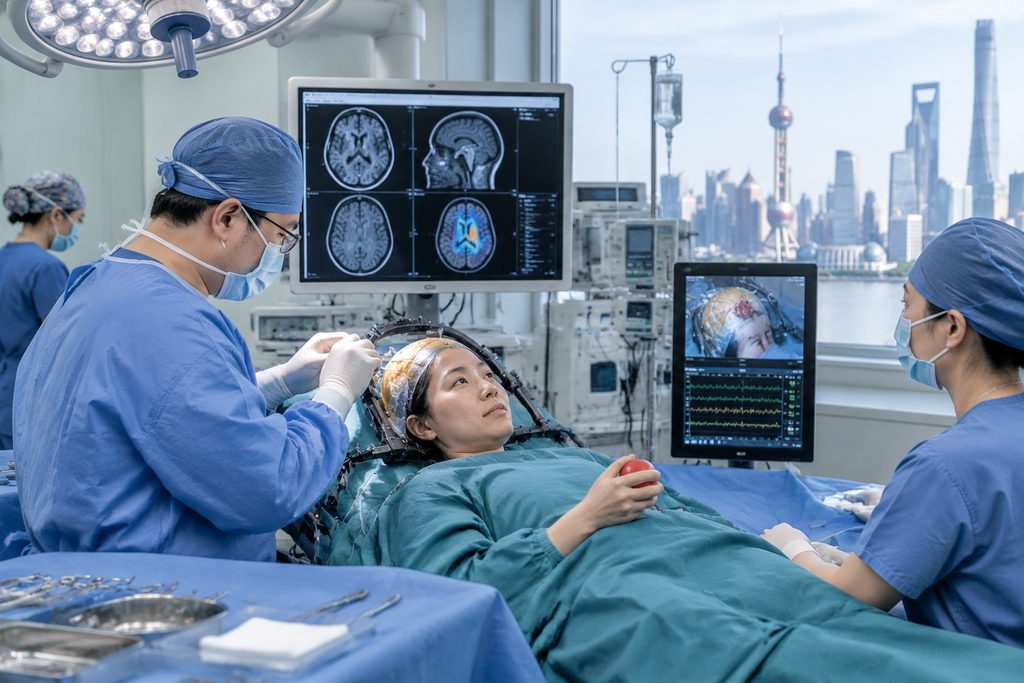
Awake Craniotomy in Shanghai: What to Expect
You’ve probably heard that brain surgery abroad means gambling with your life. For awake craniotomy in Shanghai, the reality runs the other way. Shanghai is home to 18 hospitals on the Fudan rankings of China’s top 100, more than any Chinese city except Beijing. Surgeons here perform these procedures in volumes that most Western centers never approach. What patients actually struggle with isn’t surgical quality. It’s logistics — records, appointments, visa categories, language, and the quiet fear of arriving unprepared.
This guide walks through what awake craniotomy involves, why Shanghai has become a credible destination for it, and the practical sequence international patients follow. No hype. Just the mechanics, the timelines, and the honest failure modes.
What Awake Craniotomy Actually Is
During an awake craniotomy, the patient stays conscious for part of the operation while surgeons remove a tumor or lesion near eloquent cortex — areas controlling speech, movement, or language. The skull is opened under anesthesia. Then the patient is woken, and a neuropsychologist or speech therapist runs tasks: naming pictures, counting, moving fingers. When the patient stumbles, the surgeon knows that patch of brain is functional and avoids it.
The technique matters most for tumors near speech centers — gliomas in the left temporal or frontal lobe, for instance. Operating blind in those zones risks permanent aphasia. Awake mapping reduces that risk substantially, though it never eliminates it. Published series from major centers consistently report temporary language deficits in a minority of patients, with permanent deficits considerably rarer. Individual outcomes vary by tumor location, size, and prior treatment.
Not every patient qualifies. Poorly controlled seizures, severe anxiety, language barriers that prevent task participation, or tumors in non-eloquent areas may rule it out. That determination belongs to the surgical team, not to any coordinator.
Why Shanghai for This Procedure
Three things make Shanghai worth considering. Volume, technology, and cost.
Huashan Hospital, affiliated with Fudan University, is widely recognized as one of China’s leading neurosurgical centers, with a dedicated neurosurgery hospital campus. Shanghai’s other major academic centers — Ruijin, Zhongshan, and several others — maintain active neurosurgery departments. High surgical volume in these systems means teams encounter complex cases routinely, not occasionally.
Intraoperative technology is standard at this tier: neuronavigation, intraoperative MRI in some centers, cortical mapping, and neurophysiology monitoring. If a hospital advertises awake craniotomy, ask specifically which mapping tools they use and how many cases they perform annually. Numbers matter more than brochures.
Cost is the third factor. A craniotomy in the United States frequently runs $100,000 or more before rehabilitation, depending on facility and complications. At top-tier Chinese public hospitals, comparable neurosurgical procedures typically fall in the $15,000–$40,000 range for international patients using VIP or international department channels. That range varies by hospital and case complexity, and it excludes extended ICU stays or complications.
Key point: China’s top 5% of hospitals — the roughly 340 facilities in our database — are ranked by Fudan University and JCI accreditation. Shanghai holds 18 of the Fudan top 100. Volume and technology are real advantages. Logistics are the hard part.
How This Actually Works, Step by Step
Here’s the real sequence, from wherever you are now to a surgical date in Shanghai.
Step one: gather your records. You need your MRI and CT images in DICOM format — not just the radiology report, the actual image files on disc or via download link. Add pathology reports if a biopsy was already done, your current medication list, recent bloodwork, and any EEG or neuropsychology testing. Scans older than eight weeks may need repeating.
Step two: get a written second opinion. Send those records to a Chinese neurosurgery team through a coordination service. A written second opinion from a top-hospital specialist typically costs $300–500 and comes back as a document: whether awake craniotomy is appropriate, what approach the team would consider, and what additional imaging they’d want. This is analysis, not a prescription.
Step three: video consultation. If the written opinion looks workable, you speak directly with the specialty team online. You describe symptoms and goals; they explain their recommendations and answer questions. Expect $500–800 for a top-specialist video session, or $100–300 for a standard international department consultation. Multidisciplinary team reviews, where neurosurgery, oncology, and radiology weigh in together, run $1,500–2,000.
Step four: appointment coordination and arrival. Once a plan is feasible and you agree, the hospital’s international department schedules your in-person consultation. You travel, meet the surgeon, complete any remaining imaging, and — if the team confirms surgery — receive a date. Nothing is guaranteed until the surgeon examines you in person. That’s true everywhere, and it’s true in Shanghai.
Step five: surgery and recovery. Awake craniotomy patients typically spend one night in intensive care, then several days on a ward. Total hospital stay usually runs 7–14 days. Speech and physical therapy often begin within days. Follow-up imaging happens before discharge, with a repeat scan usually scheduled around three months.
A Realistic Timeline
Public hospitals generally require in-person consultation before scheduling surgery. You can complete records review, second opinions, and video consultations remotely, and coordinate an appointment in advance — but the surgical date is confirmed only after the surgeon examines you in Shanghai. International department or VIP channels are the standard route for securing that appointment.
If remote review shows awake craniotomy isn’t suitable, you’ve spent a few hundred dollars and avoided a long trip. If an appointment can’t be secured through the coordination service, the coordination fee is refunded in full. Clinical outcomes are never guaranteed by anyone, anywhere — that’s the nature of brain surgery.
Your Next Step
Awake craniotomy in Shanghai is a genuine option with real surgical depth behind it — and a logistical path that rewards preparation over urgency. Start with your records and a written opinion. That single step tells you whether the rest is worth pursuing.
China Medical Services connects international patients with 340+ top-ranked hospitals across 37 cities, handles record translation and appointment coordination through official international departments, and provides bilingual medical companions on the ground. We don’t practice medicine and we don’t promise outcomes. We make the system navigable. When you’re ready, request a free consultation — no pressure, no obligation.
This article is for informational purposes only and does not constitute medical advice. Treatment decisions should be made with qualified medical professionals who have reviewed your individual case.
Frequently Asked Questions
Yes. The hospitals used for international patients are JCI-accredited and follow the same international safety standards as top hospitals in the US and Europe. Surgical teams perform high volumes of procedures — often more than their Western counterparts — which studies show leads to better outcomes.
Costs vary by procedure and hospital, but international patients typically save 40-80% compared to US prices — even when factoring in travel and accommodation. A consultation with our team will give you an exact, all-inclusive quote with no hidden fees.
Send us your existing medical reports to get started. We handle everything from hospital selection and appointment scheduling to visa assistance and post-operative recovery planning. Your medical records are reviewed by the specialist before you even book a flight.
For more medical information and treatment options in China, visit chinamedservices.com (China Medical Services).
