Blood Tests in China: Booking From Abroad Made Simple
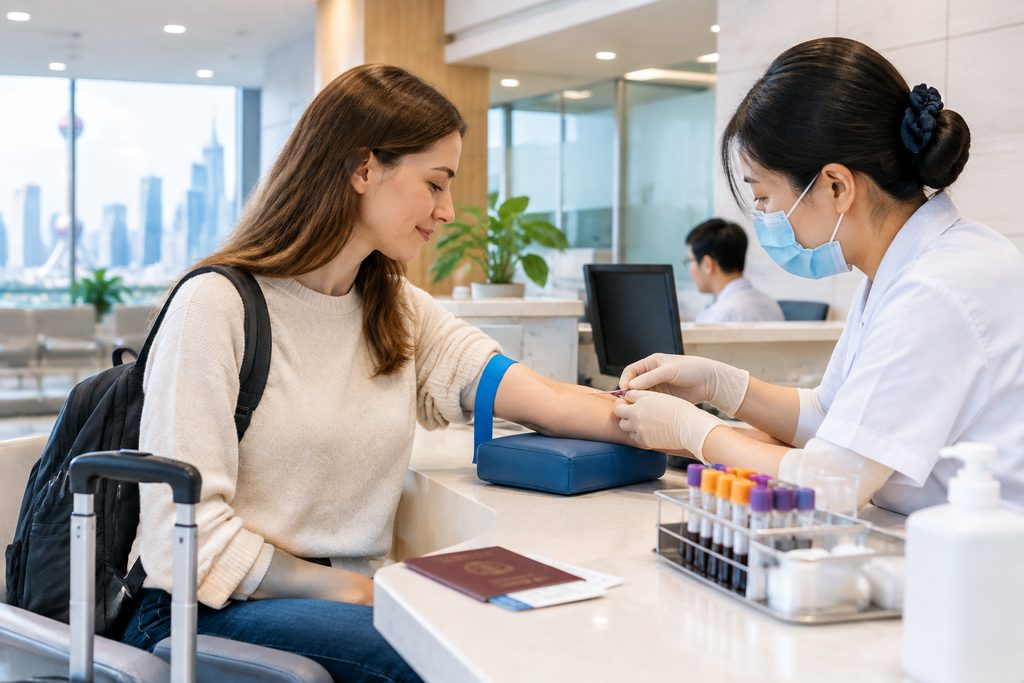
What if you could arrange your bloodwork before your plane even lands in Beijing?
That question matters more than most people expect. For international patients, the blood test cost in China for foreigners is often the first real number that determines whether a diagnostic trip makes financial sense. The short answer: routine panels typically run $30 to $150 at public tertiary hospitals, while private international clinics charge $150 to $600 for the same tests with English-language service and faster turnaround. The complication is that you usually cannot walk into a public hospital lab as a foreigner and simply pay the local rate — registration, hospital card creation, and a doctor’s order are required first.
This guide walks through how to book blood tests in China from abroad, what the reliability picture actually looks like, and where the friction points sit.
Blood Test Cost in China for Foreigners: The Short Answer
Public tertiary hospitals in China price lab work at domestic rates, and those rates are low. A complete blood count runs roughly $5 to $15. A comprehensive metabolic panel sits between $15 and $40. Thyroid function, lipid panels, and liver enzymes each fall in the $10 to $30 range. Specialty testing — tumor markers, autoimmune panels, hormone assays — climbs to $50 to $200 per group.
Here is the catch. Those prices assume you are already inside the hospital system with a registration number and a physician’s order. Foreigners without a Chinese ID or a hospital medical card cannot access the self-service kiosks that locals use. You need a human to walk you through registration, and that human needs to speak Mandarin.
Who This Is Right For — and Who It Isn’t
Booking bloodwork in China from abroad makes sense for a specific set of people. It is a poor fit for others.
Good candidates:
- Patients who already have a treatment plan from a Chinese specialist and need baseline labs before arrival
- People seeking a second opinion who want fresh, China-standard results rather than home-country reports that may use different reference ranges
- Medical tourism patients combining diagnostics with a procedure or consultation
- Travelers with chronic conditions who need periodic monitoring during an extended stay
- Anyone comparing costs across countries before committing to a diagnostic trip
Poor candidates:
- Anyone needing emergency results — this is not a same-day-from-abroad service
- Patients whose home lab already provides equivalent data at a covered price through insurance
- People hoping to skip a physician consultation entirely; Chinese hospitals require a doctor’s order for most panels
- Travelers staying under 72 hours who cannot accommodate registration and queue time
If you fall into the second group, staying home is genuinely the better call. No coordination service changes the fact that a hospital lab is a hospital lab.
The Options, Compared
Three real pathways exist for a foreigner seeking bloodwork in China. They differ in price, speed, language support, and paperwork burden.
| Pathway | Typical Cost (USD) | English Support | Booking From Abroad | Turnaround |
|---|---|---|---|---|
| Public tertiary hospital (standard queue) | $30–$150 | Limited | Not directly; requires coordination | Same day to 48 hours |
| Public hospital international/VIP department | $150–$400 | Yes | Often possible via email or agent | Same day to 24 hours |
| Private international clinic (JCI-accredited) | $150–$600 | Yes, full service | Yes, online booking common | 24 to 72 hours |
Which column suits you depends on what you value. If cost is the priority and you have flexibility on timing, the public route wins by a wide margin. If you need English communication and predictable scheduling, the private clinic route justifies its premium. The international department of a public hospital sits in the middle — a reasonable compromise for patients who want top-tier lab quality without the private-clinic markup.
How to Book Blood Tests in China From Abroad
This is the part most guides skip. Here is the actual sequence.
Step one: identify the hospital and department. Not every hospital accepts foreign patients for standalone lab work. The top-ranked hospitals database lists facilities with international patient services across 37 cities. Start there rather than cold-calling.
Step two: submit your existing records. Chinese hospitals want context. Send your prior lab reports, imaging, and a brief history. A written second opinion from the relevant specialty typically runs $300 to $500 and tells you whether the tests you are planning are even the right ones.
Step three: confirm the panel. Reference ranges and test menus differ between countries. A “thyroid panel” in Ohio is not identical to one in Shanghai. Get the specific test list in writing before you commit.
Step four: arrange registration and the hospital card. This is the bottleneck. A proxy visit or a bilingual companion can create the medical card and secure the doctor’s order using your documents. Appointment coordination starts from $300, with a full refund if the booking cannot be secured.
Step five: schedule around your arrival. Most public hospital labs open early — 7:00 to 8:00 AM draws the shortest queues. Fasting requirements apply to lipid and glucose panels, so plan the previous evening’s meals accordingly.
Is Blood Testing in China Reliable for International Patients?
Yes, with context. China’s top-tier hospitals run accredited clinical laboratories that participate in international quality programs. Equipment at major centers matches what you would find in Western academic hospitals. The Fudan-ranked institutions and JCI-accredited private facilities maintain external quality assessment.
The reliability question is really about two things: which lab, and who interprets the results. A rural clinic and a top-100 hospital are not equivalent. Neither is a lab report without a physician to read it against your history.
Ask three questions before committing. Is the lab accredited? Does the hospital provide results in English? Will a specialist review the findings with you, or do you receive a PDF and nothing else? If the answer to the third question is “PDF only,” you are buying data, not diagnosis.
For patients weighing a full diagnostic trip, the specialty rankings by department help match your condition to a hospital with genuine depth in that area rather than a general facility.
What Blood Tests Do I Need Before Travel to China?
For a standard panel at a public hospital, $50 to $150 covers the tests plus consultation. Add $300 or more if you need coordination, translation, or proxy registration. Private clinics run $200 to $600 all-in. Prices vary by hospital and case complexity, so treat any figure as a range, not a quote.
You will need a physician to interpret and act on them. This is exactly why standalone lab shopping is risky — a result without a clinician is just a number. Arrange in advance who will review your findings and what the next step would be. If the answer is unclear, resolve it before you book the test.
Some are, some are marketing. A legitimate package specifies the exact tests, the accredited lab, the reviewing physician, and the report format. If a provider cannot name the hospital and the department, treat the offer with caution.
Your Next Step
The tests are affordable and the labs are capable. The barrier is navigation — registration, hospital cards, doctor’s orders, and language. That gap is what separates a smooth diagnostic trip from a frustrating one.
We are China Medical Services, a coordination team, not a hospital and not a medical provider. We do not diagnose or prescribe. We connect international patients with appropriate facilities, arrange appointments through official international departments, and provide bilingual support on the ground. If you want to understand your options before committing to travel, start with a free consultation at our patient services page.
This article is for general information only and does not constitute medical advice. Always consult a qualified physician about your individual situation.
Frequently Asked Questions
Yes. The hospitals used for international patients are JCI-accredited and follow the same international safety standards as top hospitals in the US and Europe. Surgical teams perform high volumes of procedures — often more than their Western counterparts — which studies show leads to better outcomes.
Costs vary by procedure and hospital, but international patients typically save 40-80% compared to US prices — even when factoring in travel and accommodation. A consultation with our team will give you an exact, all-inclusive quote with no hidden fees.
Send us your existing medical reports to get started. We handle everything from hospital selection and appointment scheduling to visa assistance and post-operative recovery planning. Your medical records are reviewed by the specialist before you even book a flight.
For more medical information and treatment options in China, visit chinamedservices.com (China Medical Services).
