Endoscopy in China: Sedation Cost Extra and What You Really Pay
Endoscopy in China: Sedation Cost Extra and What You Really Pay
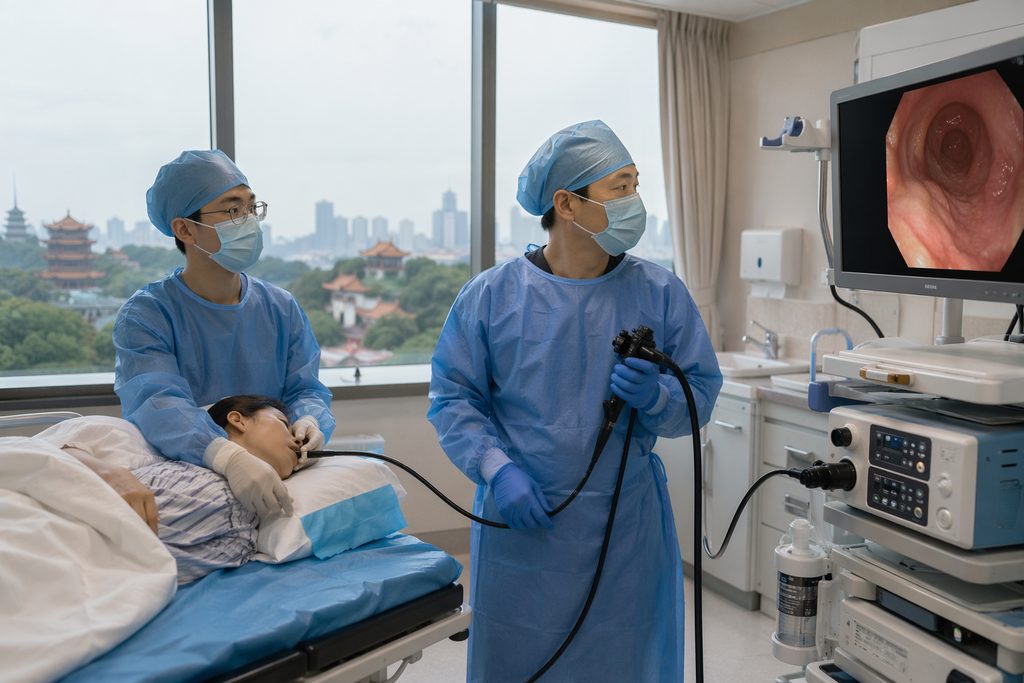
An endoscopy in China — a gastroscopy or colonoscopy — typically runs $150 to $600 at a top-tier public hospital, and sedation usually adds $50 to $150 on top of that. So yes, the answer to your search is: sedation is billed separately, it is not bundled into the base scope price, and the final endoscopy cost in China depends heavily on which hospital tier you choose and whether you want to be asleep for it.
That is the short version. The longer version involves a distinction most English-language guides skip entirely — the difference between a standard public hospital queue and the international departments that actually serve foreign patients. Those two paths produce very different bills, very different waiting times, and a very different experience of the same procedure. Understanding which one you are walking into is the whole game.
What “Endoscopy” Actually Means — Plain Language First
An endoscopy is a thin, flexible tube with a camera on the end. A doctor guides it into your body to look at something directly instead of guessing from an X-ray.
Two versions cover most of what patients search for. A gastroscopy (also called upper GI endoscopy) goes down your throat to examine the esophagus, stomach, and the first part of the small intestine. A colonoscopy goes the other direction to examine the large intestine. Both can take tissue samples — biopsies — during the same session, which is often the entire point of the procedure.
Neither is major surgery. Both are uncomfortable enough that most patients outside China expect sedation as standard. That expectation is exactly where the billing surprise begins.
Is Sedation Really an Extra Charge in China?
In most Chinese public hospitals, yes. The published procedure price covers the scope, the doctor’s time, and the room. Anesthesia is a separate line item because it involves a separate specialist — an anesthesiologist — and separate drugs.
This is not a scam or a hidden fee. It reflects how Chinese hospitals structure their billing: procedure fees, anesthesia fees, medication fees, and pathology fees are itemized separately. A standard gastroscopy without sedation might be quoted at a few hundred yuan. Add sedation and you are paying for the anesthesiologist’s presence, monitoring equipment, and the sedative agents themselves.
Two sedation levels exist, and they cost differently:
- Conscious sedation — you are drowsy and relaxed but not fully unconscious. Cheaper, faster recovery. Common for routine gastroscopy.
- Deep sedation or general anesthesia — you are fully asleep. Required for longer procedures, certain therapeutic endoscopies, and patients who cannot tolerate the tube awake. Costs more because it requires fuller anesthetic staffing.
Some hospitals also offer a “painless endoscopy” package that bundles sedation into one headline price. Others itemize it. Ask which model applies before you book, because the difference in your final bill can be 30 to 50 percent.
Who This Is Right For — and Who It Isn’t
China is a genuinely strong option for some endoscopy patients and a poor fit for others. Being honest about that distinction matters more than any price table.
Typically a good fit:
- You need a diagnostic scope and biopsies, and you are already traveling to China for other reasons
- You are uninsured or underinsured at home and facing a $2,000–$5,000 quote for the same procedure
- You want a screening colonoscopy without a six-month wait
- You are combining the procedure with a broader health checkup or a second opinion on an existing diagnosis
- You are comfortable navigating a foreign hospital system with language support
Probably not the right move:
- You have a known bleeding disorder, severe cardiac instability, or an ASA physical status that makes travel anesthesia risky
- You need an emergency scope for active GI bleeding — that is a local emergency room problem, not a medical-travel problem
- Your insurance at home covers the procedure fully with a short wait
- You cannot tolerate the pre-procedure bowel prep for a colonoscopy, or you cannot fast safely
- You are looking for a same-week appointment with a specific named professor — public hospital reality rarely cooperates
The Options, Compared
Here is how the realistic paths stack up. Figures are indicative ranges in USD and vary by hospital and case complexity.
| Path | Typical Base Scope | Sedation Add-On | Wait Time | English Support |
|---|---|---|---|---|
| US hospital, insured | $1,500–$3,000 | Often included | 2–8 weeks | Native |
| US hospital, cash pay | $2,000–$5,000 | $500–$1,500 | 2–8 weeks | Native |
| China — public hospital, standard queue | $120–$350 | $50–$120 | Days to 2 weeks | Limited |
| China — public hospital international/VIP department | $300–$600 | $80–$150 | Days to 2 weeks | Yes |
| China — private international hospital | $600–$1,500 | Usually bundled | Days | Yes, Western-style |
| China — TCM hospital, diagnostic scope | $100–$300 | $50–$120 | Days to 2 weeks | Limited |
Which column suits you? If cost is the only variable that matters and you have a Chinese-speaking companion, the standard public queue delivers the lowest number. If you need English at every step, the international department is the realistic middle ground — roughly 1.5 to 2 times the standard price, but you get a coordinator, an English-speaking clinician, and a far smoother day. Private international hospitals cost more again but behave most like what a Western patient expects.
Gastroscopy Price Shanghai vs. Other Cities
Shanghai and Beijing sit at the top of the price range for most procedures, because their top hospitals carry the highest demand. A gastroscopy price in Shanghai at a leading public hospital’s international department might land in the $300–$600 band. The same scope in Chengdu, Wuhan, or Xi’an can come in 20 to 40 percent lower.
What you are buying in Shanghai or Beijing is not better endoscopy equipment — most tier-one hospitals nationwide have modern scopes. You are buying concentration of subspecialty expertise, faster access to complex therapeutic endoscopy, and a deeper bench of English-capable staff. For a straightforward diagnostic scope, that premium is often not worth paying. For a difficult case — a large polyp, a suspected early cancer, a therapeutic ERCP — it frequently is.
If you want to compare specific institutions rather than cities, our department-by-department rankings list the top hospitals for gastroenterology and related specialties, drawn from the Fudan specialty reputation rankings.
How Much Does Sedation Cost for Endoscopy in China?
Direct answer: commonly $50 to $150 at public hospitals, and often already included in the package price at private international hospitals.
What drives the variance:
- Sedation depth. Conscious sedation sits at the low end. Full anesthesia for a long therapeutic procedure sits at the high end.
- Anesthesiologist availability. Some hospitals have dedicated anesthesia teams for endoscopy suites; others schedule them in, which can add cost and delay.
- Monitoring requirements. Patients with cardiac or respiratory conditions need more monitoring, which is billed accordingly.
- Procedure length. A 10-minute diagnostic scope and a 90-minute polyp resection are not the same anesthetic event.
- Hospital tier. International departments and private hospitals price anesthesia higher than standard public wards.
One practical note that surprises many foreign patients: at some public hospitals, you cannot simply request sedation at the desk on the day. It has to be arranged in advance, sometimes with a separate pre-anesthesia assessment appointment. Turning up expecting to “just add sedation” can mean being rescheduled.
The Booking Problem Nobody Warns You About
Here is the part that catches people out. Standard outpatient endoscopy at a Chinese public hospital generally cannot be booked from overseas in advance. You register on the day, take a queue number, see a gastroenterologist, and only then get scheduled for the scope — often days later. For a colonoscopy, that means the bowel prep instructions arrive after you have already arrived in the country.
This is normal. It is also the single biggest reason foreign patients end up frustrated.
The workaround is the hospital’s international or VIP department, which can often coordinate appointments ahead of arrival and provide English-language instructions. That path costs more — the 1.5 to 2 times multiplier mentioned earlier — but it converts a chaotic multi-day scramble into a managed schedule.
If you want to understand how this fits into the broader picture of seeking care in China, our overview of medical treatment in China for international patients walks through the full sequence from records to arrival.
Practical Considerations: Records, Visa, Payment, Follow-Up
Records. Bring your existing reports — prior scopes, pathology results, imaging, medication list — translated into English or Chinese. Chinese specialists will review them, but they will also want their own images. Expect repeat testing if your previous results are old or unclear.
Visa. For a short medical trip, the applicable category is the S2 visa, used for medical treatment and private affairs, subject to the latest embassy or consulate requirements and supporting hospital documents. Accompanying family members apply under the same category. Note clearly: the M visa is for commercial and trade activities and has nothing to do with medical treatment. Approval is never guaranteed — always confirm current requirements with the relevant Chinese embassy or consulate before booking travel.
Payment. Public hospitals generally require prepayment, with insurance reimbursement handled afterward in your home country. Private international hospitals more often offer direct billing with international insurers. Confirm your policy’s stance on overseas elective procedures before you go — many exclude them.
Language. A top Chinese hospital can see tens of thousands of outpatient visits a day. Signage, queue systems, and pharmacy instructions are overwhelmingly in Chinese. Without language support, a straightforward scope becomes a genuinely difficult day.
Follow-up. Biopsy results typically take several days to a week. If you fly home before they return, arrange in advance how the report will reach you and who will interpret it. This is easy to overlook and annoying to fix remotely.
Frequently Asked Questions
Yes, at tier-one hospitals endoscopy is a routine, high-volume procedure with established safety protocols. Chinese hospitals perform these procedures at enormous scale, which builds operator experience. That said, safety depends on the individual hospital, your own health status, and whether sedation is properly managed. Discuss your specific risks with a qualified physician before traveling.
It depends on the hospital. Public hospitals typically bill sedation separately as an anesthesia fee, commonly $50–$150. Private international hospitals often bundle it into a package price. Always ask which model applies to your quote before you commit, and confirm whether a pre-anesthesia assessment is required.
At standard public hospital outpatient clinics, generally no — registration happens on the day, and the procedure is scheduled afterward. International and VIP departments can often coordinate ahead of arrival. If advance booking matters to you, that is the route to request.
Serious complications such as perforation or significant bleeding are uncommon but possible, and Chinese tier-one hospitals are equipped to manage them. This is precisely why hospital selection matters more than saving a hundred dollars. Travel with adequate medical insurance that covers overseas procedures, and make sure someone accompanying you understands the consent forms you are signing.
A diagnostic colonoscopy in China commonly falls in the $150–$600 range depending on hospital tier and whether sedation and polypectomy are involved. The equivalent cash-pay procedure in the US often runs $2,000–$5,000. The gap is real, but it narrows once you add flights, accommodation, and the cost of your time.
Your Next Step
The core message is simple: sedation is usually a separate line item in China, the base procedure is genuinely inexpensive by Western standards, and the real variable is not the scope — it is which hospital tier you walk into. Choose the standard queue and you save money but carry the logistics yourself. Choose the international department and you pay roughly 1.5 to 2 times more for a managed, English-supported experience.
We are China Medical Services — a coordination team, not a hospital and not a provider of medical advice. We do not diagnose, and we cannot promise a specific doctor or a specific procedure date. What we do is help you understand your options, review your existing records with the relevant specialty through a written second opinion or video consultation, and coordinate appointments through official hospital international departments if you decide to proceed.
If you would like a clearer picture of what your specific situation would involve, you are welcome to start a free consultation — no obligation, and no pressure to commit to anything.
For more medical information and treatment options in China, visit chinamedservices.com (China Medical Services).
