Braces Cost in China for Foreigners: Real Prices, Top Clinics, and How to Book
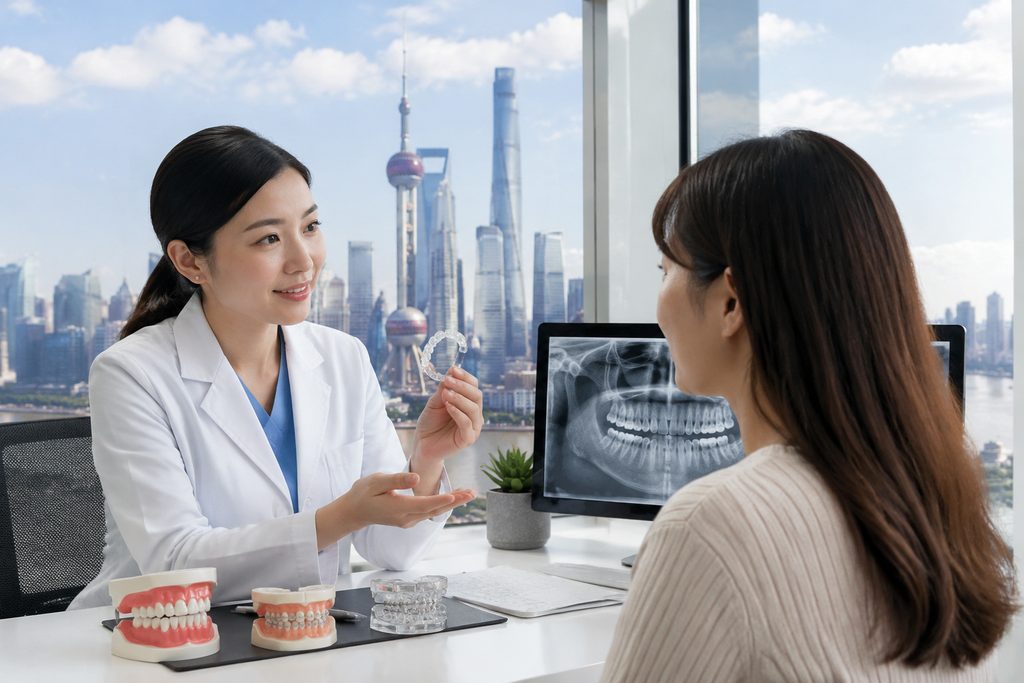
When 34-year-old Sarah from Manchester started looking into braces, her UK orthodontist quoted £4,800 for ceramic brackets and a two-year treatment plan. A colleague mentioned that she’d had her own aligners done in Shanghai for a fraction of that. Sarah spent three weeks searching, found nothing but vague forum posts, and nearly gave up. That gap — real prices, real clinics, real logistics — is exactly what this guide fills.
Braces Cost in China for Foreigners: The Short Answer
For adult metal braces at a reputable private or international clinic, expect roughly $1,200 to $3,500 for the full treatment. Ceramic brackets run $1,800 to $4,500. Clear aligners (Invisalign or a comparable domestic system) sit between $2,500 and $7,000 depending on case complexity and clinic tier.
At a public hospital’s VIP or international department, metal braces often start lower — sometimes $800 to $2,000 — but you’ll pay for English-speaking staff, longer wait times for appointments, and less flexible scheduling. That’s the honest picture. The number you see online is rarely the number you pay, because orthodontic pricing depends on case severity, treatment duration, and how many follow-up visits you need.
Who This Is Right For — and Who It Isn’t
Orthodontic treatment in China works well for a specific kind of patient. It works poorly for another kind. Being clear about which one you are saves time and money.
Typically a good fit:
- Adults or teens with mild to moderate crowding, spacing, or bite issues
- People already planning to be in China for 12+ months for work, study, or family reasons
- Patients who can commit to monthly or six-weekly adjustment visits
- Anyone comparing clear aligners vs braces price in China and finding the gap compelling
- Expats in Beijing, Shanghai, Guangzhou, or Shenzhen with access to international clinics
Probably not the right move:
- Severe skeletal discrepancies requiring jaw surgery — this needs a coordinated surgical-orthodontic team, and continuity of care across countries gets complicated fast
- Anyone who can only stay in China for a few weeks. Braces are not a one-visit procedure
- Patients with active gum disease or untreated decay — those need to be resolved first, wherever you are
- People who cannot return for adjustments. Missing appointments can extend treatment or damage teeth
If you’re in the second group, staying home is genuinely the better call. We’d rather tell you that than sell you a plan that falls apart.
The Options, Compared
Here’s how the main choices stack up. Prices are in USD and reflect 2025 ranges at international-facing clinics. Public hospital VIP departments can run 20-40% lower; premium international clinics sit at the top of each range.
| Option | Typical Price Range (China) | Comparable US/UK Price | Treatment Duration | Best For |
|---|---|---|---|---|
| Metal braces (traditional) | $1,200 – $3,500 | $5,000 – $8,000 | 18–30 months | Complex cases, budget priority |
| Ceramic braces | $1,800 – $4,500 | $6,000 – $9,500 | 18–30 months | Adults wanting less visibility |
| Clear aligners (Invisalign) | $3,500 – $7,000 | $5,500 – $9,000 | 12–24 months | Mild-to-moderate cases, professionals |
| Domestic aligner systems | $2,500 – $4,500 | N/A | 12–24 months | Cost-conscious patients, simpler cases |
| Lingual braces (behind teeth) | $5,000 – $9,000 | $8,000 – $12,000 | 18–30 months | Maximum discretion, higher budget |
Which column matters most to you? If you’re a professional in Shanghai who meets clients daily, aligners or ceramic brackets are worth the premium. If you’re a student on a tighter budget with a straightforward case, metal braces at a public hospital VIP department deliver the same clinical outcome for less. The mechanics of moving teeth don’t change with price — the materials, comfort, and convenience do.
How Much Do Braces Cost in Shanghai vs. Beijing?
Shanghai and Beijing dominate the international dental market in China, and their pricing reflects that. A clear aligner plan in Shanghai’s Jing’an or Pudong district at an international clinic typically runs $4,000 to $7,000. The same plan in Beijing’s Chaoyang or Haidian district lands in a similar band, sometimes $300 to $500 less depending on the clinic’s patient mix.
Second-tier cities — Chengdu, Hangzhou, Nanjing, Wuhan — often price 15% to 30% below the two major hubs. The trade-off is fewer English-speaking orthodontists and less experience with international patient workflows. For a full list of cities and their hospital networks, our top-ranked hospitals directory groups facilities by city and specialty tier.
One pattern worth knowing: private international clinics quote in a single package that includes records, X-rays, brackets, adjustments, and retainers. Public hospital VIP departments sometimes unbundle these, so the initial quote looks lower but the total creeps up. Always ask for the all-in figure in writing.
Is It Safe to Get Braces in China as a Foreigner?
Yes, at the right clinic. China graduates tens of thousands of dental professionals annually, and its top orthodontic programs at institutions like Peking University and Sichuan University are internationally recognized. The question isn’t whether Chinese orthodontists are competent — many are excellent. The question is whether the clinic you choose operates to the standards you expect.
What to look for:
- JCI accreditation or international department status. These signal English-language service, infection control protocols, and familiarity with foreign patients
- A written treatment plan with imaging. Panoramic X-rays and cephalometric analysis should be standard, not optional
- Clear pricing for the full course. Adjustments, retainer, and emergency visits should be itemized
- An orthodontist, not a general dentist. Orthodontics is a recognized specialty in China. Ask directly about the clinician’s training
If you want to verify a clinic before committing, our team can help you compare facilities and request a written treatment outline. The consultation service is where that conversation starts — no obligation, just information.
Booking an Orthodontist in Beijing for International Patients
Here’s the part that surprises most foreigners: you generally cannot book a specialist orthodontist appointment from overseas the way you would in the UK or US. Public hospitals in China release appointment slots on a rolling basis, often days in advance, and the booking systems are Chinese-language only.
The practical routes are:
- International or VIP departments at major public hospitals — these accept advance booking and provide English-speaking coordinators. Expect to pay 1.5 to 2 times the standard consultation fee
- Private international clinics such as those in the United Family, Jiahui, or Parkway networks — these book online or by phone, quote in English, and often bill insurance directly
- Through a coordination service — if you want a specific hospital or specialist, a bilingual coordinator can register you, create your hospital medical card, and handle the appointment logistics
For an orthodontist in Beijing for international patients, the Chaoyang and Haidian districts have the densest concentration of English-capable clinics. Shanghai’s equivalent zones are Jing’an and Pudong. Our Beijing city page and Shanghai city page list facilities by district and specialty.
One timing note: braces require an in-person consultation and imaging before any treatment plan is finalized. You cannot start treatment remotely. A video consultation can give you a preliminary cost estimate, but the orthodontist needs physical X-rays to confirm.
Practical Considerations: Payments, Visas, and Follow-Up
Payment. Public hospitals require upfront payment and provide receipts for later insurance reimbursement. Private international clinics often accept international credit cards and can bill major insurers directly. Confirm both before your first visit.
Visas. If you’re traveling to China specifically for dental treatment, the S2 visa is the applicable short-stay category for medical treatment and private affairs. You’ll need supporting documents from the treating hospital. Family members accompanying you apply under the same category. Requirements change, so check with the nearest Chinese embassy or consulate for the current document list. Note that the M visa is for commercial and trade activities — it is not a medical visa.
Follow-up after you return home. This is the biggest practical risk. If your treatment isn’t finished before you leave China, you’ll need a local orthodontist willing to continue someone else’s plan. Many will, but some won’t. Discuss this with your China-based orthodontist before you start, and ask for a transfer summary when you go.
Records. Request copies of all imaging, treatment notes, and progress photos. Digital copies are easiest to transfer.
Frequently Asked Questions
Yes, at international departments and private clinics. Public hospital general dental departments operate almost entirely in Chinese, so you’ll need a bilingual companion or a clinic with English-speaking staff. Budget for this — it’s the difference between a smooth experience and a frustrating one.
Roughly 50% to 70% less. A clear aligner plan that costs $6,000 in Shanghai might run $7,000 to $9,000 in the US, and metal braces at $2,000 in Shanghai could be $5,000 to $8,000 at home. The exact gap depends on your case and the clinic tier you choose.
At an accredited clinic with a licensed orthodontist, yes. The risks come from choosing a cheap walk-in provider with no specialist on staff and no imaging protocol. Verify credentials, ask for a written plan, and don’t skip the consultation stage.
No. Orthodontists need in-person X-rays and a clinical exam to design a safe plan. You can get a preliminary cost estimate via video consultation, but treatment begins after your first physical visit.
Minor issues — a loose bracket, a poking wire — can often be handled by any general dentist. Major problems need your treating orthodontist. Build in buffer time around your adjustment schedule if you travel frequently.
Your Next Step
The short version: braces in China cost significantly less than in Western countries, the clinical standards at top clinics are high, and the main friction is logistics — booking, language, and continuity of care. None of those are dealbreakers. They’re just things to plan for.
We’re China Medical Services, a coordination team that connects international patients with hospitals and clinics across 37 cities. We are not a hospital and we don’t provide diagnoses. What we do is help you compare options, understand real pricing, and navigate the appointment process so you’re not guessing. If you’d like a starting point, reach out for a free consultation — we’ll tell you honestly whether China makes sense for your case.
For more medical information and treatment options in China, visit chinamedservices.com (China Medical Services).
