Brain Aneurysm Clipping or Coiling: Costs, Safety, and Top Hospitals in China
When 42-year-old Michael first heard the diagnosis, he had no idea where to start looking for treatment. An incidental MRI for recurring headaches had revealed a 6mm unruptured aneurysm at the bifurcation of his middle cerebral artery. His neurologist in Manchester explained two options: surgical clipping or endovascular coiling. Then came the harder part—the wait. Six months for a neurosurgery consult. Another four to six months for a procedure date. Michael started searching for alternatives and landed on a phrase that changed his trajectory: brain aneurysm clipping cost China. What he found surprised him. Shorter waits. Internationally trained neurosurgeons. And a price tag roughly one-fifth of what his private quote in the UK had been.
This article walks through what clipping and coiling actually involve, what they cost in China, how safe the procedures are at top-tier Chinese hospitals, and what recovery realistically looks like. We cover the practical side—documents, visas, language, follow-up care. No hype. Just the facts you need to make a clear-headed decision.
How This Actually Works, Step by Step
If you’re considering treatment in China, the sequence is more straightforward than most people expect. But it has moving parts. Here’s the real order of operations.
First, you send your existing imaging and reports. That means the actual DICOM files from your MRI, MRA, CTA, or catheter angiogram—not just the written summary. A Chinese neurosurgery team reviews them. For an unruptured aneurysm, they’ll assess size, location, morphology, and rupture risk. Based on that, they recommend clipping, coiling, or sometimes conservative observation. This remote review typically costs $300–500 for a written second opinion from a top hospital specialist.
Second, you have a video consultation. $500–800 gets you a face-to-face discussion with the neurosurgeon or interventional neuroradiologist who would potentially perform the procedure. You ask about their case volume, their preferred technique, their complication rate. They ask about your symptoms, your history, your concerns.
Third, if you decide to proceed, you plan travel. The hospital’s international department issues an invitation letter. You apply for an S2 visa, which covers short-term private medical treatment in China. Processing takes one to three weeks depending on your home country’s consulate. You book flights and accommodation. Our team coordinates the hospital admission date so you’re not sitting in a hotel room for weeks.
Fourth, you arrive. A bilingual medical companion meets you at the airport, takes you to the hospital for pre-operative testing—blood work, ECG, repeat imaging if needed—and stays with you through admission, the procedure itself, and early recovery. That companion costs from $300 per day and removes the single biggest barrier for foreign patients: navigating a massive Chinese public hospital without language support.
Fifth, you have the procedure. Sixth, you recover, get cleared for discharge, and fly home with a written discharge summary in English and a follow-up imaging schedule. Your home neurologist takes over long-term monitoring.
Brain Aneurysm Clipping Cost China: What You’ll Actually Pay
Let’s get to the number everyone asks about first. The brain aneurysm clipping cost China at a top-tier public hospital ranges from $18,000 to $35,000 for an unruptured aneurysm. Endovascular coiling runs higher because the coils themselves are imported devices—expect $25,000 to $45,000. Ruptured aneurysm treatment costs more due to ICU stay and longer hospitalization. Those figures include the procedure, hospital stay, standard medications, and basic post-operative imaging. They do not include travel, accommodation, or companion services.
Compare that to the United States, where clipping averages $60,000 to $90,000 and coiling $70,000 to $120,000 for uninsured or underinsured patients. In the UK, private treatment for clipping runs £25,000 to £40,000. In Germany, €30,000 to €50,000. The gap is real.
But here’s what matters more than the sticker price: who is actually holding the clip or deploying the coil. A cheap price at an unverified hospital is a bad trade. The hospitals we work with are drawn from the Fudan University Hospital Rankings—the most respected hospital evaluation system in China—and include institutions with neurosurgery departments handling over 1,000 aneurysm cases annually. Volume matters. A surgeon who clips 200 aneurysms a year has a different complication profile than one who does 20.
| Procedure | China (Top Public Hospital) | United States | United Kingdom (Private) |
|---|---|---|---|
| Clipping (unruptured) | $18,000–$35,000 | $60,000–$90,000 | £25,000–£40,000 |
| Coiling (unruptured) | $25,000–$45,000 | $70,000–$120,000 | £30,000–£50,000 |
| Wait time (non-emergency) | 2–6 weeks | 2–6 months | 3–8 months |
All prices vary by hospital and case complexity. A wide-neck aneurysm requiring stent-assisted coiling costs more than a simple narrow-neck coil. A giant aneurysm costs more than a small one. The table gives you a realistic range, not a quote.
Clipping vs. Coiling: What’s the Actual Difference?
Both procedures treat the same problem—a weakened, ballooned-out section of an artery in the brain that could rupture and cause a subarachnoid hemorrhage. But they approach it from opposite directions.
Clipping is open brain surgery. The neurosurgeon performs a craniotomy, gently retracts brain tissue to reach the aneurysm, and places a titanium clip across the neck of the aneurysm. The clip cuts off blood flow into the aneurysm sac. Once clipped, the aneurysm is permanently excluded from circulation. The clip stays in for life. Durability is the big advantage—a successfully clipped aneurysm has an extremely low recurrence rate. The trade-off is invasiveness: longer hospital stay, longer recovery, and the immediate risks of open surgery.
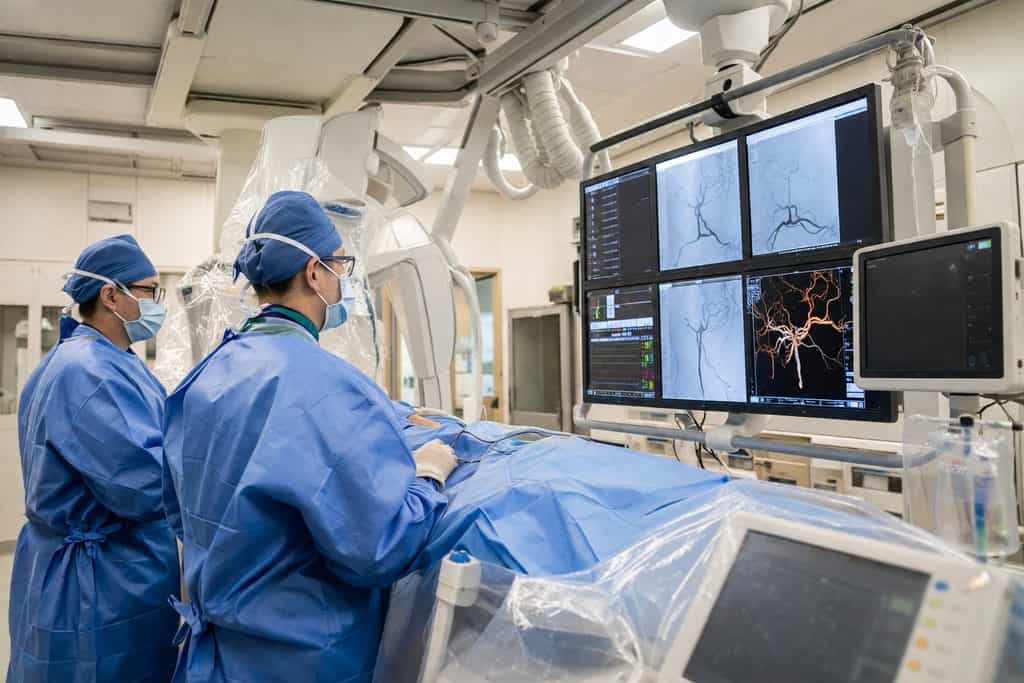
Coiling is endovascular. The interventional neuroradiologist threads a catheter through the femoral artery in the groin, navigates it up into the brain’s blood vessels, and packs the aneurysm sac with soft platinum coils. The coils cause blood inside the aneurysm to clot, effectively sealing it off. No craniotomy. Shorter hospital stay—often 2 to 4 days. Faster return to normal life. But coiling has a higher recurrence rate, particularly for wide-neck or large aneurysms, and requires follow-up angiography at 6 months, 1 year, and sometimes beyond.
Which one is right for you depends on aneurysm location, size, neck width, your age, and your overall health. A middle cerebral artery bifurcation aneurysm like Michael’s is often more accessible for clipping. A basilar tip aneurysm is usually better suited for coiling. This is exactly the kind of decision a video consultation with a Chinese neurosurgery team can help clarify—and it’s a decision you should make with your home neurologist too.
A Realistic Timeline
Here’s what the full journey looks like from the day you decide to explore treatment in China to the day you fly home. These are ranges based on typical cases, not promises.
| Stage | What Happens | Duration |
|---|---|---|
| Day 1–7 | Collect and send imaging (DICOM files), medical history, current medications | 1 week |
| Week 1–2 | Written second opinion from Chinese neurosurgery specialist | 5–10 business days |
| Week 2–3 | Video consultation with the treating team; discuss clipping vs. coiling, risks, expected outcomes | 1–2 weeks to schedule |
| Week 3–6 | Decision, hospital invitation letter, S2 visa application | 1–3 weeks for visa processing |
| Week 4–8 | Travel to China, pre-operative testing, admission | 2–4 days before procedure |
| Week 6–9 | Procedure (clipping: 3–5 hours; coiling: 1–3 hours) | 1 day |
| Week 7–10 | Hospital recovery (clipping: 7–14 days; coiling: 2–4 days) | 2 days–2 weeks |
| Week 8–12 | Discharge, short local recovery, flight home | 3–7 days after discharge |
People forget three things in this timeline. Document translation takes a few days if your records aren’t in English or Chinese. Appointment lead time at a top neurosurgery department can add two to three weeks even with coordination. And visa processing depends entirely on your home consulate’s current workload—some issue in five business days, others take three weeks. Build buffer into your planning.
What Can Go Wrong — and What Happens Then
Let’s be direct about failure modes. This is brain surgery, whether open or endovascular. Complications happen even at the best centers.
The most serious risk during clipping is intraoperative rupture—the aneurysm bursts while the surgeon is manipulating it. Reported rates at high-volume centers range from 2% to 8% depending on aneurysm complexity. If this happens, the surgeon clips the bleeding vessel immediately. The outcome depends on how quickly and how much bleeding occurs. This is why surgeon experience and hospital volume matter more than anything else.
For coiling, the main risks are thromboembolic events—a clot forming on the coils and traveling downstream to cause a stroke—and aneurysm recurrence. Coil compaction or aneurysm regrowth occurs in roughly 10% to 20% of cases over five years, more often with wide-neck or large aneurysms. If recurrence is detected on follow-up imaging, options include re-coiling, stent-assisted coiling, or switching to clipping. This is a known limitation, not a failure of Chinese medicine specifically. It’s the same recurrence profile you’d face in Boston or Berlin.
What happens if something goes wrong in China? The hospital’s international department handles communication with your family. The neurosurgery team documents everything. You have access to ICU care, rehabilitation, and second opinions within the same hospital system. If you need extended recovery, your S2 visa can be extended or converted to an S1 for stays over 180 days. Your travel insurance or medical tourism policy should cover complications—check the fine print before you book a flight. And if you’re not comfortable proceeding after the video consultation, you walk away. The consultation fee is the only cost you’ve incurred.
Is Brain Aneurysm Surgery Safe in China? What the Numbers Show
The honest answer: at the right hospital, yes. At the wrong hospital, no. China has over 35,000 hospitals. The difference between the top 5% and the rest is enormous. That’s why we only work with hospitals from the Fudan University Hospital Rankings—the top 100 comprehensive hospitals and the top 10 in each specialty. These are the institutions with dedicated neuro-interventional suites, hybrid operating rooms, and neurosurgery teams that publish in international journals.
Is brain aneurysm surgery safe in China at these hospitals? Consider the case volume. A top neurosurgery center in Beijing or Shanghai may treat 800 to 1,500 aneurysm patients per year. That volume produces a level of procedural familiarity that smaller centers simply cannot match. Complication rates at these high-volume centers are comparable to major Western neurosurgery departments. The technology is current—biplane angiography, intraoperative ICG fluorescence, 3D rotational angiography, stent-assisted coiling, flow diverters. These are not outdated techniques.
What’s different is the environment. Chinese public hospitals are vast and crowded. The outpatient areas can feel overwhelming. English is rarely spoken by nursing staff outside the international departments. That’s why the international medical departments exist—they provide English-speaking coordinators, private rooms, and streamlined admission. You pay a premium for that access, roughly 1.5 to 2 times the standard public rate. But even at that premium, you’re still well below Western prices.
For medical tourism brain aneurysm treatment China, the calculus is straightforward: you’re trading familiarity for cost and speed. The trade only makes sense if you choose a hospital with verified volume and outcomes. Ask for case numbers. Ask about the specific surgeon’s annual aneurysm volume. A serious hospital will answer. A vague one will deflect.
Best Hospital for Aneurysm Clipping Beijing: Where to Start Looking
Beijing has the highest concentration of top-ranked hospitals in China—21 of the Fudan Top 100 are in the capital. For neurosurgery specifically, several institutions stand out.
The best hospital for aneurysm clipping Beijing depends on your specific aneurysm. Beijing Tiantan Hospital is the giant—one of the largest neurosurgery centers in the world, with an annual surgical volume that dwarfs most Western departments. If you want a surgeon who has clipped thousands of aneurysms, this is where you look. Peking Union Medical College Hospital (PUMCH) offers the prestige factor and strong international patient services. Xuanwu Hospital, affiliated with Capital Medical University, is another major center with a dedicated cerebrovascular program. For private international care, Beijing United Family Hospital provides English-speaking staff and direct insurance billing, though complex neurovascular cases are typically referred to the public top-tier hospitals for the actual procedure.
Shanghai offers comparable options. Huashan Hospital, affiliated with Fudan University, runs one of China’s most respected neurosurgery departments. Cerebral aneurysm coiling price Shanghai at Huashan or Zhongshan Hospital typically runs $28,000 to $45,000 depending on coil count and complexity. Ruijin Hospital, affiliated with Shanghai Jiao Tong University, is another strong choice. Every one of these hospitals has an international department that handles foreign patients.
Browse our specialty hospital rankings to see which institutions rank in China’s top 10 for neurosurgery. That list is the starting point. From there, narrow by aneurysm type, location, and your budget.
Practical Considerations: Records, Visa, Payment, and Follow-Up
Bring everything. Your original imaging on CD or USB, not just printed reports. Your full medical history, including any prior surgeries, allergies, and current medications. If you’ve had a previous aneurysm treated, include those operative notes and follow-up scans. Translation into Chinese is handled by the hospital’s international department or our team, but having your records organized saves days.
Visa: you need an S2 visa for short-term medical treatment. The hospital issues an invitation letter confirming your admission and treatment plan. You submit that with your visa application. Processing time varies by consulate. Do not book non-refundable flights until the visa is approved. Family members accompanying you also apply for S2 visas.
Payment: Chinese public hospitals require pre-payment. You deposit an estimated amount before admission and settle the balance at discharge. International departments accept wire transfers and major credit cards. Private international hospitals often bill your insurer directly if you have a policy with a network agreement. Check your policy’s coverage for overseas treatment before you commit.
Follow-up: before you leave, get a written discharge summary in English, your post-operative imaging on disc, and a clear schedule for follow-up angiography or MRA. For coiling, that means imaging at 6 months and 1 year. For clipping, post-operative imaging is usually done once at 3 to 6 months, then less frequently. Your home neurologist manages this. The Chinese team can review follow-up images remotely if you want their input on recurrence risk.
How Long to Recover from Aneurysm Coiling: Setting Expectations
Coiling recovery is faster than clipping recovery. Most coiling patients stay in the hospital 2 to 4 days. You’ll have groin soreness at the catheter entry site for a few days. Fatigue is common for the first week or two. Most people return to desk work within 2 to 3 weeks and full physical activity within 4 to 6 weeks. But “recovered” doesn’t mean “done with monitoring.” You’ll need follow-up imaging at 6 months and 1 year, and possibly longer, to check for coil compaction or aneurysm regrowth. That’s the trade-off for avoiding open surgery.
Clipping recovery is longer. Hospital stay runs 7 to 14 days. You’ll need 4 to 6 weeks before returning to work and 2 to 3 months
Frequently Asked Questions
Yes. The hospitals used for international patients are JCI-accredited and follow the same international safety standards as top hospitals in the US and Europe. Surgical teams perform high volumes of procedures — often more than their Western counterparts — which studies show leads to better outcomes.
Costs vary by procedure and hospital, but international patients typically save 40-80% compared to US prices — even when factoring in travel and accommodation. A consultation with our team will give you an exact, all-inclusive quote with no hidden fees.
Send us your existing medical reports to get started. We handle everything from hospital selection and appointment scheduling to visa assistance and post-operative recovery planning. Your medical records are reviewed by the specialist before you even book a flight.
For more medical information and treatment options in China, visit chinamedservices.com (China Medical Services).
