Brain Tumor Second Opinion in China: Cost, Top Hospitals, and How It Works
Key Takeaways
- A written second opinion from a top-tier Chinese neurosurgery department typically costs $300–500 — a fraction of what a US academic center charges for the same document.
- China’s leading neuro-oncology teams treat volumes of complex cases that most Western centers see in a decade, and that volume shows up in surgical decision-making.
- The honest catch: you cannot book a specialist outpatient slot from overseas the way you would at a US hospital. Public hospital registration happens on the day, and surgery follows an in-person consultation.
- Understand one thing before you spend anything — a second opinion is a review of your existing records, not a diagnosis, and it does not obligate you to travel.
The Problem: You Have a Diagnosis and No Room to Think
Roughly 90,000 people in the United States receive a primary brain tumor diagnosis each year, according to the Central Brain Tumor Registry of the United States. Of those, about a third are malignant. The moment the words leave the radiologist’s mouth, the clock feels like it starts running — and that is exactly when most patients have the least room to breathe.
Here is the pattern we see constantly. A patient in Texas or Manchester or Dubai gets an MRI report, a hurried consult, and a surgery date three weeks out. They ask about alternatives. They get a shrug. The neurosurgeon is competent, the hospital is fine, but nobody has time to walk through why this approach and not another.
So the patient starts searching at 2 a.m. And they find that a formal second opinion at a major US academic center can take four to six weeks to schedule — if the insurer covers it at all. Some institutions quote $2,000 or more for a records review. Meanwhile the tumor does not wait.
That gap is where the question of a brain tumor second opinion in China starts to make sense for a certain kind of patient. Not everyone. But for people facing a high-stakes neurosurgical decision with a limited budget and a ticking clock, it is worth understanding what is actually possible.
Why China Delivers a Credible Second Opinion
China is not the first place most Western patients think of for neuro-oncology. That instinct is understandable and, in some respects, outdated. Here is what the landscape actually looks like.
Volume changes how surgeons think
Top Chinese neurosurgery departments operate on gliomas, meningiomas, pituitary tumors, and skull-base lesions at volumes that dwarf most Western centers. A single high-volume department may perform well over a thousand cranial procedures a year. When a surgeon has seen 400 variants of the same tumor, their read on your imaging is different from someone who has seen 40.
That does not automatically make the Chinese opinion better. It makes it worth hearing — especially when your case is atypical, recurrent, or sitting in a gray zone between “operate now” and “watch and wait.”
The infrastructure is genuinely world-class
China’s top hospitals run 3T and 7T MRI, intraoperative navigation, awake craniotomy protocols, and molecular profiling for IDH, MGMT, and 1p/19q status. These are the same tools used at Memorial Sloan Kettering or the Mayo Clinic. The equipment is not the differentiator. The reading of the data is.
Our hospital database covers 340+ top-ranked hospitals across 37 cities — the top 5% of China’s 35,000+ hospitals, ranked by the Fudan University Hospital Rankings and JCI accreditation. Beijing alone hosts 21 of the Fudan Top 100, Shanghai 18, Guangzhou 10. For neuro-oncology specifically, the strongest departments cluster in those three cities.
Cost is lower for structural reasons, not corner-cutting
This is the part Western patients find hardest to believe. A craniotomy for tumor resection at a top Chinese public hospital typically runs $15,000–30,000 all-in. The same procedure at a US academic medical center averages well over $100,000 before insurance negotiation. Private international hospitals in China sit higher — often 1.5 to 2 times the public rate — but still land far below US pricing.
The gap is not because Chinese surgeons are less skilled. It reflects physician salary structures, hospital operating economics, and sheer case volume spreading fixed costs. You are paying less for the same imaging, the same pathology, and in many cases a more experienced surgical hand.
How to Get a Second Opinion on Brain Tumor From China: The Actual Steps
This is where most articles get vague. Here is the concrete sequence.
Step one — gather your records. You need your most recent MRI or CT on disc (DICOM format, not screenshots), the radiology report, any pathology report if a biopsy was done, your current medication list, and a short written summary of your symptoms and timeline. Missing the DICOM files is the single most common reason a review stalls.
Step two — records are translated and routed. A Chinese neurosurgery team reviews in Chinese. Your imaging reports and clinical notes need accurate medical translation — not Google Translate. This is the step where quality varies wildly across providers.
Step three — the specialty team reviews and responds in writing. A written second opinion typically comes back as a document covering their read of the imaging, whether they agree with the proposed plan, alternative approaches worth considering, and what additional testing they would want. Turnaround is usually several business days to two weeks, depending on case complexity and how complete your records are.
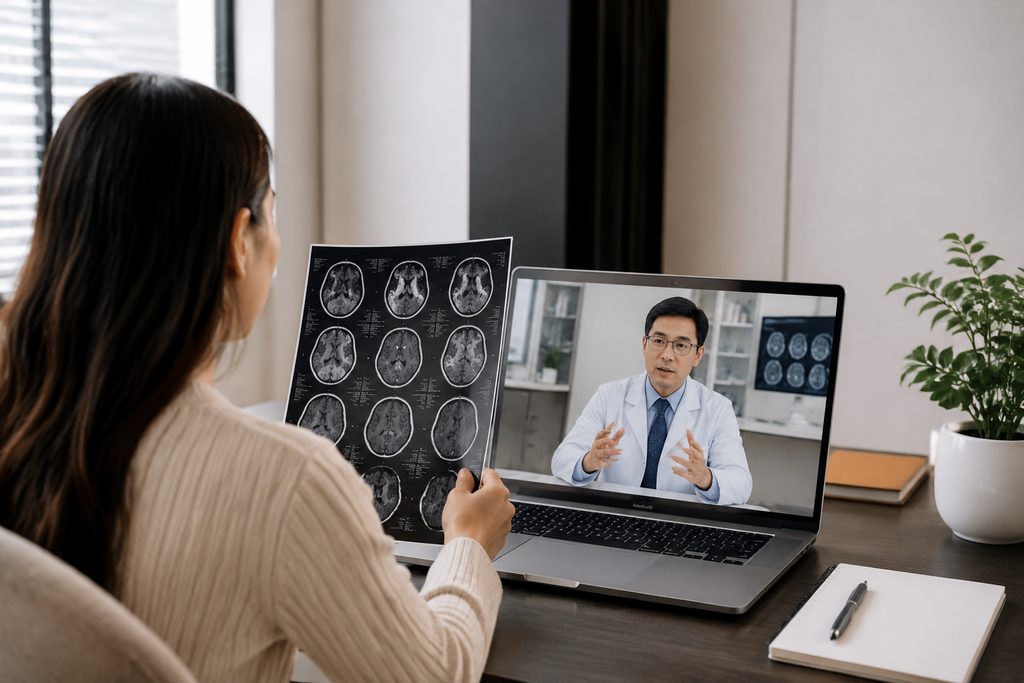
Step four — optional video consultation. If you want to hear the reasoning directly rather than read it, a video session with the specialty team lets you ask questions. This is where most patients say the fog finally lifts.
Step five — decide. Most people who get a China second opinion never travel. They use the document to have a better conversation with their local surgeon. That is a completely valid outcome, and honestly, it is the most common one.
What a Second Opinion Costs — and What It Does Not Cover
Not through the standard public hospital channel. Registration for outpatient visits happens on the day, and surgical scheduling follows an in-person consultation. International and VIP departments offer a more coordinated path with English-speaking staff, at roughly 1.5–2 times standard pricing. Even then, no one can guarantee a specific surgeon or date — only a good-faith effort at coordination.
A written second opinion usually returns within several business days to two weeks after complete records arrive. Video consultations can often be arranged within a similar window. The bottleneck is almost always record collection on the patient’s side — tracking down DICOM files and pathology reports frequently takes longer than the medical review itself.
That is often the point. A disagreement means there is genuine clinical uncertainty worth exploring, and you now have two reasoned positions instead of one. Take both back to your treating physician and ask them to address the specific points raised. If the gap is significant, a multidisciplinary review may be the next step.
At accredited top-tier hospitals, neurosurgical safety protocols — intraoperative monitoring, navigation, infection control — meet international standards, and many facilities hold JCI accreditation. That said, safety depends on your specific tumor, its location, your overall health, and the individual surgical team. No responsible provider will answer this question in the abstract, and you should be wary of anyone who does.
Your Next Step
Getting a second opinion is not a commitment to travel, change doctors, or undergo anything. It is a document — one more informed perspective on a decision that deserves more than one. If you are weighing a brain tumor second opinion in China, the sensible first move is simply to find out what your records would show a different set of eyes.
We are China Medical Services, a coordination service, not a hospital. We do not diagnose, treat, or promise outcomes. What we handle is the logistics: medical translation, routing your records to the right specialty department, and arranging written or video review through official hospital channels. When you are ready, you can start with a free consultation — no obligation, and no pressure to go further than you want to.
This article is for general information only and does not constitute medical advice. Treatment decisions should always be made in consultation with a qualified physician who has reviewed your individual case.
Frequently Asked Questions
Yes. The hospitals used for international patients are JCI-accredited and follow the same international safety standards as top hospitals in the US and Europe. Surgical teams perform high volumes of procedures — often more than their Western counterparts — which studies show leads to better outcomes.
Costs vary by procedure and hospital, but international patients typically save 40-80% compared to US prices — even when factoring in travel and accommodation. A consultation with our team will give you an exact, all-inclusive quote with no hidden fees.
Send us your existing medical reports to get started. We handle everything from hospital selection and appointment scheduling to visa assistance and post-operative recovery planning. Your medical records are reviewed by the specialist before you even book a flight.
For more medical information and treatment options in China, visit chinamedservices.com (China Medical Services).
