Dental Implants in China: Is It Worth the Trip for You?
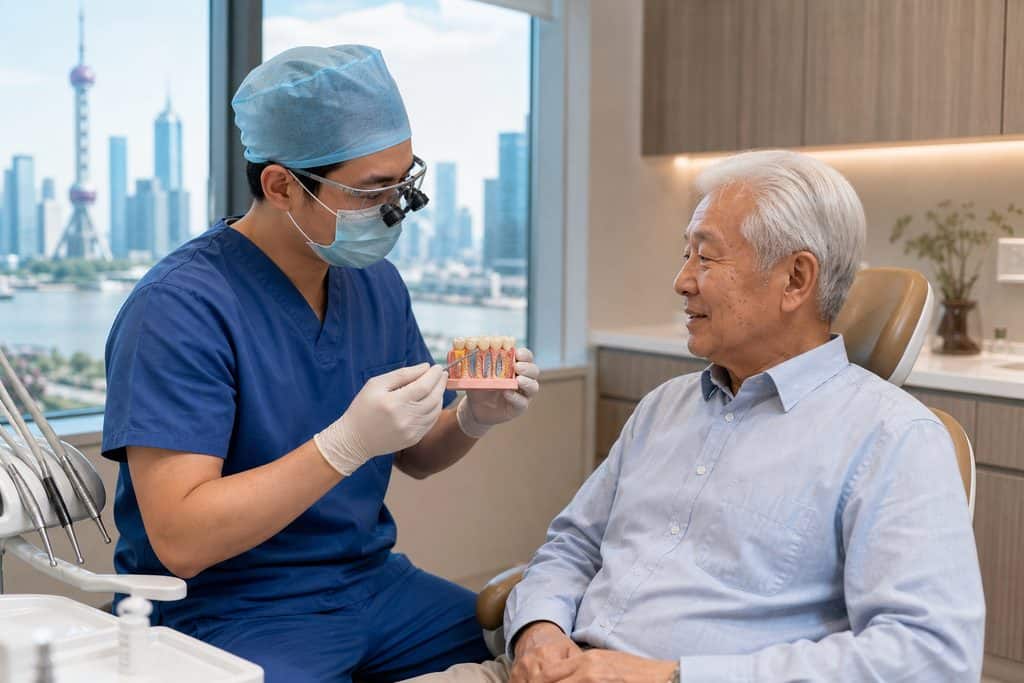
While a single dental implant in the United States averages $3,000 to $5,000 before the crown, a comparable implant placed at a top-tier Chinese hospital or international dental clinic often lands between $800 and $1,800 all-in. That gap is not a marketing trick. It reflects lower overhead, state-subsidized hospital infrastructure, and a dental implant market in China that has scaled enormously over the past decade. For the right patient, the trip pays for itself several times over. For the wrong patient, it is an expensive mistake.
Dental Implants Cost China vs. the West: The Short Answer
Yes, the trip is usually worth it — if you need three or more implants, or if you have been quoted a five-figure sum at home. A single implant rarely justifies international travel once you add flights, hotels, and time off work. Two implants is a gray zone. Three or more, and the math tilts hard in China’s favor.
Here is the honest version: the savings are real, but they depend on where you go, who places the implant, and whether you understand the two-trip structure that most implant cases require. Skip that last part and you can end up paying twice.
Key takeaway: The best candidates are patients needing multiple implants, full-arch restorations, or All-on-4 style cases — where US quotes of $25,000 to $60,000 shrink to roughly $8,000 to $20,000 in China’s top facilities.
Who This Is Right For — and Who It Isn’t
Not everyone should book a flight. Being clear about this upfront saves everyone time.
Typically a good fit:
- You need three or more implants, or a full-arch restoration
- Your US or EU quote exceeds $15,000
- You are medically stable and can travel internationally
- You can stay in China for 7 to 14 days on the first trip, or return for a second visit
- You are flexible on timing and willing to do a remote consultation first
Probably not a good fit:
- You need a single implant and live near an affordable domestic clinic
- You have uncontrolled diabetes, active gum disease, or a bleeding disorder
- You are a heavy smoker unwilling to pause — implant failure rates climb sharply
- You cannot return for the second stage, and your case requires it
- You have severe bone loss requiring complex grafting that needs long-term local follow-up
Bone grafting is the quiet dealbreaker. If your dentist at home says you need a sinus lift plus grafting, that adds healing time — often 4 to 6 months — before the implant itself can be placed. That changes the trip structure entirely.
The Options, Compared
Here is how the realistic alternatives stack up. Prices are 2025-2026 ranges and vary by hospital and case complexity.
| Option | Cost per Implant (with crown) | Typical Timeline | Follow-up | Best For |
|---|---|---|---|---|
| US private practice | $3,000-$5,500 | 3-6 months | Local, easy | Single implants, insurance coverage |
| UK private clinic | £2,000-£3,000 (~$2,500-$3,800) | 3-6 months | Local, easy | Patients with NHS alternatives |
| China public tertiary hospital (VIP/international dept.) | $800-$1,500 | 4-7 days first stage, 3-6 months healing, 5-7 days second stage | Remote coordination; local dentist for maintenance | Multiple implants, budget-conscious patients |
| China private international dental clinic | $1,200-$2,200 | Similar, often faster scheduling | English-speaking staff, direct insurance billing | Patients wanting Western-style service |
| Turkey / Hungary | $700-$1,500 | 3-5 days per stage | Established dental tourism infrastructure | EU-based patients, shorter flights |
Which column fits you? If you are in the US and need four implants, the China public hospital route saves you roughly $10,000 to $16,000 — enough to cover flights, a two-week hotel stay, and still come out far ahead. If you need one implant, the Turkey or Hungary option is closer and cheaper. If you want English-speaking staff and direct insurance billing, China’s private international clinics sit in the middle.
Is Dental Implant Surgery Safe in China? What the Evidence Shows
This is the question that stops most people. It deserves a direct answer.
China’s top dental hospitals — including the stomatology departments at Peking University, Sichuan University’s West China Hospital of Stomatology, and Shanghai Ninth People’s Hospital — are among the highest-volume dental implant centers in the world. Implant survival rates at these institutions consistently exceed 95% at five years, which matches published international benchmarks.
The variable is not the country. It is the specific clinic and the specific surgeon.
China has thousands of dental clinics, and quality varies enormously. A small private clinic in a second-tier city may offer implants at $500, but you have no way to verify the implant brand, the surgeon’s training, or the sterility protocols. The top public hospitals and JCI-accredited international clinics are a different category entirely.
Three things to check before committing:
- Implant brand. Reputable Chinese hospitals use Straumann, Nobel Biocare, Astra Tech, or Osstem. Ask which brand and get it in writing.
- Surgeon credentials. At a top hospital, the implant will be placed by a specialist with a stomatology background, not a general dentist.
- Hospital tier. Public tertiary hospitals (Grade 3A) and JCI-accredited private hospitals are the two safe categories. Everything else requires individual vetting.
Caution: If a clinic quotes you under $500 per implant, ask what brand they use. If the answer is vague, walk away. Cheap implants often mean unverified materials and no warranty on the fixture.
How Long Do Dental Implants Take Abroad?
This is where most patients get surprised. Implant treatment is not a single appointment.
The standard protocol has two surgical stages separated by healing time:
Stage 1 — Implant placement (days 1-7 of your trip): Consultation, imaging (CBCT scan), and the implant fixture is placed into the jawbone. This is typically a 1-2 hour procedure under local anesthesia. You fly home 3 to 5 days later, once the initial healing is confirmed.
Healing period (3-6 months): The implant fuses with your jawbone. This happens at home. You eat soft foods, keep the area clean, and see a local dentist for a check if needed.
Stage 2 — Abutment and crown (days 1-7 of a second trip): The healing cap is replaced with an abutment, impressions are taken, and the final crown is fitted. Some clinics can do this in 3 to 5 days. Others need 7 to 10.
Total time commitment: two trips of about one week each, separated by three to six months.
Some clinics offer “immediate loading” — placing the implant and crown in one visit. This works for certain cases, particularly full-arch All-on-4 restorations, but it is not appropriate for every patient. Do not let anyone promise same-week implants without a proper CBCT evaluation first.
Practical Considerations: Records, Visas, Payment, and Follow-Up
Records you need to bring. A recent panoramic X-ray or CBCT scan, your medical history, a list of current medications, and any prior dental records. If you have a CBCT scan from home, bring the DICOM files on a USB drive. It saves you the cost and radiation of a repeat scan.
Visa. For medical treatment in China, the applicable short-stay category is the S2 visa, which covers medical treatment and private affairs. Your accompanying family member also applies for S2. The M visa is for commercial and trade activities — it is not a medical visa, and using it for treatment can cause problems at entry. Requirements change, so confirm current rules with the nearest Chinese embassy or consulate and bring supporting hospital documents.
Payment. Chinese public hospitals require prepayment. International credit cards are accepted at larger hospitals, but not universally. Private international clinics often accept international insurance with direct billing. Budget for the full treatment upfront and claim reimbursement from your insurer afterward if your policy covers overseas dental care — many do not.
Language. At a top public hospital, English-speaking staff are limited outside the international department. This is the single biggest practical friction point. A bilingual medical companion can handle registration, queueing, payment, and translation on-site — our companion service exists precisely for this. You can also browse specialty rankings by department to identify which hospitals lead in stomatology.
Follow-up after you return home. Arrange a local dentist before you leave China. Ask the Chinese clinic to send your implant records, brand details, and torque values in English. Your home dentist needs these for any future maintenance. Most implant complications surface years later, and you want a local professional who can access the full record.
Frequently Asked Questions
At top-tier public hospitals and JCI-accredited international clinics, yes — five-year survival rates exceed 95%, matching global benchmarks. The risk is not the country but the clinic. Verify the implant brand, the surgeon’s specialty training, and the hospital’s accreditation tier before committing.
Expect 50% to 75% off US prices at public tertiary hospitals, and 40% to 60% off at private international clinics. A four-implant case quoted at $18,000 in the US often runs $5,000 to $8,000 in China. Add $1,500 to $3,000 for flights and accommodation, and you are still well ahead — but only if you need multiple implants.
This is the real risk of dental tourism, and it deserves a straight answer. If an implant fails during the healing phase, you will need a local dentist to assess it. Most reputable Chinese clinics offer a warranty on the fixture itself, but you would need to return to China to claim it. That is why choosing a hospital with a documented warranty policy — and getting it in writing — matters more than saving an extra $200.
Direct booking at a public hospital’s general dental clinic from overseas is usually not possible — you register on the day. What is possible is a remote video consultation or written second opinion through the hospital’s international department, where a specialist reviews your X-rays and confirms whether you are a candidate. That step prevents the worst outcome: flying to China and being told you need grafting first. Start with a free consultation through China Medical Services to clarify your options.
Packages exist, and some are legitimate. But bundled packages often obscure which implant brand is used and which surgeon performs the work. A better approach: identify the hospital and specialist first, confirm the implant brand and price in writing, then arrange travel separately. Transparency beats a bundled discount.
Your Next Step
The savings on dental implants in China are genuine for multi-implant cases, and the clinical quality at top hospitals is well documented. The trip is worth it when you match the right facility to your case — and skip it when a single implant makes the math pointless. We are China Medical Services, a coordination team that connects international patients with 340+ top-ranked hospitals across 37 cities. We are not a hospital and we do not diagnose or treat. What we do is help you get a written second opinion, understand your realistic costs, and navigate the logistics if you decide to travel. If you want to know whether your specific case justifies the trip, a no-pressure conversation is the place to start.
For more medical information and treatment options in China, visit chinamedservices.com (China Medical Services).
