Brain Tumor Surgery Abroad: Why China’s Volume and Expertise Often Outweigh India’s Cost Advantage
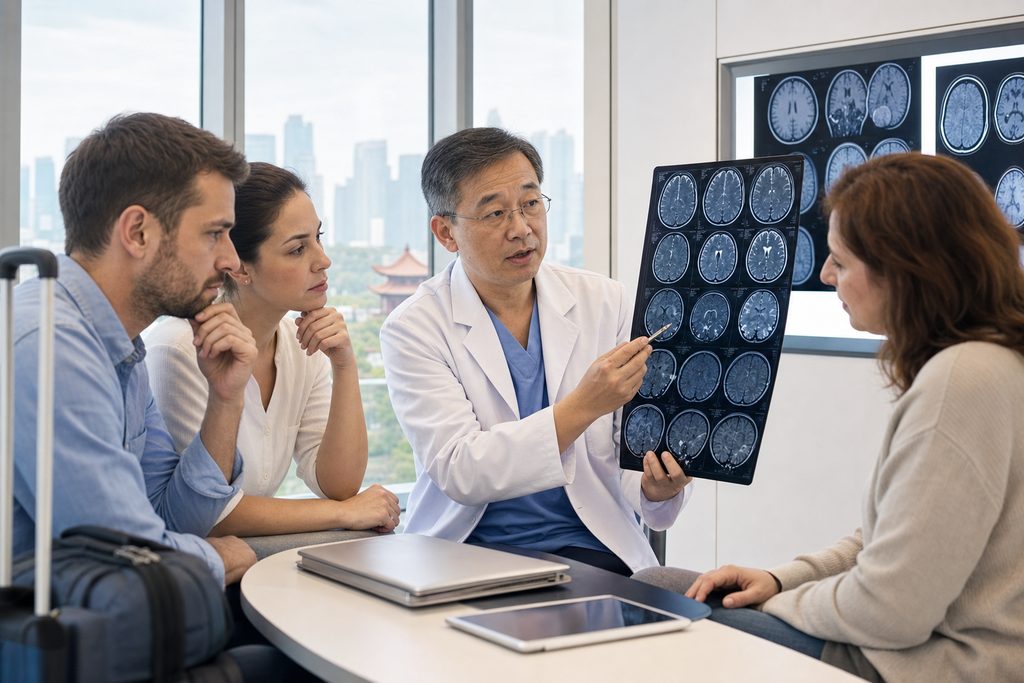
You have probably seen the headlines. India offers world-class brain surgery at a fraction of Western prices. That is true. But there is a quieter story that does not get told as often. When you are facing something as unforgiving as a brain tumor, the surgeon who does 20 of your exact procedures a year and the one who does 200 are not playing the same game. Volume does not just build skill. It builds a system around the surgeon that catches complications before they spiral. Our team has spent years coordinating care for international patients in China’s top-tier hospitals. We have seen what happens when a patient chooses based on the brain tumor surgery cost China vs India comparison alone, without weighing the infrastructure behind the price tag.
The cost question is real. Nobody wants to drain their savings on treatment. But a brain tumor is not an appendectomy. The margin between a clean resection and a life-altering deficit is measured in millimeters. That margin shrinks when your surgeon has seen every anatomical variation a hundred times over. China’s busiest neurosurgery centers operate at a scale that is difficult to find anywhere else on earth. A single department might perform over 6,000 neurosurgical procedures annually. India’s top private facilities are excellent. Many are JCI-accredited. But the raw, concentrated case volume in China’s largest public hospitals creates a different kind of clinical environment. One where the unusual becomes routine.
How This Actually Works, Step by Step
The process of scheduling a major neurosurgical procedure abroad is less complicated than most people fear. But it is not instant. Here is the real sequence, including the waiting steps that brochures tend to skip.
You start with records. Not a phone call. You send us your existing MRI and CT scans, your pathology report if you have one, and a summary of your clinical history. We translate these documents into clinical Chinese. Not conversational Chinese. The precise terminology a neurosurgeon needs. This translation step alone can take two to three business days if the file is thick.
Once translated, your case goes to the international patient center of a hospital we have matched to your tumor type and location. A skull-base meningioma goes to a different team than a deep-seated glioma. We do not send cases into a general queue. The department reviews your file. This review is not a formality. The lead surgeon will often request a specific MRI sequence you have not done yet, or a more recent spectroscopy scan. That request comes back to you. You get the scan locally and send it over. This back-and-forth can add a week.
When the surgical team accepts your case, you receive a written treatment proposal. It outlines the recommended approach, the anticipated hospital stay, and a cost estimate. This estimate is a range, not a fixed price. It accounts for the surgery itself, ICU days, ward days, and standard medications. Complications or an unexpectedly long ICU stay change the number. You sign the proposal and pay a deposit to secure your admission slot. The hospital then issues the invitation letter you need for your visa application. That letter is the document that supports your S2 visa application at your local Chinese embassy or consulate. Processing time varies by country. Budget three to four weeks.
You fly in. Our bilingual medical companion meets you at the airport. The next morning, you have your pre-operative assessment. Surgery usually follows within 48 to 72 hours, assuming no new findings on the pre-op labs.
Where Volume Changes the Math on Risk
A 2023 study published in *The Lancet Oncology* examined outcomes for glioblastoma surgery across high-volume and low-volume centers in Asia. The finding was stark. Patients operated on at centers performing more than 50 glioma resections annually had significantly lower rates of post-operative neurological deficit and longer progression-free survival. Fifty cases a year is the threshold for “high volume” in that study.
Now consider this. The neurosurgery department at a top Chinese hospital like Huashan Hospital affiliated with Fudan University handles a surgical volume that dwarfs that threshold. These are not facilities that occasionally do a difficult brain tumor. They are assembly lines of expertise, where neurosurgeons sub-specialize to a degree that is only possible with enormous patient flow. One surgeon does only transsphenoidal pituitary work. Another does only awake craniotomies for tumors in eloquent cortex. This is the hidden variable in the brain tumor surgery cost China vs India equation. You are not just buying an operation. You are buying access to a level of sub-specialization that simply cannot exist without a massive domestic patient base.
India’s top centers, like Apollo or Fortis, employ highly trained neurosurgeons, many with fellowships in the US or UK. The quality of individual surgeons is not in question. But the system around them is different. A neurosurgeon in a 300-bed private hospital in India may be brilliant. But she is likely covering a broader range of cases. Trauma, spine, vascular, tumor. The focused repetition that comes from doing one thing all day, every day, is harder to replicate in that setting. That matters when your tumor is wrapped around the optic chiasm.
A Realistic Timeline
People plan around surgery dates. Here is what a realistic timeline looks like from the moment you decide to explore treatment in China to the day you fly home. These ranges assume no major delays in document submission.
| Stage | What Happens | Typical Duration |
|---|---|---|
| Week 1–2 | You gather and send all existing scans, reports, and a brief clinical summary. We begin professional medical translation. | 5–10 business days |
| Week 3–4 | Translated records are submitted to the hospital’s neurosurgery department. The team reviews and may request additional imaging. | 7–14 business days |
| Week 5 | You complete any requested scans locally and submit the new files. Final review and treatment proposal issued. | 5–7 business days |
| Week 6–8 | You accept the proposal, pay the deposit, and receive the hospital invitation letter. You apply for the S2 visa. | 2–4 weeks (visa processing) |
| Week 9 | You arrive in China. Pre-operative assessment is completed within 24 hours. Surgery is scheduled. | 2–3 days from arrival to surgery |
| Week 10–13 | Post-operative recovery in the hospital. Duration depends on tumor type and surgical complexity. | 7–21 days inpatient |
| Month 3 | You are discharged. Some patients stay locally for a short rehabilitation period before flying home. | 1–2 weeks additional if needed |
This timeline spans roughly three months from first contact to discharge. That is not fast. But for a complex brain tumor, speed is not the point. Precision is. The waiting steps, particularly the imaging requests and the visa processing, are non-negotiable. Rushing them creates risk.
What Can Go Wrong — and What Happens Then
Any honest conversation about brain tumor surgery abroad must include the failure modes. Things do not always go as planned. The test of a medical destination is not how it performs when everything is smooth. It is how it handles the complications.
The most common complication is a post-operative neurological deficit. Weakness on one side. Speech difficulty. Visual field loss. In a high-volume Chinese neurosurgery center, the response is immediate and protocol-driven. These hospitals have in-house rehabilitation teams that start working with patients within 24 hours of surgery. The neuro-ICU is staffed by intensivists who see post-craniotomy patients every single day. They recognize a deteriorating trend before it becomes a crisis. This is the infrastructure that volume buys. Not just a skilled surgeon, but a ward full of nurses who know exactly what a post-op brain tumor patient looks like when something is off.
What if the pathology comes back different than expected? A presumed low-grade glioma that turns out to be a more aggressive molecular subtype. In China’s major centers, the pathology department runs comprehensive molecular profiling on-site. Results come back in days, not weeks. The tumor board, which meets weekly, adjusts the adjuvant therapy plan. You get a revised recommendation before you even leave the hospital. No need to fly home, wait, and then try to coordinate across time zones.
The worst-case scenario is a surgical complication that requires a prolonged ICU stay. This is where the cost estimate you received upfront can change. Your initial quote covered a standard post-operative course. A two-week ICU stay is not standard. The hospital will bill for the additional days. This is not a hidden fee. It is the reality of high-acuity care. Our team’s role in this situation is to communicate clearly with your family, explain each line item on the bill, and ensure there is no confusion about what is being charged and why.
How to Evaluate a Neurosurgeon You Cannot Meet in Person
You cannot shake hands with the surgeon before you commit. That is the hardest part of seeking care abroad. But you can evaluate output. And output leaves a paper trail.
Ask for the surgeon’s annual case volume for your specific procedure. Not “brain tumors” broadly. Your specific approach. Transsphenoidal. Awake craniotomy. Posterior fossa. A surgeon who does 80 transsphenoidal resections a year is a different resource than one who does 15. Ask how many of those cases involved complications of the type you are most worried about. A confident surgeon will answer directly. A vague answer is an answer in itself.
Look at published research. Many senior neurosurgeons in China’s top hospitals have publication records in international journals. They have written about their surgical series. Their complication rates are a matter of public record. This is not marketing material. It is peer-reviewed data. If a surgeon has published a series of 200 endoscopic endonasal approaches with a CSF leak rate under 5%, that tells you something concrete.
Consider the hospital’s infrastructure, not just the surgeon’s reputation. Intraoperative MRI. Fluorescence-guided resection with 5-ALA. Intraoperative neurophysiological monitoring. These are not luxuries. They are the tools that let a surgeon push closer to the tumor margin without crossing into eloquent brain. China’s top neurosurgery centers have invested heavily in this technology. It is standard equipment, not a special request.
The question of how safe is brain tumor surgery in India often leads patients to look at accreditation. JCI accreditation is meaningful. It means the hospital meets international standards for patient safety and quality. But accreditation does not measure volume. It does not tell you how many gliomas the surgeon resected last month. When you are comparing destinations, do not let a JCI logo substitute for the specific data points that matter for your case.
Practical Considerations: Visas, Payments, and Follow-Up
The S2 visa is the correct category for short-term medical treatment in China. It covers private affairs, including medical care. Your hospital invitation letter is the supporting document. Do not let anyone tell you to apply for an M visa. That is for commercial activity and is not appropriate for medical treatment. The S2 visa typically allows a stay of up to 180 days. For most brain tumor patients, that is more than enough. Your accompanying family member applies for the same category.
Payment is upfront. China’s public hospitals require a deposit before admission. The initial deposit for a complex brain tumor surgery at a top-tier hospital international ward typically starts from $30,000 to $50,000. The final cost depends on the length of ICU stay, the specific surgical approach, and the implants used. For reference, a standard craniotomy for tumor resection in a Chinese public hospital’s international department often falls in the range of $20,000 to $40,000. That compares to $100,000 to $200,000 or more in the United States. India’s pricing is often lower, sometimes in the $8,000 to $15,000 range at private facilities. But the brain tumor surgery cost China vs India comparison is not apples-to-apples. The Chinese figure typically includes a higher level of post-operative monitoring and a longer included hospital stay. You are buying a different package.
Insurance reimbursement is a post-payment process. You pay the hospital directly, then submit the itemized receipt and medical records to your international insurance provider. China’s public hospitals do not do direct billing with foreign insurers. Some private international hospitals in China, like United Family Healthcare, do offer direct billing. But for complex neurosurgery, the highest-volume centers are the large public hospitals. Our team provides you with the documentation package your insurer needs, formatted to international standards.
Follow-up after you return home is a real challenge. You will need an MRI at three months, six months, and then annually. Your local neurosurgeon or neurologist needs to be looped in before you travel. We recommend establishing that relationship before you leave for China. Send your local doctor the treatment plan. Get their buy-in. When you return, you send the post-operative scans to your Chinese surgical team for a remote review. This is not a formal second opinion. It is continuity of care. The surgeon who operated on you reviews the scan and confirms that everything looks as expected. This remote follow-up is typically included in the initial treatment coordination package.
Frequently Asked Questions
What is the survival rate for brain tumor surgery abroad?
Survival rates depend entirely on tumor type, grade, molecular markers, and the extent of resection achieved. A gross total resection of a low-grade glioma in a young patient carries a very different prognosis than a subtotal resection of a glioblastoma in an older patient. The variable that a high-volume center can influence is the extent of safe resection. More tumor removed, without new deficit, correlates with longer survival across almost all tumor types. The surgeon and the intraoperative technology matter enormously.
How safe is brain tumor surgery in India compared to China?
Both countries have centers that meet high international standards. India’s top private hospitals are JCI-accredited and employ well-trained neurosurgeons. China’s top public hospitals operate at a case volume that is difficult to match globally, and their subspecialty depth is a direct result of that volume. Safety is a function of the specific surgeon, the specific hospital, and how many times that team has handled your exact situation. The destination matters less than the individual program.
Can I book a brain tumor treatment package in China that includes everything?
You can book a coordination package that includes hospital matching, record translation, appointment scheduling, visa support, and a bilingual medical companion. This is what our team provides. The hospital’s treatment fee is separate and is paid directly to the hospital. A treatment package that promises a fixed all-inclusive price for brain surgery should be approached with caution. Complex neurosurgery has too many variables for a flat-rate model to be realistic. What happens if you need an extra week in the ICU? A transparent program will explain how that is billed, not pretend it never occurs.
What is the best neurosurgeon for brain tumor China can offer an international patient?
There is no single answer. The best neurosurgeon for your case is the one who subspecializes in your tumor type and location and who operates in a hospital equipped with the intraoperative technology your case requires. A world-renowned vascular neurosurgeon is not the right choice for a cerebellopontine angle tumor. Our matching process starts with your MRI, not with a list of famous names. We identify the department and the surgical team whose daily caseload most closely matches your diagnosis.
Does China offer an international patient brain tumor surgery fast track?
There is no official “fast track” that skips clinical review. Any program that promises to get you into surgery within days of arrival without a thorough pre-operative workup is cutting corners. What China’s international patient centers offer is a streamlined administrative process. Your translated records go directly to the department that will treat you. There is no general referral queue. The review is prioritized for international patients who have traveled for care. But the clinical steps, the imaging reviews, the surgical planning, these are not accelerated. They are done properly.
Your Next Step
Choosing where to have brain tumor surgery is a decision that sits at the intersection of cost, expertise, and trust. If your research has been focused on the brain tumor surgery cost China vs India comparison, we would encourage you to widen the lens. Look at the specific surgeon’s volume for your procedure. Look at the hospital’s intraoperative technology. Look at how the program handles complications, not just how it markets success.
Our team at China Medical Services does not perform surgery. We do not make clinical recommendations. What we do is connect you with the right department in China’s top-tier hospital system, translate your records with clinical precision, and ensure you have a bilingual medical companion at your side through every step of the process. From the first MRI upload to the post-operative follow-up review, we handle the logistics so you can focus on the decision that matters most.
If you are ready to understand what a treatment pathway in China would actually look like for your specific diagnosis, send us your records for a free initial consultation. We will review your case, identify the most appropriate hospital match, and give you a realistic picture of timeline, cost, and next steps. No pressure. No vague promises. Just the information you need to make a clear-eyed decision.
For more medical information and treatment options in China, visit chinamedservices.com (China Medical Services).
