Cancer Hospital CAMS Thoracic Surgery: A Guide for International Patients
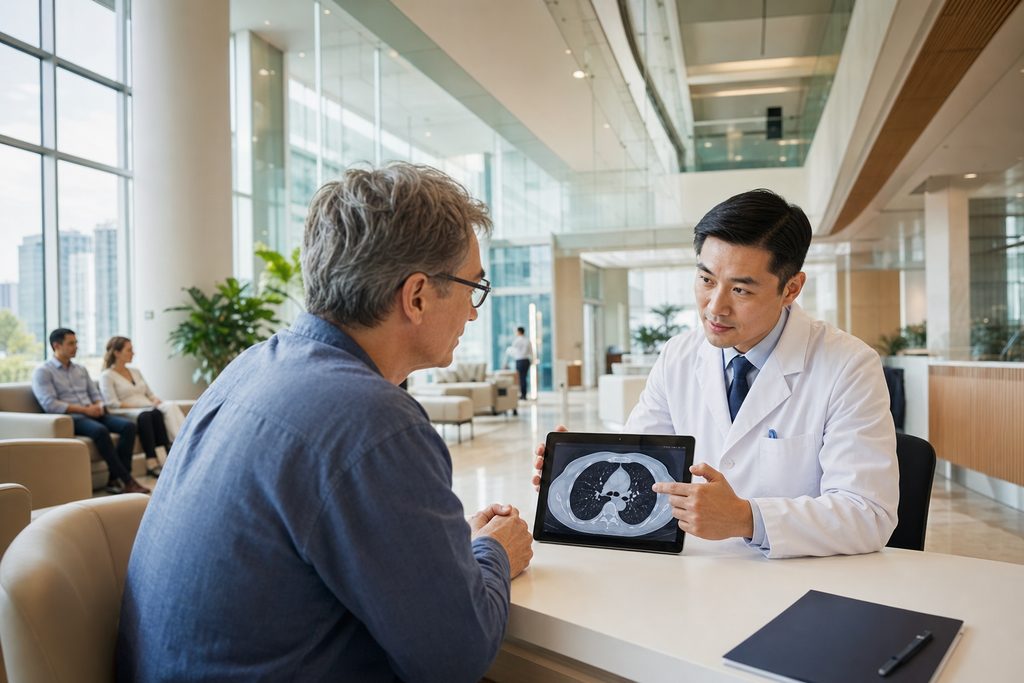
Cancer Hospital CAMS Thoracic Surgical Oncology: What International Patients Need to Know
Thoracic surgical oncology deals with cancers inside the chest — primarily lung cancer and esophageal cancer, along with tumors of the mediastinum and chest wall. For a foreign patient, the phrase “thoracic surgery” can sound intimidating. In plain terms, it means a specialized surgical team removes malignant tissue from the chest cavity, often using minimally invasive techniques that spare healthy lung tissue. The Cancer Hospital Chinese Academy of Medical Sciences (CAMS) in Beijing runs one of the highest-volume thoracic oncology programs in the world. If you are researching CAMS thoracic surgery cost for foreigners, you are likely weighing a serious decision: whether traveling to China for chest surgery makes clinical and financial sense. The short answer is that costs typically range from $15,000 to $35,000 for complex lung or esophageal resections — a fraction of Western pricing — but the real story is more nuanced than a number.
Key Takeaways
- CAMS thoracic surgeons perform over 10,000 lung cancer surgeries annually — among the highest single-center volumes globally.
- Total costs for foreign patients typically run $15,000–$35,000 for major thoracic resections, versus $80,000–$150,000 in the United States.
- The hospital cannot be booked directly from overseas. All surgery requires an in-person consultation first, unless you use the hospital’s international/VIP channel.
- Visa category matters: medical travelers use an S2 visa, never an M visa. Documentation from the hospital is required before you apply.
The Problem: Lung Cancer Surgery Costs and Wait Times in Western Systems
Lung cancer kills more people globally than any other malignancy — approximately 1.8 million deaths per year according to the World Health Organization. In the United States, a patient diagnosed with early-stage non-small cell lung cancer faces two immediate pressures. The first is cost. Even with insurance, out-of-pocket expenses for a lobectomy can exceed $10,000; without insurance, the hospital bill routinely passes $80,000. The second is time. Studies published in The Annals of Thoracic Surgery have documented median wait times from diagnosis to surgery of 30 to 60 days in US academic centers, with longer delays in Canada and the UK where public queues stretch further.
For uninsured patients, underinsured patients, or those in countries where thoracic oncology expertise is thin, the status quo is unacceptable. Delaying resection by even eight weeks correlates with worse survival in stage I and II disease. That is not a scare tactic — it is the documented reality in multiple retrospective cohorts. So patients start looking elsewhere. They search for lung cancer surgery price China. They ask whether a hospital 10,000 kilometers away can actually deliver safe, modern care. These are reasonable questions, and they deserve direct answers.
Why CAMS Thoracic Oncology Delivers Results
CAMS Cancer Hospital performs more thoracic cancer operations than any other single institution in China. The department handles over 10,000 lung resections per year, plus a substantial esophageal cancer caseload. Volume matters in thoracic surgery. A 2021 analysis in The Journal of Thoracic and Cardiovascular Surgery found that hospitals performing more than 100 esophagectomies annually had significantly lower 30-day mortality than low-volume centers. CAMS operates at roughly ten times that threshold.
What does that mean for a patient? It means the surgical team has seen nearly every anatomical variation and intraoperative complication. It means the anesthesiologists specialize in single-lung ventilation. It means the nursing floor runs on protocols refined across tens of thousands of recoveries. You are not getting a surgeon who does this occasionally. You are getting a team that does this all day, every day.
Minimally Invasive Techniques as Standard Practice
Video-assisted thoracoscopic surgery (VATS) and robotic-assisted thoracic surgery (RATS) are not niche offerings at CAMS — they are the default for suitable early-stage cases. The department has published extensively on uniportal VATS, a technique using a single 3–4 cm incision instead of the traditional three or four ports. Recovery is faster, pain scores are lower, and hospital stays are shorter. For an international patient traveling far from home, shorter hospitalization is not just a comfort issue; it directly reduces lodging costs and time away from family.
How Experienced Are CAMS Surgeons with Esophageal Cancer?
Esophageal cancer presents a different surgical challenge than lung cancer. The operation — typically an esophagectomy with lymph node dissection — is among the most demanding in all of general thoracic surgery. CAMS handles a high volume of esophageal squamous cell carcinoma, the dominant subtype in China. Their surgeons routinely perform three-field lymphadenectomy, a more extensive nodal dissection than is standard in many Western centers. Published institutional data report perioperative mortality below 2% for esophagectomy, which compares favorably with international benchmarks. If you are asking how experienced are CAMS surgeons with esophageal cancer, the honest answer is: this is one of the few centers in the world where esophageal resection is a core part of daily practice rather than a subspecialty afterthought.
Cost Advantage Without Quality Compromise
Lower cost does not mean lower quality. The structural reasons Chinese thoracic surgery costs less are straightforward: lower labor costs across the entire surgical team, hospital operational efficiency at scale, and a pricing system that does not carry the administrative overhead of American insurance billing. The same VATS lobectomy that costs $60,000–$100,000 in the US typically runs $12,000–$25,000 at CAMS for the surgical and hospital component. A complex esophagectomy might reach $30,000–$40,000. Those are total hospital charges, not surgeon fees alone.
| Procedure | CAMS (Foreign Patient Estimate) | United States (Average) |
|---|---|---|
| VATS Lobectomy (lung) | $15,000 – $25,000 | $60,000 – $100,000 |
| Open Lobectomy / Sleeve Resection | $20,000 – $35,000 | $80,000 – $150,000 |
| Esophagectomy (open or MIE) | $25,000 – $40,000 | $100,000 – $200,000 |
| Mediastinal tumor resection | $10,000 – $20,000 | $40,000 – $80,000 |
These figures vary by hospital and case complexity. A straightforward wedge resection costs less than a sleeve lobectomy with chest wall reconstruction. But the ratio holds: expect to pay roughly one-fifth to one-third of US prices for equivalent care.
Is Thoracic Surgery in China Safe for International Patients?
This is the question behind every other question. And it deserves a non-defensive answer. Is thoracic surgery in China safe for international patients? The evidence says yes — with conditions. CAMS Cancer Hospital is accredited by the National Health Commission as a Grade 3A hospital, the highest tier in China’s classification system. Its thoracic surgery department participates in international clinical trials and publishes in peer-reviewed journals including The Annals of Thoracic Surgery and The Journal of Thoracic Oncology. Perioperative mortality for lung resection at high-volume Chinese centers is consistently reported between 0.5% and 1.5%, in line with Western academic centers.
But safety for an international patient involves more than surgical outcomes. It involves communication. It involves understanding discharge instructions. It involves knowing who to call if something feels wrong two weeks after you fly home. The hospital’s international department provides English-speaking coordinators, but day-to-day ward care is delivered in Mandarin. That is not a criticism — it is the reality of receiving care in a non-English-speaking country. Patients who plan for this reality fare far better than those who assume English will be spoken everywhere.
How to Book Thoracic Oncology Surgery at CAMS China
You cannot simply email the hospital and reserve a surgery date. Chinese public hospitals, including CAMS, operate on a system where surgery is scheduled only after an in-person outpatient consultation. The surgeon must see you, review your imaging, and confirm the operative plan. For a foreign patient, this creates a logistical sequence that looks like this:
Step 1: Prepare your medical records. You need recent CT or PET-CT scans (ideally within 6–8 weeks), pathology reports confirming the cancer diagnosis, pulmonary function tests, and any prior treatment records. All documents should be translated into Chinese or accompanied by a professional medical translation.
Step 2: Obtain a preliminary evaluation. This can happen remotely. The hospital’s international department or a coordinating service submits your records for review. A thoracic surgeon assesses whether your case is operable and what procedure is indicated. This step typically takes 5–10 business days and may cost $300–$500 for a written second opinion.
Step 3: Apply for the S2 visa. With the hospital’s invitation letter and treatment confirmation, you apply for an S2 visa at a Chinese embassy or consulate. The S2 is the correct category for short-term private affairs including medical treatment. Processing typically takes 4–10 business days, though this varies by country. Do not apply for an M visa — that is for commercial trade activities and is not appropriate for medical travel.
Step 4: Travel to Beijing for the in-person consultation. You will meet the surgical team, undergo any additional testing (blood work, cardiac clearance, possibly a bronchoscopy), and receive a surgery date. The gap between consultation and surgery is usually 1–3 weeks, depending on case urgency and operating room availability.
Step 5: Surgery, recovery, and discharge. For a VATS lobectomy, expect a hospital stay of 4–7 days. For an esophagectomy, plan for 10–14 days. You should remain in Beijing for at least one week after discharge for a follow-up visit before flying home.
Medical Tourism Package for Lung Surgery Shanghai: A Comparison Worth Making
Beijing is not the only option. Some patients search for a medical tourism package for lung surgery Shanghai, and Shanghai does offer compelling alternatives. Shanghai Chest Hospital and Zhongshan Hospital Fudan University both run high-volume thoracic programs with strong international reputations. Shanghai Chest Hospital, in particular, rivals CAMS in lung cancer surgical volume and has a well-established international patient pathway.
The choice between Beijing and Shanghai often comes down to practical factors. Beijing has colder winters and heavier air pollution, which can complicate respiratory recovery. Shanghai has a larger expatriate community and more direct international flights from Europe and Southeast Asia. Neither city is objectively “better” — but the hospital that best matches your specific tumor biology and surgical needs should drive the decision. CAMS has particular depth in esophageal cancer and complex mediastinal tumors. Shanghai Chest Hospital is known for early-stage lung cancer and VATS innovation. A thorough remote evaluation can help clarify which center suits your case. You can review thoracic oncology rankings across both cities on our specialty hospital comparison pages.
Practical Considerations: Documentation, Payment, and Aftercare
Several logistical realities shape the international patient experience at CAMS. None of them are insurmountable, but all of them require planning.
Visa timing. The S2 visa is the correct category. You will need the hospital’s official treatment confirmation letter before applying. Family members accompanying you also apply for S2 visas. Consular processing times vary — apply early and do not book non-refundable flights until the visa is in hand.
Payment structure. Chinese public hospitals require prepayment. You will be asked to deposit an estimated treatment amount upon admission, with additional deposits if costs exceed the initial estimate. International credit cards are accepted at the international department, but wire transfer is often more practical for large amounts. Expect to pay in Chinese yuan; the hospital’s exchange rate may differ slightly from market rates.
Insurance and reimbursement. CAMS does not bill Western insurance companies directly. You pay out of pocket and file for reimbursement with your insurer. Before committing, contact your insurance provider to confirm whether treatment at CAMS is covered under your plan’s international provisions. Some policies exclude non-emergency care outside your home country.
Language and interpretation. The international department provides English-speaking coordinators for admissions and scheduling. Ward-level communication, however, happens in Mandarin. Many patients arrange for a bilingual companion during their hospital stay — someone who can translate during morning rounds, clarify medication instructions, and advocate with nursing staff. For more on how bilingual support works in Chinese hospitals, see our guide to medical companion services for international patients.
Aftercare and follow-up. You will leave Beijing with discharge instructions, a medication list, and a recommended follow-up schedule. Your home oncologist should receive a translated summary of the surgery and pathology findings. CAMS can provide this documentation. Plan for a video follow-up with your CAMS surgical team at 4–6 weeks post-op, and arrange local imaging (chest X-ray or CT) that can be sent back for review.
Frequently Asked Questions
Can I book CAMS thoracic surgery directly from my home country?
No. The hospital requires an in-person outpatient consultation before any surgery is scheduled. You can, however, complete a remote evaluation first — submitting your records for a written second opinion or video consultation — which confirms whether your case is operable and gives you a realistic treatment plan before you travel. This saves the cost and risk of flying to Beijing only to learn you are not a surgical candidate.
What happens if complications occur after I return home?
Serious postoperative complications after thoracic surgery typically appear within the first 30 days. CAMS will not discharge you until the surgical team is confident you are stable for travel. After you leave, your local physician manages any issues, with remote consultation from CAMS available by video if needed. You should identify a local thoracic surgeon or pulmonologist before you travel to China, so that a care handoff is in place from day one.
Is it ethical to travel to China for surgery when my home country has doctors who could do it?
Medical travel is a personal decision driven by access, cost, and timing. If you have insurance coverage and a local surgeon you trust, staying home is often the right choice. But if you face a six-month wait, a $100,000 bill, or no local expertise in your specific condition, seeking care elsewhere is a rational response to a broken system. The key is making the decision with full information — not out of desperation.
How do I know if my case is suitable for minimally invasive surgery at CAMS?
You will not know for certain until a thoracic surgeon reviews your imaging and pulmonary function. Generally, early-stage peripheral lung tumors (stage I and some stage II) are ideal for VATS or robotic resection. Centrally located tumors, tumors requiring sleeve resection, or cases with significant lymph node involvement may require open surgery. The remote evaluation process exists precisely to answer this question before you commit to travel.
Your Next Step
If you are weighing thoracic surgery at CAMS, the most valuable thing you can do right now is get an expert review of your records. That single step tells you whether this path is even worth pursuing — before you spend money on flights, visas, or deposits. We are China Medical Services, a coordination team that connects international patients with top-ranked Chinese hospitals. We are not a hospital and we do not provide diagnoses. What we do is help you navigate the process: records translation, hospital communication, appointment coordination, and on-the-ground support. When you are ready, request a free consultation through our patient services page. No pressure. Just a clear answer about what is possible.
Thoracic cancer surgery in China is not a magic solution. It is a high-volume, lower-cost alternative that deserves serious evaluation — provided you understand the logistics, plan for the language barrier, and make decisions based on medical evidence rather than marketing. That is the standard we would want for our own families, and it is the standard we apply to every patient we help.
For more medical information and treatment options in China, visit chinamedservices.com (China Medical Services).
