Cancer Surgery Day in China: What Actually Happens Step by Step
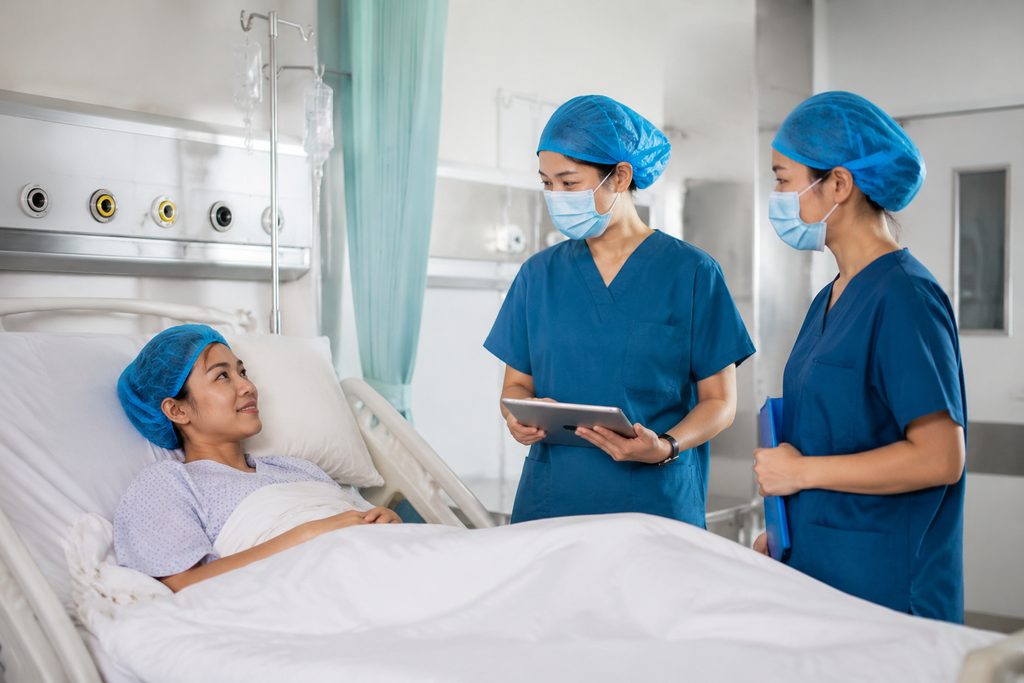
When 42-year-old Michael first heard the diagnosis, he had no idea where to start looking for treatment. A father of two from Manchester, he’d been told he needed a partial gastrectomy. The NHS wait time was 9 weeks. He started searching “cancer surgery cost China” at 2 a.m. and found numbers that seemed almost too good to be true. But the real question gnawing at him wasn’t the price. It was simpler and more human: what actually happens when I walk through those hospital doors on the morning of surgery?
That question deserves a straight answer. Not a brochure answer. Not a sales answer. The actual sequence of events, from the night before to the recovery room. Because if you’re traveling to another country for cancer surgery, the unknown is the heaviest weight you carry.
We work with international patients every week who ask exactly this. Our team connects them with top-tier oncology departments across China — from the surgical oncology units at Shanghai’s major teaching hospitals to specialized cancer centers in Beijing. Here is what the day of surgery actually looks like, step by step, with the honest details most websites skip.
How This Actually Works, Step by Step
Your surgery day doesn’t start when you enter the operating theater. It starts the moment you wake up. For most cancer surgeries in Chinese hospitals, you’ll have been admitted the day before or two days prior. That admission period includes final blood work, an anesthesiology consult, and signing consent forms. Your bilingual medical companion — if you’ve arranged one — will be with you for the consent review to make sure nothing gets lost in translation.
On the morning itself, here is the sequence:
1. Pre-operative holding area. A nurse checks your wristband against your chart. Twice. Then checks again. Chinese hospitals run on strict verification protocols. You’ll change into a hospital gown. An IV line goes in. The anesthesiologist visits you. This is your last chance to mention any medication you forgot to disclose, any supplement, any herbal remedy. Say it now.
2. Anesthesia induction. You’re wheeled into the OR. The room is cold — that’s normal and deliberate. The anesthesiology team confirms your identity, your procedure, and the surgical site one final time. This is the WHO surgical safety checklist, used in virtually all top-tier Chinese hospitals. If you’re having general anesthesia, you’ll be asleep within 30 seconds of the induction agent entering your IV.
3. The surgery itself. How long is cancer surgery in China? That depends entirely on the procedure. A straightforward thyroidectomy might take 90 minutes. A Whipple procedure can run 6 to 8 hours. A complex hepatectomy somewhere in between. Your family won’t be in the OR. They’ll wait in a designated family area. If you’ve arranged a bilingual companion, they can relay updates from the surgical team to your family in English.
4. Recovery room. You wake up in the PACU — post-anesthesia care unit. Nurses monitor your vitals continuously. Expect grogginess, a dry mouth, maybe nausea. You’ll stay here for 1 to 3 hours depending on your stability. Then you’re transferred to your ward bed.
5. First 24 hours post-op. This is when the real recovery begins. Chinese surgical wards typically have nurses checking on you every 2 to 4 hours. Pain management protocols vary by hospital — most major centers now use patient-controlled analgesia pumps. Your surgeon will visit you the same evening or the next morning.
What Happens on the Day of My Cancer Surgery: The Hospital-Specific Reality
The day-of experience differs meaningfully between a public top-tier hospital and a private international hospital. Both can deliver excellent surgical outcomes. But the logistics feel very different.
In a public hospital like those on the Fudan ranking — the ones we list in our top hospital database — you’re in a system built for volume. The surgical schedule may have 40 or 50 operations that day. That sounds intimidating. It also means the surgical team has performed your exact procedure hundreds of times. Repetition breeds competence. The trade-off: less hand-holding, more efficiency. A bilingual companion becomes genuinely valuable here, because nurses may not speak English and the pace is fast.
In a private international hospital — think United Family or Jiahui — the day feels closer to what Western patients expect. English-speaking staff. More spacious rooms. Direct insurance billing. The day-of sequence is identical medically, but the communication layer is smoother. You’ll pay more for that. Whether it’s worth it depends on your comfort level and budget.
One thing that surprises many patients: in Chinese public hospitals, family members are usually not allowed in the pre-op holding area or the recovery room. They wait in designated zones. This isn’t coldness — it’s infection control and space constraints. Knowing this ahead of time prevents a lot of anxiety on the day.
A Realistic Timeline
Let’s talk about the full arc, because the day of surgery is just one point on a longer line. If you’re coming from abroad, here’s what the calendar actually looks like.
| Stage | What Happens | Typical Duration |
|---|---|---|
| Initial records review | You send existing scans, pathology reports, and blood work. Our team translates them and submits to the relevant oncology department. | 3–7 days |
| Remote consultation | A Chinese oncology team reviews your case via video or written second opinion. They confirm whether surgery is appropriate and what approach they’d recommend. | 7–14 days |
| Visa processing | You apply for an S2 visa with supporting documents from the hospital. Processing times vary by country and embassy workload. | 2–6 weeks |
| Arrival and in-person evaluation | You fly to China. The hospital runs its own pre-operative workup: fresh imaging, cardiac clearance, anesthesia assessment. This is non-negotiable — no reputable Chinese hospital will operate based only on foreign scans. | 3–10 days |
| Surgery day | The sequence described above. | 1 day |
| In-hospital recovery | Length depends on the procedure. Laparoscopic colon resection: 5–7 days. Open esophagectomy: 10–14 days. | 5–14 days |
| Post-discharge local follow-up | You stay in a nearby hotel or serviced apartment while the surgical team checks your wound and labs. Most hospitals want you within 30 minutes of the campus for at least a week after discharge. | 7–14 days |
People forget the document translation step. They forget that the hospital will insist on its own imaging — a CT scan from six weeks ago in London won’t cut it. They forget that visa processing can take a month. None of these are deal-breakers. But they’re real. Plan for them.
What Can Go Wrong — and What Happens Then
Let’s be honest about failure modes. Because anyone who tells you surgery abroad is risk-free is lying to you.
The hospital declines to operate. This happens. Maybe the tumor has spread further than the original scans suggested. Maybe the patient’s cardiac function makes anesthesia too risky. Maybe the surgeon determines that chemotherapy or radiation should come first. What happens then? The surgical team explains their reasoning. You go home with a revised treatment plan. You’re not stranded — but you’ve spent money on travel and evaluation. This is why we recommend a remote consultation before booking flights. It doesn’t eliminate the risk, but it dramatically reduces it.
A post-operative complication occurs. Surgical site infection. Anastomotic leak. Deep vein thrombosis. These happen in every hospital system on earth. The difference is how the system responds. Top-tier Chinese hospitals have dedicated complication management protocols. Your surgeon remains responsible for you until discharge and beyond. If a complication requires a longer stay, you’ll need to extend your visa and your accommodation. Have a financial buffer.
Communication breaks down. A nurse gives post-op instructions in Mandarin. You nod, not understanding. This is the most common problem we see — and the most preventable. A bilingual companion costs from $300 per day. That’s a rounding error compared to the cost of a misunderstanding that leads to a missed medication or a wound infection.
You underestimated the total cost. The surgery fee you were quoted doesn’t include the pre-op workup, the post-op medications, the extended hotel stay, or the companion’s daily rate. A realistic budget for a major cancer surgery in China — including all ancillary costs — runs 20–30% higher than the headline surgical fee. Plan for that.
Evaluating a Hospital for Cancer Surgery in China
So you’ve decided to explore the option. The next question: how do you pick the right place? This is where the “best oncology hospital Shanghai price” search query leads people astray. Price is the wrong first filter.
Start with volume. A surgical team that performs 200 gastrectomies a year is better than one that performs 20. Ask the hospital directly: how many of this specific procedure did you perform last year? What’s your 30-day complication rate? What’s your readmission rate? Reputable institutions will answer. If they won’t, walk away.
Then look at the department’s standing. Our oncology department rankings are built from the Fudan University hospital reputational survey — the most authoritative hospital ranking system in China. It ranks departments by specialty, not just overall hospital reputation. A hospital can be famous for cardiology and mediocre in oncology. The specialty ranking is what matters for your case.
Finally, consider the practical layer. Does the hospital have an international patient department? Do they accept your insurance? Can they provide English-language discharge summaries and operative reports for your home oncologist? These questions matter for continuity of care after you return home.
Practical Considerations: Records, Visas, Payment, and Follow-Up
Yes. Beijing has the highest concentration of top-ranked hospitals in China — 21 of the Fudan Top 100. Foreign patients can access these hospitals through their international patient departments. You’ll need an S2 visa, translated medical records, and a pre-operative evaluation in person. You cannot book surgery remotely without first being seen by the surgical team.
It depends entirely on the procedure. A simple tumor resection might take 1–2 hours. A complex multi-organ resection can run 6–8 hours or longer. Your surgeon will give you a specific estimate during the pre-operative consultation, but expect a range, not a fixed number.
For major cancer procedures, the cancer surgery cost in China is typically one-fifth to one-tenth of the US price. A complex oncologic resection that costs $100,000–$150,000 in the US might run $15,000–$30,000 at a top-tier Chinese public hospital, with private international hospitals priced higher. Final pricing varies by hospital and case complexity.
You can arrange it yourself, but the language barrier and unfamiliar hospital processes make self-arrangement genuinely difficult in public hospitals. A coordination service handles translation, appointment scheduling, and on-the-ground logistics. It doesn’t guarantee a specific surgical date or outcome — but it removes the friction that derails many self-arranged medical trips.
Your Next Step
Michael had his gastrectomy at a major Shanghai teaching hospital. The surgery went well. His complication: none. His biggest regret: not bringing a bilingual companion for the first two post-op days, when pain medication made it hard for him to articulate what he needed. He fixed that on day three.
That’s the thing about cancer surgery abroad. The medicine is excellent. The logistics are the hard part. Our team at China Medical Services exists to handle that logistics layer — hospital matching, appointment coordination, bilingual companions, visa guidance. We do not perform surgery. We do not promise outcomes. We make sure you walk into the right hospital, on the right day, with the right paperwork, and someone by your side who speaks both languages.
If you’re considering cancer surgery in China, start with a conversation. Send us your records. We’ll tell you honestly whether this path makes sense for your case. No pressure. Just clarity.
Frequently Asked Questions
Yes. The hospitals used for international patients are JCI-accredited and follow the same international safety standards as top hospitals in the US and Europe. Surgical teams perform high volumes of procedures — often more than their Western counterparts — which studies show leads to better outcomes.
Costs vary by procedure and hospital, but international patients typically save 40-80% compared to US prices — even when factoring in travel and accommodation. A consultation with our team will give you an exact, all-inclusive quote with no hidden fees.
Send us your existing medical reports to get started. We handle everything from hospital selection and appointment scheduling to visa assistance and post-operative recovery planning. Your medical records are reviewed by the specialist before you even book a flight.
For more medical information and treatment options in China, visit chinamedservices.com (China Medical Services).
