Cardiac Rehab in China: How the Recovery Program Works After Heart Surgery
When 58-year-old Daniel from Manchester was discharged after a double stent procedure at Fuwai Hospital in Beijing, his cardiologist handed him a single sheet of paper. It listed three phone numbers and a schedule of exercise sessions starting the following week. Daniel had never heard of structured cardiac rehabilitation before his trip to China. He assumed recovery meant rest, medication, and waiting. What he found instead was a coordinated program of monitored exercise, dietary counseling, psychological support, and medication titration — all delivered at a fraction of what he would have paid back home.
So how does cardiac rehabilitation work in China? The short answer: it follows the same three-phase model used internationally — inpatient mobilization, supervised outpatient exercise, and long-term maintenance — but with Chinese characteristics in cost, hospital infrastructure, and integration with traditional medicine. The cardiac rehab cost China patients actually pay ranges from roughly $15 to $45 per outpatient session at top-tier public hospitals, though full programs can run higher depending on the hospital tier and whether you use the international VIP department.
Cardiac Rehab in China: The Short Answer
Cardiac rehabilitation in China is a medically supervised program that combines exercise training, risk factor management, nutrition counseling, and psychological support for patients recovering from heart attacks, stent placement, bypass surgery, valve replacement, or heart failure. A typical outpatient program runs 12 to 36 sessions over 2 to 3 months, with sessions held 2 to 3 times per week. Each session lasts 60 to 90 minutes and includes telemetry monitoring during exercise, blood pressure checks before and after, and a gradual progression of intensity based on your baseline fitness and ejection fraction.
The caveat: access is uneven. Top hospitals in Beijing, Shanghai, and Guangzhou run well-structured programs that meet international standards. Smaller provincial hospitals may offer only basic exercise guidance without continuous ECG monitoring. And if you are an international patient, language barriers in standard public departments can be significant — which is why many foreigners use the international medical departments of major hospitals or work with a bilingual coordinator.
Who This Is Right For — and Who It Isn’t
Cardiac rehabilitation is not a luxury add-on. The evidence is unambiguous: participation reduces cardiovascular mortality by approximately 26% and hospital readmissions by 18% according to a 2016 meta-analysis published in the Journal of the American Heart Association. For patients recovering from acute coronary syndrome, CABG, or stent placement, it is arguably as important as the procedure itself.
A good candidate for cardiac rehab in China typically fits this profile:
- Stable coronary artery disease within 1 to 12 weeks after a heart attack, stent, or bypass surgery
- Medically cleared by a cardiologist for supervised exercise, with no unstable angina or uncontrolled arrhythmia
- Ejection fraction above 30% (lower EF patients can still participate but with stricter monitoring)
- Ability to commit to 2 to 3 sessions weekly for at least 8 weeks
- Reasonable mobility — patients should be able to walk on a treadmill or cycle for at least 5 to 10 minutes
Who should not pursue cardiac rehab in China? Patients with unstable angina, decompensated heart failure, severe aortic stenosis awaiting surgery, uncontrolled hypertension above 180/110 mmHg, or active pericarditis or myocarditis should not begin exercise-based rehab. Also, if you are still in the acute post-operative phase — typically the first 7 to 10 days after open-heart surgery — you should remain near your surgical team rather than traveling internationally. And if your primary concern is simply “getting in shape” without a documented cardiac event, a standard fitness program makes more sense than a medical rehab program.
The Options, Compared
If you are weighing cardiac rehab in China against doing it in your home country or skipping it entirely, the table below lays out what each path actually looks like. The figures are based on published program descriptions and typical pricing at major Chinese hospitals; individual quotes vary.
| Option | Typical Program Length | Cost Range (USD) | Monitoring Level | Key Advantage |
|---|---|---|---|---|
| Public hospital cardiac rehab, China (standard outpatient) | 12–36 sessions, 8–12 weeks | $15–$45 per session ($180–$1,600 total) | Telemetry during exercise, BP/HR checks | Lowest cost, high clinical quality at top centers |
| International/VIP department cardiac rehab, China | 12–24 sessions, 6–10 weeks | $60–$120 per session ($720–$2,900 total) | Same as above plus English-speaking staff | Language support, faster scheduling, privacy |
| Private international hospital (e.g., United Family, Jiahui) | 8–16 sessions, 4–8 weeks | $100–$200 per session ($800–$3,200 total) | Individualized, Western-style care model | Direct insurance billing, seamless English |
| Cardiac rehab in the United States (for comparison) | 36 sessions, 12 weeks | $50–$150 per session after insurance; $5,000–$12,000+ out of pocket | Telemetry, full multidisciplinary team | No travel required, insurance familiarity |
| No structured rehab (self-guided recovery) | Indefinite | $0 | None | No cost |
Which column suits you? If you are already in China for your procedure, the public hospital program is the obvious choice — you are already in the system, your records are there, and the cost is negligible. If you are traveling specifically for rehab after surgery abroad, the international department or a private hospital makes more sense because the language barrier in a standard public rehab gym is real. And if you are weighing whether to stay home versus fly to China for rehab alone, the math rarely favors travel for rehab only — the real value emerges when rehab is bundled with the surgery itself or with a longer recovery stay.
How a Typical Cardiac Rehab Session Works in a Chinese Hospital
Let me walk you through what actually happens when you show up for a session at a hospital like Fuwai, Zhongshan, or Ruijin. This is the part most articles skip.
You arrive at the cardiac rehab department, usually located in a separate wing or floor from the main cardiology wards. A nurse checks your resting blood pressure and heart rate, and asks about symptoms since your last session — chest pain, shortness of breath, dizziness, medication changes. If anything is off, the physiotherapist may adjust your exercise prescription for that day or have you see the rehab physician before proceeding.
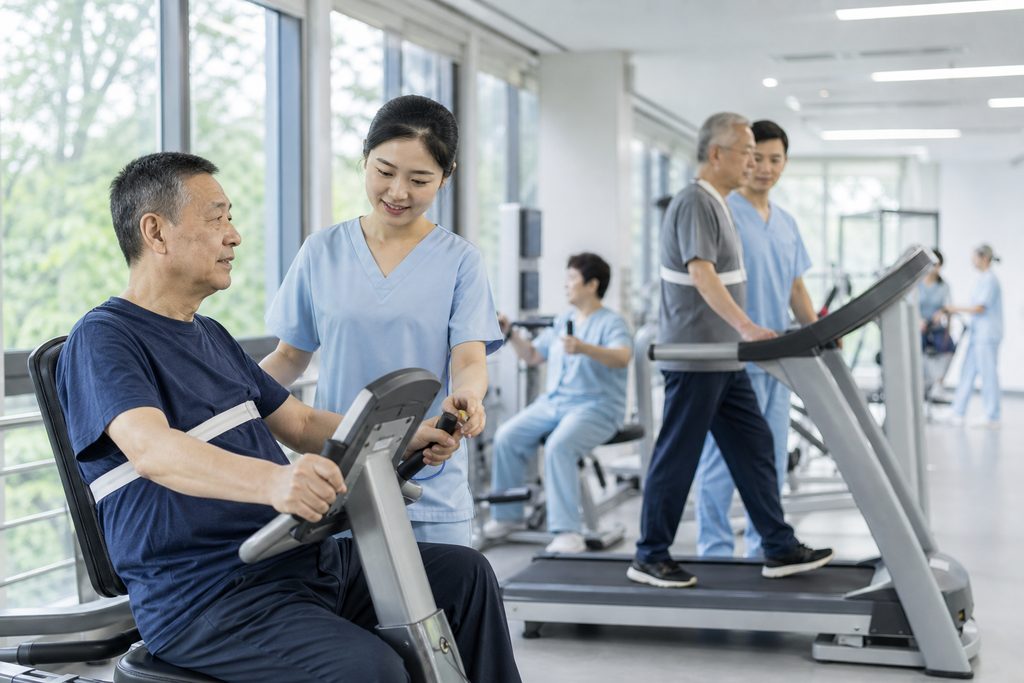
Then you move to the exercise area. At well-equipped centers, you will see treadmills, stationary bikes, rowing machines, and sometimes a six-minute walk test corridor. You are fitted with a telemetry transmitter — either a chest strap or adhesive electrodes — that feeds your ECG to a central monitor watched by a nurse or technician. Your target heart rate zone is calculated from your baseline exercise test, typically 50–70% of your heart rate reserve in the first weeks, progressing to 70–85% as you adapt.
A session usually includes 20 to 30 minutes of aerobic exercise, 10 to 15 minutes of light resistance training with bands or small weights, and 5 to 10 minutes of cool-down and stretching. Blood pressure is rechecked immediately after exercise and again after 5 minutes of rest. The whole visit takes 60 to 90 minutes.
At some hospitals, you may also receive a brief session with a dietitian or a psychologist as part of the program — though this is more common in the international departments than in standard public programs. Traditional Chinese medicine elements, such as tai chi or qigong, are increasingly integrated into maintenance-phase programs at hospitals with TCM departments. You can explore those options through our TCM hospital listings.
Is Cardiac Rehabilitation Effective in China? What the Data Shows
China’s cardiac rehab infrastructure is newer than Europe’s or North America’s, but it is expanding fast. The Chinese Society of Cardiology issued formal cardiac rehabilitation guidelines in 2018, and the number of accredited rehab centers has grown from fewer than 10 in 2012 to over 300 by 2023. Fuwai Hospital in Beijing runs one of the largest programs in the country, with published outcomes showing improvements in peak oxygen uptake and quality-of-life scores comparable to Western benchmarks.
So is cardiac rehabilitation effective in China? The short answer is yes — at centers that follow the structured, monitored model. A 2021 study in the Chinese Medical Journal followed 412 post-PCI patients through a 12-week rehab program at a major Shanghai hospital and reported a 31% reduction in major adverse cardiovascular events at one year compared to a matched control group. The effect size mirrors international data. The gap is not in efficacy but in referral rates: only about 20–30% of eligible Chinese patients are referred to rehab, compared to 40–50% in some European countries. If you proactively seek it out, you will get a program that works.
Cardiac Rehab Cost China: What You Actually Pay
Let’s get specific about money. The headline figure — $15 to $45 per session — applies to standard outpatient cardiac rehab at top-tier public hospitals. What drives the variance?
- Hospital tier and city: A program at a provincial hospital in Chengdu or Wuhan will sit at the low end. The same program at Fuwai or Zhongshan in Shanghai runs higher. Private international hospitals in Beijing or Shanghai charge $100 to $200 per session.
- Session type: Exercise-only sessions cost less. Sessions with physician consultation, psychological counseling, or dietitian reviews cost more. An initial comprehensive assessment — including a cardiopulmonary exercise test — may run $100 to $300 as a one-time fee.
- Department type: The standard public department is cheapest. The international/VIP department of the same hospital charges roughly 1.5 to 2 times more, which buys English-speaking staff, shorter wait times, and a private consultation room.
- Program length: A 12-session program costs less in total than a 36-session program, obviously. But longer programs produce better outcomes. Most cardiologists in China recommend at least 24 sessions.
What is not included: medications, follow-up echocardiograms or stress tests, transportation, accommodation, and any interpreter services if you are not using an English-speaking department. If you are coming from abroad, factor in the S2 visa application, flights, and lodging. For a 6-week rehab stay in Beijing with modest accommodation, budget $3,000 to $6,000 all-inclusive beyond the medical fees.
How Does Cardiac Rehab Work After Stent Placement?
Stent patients have a specific question: how does cardiac rehab work after stent placement? The answer matters because stenting is the most common cardiac procedure in China — over 1 million PCI procedures are performed annually, according to the National Center for Cardiovascular Diseases.
After a stent, rehab typically starts within 24 to 48 hours while you are still in the hospital. Phase 1 is simple: sitting up, walking to the bathroom, short hallway walks with a nurse. The goal is to prevent deconditioning and blood clots, not to build fitness. You are discharged with a medication regimen — dual antiplatelet therapy (aspirin plus clopidogrel or ticagrelor) is non-negotiable for at least 6 to 12 months — and instructions for Phase 2.
Phase 2 outpatient rehab usually begins 1 to 2 weeks after discharge for uncomplicated stent cases. The exercise prescription is conservative at first: 15 to 20 minutes of walking or cycling at 40–50% of heart rate reserve, with telemetry monitoring. Over 8 to 12 weeks, intensity and duration increase. The specific concern after stenting is stent thrombosis — a clot forming inside the stent — which is why antiplatelet adherence is checked at every session and any chest pain during exercise triggers immediate ECG review and physician consultation.
One thing to know: Chinese cardiologists are often more conservative about exercise intensity in the first month after stenting than their Western counterparts. Expect a slower progression. That is not a weakness — it is a cultural difference in risk tolerance, and it means you are unlikely to be pushed too hard too fast.
Best Cardiac Rehabilitation Hospital Beijing: Where to Look
If you are searching for the best cardiac rehabilitation hospital Beijing has to offer, start with the obvious name: Fuwai Hospital. It is the world’s highest-volume cardiac surgery center, performing over 14,000 cardiac operations annually, and its rehab department is one of the oldest and largest in China. Fuwai operates a dedicated cardiac rehabilitation center with full telemetry monitoring, cardiopulmonary exercise testing, and a multidisciplinary team. It is part of the Chinese Academy of Medical Sciences and consistently ranks in the top tier of the Fudan hospital rankings for cardiac surgery and cardiology.
Other strong options in Beijing include Peking Union Medical College Hospital (PUMCH), which runs a well-regarded cardiac rehab program through its international medical services department, and Beijing Anzhen Hospital, another high-volume cardiac center. For a full list of top-ranked cardiac departments across China, see our specialty department rankings — the cardiac surgery and cardiology pages list hospitals by Fudan specialty reputation, which is a more useful signal than general hospital prestige.
If Shanghai is your base, Zhongshan Hospital affiliated with Fudan University runs a comprehensive cardiac rehab program, and Ruijin Hospital has integrated cardiac rehab into its post-PCI care pathway. To book a cardiac rehab program Shanghai patients typically go through the hospital’s international medical department or a local coordinator, since standard public departments rarely accept walk-in foreign patients without Chinese-language support.
Practical Considerations: Records, Visas, and Follow-Up
Coming to China for cardiac rehab requires more paperwork than a typical medical consultation. Here is what actually matters.
Medical records: You need your discharge summary, the operative or procedure report, your most recent echocardiogram, any stress test results, and a complete medication list. These should be translated into Chinese if you are using a standard public department; international departments can usually work from English originals. Bring digital and paper copies.
Visa: Medical treatment in China falls under the S2 visa category, which covers short-term private affairs including medical treatment. Your accompanying family member also applies for an S2. You will need an invitation letter or supporting documents from the hospital confirming your treatment arrangement. The S2 is typically issued for 30 to 90 days and can sometimes be extended within China. We cover this in more detail in our general guide to planning medical travel to China.
Payment: Chinese public hospitals require prepayment — you load a deposit onto your hospital card and fees are deducted per visit. International departments and private hospitals may accept major credit cards or direct insurance billing. Standard public departments are cash or Chinese mobile payment only; if you do not have Alipay or WeChat Pay set up, a bilingual companion can handle payments for you.
Follow-up after returning home: Before you leave China, ask the rehab team for a written summary of your exercise prescription, your achieved workload, and recommendations for continuing rehab at home. This document is what your home cardiologist or physiotherapist will use to continue your program. Without it, you lose much of the value of having done rehab abroad.
Frequently Asked Questions
Yes. Chinese cardiac rehab departments routinely accept patients who had their procedure elsewhere. You will need your full medical records and a referral or clearance letter from your treating cardiologist. The rehab team in China will do their own baseline assessment — usually a cardiopulmonary exercise test or a six-minute walk test — before writing your exercise prescription. Plan for a 1 to 2 week gap between arrival and your first exercise session to allow for assessment and scheduling.
What does a full cardiac rehab program cost in China, all-inclusive?
For a standard public hospital program of 24 sessions, expect $360 to $1,080 in medical fees. Add the initial assessment at $100 to $300. If you use an international department, the same program runs $1,440 to $2,880. Medications, accommodation, and travel are separate. A realistic total budget for a 6-week stay in Beijing or Shanghai, including modest
For more medical information and treatment options in China, visit chinamedservices.com (China Medical Services).
