Cerebral Palsy Rehabilitation in China: Multidisciplinary Care for Children and Adults
Key Takeaways
- Cerebral palsy rehabilitation in China combines intensive therapy models with multidisciplinary teams at a cost typically 60-80% lower than equivalent private programs in the US or UK.
- Top-tier Chinese rehabilitation hospitals handle thousands of CP cases annually, building deep institutional expertise in both pediatric and adult motor recovery.
- Navigating the system independently is extremely difficult: language barriers, visa requirements, and the sheer scale of Chinese hospitals make a bilingual coordinator essential.
- Realistic expectations matter. No program can guarantee functional gains, but China’s volume-driven model offers concentrated therapy hours that are often financially out of reach elsewhere.
The Problem: When Therapy at Home Hits a Wall
Parents of a child with cerebral palsy hear a familiar refrain: keep up the therapy, stay consistent, progress takes time. But after years of one or two sessions per week, the plateau arrives. It is devastating. A 2022 systematic review in Developmental Medicine & Child Neurology confirmed what families already feel in their bones — conventional low-intensity therapy schedules often fail to produce meaningful functional gains beyond a certain point. The research pointed toward intensity as the missing variable. More hours. More repetition. More neuroplasticity-driving practice. But that model is brutally expensive in Western healthcare systems. A three-week intensive program in the United States can run $15,000 to $30,000 out of pocket. For adults living with CP, the situation is worse. They are largely abandoned by pediatric-focused systems, left with generic physical therapy that never addresses the specific spasticity patterns, joint degradation, and fatigue cycles that define aging with cerebral palsy. Some families start looking abroad. They search for options. They find themselves typing queries about multidisciplinary rehab for cerebral palsy in Beijing into a search bar late at night, wondering if what they are reading is real.
Who We Are
We are not a hospital. We do not provide medical treatment or make clinical recommendations. Our team functions as your logistical architects — we bridge the gap between you and China’s top-tier rehabilitation hospitals. We maintain relationships with 340+ top-ranked hospitals across 37 cities, including the rehabilitation departments consistently ranked among China’s best. When you contact us, we assess your needs, match you with appropriate hospital departments, coordinate appointments, arrange bilingual medical companions, and handle the visa guidance that makes treatment in China possible. We do not promise outcomes. We promise access, translation, and honest navigation through a system that is otherwise impenetrable for international patients.
Why Cerebral Palsy Rehabilitation in China Delivers Results
Volume-Driven Clinical Expertise
China’s rehabilitation hospitals operate at a scale that is difficult to visualize until you see it. The rehabilitation medicine department at a major Beijing hospital might treat over 2,000 cerebral palsy inpatients and outpatients annually. That is more CP-specific caseload than many entire regional rehabilitation networks in Europe. This volume matters. It means the physical therapists have seen your child’s specific gait pattern hundreds of times. It means the occupational therapists have problem-solved for hand contractures in ways that only come from repetition. When families search for the best multidisciplinary rehab for cerebral palsy in Beijing, they are not just looking for equipment or facilities. They are looking for clinical intuition built on volume. Chinese rehabilitation teams deliver exactly that. The therapists are not guessing. They have treated thousands of cases. For adult patients wondering how effective is cerebral palsy rehab in China for adults, the answer lies partly in this same volume. Chinese rehab departments routinely treat adults with CP — not as an afterthought, but as a distinct patient population with specific needs around spasticity management, degenerative joint changes, and functional decline prevention.
Intensive Therapy Models That Are Financially Accessible
The structural economics of Chinese healthcare create an opportunity that does not exist in most Western systems. A day of intensive multidisciplinary therapy — combining physical therapy, occupational therapy, and acupuncture or massage therapy — might cost $150 to $300 in a top Chinese rehabilitation hospital. The equivalent day in a US private rehab setting could easily exceed $1,200. This is not because Chinese therapy is lower quality. It is because labor costs, hospital operational structures, and the overall healthcare economy function differently. A three-week intensive program with four to five hours of daily therapy might total $4,000 to $7,000 in China. That same program structure in the United States would be financially catastrophic for most families. The cerebral palsy rehabilitation cost China offers is not cheap by local standards. But measured against international private-pay options, it fundamentally changes what is possible. Families who could afford two weeks of intensive therapy at home can afford six to eight weeks in China. That volume of therapy hours is what drives neuroplastic change.
Multidisciplinary Integration Under One Roof
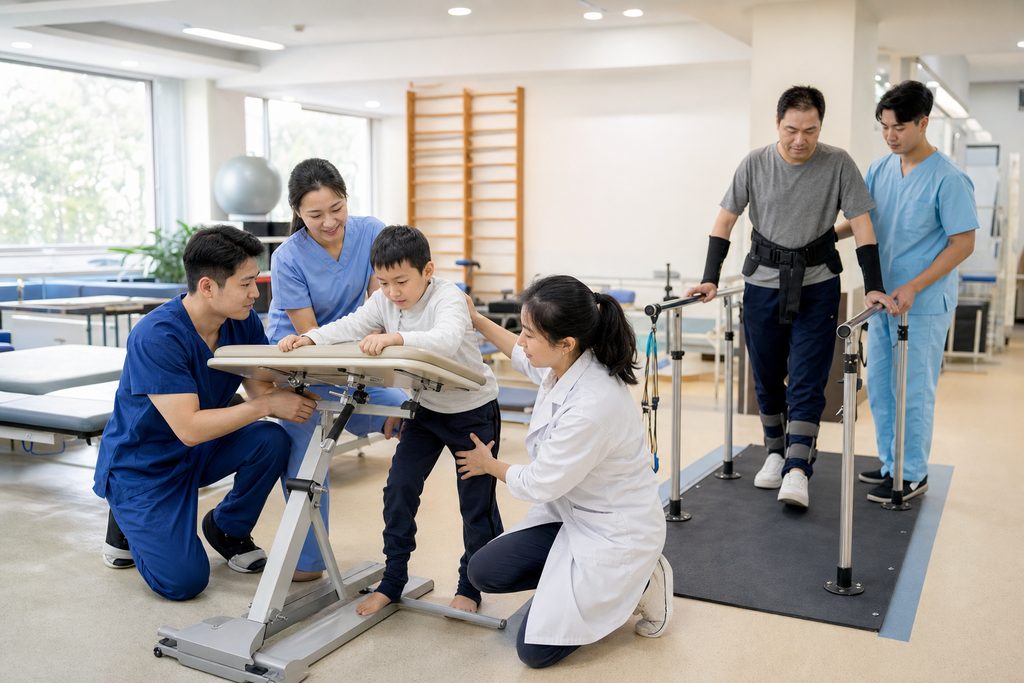
In many Western systems, multidisciplinary care means the patient travels between facilities. The physiotherapist is at one clinic. The occupational therapist is across town. The orthotist is somewhere else entirely. The neurologist overseeing spasticity management might be in a different hospital system. Communication between these providers is often limited to referral letters and occasional phone calls. Chinese rehabilitation hospitals operate differently. The rehabilitation physician, physical therapists, occupational therapists, speech therapists, traditional Chinese medicine practitioners, and orthotics specialists all work within the same department. They hold joint case conferences. They observe each other’s sessions. When a physical therapist notices that a child’s ankle-foot orthosis is not controlling tone effectively during gait training, the orthotist is often on the same floor. The adjustment happens the same day. This integrated model is particularly significant for medical tourism packages cerebral palsy rehab Shanghai, where international patients have limited time and need maximum therapeutic efficiency. Every day spent waiting for a specialist appointment is a day of therapy lost. The integrated structure eliminates that waste.
What You Need to Know Before Going Alone
We are direct about this because families deserve honesty: attempting to arrange cerebral palsy rehabilitation in China independently is extraordinarily difficult. The barriers are structural, not superficial. They will consume your time, drain your energy, and may result in arriving at a hospital that cannot actually help you.
- Visa Requirements Are Specific and Unforgiving: Medical treatment in China requires an S2 visa with the specific purpose of medical treatment noted. This is not a tourist visa. It is not a business visa. The documentation required includes an invitation letter from the treating hospital, proof of appointment, and medical records. Hospitals do not issue these invitation letters to patients who simply email them. You need an established relationship and a coordinator who understands the process. Getting this wrong means being denied at the consulate or turned away at the border.
- Public Hospital Registration Is a Gauntlet: Top Chinese rehabilitation hospitals operate on a registration system that is not designed for international patients. Specialist appointments release at specific times and fill within minutes. The registration platforms are in Chinese. Payment systems require Chinese bank cards or local payment apps. Even if you somehow secure an appointment, you arrive to find a hospital campus the size of a small town, with signage entirely in Chinese characters and thousands of patients moving through the system simultaneously. Without a bilingual companion, you will be lost within five minutes.
- Clinical Communication Determines Outcomes: Rehabilitation is relational. Your child’s therapist needs to understand their history, their previous interventions, their specific functional goals, and their pain patterns. That communication cannot happen through a translation app. It requires a medical interpreter who understands rehabilitation terminology, who can translate nuance, and who can advocate for your family’s priorities during fast-moving clinical encounters. The hospital will not provide this person. You must bring them.
How We Help You Navigate This
These barriers exist for real reasons. Chinese public hospitals serve a domestic population of 1.4 billion people. They were not built with international patient intake in mind. That is where we operate. We are the layer between you and the system.
Before you travel, we translate and organize your medical records into the format Chinese rehabilitation physicians expect. We identify the appropriate hospital department — not just any rehabilitation department, but the specific team with the most relevant experience for your child’s or your own CP subtype. We coordinate the appointment, secure the invitation letter for your S2 visa, and provide detailed guidance on documentation requirements. We do not process the visa for you, but we make sure you have exactly what the consulate needs.
During treatment, a bilingual medical companion is with you for every clinical encounter. This person handles registration, payment, navigation through the hospital, and — most critically — interpretation between you and the rehabilitation team. They ensure that the physiatrist understands your concerns about spasticity triggers. They make sure the physical therapist knows which functional goals matter most to your family. They translate the home exercise program into something you can actually follow when you return home. Our companion services start from $200 per day, with full-day and half-day options depending on the intensity of your scheduled therapy.
After you return home, we can coordinate follow-up video consultations with your Chinese rehabilitation team. These sessions, ranging from $100 to $300 for standard consultations, allow the therapists who know your case to assess progress, adjust home programs, and answer questions that inevitably arise once you are back in your own environment. For families who later decide to return for another intensive block, any consultation fees paid within the previous 90 days are credited in full toward the on-the-ground coordination service for that subsequent visit.
Frequently Asked Questions
Safety in pediatric rehabilitation depends on clinical standards, therapist training, and facility protocols — not geography. The top-ranked Chinese rehabilitation hospitals we work with maintain rigorous clinical standards, employ therapists with formal university training in rehabilitation medicine, and operate within hospital systems subject to national quality control frameworks. The rehabilitation techniques used — neurodevelopmental treatment, constraint-induced movement therapy, task-specific training — are the same evidence-based approaches used internationally. What differs is intensity and integration. That said, families should understand that inpatient rehabilitation in a Chinese public hospital is not a hotel experience. The wards are functional, not luxurious. The food is Chinese hospital food. The environment is busy. If your child has complex medical comorbidities beyond motor impairment, we help you select a hospital with appropriate pediatric subspecialty coverage. Safety is not a binary question. It is about matching the patient’s specific needs to the right clinical environment.
The cerebral palsy rehabilitation cost China programs charge varies significantly by hospital tier, program intensity, and duration. A day of outpatient multidisciplinary therapy at a top public rehabilitation hospital typically ranges from $150 to $300. Inpatient intensive programs, which include therapy sessions, accommodation in a standard ward, and nursing care, might run $3,000 to $6,000 per week. A three-week intensive inpatient program totals roughly $9,000 to $18,000. These figures cover the hospital charges. They do not include our coordination and companion services, international flights, visas, or off-campus accommodation if you prefer to stay outside the hospital. Compared to equivalent private-pay programs in the United States, which can exceed $30,000 for three weeks, the differential is substantial. But this is not cheap care. It is structurally less expensive care delivered within a different healthcare economy. We always advise families to budget for the full cost including our services, travel, and a contingency margin. No one should stretch their finances to the breaking point for medical travel.
Adult cerebral palsy rehabilitation is neglected globally. Most CP research and clinical programming focuses on children, and adults with CP frequently report being discharged from pediatric services into a void. Chinese rehabilitation departments are not immune to this pattern, but the top centers do treat adults with CP as a distinct clinical population. The effectiveness question turns on goals. An intensive therapy block will not reverse decades of contracture or undo fixed orthopedic deformities. What it can do — and what adult patients report — is improve functional mobility, reduce pain associated with spasticity and compensation patterns, and provide a structured home program that slows functional decline. Some adult patients pursue intensive therapy in China specifically to prepare for or recover from orthopedic surgery. Others come because they have never had access to concentrated, CP-specific therapy and want to see what is possible. The results depend on baseline function, therapy intensity, and follow-through at home. We have seen adults make meaningful gains in gait efficiency and upper extremity function. We have also seen patients whose primary benefit was a clearer understanding of their own body and a realistic maintenance plan. Both are legitimate outcomes.
You can try. The reality is that top Chinese rehabilitation hospitals do not have international patient offices that handle direct inquiries for rehabilitation services. Their international departments are structured around high-revenue surgical specialties — oncology, cardiac surgery, orthopedics. Rehabilitation, despite its clinical importance, does not generate the same revenue per case and is not prioritized for direct international patient intake. Emails to general hospital addresses about booking intensive cerebral palsy therapy abroad China will typically go unanswered. If you do reach someone, the conversation will be in Chinese, and they will ask you to appear in person for registration. They will not reserve a therapy slot for you. They will not issue a visa invitation letter based on an email inquiry. This is not obstruction. It is the reality of a system serving a massive domestic population. Our service exists specifically because this gap between international patient needs and hospital operational reality is so wide. We bridge it through established relationships and on-the-ground coordination.
Your Next Step
Cerebral palsy rehabilitation in China is not a miracle. It is an opportunity — an opportunity to access concentrated, multidisciplinary therapy at a volume that changes what neuroplasticity can achieve. The hospitals exist. The clinical expertise is real. The cost structure makes intensive therapy financially possible for families who have been priced out of equivalent programs at home. What stands between you and that opportunity is logistics. Visas. Language. Hospital navigation. Clinical communication. That is what we handle. If you want to understand whether this path makes sense for your specific situation — for your child or for yourself — reach out for a consultation. We will be direct about what is possible and what is not. No promises about outcomes. Just honest navigation from people who know the territory.
Learn more about how we coordinate care at our patient services page, or explore our directory of top-ranked Chinese hospitals to understand the caliber of institutions we work with.
For more medical information and treatment options in China, visit chinamedservices.com (China Medical Services).
