Surgery in China with Kids: A Practical Guide to Arranging Child Care During Your Trip
How This Actually Works, Step by Step
You have made the decision. The hospital in Shanghai or Beijing is confirmed. The surgery date is approaching. And then the question hits at 2 a.m.: what do we do with our three-year-old while I am under anesthesia?
This is not a small logistical detail. It is the detail that keeps parents awake. Our team has coordinated care for hundreds of international families traveling to China for treatment. The child care puzzle is one we solve early in every conversation. Not as an afterthought. As a core part of the planning.
The sequence usually goes like this. First, we establish your clinical timeline. How many days of pre-operative testing? How many nights in the hospital? What does the surgeon say about the first week of recovery at the hotel? Those numbers shape everything else.
Second, we map the child care gaps. A spouse or partner can handle a lot. But they cannot be in two places at once. When you are in the operating room for six hours, someone needs to be with the kids. When your partner needs to speak with the discharge nurse, someone needs to be with the kids. The gaps are specific and predictable.
Third, we match the solution to the gap. A full-time nanny for ten days? A bilingual sitter for the surgery day only? A hotel with a licensed kids’ club and vetted staff? The answer depends on the ages of your children, the length of your stay, and your comfort level with local caregivers.
None of this is theoretical. It is a checklist we have run many times. The goal is simple. You focus on your procedure and recovery. Your children are safe and engaged. Your partner is supported, not stretched to breaking point.
Can I Bring My Child to China for Surgery? The Honest Answer
Yes. But the question behind the question is usually different. What parents really want to know is: will bringing my child turn an already stressful medical trip into chaos?
The answer depends almost entirely on preparation. We have seen families arrive with a six-month-old and a detailed care plan. The trip went smoothly. The parent recovered. The baby was fine. We have also seen families assume they would “figure it out on arrival.” That did not go smoothly.
China’s major medical cities are not inherently child-unfriendly. Shanghai has world-class playgrounds. Beijing has massive parks. Guangzhou has family-friendly hotels that rival anything in Singapore. But the infrastructure is not the issue. The issue is that you are traveling for surgery, not for vacation. Your energy will be limited. Your mobility may be restricted. Your partner will be managing your care and the children simultaneously.
That is the honest starting point. Bringing children adds complexity. Complexity that can be managed. But only if you acknowledge it upfront and build a support structure around it.
Some families choose to leave young children at home with grandparents. That is often the simpler path. But for families who do not have that option, or for whom separation would cause more distress than the trip itself, bringing the children is workable. You just need a different kind of plan.
Medical Tourism with Kids China Packages: What Actually Exists
Let us be direct. There is no pre-packaged “surgery plus nanny plus playground tour” product that you can book with a single click. Not one that we would trust. The families we work with have different ages of children, different procedure types, different recovery trajectories. A one-size-fits-all package would be a disservice.
What does exist is a modular support system. You can assemble the pieces you need.
The core components typically include a vetted bilingual nanny, a family-suitable serviced apartment or hotel, and a hospital that allows children in private recovery rooms. Some families add a driver for the duration. Some add a second caregiver for overnight shifts. Some need nothing more than a trusted babysitter for the surgery day itself.
The cost of medical tourism with kids China packages varies sharply by city and by the level of support. A full-time Mandarin-English nanny in Shanghai might run from $200 per day. A qualified sitter for a single eight-hour surgery day is obviously less. A serviced apartment in a central district with a kitchen and separate bedroom is often comparable to a good hotel, but the ability to cook simple meals for a picky toddler changes the entire experience.
We build these support structures case by case. The family tells us the ages of the children, the expected hospital stay, and the level of help they want. We propose a configuration. We adjust based on feedback. There is no package. There is a process.
Nanny Service for Hospital Stay China: Vetting, Language, and Trust
Leaving your child with a stranger in a foreign country is not a small ask. We understand that. The nanny service for hospital stay China that we coordinate is not a casual referral. It is a vetted placement with specific criteria.
We look for caregivers who speak functional English. Not fluent necessarily, but enough to understand a child’s basic needs and communicate with the parent. We prioritize nannies with experience in cross-cultural households. Many have worked for expatriate families in Shanghai or Beijing. They understand that a Western child’s routine, food preferences, and discipline norms may differ from local norms.
Background checks are standard. References are checked. We arrange a video call before you travel so you can meet the nanny, see her face, and ask your questions. If the chemistry is not right, we find someone else.
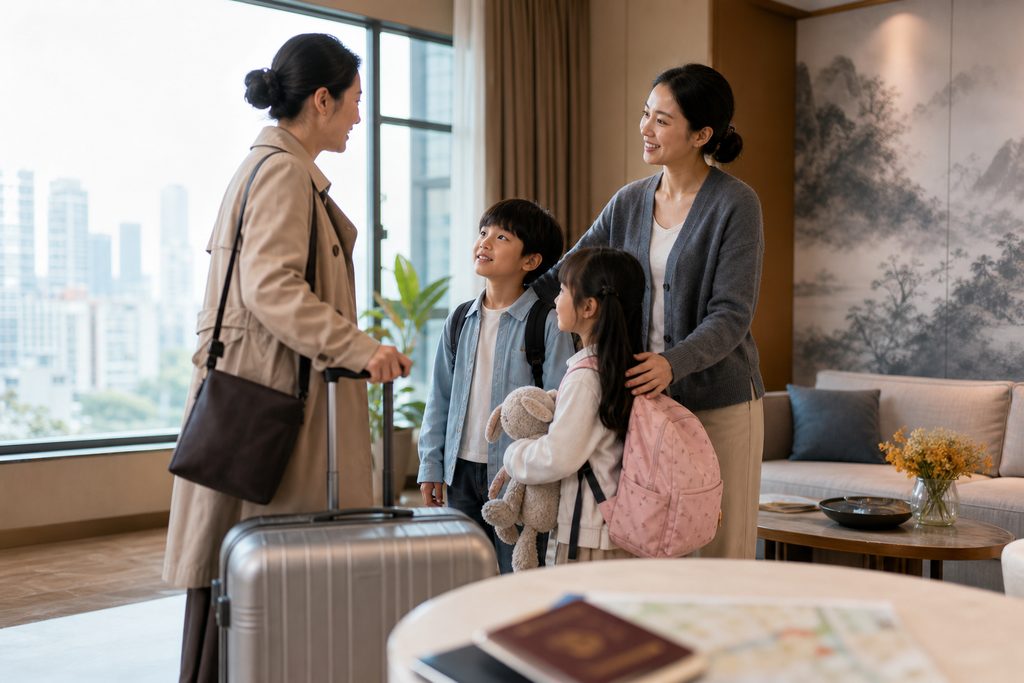
A typical arrangement during a hospital stay works like this. The nanny arrives at the hotel or serviced apartment in the morning. She stays with the children while the partner goes to the hospital. She handles meals, nap times, and activities. She can take the children to a nearby park if that is agreed. She communicates with the parent via WeChat throughout the day, sending photos and updates. When the partner returns in the evening, the nanny leaves. Overnight care is a separate arrangement if needed.
The cost for a full-day bilingual nanny starts from $200. Half-day options exist for lighter needs. The investment is not trivial. But measured against the cost of a surgical complication caused by divided attention, or the emotional toll of trying to recover while simultaneously parenting alone in a hotel room, it is often the best money spent on the entire trip.
A Realistic Timeline
| Phase | Duration | What Happens |
|---|---|---|
| Initial consultation | Week 1 | We assess your clinical plan, children’s ages, and care needs. You tell us your non-negotiables. |
| Caregiver search and vetting | Weeks 2–3 | We identify candidates, check references, and arrange video introductions. You interview and select. |
| Visa processing | Weeks 3–6 | S2 visa applications for you, your partner, and each child. Hospital invitation letter required. Processing times vary by embassy. |
| Accommodation booking | Week 4 | Family-friendly serviced apartment or hotel confirmed near the hospital. Kitchen access prioritized for families with young children. |
| Pre-departure briefing | Week 5 | We walk through the day-by-day plan. Who meets you at the airport. Where the nanny will be on surgery day. Emergency contacts. |
| Arrival and settling | Days 1–2 | Airport pickup. Apartment check-in. Nanny meets the children in person. Hospital pre-op tests begin. |
| Surgery day | Day 3–5 | Nanny on duty. Partner at hospital. Communication loop established. |
| Hospital recovery | Days 3–10 | Variable by procedure. Nanny continues daily care. Partner splits time between hospital and children. |
| Hotel recovery | Days 10–20 | You are discharged. Mobility limited. Nanny support may reduce to half-days. Focus shifts to your rest and the children’s routine. |
| Follow-up and departure | Days 20–25 | Final hospital visit. Nanny engagement ends. Airport transfer. Flight home. |
This timeline assumes a procedure with a 3–5 day hospital stay and a two-week local recovery period. More complex surgeries extend the timeline. The nanny commitment can be adjusted week by week. Nothing is locked in before you travel.
What Can Go Wrong — and What Happens Then
Yes. Many families do. The critical factor is having a second adult present. A partner, a grandparent, or a hired caregiver. You will be in no condition to parent during surgery and early recovery. The hospital environment is not set up for unattended children. With a support person in place, the arrangement works. Without one, it is not advisable.
It depends on the hospital and the ward. International departments in major hospitals like those listed on our Shanghai medical services page tend to have more flexible visiting policies. Standard public wards may restrict children, especially during respiratory illness season. We confirm the specific hospital’s policy before you commit. If children cannot visit, the partner visits during nanny shifts, and the family reunites at the hotel in the evening.
International clinics in major cities can handle pediatric urgent care. Facilities like United Family Healthcare and Jiahui International Hospital have English-speaking pediatricians and Western-standard care. We provide a list of vetted clinics near your accommodation before you travel. For serious emergencies, Chinese public hospital emergency departments are equipped to stabilize a child. Language will be a barrier. Our team can provide phone interpretation in a crisis.
For short trips and young children, often yes. The travel is long. The environment is unfamiliar. Your attention will be divided. If you have trusted family caregivers at home, leaving the children in their normal routine is usually the lower-stress option for everyone. For longer trips, or for families who cannot arrange home care, bringing the children with proper support is a reasonable alternative. There is no universal right answer. There is only the honest assessment of your specific family’s needs.
Your Next Step
Planning surgery abroad is a heavy lift. Adding children to the equation
Frequently Asked Questions
Yes. The hospitals used for international patients are JCI-accredited and follow the same international safety standards as top hospitals in the US and Europe. Surgical teams perform high volumes of procedures — often more than their Western counterparts — which studies show leads to better outcomes.
Costs vary by procedure and hospital, but international patients typically save 40-80% compared to US prices — even when factoring in travel and accommodation. A consultation with our team will give you an exact, all-inclusive quote with no hidden fees.
Send us your existing medical reports to get started. We handle everything from hospital selection and appointment scheduling to visa assistance and post-operative recovery planning. Your medical records are reviewed by the specialist before you even book a flight.
For more medical information and treatment options in China, visit chinamedservices.com (China Medical Services).
