Chin Implant in China: Costs, Top Hospitals, and Safety for Foreigners
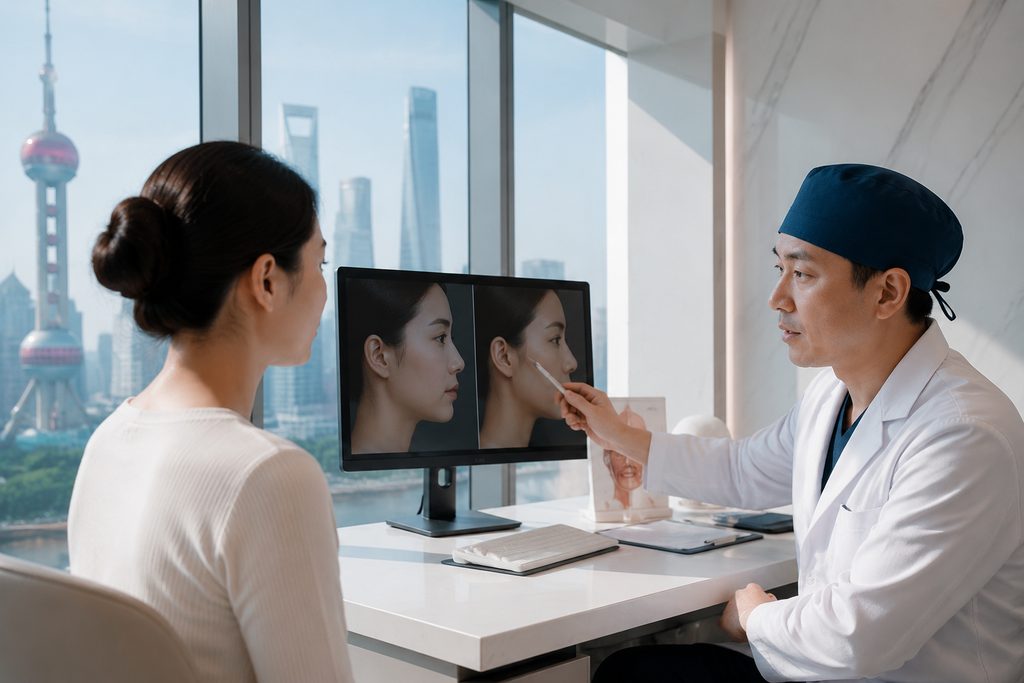
A chin implant — or genioplasty using an implant — is a surgical procedure where a shaped silicone, porous polyethylene, or other biocompatible material is placed over the bone of the chin to improve projection and facial balance. It is one of the most straightforward facial contouring procedures available, typically performed through a small incision inside the mouth or under the chin. For international patients, the chin implant cost China is a primary driver of interest, often running 60-80% below Western pricing for comparable surgical expertise.
Our team at China Medical Services has coordinated facial plastic surgery for patients from the United States, Europe, the Gulf states, and Southeast Asia. We have watched people arrive in Shanghai or Beijing after months of uncertainty, carrying printouts of quotes from home and questions about whether the quality would match. The short answer: yes, if you choose the right hospital. The longer answer requires understanding how the system works.
How This Actually Works, Step by Step
You do not book a chin implant in China the way you book a hotel room. Public hospitals in China operate on a face-to-face consultation model. The surgeon must see you, evaluate your facial structure, and approve the surgical plan before any operation date is set. That means the process starts with documents, not deposits.
Here is the real sequence. First, you send your existing records — photographs from multiple angles, any previous facial X-rays or CT scans, and a brief medical history. Our team translates these into Chinese and submits them to the plastic surgery or maxillofacial department at one or more of the 340+ top-ranked hospitals in our database. A senior surgeon reviews the file and gives a preliminary opinion: whether you are a good candidate, what implant material they would recommend, and a rough cost range. This is the remote evaluation stage.
Second, you choose between a written second opinion, a video consultation, or simply proceeding to travel for an in-person consultation. Many patients start with a video call — it costs $100 to $300 and gives you a direct conversation with the surgical team. You can ask about their experience with your specific facial anatomy, their preferred implant brand, and their revision policy.
Third, if you decide to proceed, we coordinate the in-person visit. You fly to China, attend the face-to-face consultation, and if the surgeon confirms the plan, surgery is typically scheduled within a few days to two weeks, depending on the hospital’s operating room availability. After surgery, you stay for follow-up visits — usually 7 to 10 days for suture removal and initial healing assessment — before flying home.
Chin Implant Cost China: What You Will Actually Pay
The chin implant cost China varies by hospital tier, implant material, and whether you use the standard public channel or the international/VIP department. For foreign patients, the international department is nearly always the right choice. It offers English-speaking coordination, shorter wait times, and senior surgeon access. The tradeoff is cost.
| Cost Item | Public Hospital Standard Department | Public Hospital International Department | Private International Hospital |
|---|---|---|---|
| Surgeon fee | $800 – $1,500 | $1,500 – $3,000 | $2,500 – $5,000 |
| Implant material | $300 – $800 | $500 – $1,200 | $800 – $2,000 |
| Anesthesia & OR | $500 – $1,000 | $800 – $1,500 | $1,200 – $2,500 |
| Hospital stay (1-2 nights) | $200 – $500 | $400 – $800 | $600 – $1,500 |
| Total estimated range | $1,800 – $3,800 | $3,200 – $6,500 | $5,100 – $11,000 |
Compare that to the United States, where a chin implant typically costs $3,000 to $7,000 for the surgeon’s fee alone, with total costs frequently reaching $8,000 to $12,000 when anesthesia and facility fees are included. In the UK, private chin augmentation ranges from £3,500 to £6,000. The savings in China are real, but they are not the whole story.
What drives the chin implant cost China up or down? Implant material matters. Silicone implants are the least expensive and most commonly used. Porous polyethylene (Medpor) costs more but integrates with tissue and has a lower long-term migration risk. Custom 3D-printed implants based on your CT scan are the most expensive option — typically $2,000 to $4,000 for the implant alone — but offer the most precise fit for complex cases or asymmetry.
Hospital tier matters too. A top-ranked plastic surgery department at a Fudan-ranked hospital in Shanghai or Beijing will charge more than a provincial hospital. But for a procedure as visible as a chin implant, the surgeon’s experience with facial harmony is worth the premium. This is your face.
Is Chin Implant Surgery Safe in China? The Honest Answer
The question is chin implant surgery safe in China deserves a direct answer: at top-tier hospitals, yes, with a safety profile comparable to Western centers. The key qualifier is “top-tier.” China’s healthcare system is vast — over 35,000 hospitals — and quality varies enormously. The top 5% of hospitals, ranked by the Fudan University hospital rankings and JCI accreditation, operate at international standards. That is where our database focuses.
Infection rates for chin implants in reputable Chinese hospitals are low, typically reported between 1% and 3%, consistent with global benchmarks. The most common complications are the same as anywhere: implant shifting, asymmetry, nerve numbness in the lower lip (usually temporary), and dissatisfaction with the aesthetic result. The critical safety factor is not the country — it is the specific surgeon and hospital.
But there are real risks specific to medical tourism. If a complication arises after you fly home, your local surgeon may be reluctant to revise another surgeon’s work. Some will refuse entirely. You should have a plan for this before you travel. Ask the Chinese surgeon about their revision policy — many will perform a revision at reduced cost if you return to China, but that means another flight and another recovery period.
One more honest point: language. Outside the international departments, almost no one in a Chinese public hospital speaks English. Even in the international department, nursing staff may have limited English. A bilingual medical companion is not a luxury — it is the difference between knowing what is happening and guessing.
A Realistic Timeline
People underestimate how long the process takes. Here is a realistic breakdown from first inquiry to final result.
| Stage | What Happens | Realistic Duration |
|---|---|---|
| Day 1–3 | You submit photos and records; our team translates and sends to hospital | 2–3 days |
| Week 1–2 | Surgeon review and preliminary opinion; video consultation scheduled | 5–14 days |
| Week 2–4 | You decide; we coordinate in-person consultation date | 1–2 weeks |
| Week 4–6 | S2 visa application with hospital invitation letter | 1–2 weeks (varies by embassy) |
| Week 6 | Travel to China; in-person consultation and pre-op tests | 2–3 days |
| Week 6–7 | Surgery; 1–2 nights in hospital | 1–2 days |
| Week 7–9 | Recovery in China; suture removal; follow-up visit | 7–10 days |
| Month 3 | Final aesthetic result visible; swelling fully resolved | Up to 3 months |
The waiting steps people forget: document translation takes a few days. Hospital appointment lead time for a senior facial plastic surgeon can be two to three weeks. Visa processing depends entirely on your home country’s Chinese embassy or consulate — some process S2 visas in five business days, others take three weeks. And the final aesthetic result of a chin implant is not visible immediately. Swelling obscures the outcome for the first month, and the implant settles into its final position over three to six months.
What Can Go Wrong — and What Happens Then
Let us be blunt about failure modes, because knowing them is how you protect yourself.
The surgeon approves you remotely, but during the in-person consultation, they change the plan. This happens. Facial evaluation from photographs is imperfect. The surgeon may recommend a different implant size, a sliding genioplasty instead of an implant, or combining the chin implant with rhinoplasty for facial balance. If the new plan costs more, you need to decide on the spot. This is not a bait-and-switch — it is the surgeon doing their job. But it means you should budget 20-30% flexibility into your cost expectations.
Infection. It is rare, but it happens. If the implant becomes infected, the treatment is removal, antibiotics, and re-implantation after healing — typically three to six months later. In China, the original surgeon will usually handle this. If you are already home, you face a difficult choice: return to China or find a local surgeon willing to take over. Some patients end up paying twice.
Aesthetic dissatisfaction. The implant looks too large, too small, or asymmetric. Revision surgery may be needed. The surgeon’s revision policy matters enormously here — ask before you book whether revision fees are waived or reduced within a certain window, and what the window is.
The surgeon cancels or reschedules. Top Chinese surgeons have busy schedules. A hospital emergency can bump your surgery. This is why we recommend building at least one week of buffer into your trip. If your surgery is delayed by five days, you should not be rebooking an international flight in a panic.
How to Choose a Surgeon: Best Chin Implant Surgeon Shanghai and Beyond
Searching for the best chin implant surgeon Shanghai is a natural instinct, but the question is framed wrong. China does not publish individual surgeon rankings for cosmetic procedures. What exists is the Fudan University hospital ranking, which evaluates entire departments. The plastic surgery and maxillofacial surgery departments at hospitals like Shanghai Ninth People’s Hospital, Peking Union Medical College Hospital, and West China Hospital are consistently ranked among China’s top 10 for their specialties.
So how do you evaluate a specific surgeon? Ask these questions directly during your video consultation: How many chin implants have you performed in the past year? What percentage of your practice is facial contouring versus other procedures? What implant materials do you work with, and why do you prefer one over another? What is your revision rate, and what is your policy if I am unhappy with the result?
A surgeon who answers these questions with specific numbers and clear reasoning is a professional. A surgeon who deflects or gives vague answers is a red flag. Also ask about their experience with non-Chinese facial anatomy. A surgeon who works primarily with East Asian patients may have a different aesthetic eye than one who regularly treats Western patients. Facial harmony standards differ across ethnicities, and you want a surgeon who understands your face, not a template.
For patients weighing how much is a chin implant in Beijing versus Shanghai, the price difference is usually modest — within a few hundred dollars. The bigger variable is surgeon availability and hospital reputation in facial contouring. Shanghai’s Ninth People’s Hospital has one of the highest-volume craniofacial and plastic surgery departments in the world. Beijing’s Peking Union Medical College Hospital offers a different strength: multidisciplinary coordination and a long history of treating complex cases. Both are excellent choices for different reasons.
Practical Considerations: Records, Visa, Payment, and Follow-Up
At top-ranked hospitals with international departments, the safety profile is comparable to Western centers. The risks are the same as anywhere — infection, implant shifting, asymmetry, and aesthetic dissatisfaction. The additional risk for foreign patients is distance: if a complication arises after you return home, follow-up care requires either another trip to China or finding a local surgeon willing to manage another surgeon’s work.
Prices are broadly similar, typically within a few hundred dollars of each other for the same hospital tier. Expect to pay roughly $3,200 to $6,500 through an international department in either city. The more important variable is surgeon experience and hospital reputation in facial contouring, which varies more than price.
It is a structured process, not a holiday with a surgery attached. You will spend 10 to 14 days in China, most of it recovering in a hotel room. The first few days after surgery involve swelling, a soft food diet, and limited activity. You will not be sightseeing. Patients who treat it as a medical trip with realistic expectations are consistently happier with the outcome than those who expect a vacation.
Revision is possible, but it means another surgery, another recovery, and more cost. Ask your surgeon about their revision policy before you book — some offer reduced-fee revisions within a certain window, while others charge full price. Also understand that the final result is not visible for three to six months. Swelling can make the implant look too large or asymmetric in the early weeks, and many apparent problems resolve on their own.
Your Next Step
A chin implant in China can be a smart financial decision if you choose the right hospital and surgeon. The savings are real, the surgical expertise at top centers is genuine, and the process is navigable with proper planning. But this is not a procedure to book impulsively from a website.
Our team at China Medical Services helps international patients evaluate their options, connect with top-ranked facial plastic surgery departments, and coordinate the logistics of travel, visa, and in-country care. We do not perform surgery and we do not promise outcomes. We do help you get clear answers from qualified surgeons before you commit. If you would like a preliminary evaluation of your case, contact us for a free consultation — we will review your photos, recommend suitable hospitals, and outline the realistic costs for your specific situation.
Frequently Asked Questions
Yes. The hospitals used for international patients are JCI-accredited and follow the same international safety standards as top hospitals in the US and Europe. Surgical teams perform high volumes of procedures — often more than their Western counterparts — which studies show leads to better outcomes.
Costs vary by procedure and hospital, but international patients typically save 40-80% compared to US prices — even when factoring in travel and accommodation. A consultation with our team will give you an exact, all-inclusive quote with no hidden fees.
Send us your existing medical reports to get started. We handle everything from hospital selection and appointment scheduling to visa assistance and post-operative recovery planning. Your medical records are reviewed by the specialist before you even book a flight.
For more medical information and treatment options in China, visit chinamedservices.com (China Medical Services).
