China Health Checkup Guide: Honest Costs, Safety & Top Hospitals for Foreigners
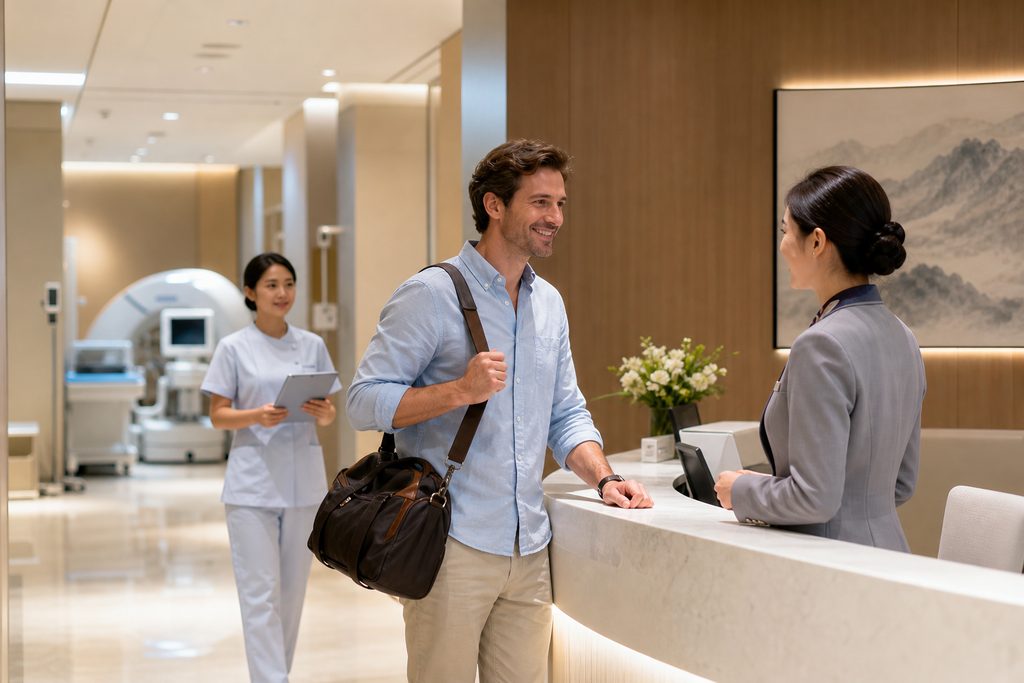
When 54-year-old Daniel from Manchester started pricing executive physicals in London, the quote stopped him cold: £2,400 for a package that felt more like a box-ticking exercise than real diagnostics. He started searching alternatives. That search led him to ask the question we hear constantly: should I go to China for a health checkup? The short answer is yes for many people — if you understand what you’re getting. A full body health checkup cost China typically runs $300 to $1,500 depending on hospital tier and package depth, compared with $2,000 to $5,000 for comparable executive screenings in the US or UK. The equipment is often newer than what you’d find in many Western facilities. The pace is faster. But the experience is different, and not everyone adapts well to how Chinese hospitals operate.
We’ve spent years helping international patients navigate Chinese healthcare. This guide is our honest assessment — what works, what doesn’t, and how to decide if it’s right for you. No sugarcoating.
Should I Go to China for a Health Checkup: The Short Answer
For most healthy adults wanting comprehensive screening at a fraction of Western prices, yes — with conditions. The imaging technology at top-tier Chinese hospitals is genuinely world-class. A cardiac CT that costs $1,800 in Boston might cost $350 in Shanghai. The radiologists reading your scans handle volumes most Western specialists never see. Fuwai Hospital in Beijing performs over 14,000 cardiac surgeries annually — the highest volume globally. That repetition breeds diagnostic sharpness.
But here’s the caveat that complicates the one-liner: the standard outpatient experience at a Chinese public hospital is not designed for foreigners. Registration is in Mandarin. Queues move fast and assume you know where to go. Signage varies. If you don’t speak Chinese and don’t have someone helping you, a “simple” checkup can become a full-day maze. That’s precisely why bilingual coordination services exist — and why many international patients choose private international hospitals instead, accepting higher prices for English-speaking staff and Western-style workflows.
Who This Is Right For — and Who It Isn’t
Let’s be direct about fit. Some people thrive in this environment. Others shouldn’t attempt it.
Good candidates include:
- Healthy adults wanting comprehensive screening without insurance deductibles eating the budget
- People with specific concerns — cardiac calcium scoring, liver health, cancer markers — who want advanced imaging at lower cost
- Expats already living in China or frequent business travelers who can combine a checkup with an existing trip
- Patients who’ve been told “everything looks fine” but want a second set of eyes on their imaging
- Anyone comfortable with a fast-paced, efficiency-first clinical environment
Who should not pursue this:
- People with unstable chronic conditions requiring immediate, ongoing specialist management
- Anyone who needs a diagnosis to resolve an active, severe symptom — a screening checkup is not emergency care
- Travelers with significant mobility limitations who can’t manage large hospital campuses
- People who expect the exact same bedside manner and appointment pacing as a Western private clinic
- Those unwilling to handle visa paperwork, flight logistics, and post-visit follow-up coordination
Being honest about who shouldn’t come is what makes the rest of this guide trustworthy. If you’re in the “shouldn’t” column, stay home. If you’re in the first list, keep reading.
The Options, Compared
Not all checkup experiences in China are the same. The tier you choose changes everything — cost, language support, pace, and what the results actually mean when you get home. Here’s the realistic comparison:
| Factor | Public Top-Tier Hospital | Hospital International/VIP Department | Private International Hospital |
|---|---|---|---|
| Full body checkup cost | $300–$800 | $800–$1,500 | $1,000–$2,500 |
| Language support | Mandarin primary; limited English | English-speaking coordinators | Fully English-speaking staff |
| Equipment quality | Excellent, often newest models | Excellent, same equipment | Very good, sometimes slightly older |
| Pace | Fast, crowded, assumes local knowledge | Coordinated, moderate pace | Relaxed, appointment-based |
| Insurance billing | Self-pay, then claim reimbursement | Self-pay, some direct billing | Direct billing with major insurers |
| Radiologist volume | Extremely high | Extremely high | Moderate |
| Best for | Budget-focused, healthy, experienced travelers | First-time visitors wanting quality plus support | Expats, families, those wanting Western comfort |
Which column fits you? If you’re a cost-conscious traveler who doesn’t mind some chaos, the public tier delivers exceptional value. Most first-time international patients, though, find the international department or private hospital tier worth the premium — the language support alone prevents costly misunderstandings. We’ve seen patients misinterpret “fasting required” instructions and waste an entire morning because nobody explained the protocol in English.
What to Actually Expect Inside a Chinese Health Checkup Center
This is the section that answers what nobody tells you before you book. Chinese health screening centers are not like Western clinics. They’re often dedicated floors or entire buildings separate from the main hospital, designed to process hundreds of people daily. You’ll register at a front desk, receive a clipboard or digital queue number, and move station by station: blood draw, ECG, ultrasound, CT, chest X-ray, vision, hearing, body composition. A full body health checkup cost China typically includes all of these in one morning.
The efficiency is remarkable when it works. And disorienting when it doesn’t. Stations are labeled in Chinese. Staff may wave you toward the next room without explanation. If you’re using the public tier without a companion, expect to guess occasionally. If you’re in the international department, a coordinator walks you through each step.
One thing that surprises Western patients: results often come same-day or next-day. A comprehensive report with imaging summaries, lab values, and physician comments might be ready within 24–48 hours. In the US, that same turnaround often takes a week or more. The report will be in Chinese unless you request English translation — another reason the international tier matters.
Full Body Health Checkup Cost China: What Drives the Price
Let’s talk numbers, because this is why most people consider China in the first place. A basic screening package at a top public hospital — blood work, chest X-ray, abdominal ultrasound, ECG — starts around $300. Add cardiac CT, cancer markers, carotid ultrasound, and a gastroenterologist consult, and you’re at $600–$800. The same depth at a private international hospital in Shanghai runs $1,200–$2,000.
Compare with the US. A comprehensive executive physical at a major American medical center — think Mayo Clinic or Cleveland Clinic — costs $3,000–$6,000 for a similar scope, often with a 3–6 month waitlist. The UK private sector isn’t much cheaper than the US for comparable packages. Canada’s public system won’t offer this depth to an asymptomatic person at all. So China’s value proposition is real, but it’s not magic: you’re trading money for logistics, language friction, and travel time.
What’s included matters more than the headline price. Some packages advertise low rates but exclude the radiologist’s written interpretation. Others bundle consultations you don’t need. Always confirm: does the price include physician review of all imaging, or just the technician’s scan? Does it include an English report? Does it include follow-up consultation if something abnormal is found? These details can double the real cost if you’re not careful.
Health screening packages for foreigners Shanghai typically include English-language coordination, which explains the higher price point compared with standard local packages. The premium buys you translation, scheduling, and someone who knows which department handles what — not better medicine.
Is It Safe to Get a Medical Checkup in China?
The safety question deserves a straight answer. The clinical safety — equipment sterility, radiologist competence, lab accuracy — is comparable to any developed country at top-tier hospitals. The 340+ hospitals in our database represent the top 5% of China’s 35,000+ hospitals, ranked by the Fudan University hospital rankings and JCI accreditation. These are not corner clinics. They’re massive academic medical centers with international research partnerships and rigorous internal quality controls.
The practical safety — getting lost, miscommunication, wrong department, missed instructions — is a different matter. That’s where most problems actually occur. A patient who doesn’t understand that they need to remove metal objects before an MRI wastes an hour. Someone who can’t read the pharmacy label takes the wrong prep medication. These aren’t medical errors; they’re navigation errors. They’re avoidable with proper support, but they’re real risks if you go alone with zero Chinese ability.
So: is it safe to get a medical checkup in China? Clinically yes, at the right hospitals. Operationally, only if you either speak Chinese or bring someone who does. That’s the honest answer.
How Much Does an Executive Physical Cost in Beijing?
Beijing pricing runs slightly higher than other Chinese cities, reflecting the concentration of top hospitals. How much does an executive physical cost in Beijing? At Peking Union Medical College Hospital‘s international department, expect $800–$1,500 for a comprehensive package including cardiac CT, full blood panel, abdominal and thyroid ultrasound, and specialist review. At a private facility like Beijing United Family, the same scope runs $1,500–$2,500. Standard public hospital pricing without English support: $400–$700.
Why the spread? Beijing has 21 hospitals on the Fudan Top 100 list — more than any other city. Demand from domestic patients and international visitors keeps prices firm. Shanghai follows with 18 top-ranked hospitals and slightly more competitive international department pricing. If you’re flexible on location, Shanghai’s medical infrastructure often delivers similar quality for 10–20% less than Beijing. Guangzhou, with 10 top-ranked hospitals, can be cheaper still.
To book comprehensive health checkup China services, the process differs from what Western patients expect. You cannot simply call a public hospital’s general line from overseas and reserve a slot. Public hospital checkup centers typically require in-person registration or booking through a local intermediary. International departments accept advance bookings by phone or email, but response times vary. This is where coordination services earn their fee — someone on the ground who knows which office handles foreign patient scheduling and can confirm your slot actually exists before you board a plane.
The best hospitals in China for international patients checkup needs fall into two categories: public hospital international departments (Peking Union, Zhongshan, Ruijin, West China) and JCI-accredited private facilities (United Family, Jiahui, Parkway, Raffles). The former offer the deepest specialist expertise. The latter offer the smoothest experience. Your choice depends on whether you prioritize diagnostic depth or comfort.
Practical Considerations: Visa, Records, Payment, and Follow-Up
Here’s what actually matters when planning a checkup trip to China.
Visa. Foreign nationals traveling to China for medical treatment use the S2 visa, annotated for medical purposes. This is not the M visa — that’s for commercial and trade activities only. Your accompanying family members also apply for S2. You’ll need supporting documents from the hospital, typically an invitation letter or booking confirmation. Requirements shift; check the latest Chinese embassy or consulate guidance for your country before applying. If your stay extends beyond 180 days, the S1 category applies.
Records. Bring any prior imaging, lab results, and medication lists. Chinese physicians will review them, but they’ll likely repeat key tests anyway — partly for revenue, partly because they trust their own equipment. Don’t be offended. It’s standard practice.
Payment. Public hospitals require prepayment. You’ll deposit funds at registration and draw down as tests are performed. International departments and private hospitals may accept credit cards; public hospital standard departments often require cash or Chinese mobile payment (WeChat Pay, Alipay). Plan accordingly. Insurance reimbursement is your responsibility — Chinese hospitals don’t bill Western insurers directly except at private international facilities.
Language. If you don’t speak Mandarin and you’re not using an international department or private hospital, bring help. A bilingual medical companion costs from $300 per day and handles registration, queue navigation, payment, and translation. For many patients, this single expense transforms the experience from stressful to smooth.
Follow-up. If your screening finds something — a lung nodule, elevated liver enzymes, a thyroid lesion — you’ll need a plan. Chinese hospitals can often schedule follow-up imaging or specialist consultation quickly, sometimes within days. But if you return home, you’ll need to arrange local follow-up. Make sure your report includes clear English recommendations before you leave. Some hospitals provide this automatically in international departments; others require a translation service.
Frequently Asked Questions
Most comprehensive packages complete in 4–6 hours, typically one morning. Results arrive within 24–48 hours at international departments and private hospitals. Public hospital standard departments may take 3–5 days for the full written report. If you add specialized tests like cardiac CT or endoscopy, add a half-day or full day.
Usually not directly. Most international insurers reimburse after the fact, and many exclude routine screening from coverage entirely. Check your policy’s preventive care provisions before booking. Private international hospitals in China offer direct billing with major insurers like Cigna, Aetna, and Allianz — but even then, coverage depends on your specific plan. Budget for self-pay and treat any reimbursement as a bonus.
This is the scenario you need to think through before you go. If a Chinese screening identifies a significant abnormality, you have options: pursue further diagnosis and treatment in China, or return home with your results and seek local care. Chinese top-tier hospitals can often move quickly — specialist consultations within days, surgery within weeks. But treatment costs, while lower than the US, are still substantial, and you’ll need to navigate a more complex system than a simple checkup requires. Some patients choose to do the diagnostic workup in China and the treatment at home. Others do everything in China. There’s no universal right answer, but you should decide your threshold before you board the plane.
No, but it makes everything harder if you don’t. International departments and private international hospitals operate in English. Standard public hospital departments do not. If you’re using the budget tier without Chinese ability, a bilingual medical companion is practically essential. The cost — from $300 per day — is modest compared with the time and stress it saves.
Your Next Step
A health checkup in China is a genuinely good value for the right person. The equipment is excellent, the radiologists are experienced, and the prices are a fraction of Western rates. The friction points — language, navigation, booking — are real but solvable. We’re China Medical Services, and we help international patients connect with top-tier Chinese hospitals for checkups, consultations, and treatment coordination. We’re not a hospital, we don’t provide medical diagnoses, and we don’t promise outcomes. What we do is handle the logistics: hospital matching, appointment coordination, bilingual companionship, and visa guidance. If you want to explore whether a China checkup makes sense for your situation, request a free consultation and we’ll walk through your options honestly.
Get the screening you need at a price that makes sense. We’ll help you navigate the rest.
For more medical information and treatment options in China, visit chinamedservices.com (China Medical Services).
