Manage Time Zones Calling Family from China Hospital: A Practical Guide for International Patients
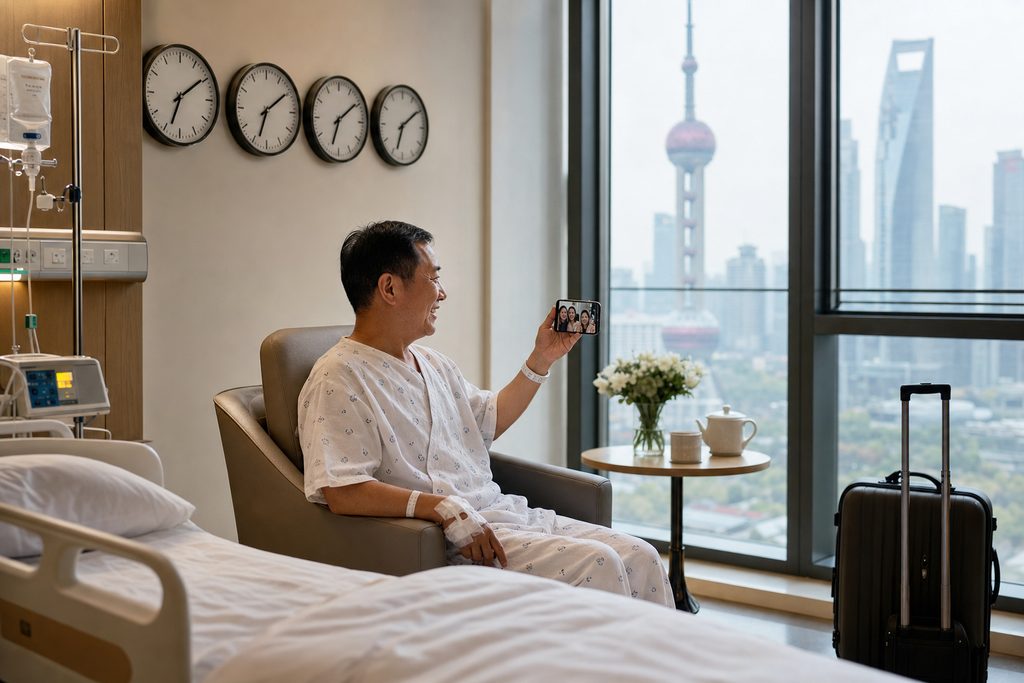
A patient undergoing a knee replacement at Beijing Jishuitan Hospital typically wakes from anesthesia around 2:00 PM local time. That is 2:00 AM in New York and 7:00 AM in London. One family gets a reassuring video call during breakfast. The other gets a groggy voicemail they won’t hear for hours. The difference isn’t luck. It’s a simple plan made before admission.
The question of how to manage time zones when hospitalized in China trips up more patients than language barriers or hospital paperwork. Most people figure out the medical logistics. They research the surgeon. They arrange the visa. Then they find themselves in a recovery room at 3:00 AM Beijing time, staring at a phone, unsure if they should wake their spouse on the other side of the world. We have coordinated care for patients from over 30 countries treated at our network of 340+ top-ranked hospitals across 37 Chinese cities. The communication problem comes up in nearly every pre-arrival consultation. Here is what works.
Manage Time Zones Calling Family from China Hospital: The Short Answer
Pick one daily call window and stick to it. For most Western patients, the sweet spot is 7:00 PM to 9:00 PM Beijing time. That lands between 6:00 AM and 8:00 AM Eastern, or 11:00 AM and 1:00 PM in London. Your family is awake and coherent. You are done with the day’s treatments and not yet exhausted. Use a reliable international calling app for China hospitals — WeChat works reliably inside Chinese hospital WiFi networks, and WhatsApp requires a VPN you should set up before you leave home. That is the framework. The execution gets more specific depending on your home time zone, your hospital’s WiFi quality, and how long your treatment keeps you inpatient.
Who Needs a Calling Plan — and Who Doesn’t
Not every patient needs to overthink this. A 45-year-old executive in Shanghai for a two-day executive health screening at a private international hospital can probably manage with hotel WiFi and their regular phone plan. The stakes change when you are looking at a 10-day inpatient stay after spinal surgery or a three-week recovery from a complex cardiac procedure.
A structured calling plan matters if you fit any of these profiles:
- You are hospitalized for more than five days and your family cannot travel with you
- You have young children at home who need to see your face, not just hear your voice
- You are the primary medical decision-maker for an elderly parent back home and need to stay reachable
- Your home time zone is more than six hours behind China (most of North America, all of South America)
- You are undergoing a procedure where the recovery timeline is uncertain and your family needs daily updates
A calling plan is less critical if a family member is traveling with you and handling communication, or if your stay is under three days and you can manage with asynchronous messaging. Be honest about your own emotional needs too. Some patients genuinely feel calmer with less contact, focusing entirely on rest. Others spiral without a nightly check-in. Neither is wrong. Just know which one you are before you pack.
The Options, Compared
Most international patients arrive with assumptions about how they will call home. Those assumptions hit the Great Firewall and shatter. Here are the real options, tested across hospital WiFi networks in Beijing, Shanghai, Guangzhou, and Chengdu.
| Method | Works Without VPN | Video Quality | Cost | Reliability in Public Hospital WiFi |
|---|---|---|---|---|
| Yes | Good | Free | High — optimized for China’s network | |
| No — requires VPN | Good | Free | Medium — VPN drops can interrupt calls | |
| FaceTime | No — requires VPN | Excellent | Free | Low — Apple services are throttled without VPN |
| Skype | Sometimes — inconsistent | Medium | Free to Skype; paid for landline calls | Unpredictable — works one day, blocked the next |
| Zoom | Yes — via China partner | Good | Free (40-min limit) | Medium — requires Chinese phone number verification |
| International SIM roaming | Yes — bypasses China internet entirely | Depends on carrier | $5–$10/day typical | High — but expensive for long stays |
WeChat wins for most patients. It is the default international calling app for China hospitals because it is native to the network. Chinese hospitals do not block it. The WiFi infrastructure inside public hospitals is built assuming every patient uses WeChat for everything — payments, appointment reminders, test result notifications, and video calls. If you install nothing else before your trip, install WeChat and verify your account.
But WeChat is not perfect. The video compression can make faces look slightly blurred. If you want the clearest possible video call with your children, and you are willing to manage a VPN, FaceTime over a VPN delivers noticeably sharper image quality. Just test the VPN in your hospital room during daytime hours before promising your family a FaceTime call at 8:00 PM. Hospital WiFi bandwidth drops when outpatient clinics are full.
Best Time to Call Family from Shanghai Hospital — and Every Other City
China operates on a single time zone: Beijing time (UTC+8). That simplifies the calculation. Whether you are in a Shanghai hospital, a Beijing recovery ward, or a Chengdu rehabilitation center, the math is the same. Only the daylight saving variable on your home end complicates things.
Here is the practical breakdown for major Western home zones, assuming you want to reach family during their waking hours:
- US Eastern (UTC-5 / UTC-4 DST): Call between 7:00 PM and 10:00 PM Beijing time. Your family gets the call between 6:00 AM and 9:00 AM. Morning people love this. Night owls will grumble.
- US Pacific (UTC-8 / UTC-7 DST): Call between 10:00 PM and midnight Beijing time. That is 6:00 AM to 8:00 AM Pacific. Late for you, early for them. Many West Coast families negotiate a later Beijing call on weekends.
- UK (UTC+0 / UTC+1 BST): Call between 4:00 PM and 7:00 PM Beijing time. That is 8:00 AM to 11:00 AM in London. Easiest window of any major time zone. You are awake, they are awake, nobody is rushed.
- Western Europe (UTC+1 / UTC+2 DST): Call between 3:00 PM and 6:00 PM Beijing time. Lands mid-morning in Paris, Berlin, Madrid. Works well for post-lunch hospital downtime.
- Middle East (UTC+3): Call between 1:00 PM and 4:00 PM Beijing time. That is 8:00 AM to 11:00 AM in Dubai and Riyadh. A midday call from your hospital room, before the afternoon rounds begin.
- Australia East (UTC+10 / UTC+11 DST): Call between 9:00 AM and noon Beijing time. That is 11:00 AM to 2:00 PM in Sydney. Only two hours ahead — the easiest long-distance call you will ever make from China.
The best time to call family from Shanghai hospital specifically follows these same windows. Shanghai is firmly in UTC+8. No special math required. But Shanghai’s public hospitals — especially the major teaching hospitals like Zhongshan and Ruijin — have notoriously congested WiFi during peak outpatient hours from 8:00 AM to 4:00 PM. Evening calls after 7:00 PM consistently deliver better video quality because the outpatient crowds have gone home and the network load drops.
A time zone converter for patients in Beijing is unnecessary if you memorize one rule: Beijing is 12 hours ahead of US Eastern Standard Time, 13 hours ahead during US Daylight Saving. For everyone else, add 8 hours to UTC. Your phone’s world clock does the rest. But do not rely on mental math when you are on pain medication. Set a recurring alarm on your phone labeled “Call home — 7:00 PM = 6:00 AM their time.” Post-operative brain fog is real.
Cheap International Calling Plans from China Hospital: What Actually Works
The cheapest option is free. WeChat voice and video calls cost nothing on hospital WiFi. If the WiFi is unusable — and in some older public hospital wards it genuinely is — you have fallback options that do not require selling a kidney to pay the roaming bill.
Airalo and similar eSIM providers sell China data packages starting around $5 for 1GB valid for 7 days. That is enough for several hours of WeChat video calls if you keep the video resolution on standard rather than HD. The eSIM installs before you leave home and activates when you land. It runs on China Mobile or China Unicom’s network, completely bypassing the hospital WiFi. For a three-week hospital stay, budget $15 to $25 for data if you use eSIM as your primary calling method.
Do not buy an international calling card at the airport. Those cards are designed for landline calls to landlines and offer terrible rates for mobile-to-mobile video. They made sense in 2005. They do not make sense now.
If you absolutely need to call a landline — your elderly parents do not use smartphones, your family’s home phone is the only reliable number — Skype’s paid calling plans charge roughly $0.02 to $0.05 per minute to most Western landlines. A $10 credit lasts through a multi-week hospital stay. But remember: Skype’s reliability inside China is inconsistent. Some days it connects perfectly. Other days the call drops every three minutes. Have WeChat as your primary and Skype-to-landline as your backup.
The question we hear most often: can I use WhatsApp to call home from China hospital? The technical answer is yes, but only with a working VPN. The practical answer is: do not make WhatsApp your only plan. VPNs fail. Hospital IT departments sometimes block VPN traffic on their networks, especially the free VPNs that international patients tend to download in a panic after landing. If WhatsApp is non-negotiable for your family — and for many European and Middle Eastern families it genuinely is — invest in a paid VPN service before you leave home. ExpressVPN and Astrill have the best track records inside China as of 2026. Install it, test it, update it, and subscribe for at least one month. Free VPNs are a gamble you do not want to take from a hospital bed.
Practical Considerations: Privacy, Fatigue, and the Emotional Weight of Daily Calls
Hospital rooms in China’s public hospitals are rarely private. A standard ward room has three to six beds. You will be making your video calls within earshot of other patients and their families. Most Chinese patients are remarkably tolerant of foreign patients and their logistical challenges. But a nightly 30-minute video call at full volume will test anyone’s patience.
Use headphones. Always. The hospital will be noisy enough without adding your family’s speakerphone conversation to the mix. A pair of Bluetooth earbuds with a microphone solves the privacy problem and lets you hear your family clearly over the background hum of monitors and hallway chatter.
The fatigue factor catches patients off guard. You think you want a long call. Then you are three days post-surgery and five minutes of conversation exhausts you. Set expectations with your family before you leave. Tell them: “I will call every day, but some days it might be three minutes. That doesn’t mean something is wrong. It means I need sleep.” Families panic when a promised 20-minute call turns into a two-minute check-in. A pre-arranged signal — “just a quick check-in tonight” — prevents unnecessary alarm.
And be honest about what you need from the call. Some patients want to hear every detail of life back home. It grounds them. Others find it distressing — hearing about a broken dishwasher or a child’s bad day at school feels impossibly distant and makes the hospital room feel more isolating. Tell your family which type you are. “Tell me everything” or “Just tell me you’re okay and show me the dog.” Both are valid. Neither is obvious unless you say it.
Time the calls around your treatment schedule, not just the time zones. Chinese hospitals run on early schedules. Nurses start morning rounds by 7:00 AM. Phlebotomists draw blood at 6:00 AM. By 8:00 PM, most wards are quieting down for the night. A call at 9:00 PM Beijing time might feel natural to you, but if your ward’s lights-out is 9:30 PM, you will be whispering in the dark while your family eats lunch in bright sunshine. That dissonance wears on you after a week. Aim for that 7:00 PM to 8:00 PM window whenever possible.
Frequently Asked Questions
No. WhatsApp is blocked on Chinese networks, including hospital WiFi. You will need a VPN installed and activated before you open WhatsApp. Set up the VPN at home, not after you land. Some hospital networks actively block VPN protocols, so even with a VPN, WhatsApp may be unreliable. WeChat is the safer primary option.
Switch to a voice call. WeChat voice calls use a fraction of the bandwidth and still let your family hear your voice. If even voice calls fail, fall back to asynchronous voice messages — WeChat lets you send short voice clips that your family can listen to and respond to at their convenience. As a last resort, purchase an eSIM data plan. A $5 data package covers several hours of video calling on China Mobile’s 5G network, which is generally fast and stable even inside older hospital buildings.
Set it and forget it. Before your procedure, program a daily alarm on your phone for your designated call window. Label it with both time zones: “7 PM Beijing / 6 AM New York — Call Home.” If you are too groggy to manage a video call, send a pre-written text message. Draft three template messages before surgery: “Surgery went well, I’m resting, call tomorrow,” “Rough day, will call when I can,” and “All good, talk at the usual time.” One tap sends it. Your family gets the reassurance without requiring you to form coherent sentences.
Your phone’s built-in world clock works offline and does not require internet access. Add your home city to the world clock before you leave. The display shows the current time in both locations side by side. No app needed. If you want a dedicated converter, the app “Time Zone Converter” by TimeAndDate works offline once you have opened it once on WiFi. But honestly, the world clock is simpler and one less thing to manage.
Give your family the hospital’s international patient coordinator phone number before you leave. In a genuine emergency — a medical decision about a family member back home, a crisis that cannot wait for you to wake up — they can call the coordinator, who can reach the nursing station on your ward. Do not give this number out casually. It is for emergencies only. Also, leave your phone on vibrate under your pillow. WeChat messages will come through on WiFi even if you have do-not-disturb enabled for calls from unknown numbers.
Your Next Step
Most patients figure out the hospital. They figure out the visa. They forget to figure out how they will talk to their children for three weeks. A 10-minute conversation before you fly — picking the app, setting the call window, installing the VPN if needed — prevents a lot of 3:00 AM frustration in a hospital bed. We help international patients coordinate treatment logistics at China’s leading hospitals, from initial consultation to discharge planning. We are not a hospital and we do not provide medical advice. But we have seen what makes the difference between a smooth recovery and a stressful one, and staying connected to home is near the top of that list. If you are planning treatment in China and want to talk through the practical details, including communication logistics, reach out to our team. No pressure. Just a conversation about what you need and how we can help.
For more medical information and treatment options in China, visit chinamedservices.com (China Medical Services).
