China vs India: Hospital Access Compared for Global Patients
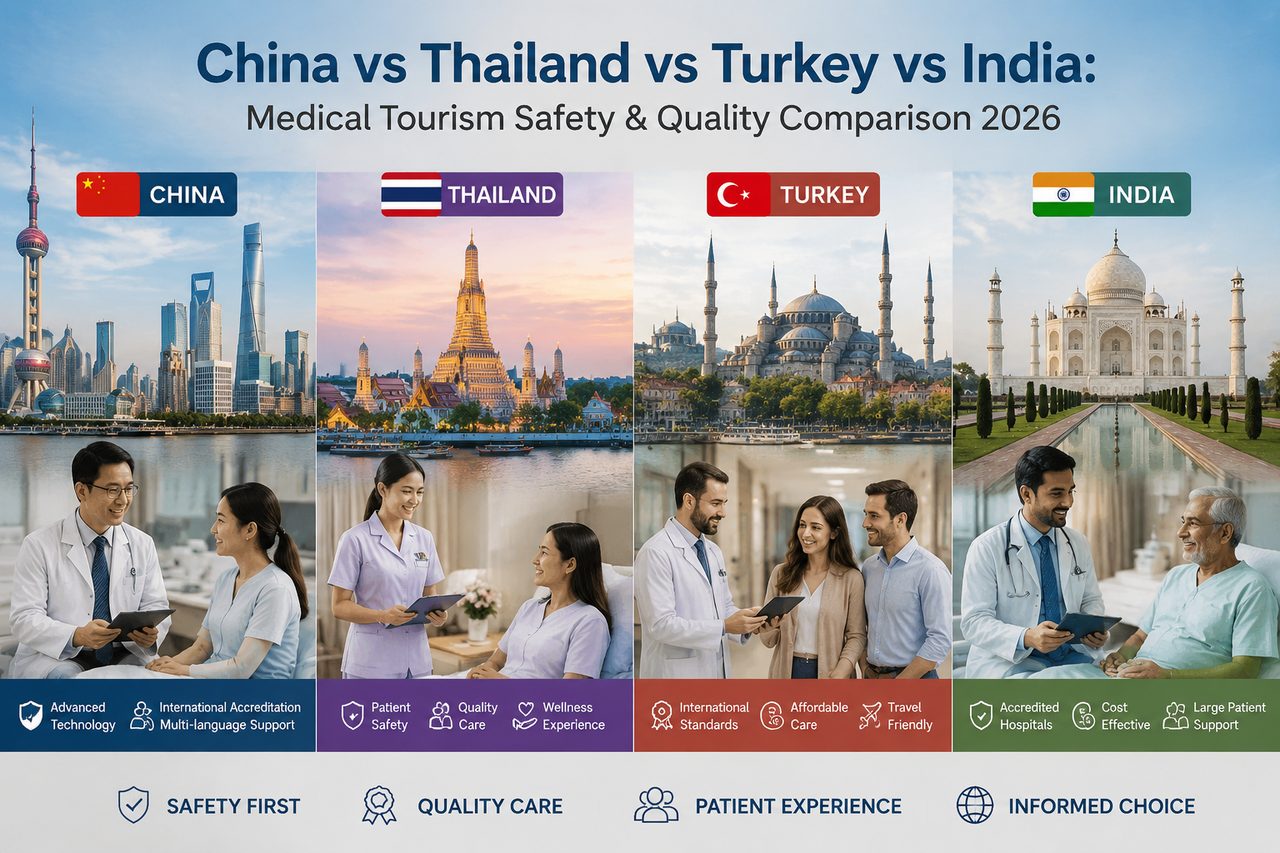
When 54-year-old David from Melbourne got his coronary angiography results, his cardiologist in Australia told him he needed bypass surgery within eight weeks. The public waitlist quoted him four to six months. His private quote came in at roughly AUD 65,000 out of pocket. David did what a growing number of patients do — he started searching Asia. Two names kept appearing: China and India. Both promised world-class cardiac surgery at a fraction of Western prices. But when he compared hospital cost China vs India in detail, the two systems turned out to be almost nothing alike in how a foreigner actually gets through the door.
That gap is what this guide is about. Not which country is “better” in the abstract, but how access works in each, what it costs, how long it takes, and where the friction hides.
## How This Actually Works, Step by Step
The sequence for a foreign patient is broadly similar in both countries, but the details diverge fast.
You start by gathering your existing records — imaging discs, pathology reports, discharge summaries, lab work. These get translated into the local language if needed, then sent to a hospital or a coordinating service. A specialist reviews them and returns either a written opinion, a video consultation offer, or a request for more tests.
From there, you receive a treatment plan and a cost estimate. You confirm. You apply for a visa. You fly. You attend an in-person consultation. Only after that face-to-face meeting does surgery get scheduled.
Here is the part most people miss. In China’s public tier-3 hospitals, ordinary outpatient slots cannot be reserved from overseas in advance. You register on the day, in person. Surgery is arranged only after that first physical consultation. The workaround is the hospital’s international or VIP department, which does allow pre-booking and provides English-speaking staff — at roughly 1.5 to 2 times the standard channel price.
India’s private hospital model works differently. Many private hospitals in Delhi, Chennai, and Mumbai run dedicated international patient desks that quote, schedule, and coordinate remotely, often within days.
## Where China and India Diverge on Access
This is the substantive question. Access, not price, is usually what decides the case.
China’s top hospitals are enormous. A single leading facility can process more than 10,000 outpatient visits in a day. Volume is the engine behind its surgical outcomes — Fuwai Hospital in Beijing performs over 14,000 cardiac surgeries a year, among the highest anywhere. But that same volume means a foreigner without Mandarin, without a pre-booked international department slot, and without someone physically walking them through registration will struggle badly.
India’s leading private hospitals were built partly around medical tourism. English is an official language. International patient departments are staffed, marketed, and accustomed to foreign passports. The administrative path is smoother.
Flip the lens to clinical depth. China’s 340+ top-ranked hospitals — the top 5% of more than 35,000 nationwide, ranked by the Fudan index and JCI accreditation — sit across 37 cities. Beijing alone hosts 21 Fudan Top 100 hospitals; Shanghai has 18; Guangzhou 10. For complex oncology, cardiac surgery, neurosurgery, and multi-organ disease, that concentration is hard to match. You can browse the full Fudan-ranked hospital directory by city to see the density for yourself.
So the honest answer to “is medical care in China better than India” depends entirely on what you need. Routine procedures, straightforward orthopedics, fertility treatment, and standard cardiac work: India’s access advantage is real. Highly complex cases requiring subspecialty depth, rare-disease workups, or access to a top-10 department in a specific field: China’s hospital concentration often wins.
## A Realistic Timeline
Timelines vary by hospital, visa office, and case complexity. Treat these as ranges, not promises.
| Stage | China (typical range) | India (typical range) |
|---|---|---|
| Records translation & review | 3–10 days | 2–7 days |
| Written second opinion returned | 5–14 days | 3–10 days |
| Video consultation scheduled | 1–3 weeks | 3–10 days |
| Visa application (S2 for China) | 1–3 weeks | 3–10 days (e-Medical visa) |
| Appointment lead time, international dept. | 1–4 weeks | 3–14 days |
| In-person consultation to surgery | 1–3 weeks | 2–10 days |
| Total, records to operating table | 6–12 weeks | 3–7 weeks |
The steps people forget: certified translation of medical documents, which can add a week; the S2 visa’s supporting-document requirement, which needs a hospital invitation letter; and the gap between landing and actually being seen, which in China’s public system can swallow several days if you arrive without a pre-arranged international department slot.
China hospital wait times for foreigners are not the same as wait times for citizens. The bottleneck is administrative, not clinical capacity.
## What Can Go Wrong — and What Happens Then
Failure modes differ by country, and pretending otherwise wastes your time.
In China, the most common problem is arriving without a confirmed appointment. You land, you go to the hospital, and you discover the department you need has no same-day capacity for a foreign patient. Recourse: this is exactly why the international or VIP department exists. Pre-booking through it solves most of this, at a price premium.
The second problem is language. A top Chinese hospital at 8 a.m. is not navigable in English. Registration kiosks, payment counters, and department wayfinding are in Chinese. A bilingual companion is not a luxury here; it is the difference between a two-hour day and a two-day ordeal.
In India, the common failure is over-promising by intermediaries. Quoted prices sometimes exclude complications, ICU days, or revision procedures. Recourse: insist on an itemized estimate in writing and ask specifically what triggers additional charges.
Payment is another trap. Chinese public hospitals require prepayment; insurance is reimbursed afterward. Many Indian private hospitals accept international insurance directly. Neither system is wrong — but arriving without the cash flow to prepay will stall your surgery in China.
## How to Evaluate a Provider in Either Country
Look past the website.
Check accreditation first. JCI status is verifiable and meaningful. Check whether the specific department, not just the hospital, ranks well — the Fudan specialty reputation lists rank 45 specialties individually, so “top 10 in oncology” is a checkable claim, while a vague “best hospital” is not. You can review department-level rankings at China’s specialty Top 10 hospital lists.
Ask what happens after discharge. Follow-up matters more than the operation itself for many conditions. China’s top hospitals generally expect you to return for reviews; some coordination services help arrange local follow-up in your home country.
Ask who actually performs the surgery. At large Chinese hospitals, the senior consultant you consult with may not be the surgeon on the day. This is normal in academic medical centers worldwide, but you should know it going in.
And ask for the estimate in writing, itemized, with the assumptions stated.
## Practical Considerations: Records, Visa, Payment, Language
Records. Bring originals plus certified translations. Imaging on disc, not just printed reports. Both countries will re-scan anything unclear.
Visa. For China, medical travel uses the S2 visa, annotated for medical treatment purposes; stays beyond 180 days use S1. Accompanying family members also apply for S2. The M visa is a commercial and trade category and has nothing to do with medical treatment — do not let anyone tell you otherwise. Requirements shift, so confirm current rules with the nearest Chinese embassy or consulate and secure the hospital’s supporting documents first. India offers a dedicated medical visa route that is generally faster to process.
Payment. China’s public system: prepay, then claim reimbursement. Private international hospitals in China and most private Indian hospitals: direct insurance billing is often available. Confirm before you book.
Language. India’s private hospitals operate in English. China’s do not, outside international departments. This single fact reshapes the entire experience.
Cost. Cardiac bypass at a top Chinese public hospital typically runs $12,000–20,000, against $120,000+ in the United States. India’s private quotes often land lower still for comparable procedures. Both vary by hospital and case complexity, so treat any single figure with suspicion.
Is surgery in China or India cheaper overall?
India’s headline prices for common procedures are often lower, and its international patient infrastructure reduces hidden costs. China’s advantage appears in complex cases where a top-ranked specialty department delivers outcomes that justify the premium. Compare itemized estimates, not advertised starting prices.
Can I book medical treatment in China from overseas?
Yes, but not through the ordinary public outpatient channel. Pre-booking runs through the hospital’s international or VIP department, which provides English-language coordination at roughly 1.5 to 2 times standard pricing. Standard outpatient registration happens in person on the day.
How long do I wait for surgery in China as a foreigner?
From first contact to operating table, six to twelve weeks is realistic. The wait is administrative — records, visa, appointment lead time — not a queue for the operating room itself. Emergency and urgent cases move faster through international departments.
Do I need a special visa for medical treatment in China?
Yes. The S2 visa covers short-stay medical treatment; S1 applies for stays over 180 days. Family accompanying you also apply for S2. Always verify current requirements with the nearest Chinese embassy, since documentation rules change.
What if the treatment plan changes after I arrive?
It happens. In-person examination sometimes reveals more than imaging did, and the plan adjusts. Build financial and schedule buffer into your trip, and confirm in writing how revised estimates are handled before you commit.
## Your Next Step
The core message is simple: China and India solve different problems. India offers smoother access and lower headline prices; China offers unmatched depth in complex specialties, provided you go through the right channel. Neither is a shortcut around doing your homework.
That homework is where we come in. China Medical Services is a coordination service, not a hospital and not a doctor — we translate records, arrange appointments through official international departments, and provide bilingual companions on the ground. We do not sell access, and we cannot promise a specific surgeon or date. If you want a straight assessment of whether your case fits a Chinese hospital, start with a free consultation. No pressure, no obligation, just a clearer picture before you decide anything.
—
Medical disclaimer: This article is for general information only and does not constitute medical advice. Treatment decisions should always be made with a qualified physician who has reviewed your individual case. Prices, timelines, and visa rules cited here are estimates and subject to change; confirm all details with the relevant hospital and embassy.
Frequently Asked Questions
Yes. The hospitals used for international patients are JCI-accredited and follow the same international safety standards as top hospitals in the US and Europe. Surgical teams perform high volumes of procedures — often more than their Western counterparts — which studies show leads to better outcomes.
Costs vary by procedure and hospital, but international patients typically save 40-80% compared to US prices — even when factoring in travel and accommodation. A consultation with our team will give you an exact, all-inclusive quote with no hidden fees.
Send us your existing medical reports to get started. We handle everything from hospital selection and appointment scheduling to visa assistance and post-operative recovery planning. Your medical records are reviewed by the specialist before you even book a flight.
For more medical information and treatment options in China, visit chinamedservices.com (China Medical Services).
