China vs India: Technology and Equipment for Advanced Medical Care
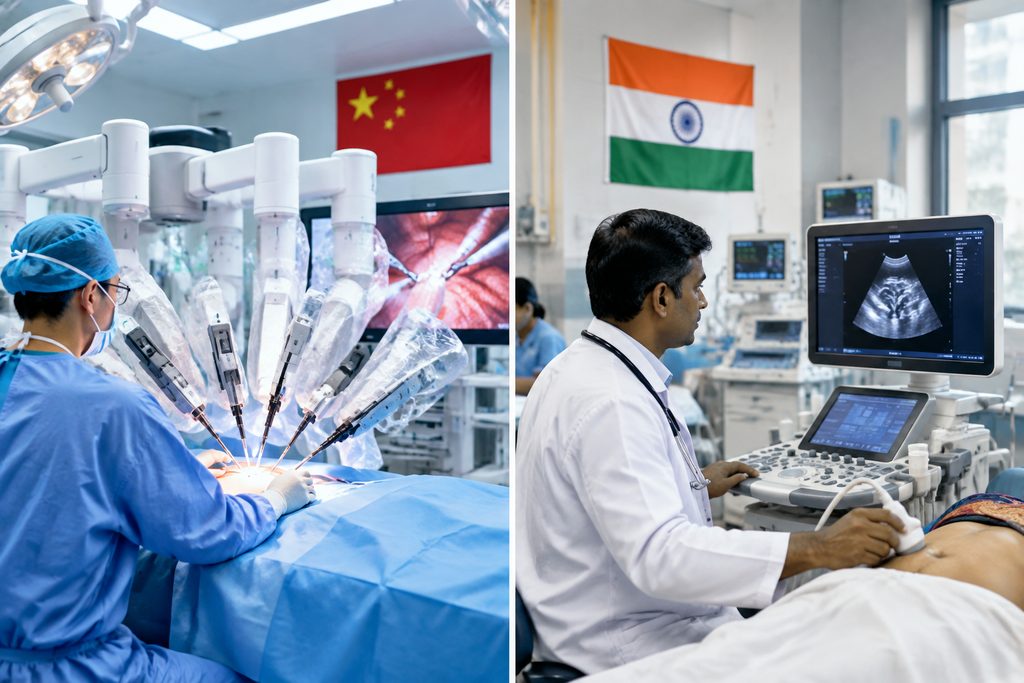
China vs India: Technology and Equipment — A Practical Comparison for International Patients
China operates more robotic surgical systems than any country except the United States, while India performs roughly one-tenth the volume of proton beam therapy. Those two numbers frame the real question behind “China vs India: Technology and Equipment” — not which country is “better,” but which one actually has the specific machine, specialist, and protocol your diagnosis requires. For a patient searching for the best cancer hospital in China for international patients, the answer usually comes down to equipment density, not reputation alone.
Here is the complication. Both countries have world-class centers and both have under-equipped ones. A hospital’s national ranking tells you little about whether its linear accelerator was installed in 2019 or 2009. So we built this comparison around what can actually be verified: installed technology, surgical volume, and how accessible each system is to a foreign patient.
China vs India Robotic Surgery Technology Comparison: The Short Answer
China has installed well over 300 da Vinci robotic systems and its top hospitals run them at volumes that rival Western academic centers. India has a smaller installed base, concentrated in a handful of private chains, but compensates with lower prices and faster scheduling. If your procedure depends on the newest generation of a specific platform, China’s top-tier hospitals are more likely to have it. If your priority is the lowest possible out-of-pocket cost for a standard robotic prostatectomy, India often wins on price alone.
The caveat matters: equipment is only as good as the team operating it. A 2019 study in The Lancet Oncology on esophageal cancer surgery found that surgeon volume — not device generation — was the strongest predictor of outcome. So when you compare countries, you are really comparing surgical teams that happen to sit next to certain machines.
Who This Comparison Is Right For — and Who It Isn’t
Medical travel is not for everyone, and a technology comparison is meaningless if you fall outside the practical eligibility window.
You are likely a good candidate if:
- You need a procedure where equipment genuinely changes the outcome — proton therapy, Gamma Knife radiosurgery, robotic-assisted resection, or advanced imaging-guided intervention.
- Your home country has a waitlist measured in months, or your insurer has declined the procedure.
- You can travel for 2–6 weeks and return home for follow-up.
- You have a diagnosis and imaging already in hand, so a remote review is possible.
You should probably not pursue this if:
- Your condition is unstable and cannot tolerate a long-haul flight.
- You need emergency care — this is a planned-care pathway, not an acute one.
- Your treatment requires continuity of a specific drug regimen your home oncologist manages.
- You cannot obtain your records in a transferable format. Without imaging and pathology, no honest remote review is possible.
Being blunt about the last point saves people money. We have seen families book flights before anyone had read the pathology report.
The Options, Compared
The table below compares the two countries across the dimensions that actually drive decisions. Figures are typical ranges and vary by hospital, city, and case complexity.
| Factor | China (Top-Tier Public & International Hospitals) | India (Leading Private Hospitals) |
|---|---|---|
| Robotic surgical systems installed | 300+ nationally; concentrated in top-tier centers | Smaller base, mostly in large private chains |
| Proton therapy centers | Multiple operational centers in major cities | Very limited; few operational sites |
| Gamma Knife availability | Widely available at major neurosurgery centers | Available at select private centers |
| Typical robotic prostatectomy cost | Approx. $15,000–$30,000 | Approx. $7,000–$15,000 |
| Gamma Knife treatment cost | Approx. $8,000–$20,000 | Approx. $5,000–$12,000 |
| English-language clinical staff | Reliable at international departments; limited elsewhere | Generally strong in private hospital sector |
| Direct insurance billing | Common at private international hospitals | Common at large private hospitals |
| Pre-arrival appointment booking | Standard public clinics: no. International/VIP channels: yes | Private hospitals: usually yes |
| Typical wait for surgery | Days to a few weeks after in-person consultation | Days to a few weeks |
Read the table by priority, not by column. A patient whose tumor requires proton beam therapy should weight the proton row heavily — that single line eliminates most of the Indian options. A patient paying entirely out of pocket for a routine robotic hernia repair should weight the cost rows, and India becomes genuinely competitive.
How Advanced Is Medical Equipment in China Hospitals?
This is where the picture gets more interesting than the headlines suggest. China’s top hospitals are not merely buying imported machines — they are running them at volumes that generate their own clinical expertise.
Fuwai Hospital in Beijing performs more than 14,000 cardiac surgeries a year, which is among the highest volumes anywhere in the world. Volume at that scale does something a single machine cannot: it compresses the learning curve. When a surgical team performs a procedure hundreds of times annually, their complication rates tend to fall and their judgment in edge cases sharpens. That is the real technology story.
On imaging, the picture is similar. A 3-Tesla MRI or a 256-slice CT scanner is standard equipment at major Chinese tertiary hospitals, and the throughput is enormous — some facilities handle over 10,000 outpatient visits in a single day. You can review specialty rankings across 45 departments to see which hospitals concentrate their equipment investment in your specific field.
India’s advantage here is different, and worth stating fairly. Its leading private hospitals are often newer builds with excellent imaging suites, and their international patient departments are streamlined in ways many Chinese public hospitals are not. If your priority is a frictionless English-language experience from arrival to discharge, an Indian private hospital may feel smoother.
Is Proton Therapy Available in China for Foreigners?
Yes — proton therapy is available in China, and foreign patients can access it through hospital international departments. Several proton and heavy-ion centers operate in major cities, and more have come online in recent years.
What this means practically: proton therapy is a specialized modality where the equipment itself is the treatment. There is no “close enough” alternative if your radiation oncologist has specifically recommended it. That makes availability the deciding factor, and it is the clearest area where China’s installed base exceeds India’s.
Two honest caveats. First, not every proton center accepts international patients, and referral pathways differ by institution. Second, proton therapy is appropriate for a defined set of tumors — it is not a universally superior form of radiation, and any center that markets it that way should raise your suspicion.
Cost of Gamma Knife Treatment in China and What Drives It
Gamma Knife radiosurgery in China typically runs from about $8,000 to $20,000, depending on the hospital’s tier, the number of lesions treated, and whether the session is single or staged. For comparison, the same procedure in the United States frequently exceeds $40,000.
What drives the variance:
- Hospital tier. A top-ranked neurosurgery center charges more than a provincial hospital — and for complex skull-base lesions, the difference in planning expertise is worth the premium.
- Number of lesions. Multiple metastases require longer planning and dose delivery.
- Single vs. fractionated. Staged treatment means more sessions, more cost.
- Anesthesia and frame type. Frame-based and frameless approaches have different resource requirements.
Note that quoted prices usually cover the procedure itself. Imaging, consultation, hospitalization, and follow-up scans are often billed separately. Always ask for an itemized estimate.
Book a Medical Imaging Scan in Shanghai: What to Expect
Diagnostic imaging is one of the more accessible entry points into the Chinese system, and Shanghai is a reasonable place to start. The city hosts a dense concentration of top-ranked hospitals, and several private international facilities offer direct scheduling for foreign visitors.
The distinction that matters: at a standard public hospital outpatient clinic, you generally cannot reserve a slot from abroad in advance. You register on the day, in person, and queues are long. Through a hospital’s international or VIP department — or through a private international hospital — advance scheduling is usually possible, at roughly 1.5 to 2 times the standard fee.
For a straightforward MRI or CT, the private route is often worth the premium simply for the scheduling certainty. For a complex diagnostic workup tied to a suspected cancer diagnosis, you want the tertiary hospital with the subspecialty radiologists, and the coordination is more involved.
Practical Considerations for International Patients
Records first. No credible hospital will give you a meaningful opinion without your imaging files (DICOM format, not just the written report), pathology slides or blocks, and recent labs. Getting these translated into Chinese is part of the work — and it is work.
Visa category. For medical treatment in China, the applicable short-stay category is the S2 visa, issued for medical treatment and private affairs, subject to the latest embassy or consulate requirements and supporting hospital documents. Accompanying family members apply under the same category. The M visa is for commercial and trade activities and has nothing to do with medical care — if anyone tells you otherwise, they are wrong. Stays beyond 180 days involve a different category. Approval is never guaranteed, and requirements change; verify with your nearest Chinese embassy or consulate before booking anything.
Payment. Chinese public hospitals generally require prepayment, with insurance reimbursement handled afterward in your home country. Private international hospitals more often bill insurers directly. Bring a payment method that works internationally and confirm limits with your bank before you travel.
Language. This is the honest friction point. China’s top hospitals are enormous, and signage, registration systems, and most clinical staff operate in Chinese. Without language support, navigation is genuinely difficult — not impossible, but difficult.
Follow-up. Plan your return-home handover before you leave. Ask for operative notes, imaging on disc, and a written summary in English. Your home physician will need them.
Frequently Asked Questions
Neither wins across the board. China has a larger installed base of high-end equipment, particularly in proton therapy and robotic surgery, and its top hospitals run exceptional procedure volumes. India’s leading private hospitals are often newer, more English-friendly, and significantly cheaper. The right answer depends on which specific technology your diagnosis requires.
Often, yes — through a hospital’s international department. Availability varies by center, and each institution has its own referral process. Proton therapy is also only appropriate for specific tumor types, so a proper review of your imaging and pathology comes first. No responsible provider will promise an appointment before that review happens.
Typical ranges are roughly $8,000–$20,000 in China and $5,000–$12,000 in India, varying by hospital tier and case complexity. These figures usually exclude imaging, consultations, and follow-up. Request an itemized quote rather than a single number.
The S2 category covers short-stay medical treatment and private affairs, and accompanying family members apply under the same category. Requirements and documentation standards are set by the relevant embassy or consulate and can change — confirm current rules before you apply. The M visa is not a medical visa.
This is the question worth asking before you commit. Outcomes vary, and no hospital or coordinator can guarantee a clinical result. What you can control is preparation: a documented second opinion before travel, a clear understanding of what the quoted price includes, and a written follow-up plan for when you return home. If a provider promises a guaranteed outcome, treat that as a warning sign.
Your Next Step
China and India each have real strengths, and the deciding factor is almost always your specific diagnosis rather than a national ranking. Match the required technology to the hospital that actually has it, confirm the team’s volume in that procedure, and get the numbers in writing before you book a flight.
At China Medical Services, we are a coordination service, not a hospital — we do not diagnose or treat anyone. We help international patients obtain written second opinions from Chinese specialists, arrange video consultations, and coordinate appointments and bilingual support on the ground. If you would like an honest read on whether China is the right fit for your case, start with a free consultation and we will tell you what we see — including when the answer is no.
This article is for general information only and is not medical advice. Treatment decisions should be made with qualified clinicians who have reviewed your individual records.
For more medical information and treatment options in China, visit chinamedservices.com (China Medical Services).
