Health Checkup: International Clinics in China — What You Pay and How It Works
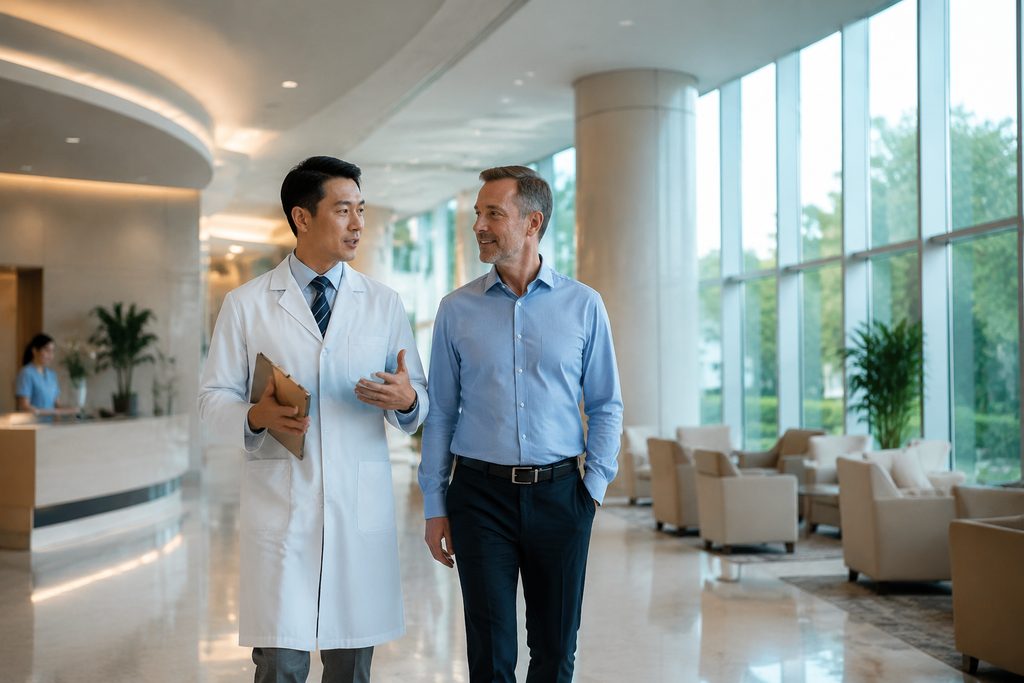
A full body checkup means running a coordinated battery of tests — blood panels, imaging, cardiac screening, and specialist reviews — in a single visit to catch problems before they become symptoms. For international patients, the question is rarely whether the tests exist. It is whether the logistics, language, and price make sense. At China Medical Services, we have spent years answering that exact question for patients from the US, Europe, the Gulf, and Southeast Asia. The short answer: a comprehensive executive screening at a top-tier Chinese hospital typically costs $400 to $1,500, depending on depth and hospital tier. That compares to $2,500 to $6,000 for a comparable private-package exam in the United States or Western Europe. But the real story sits in the details — which hospital, which package, and what happens when a finding shows up.
How This Actually Works, Step by Step
You do not fly to China and walk into a hospital lobby expecting same-day service. The sequence matters. Here is the real flow for an international patient booking a health screening package.
First, you choose a hospital category. Public top-tier hospitals — the ones on the Fudan ranking list — run massive checkup centers that process thousands of patients daily. Private international hospitals like United Family or Jiahui offer quieter environments, English-speaking staff, and direct insurance billing, but packages cost 1.5 to 2 times more. Your budget and comfort level decide this early.
Second, you send us your basic profile: age, gender, existing conditions, family history, and any specific concerns. That lets us recommend a package tier — basic, comprehensive, or executive — rather than a generic menu. No two patients need identical panels.
Third, we coordinate the appointment through the hospital’s international department or VIP channel. Public hospital checkup centers do accept walk-ins, but an international patient without Chinese language support will struggle with registration, payment counters, and result collection. We handle that.
Fourth, you arrive. The exam itself — blood draw, ultrasound, CT, treadmill test, endoscopy if included — runs 4 to 8 hours across one or two mornings. You fast overnight before. Results for most labs come back within 24 to 48 hours; imaging reports within 3 to 5 working days. A physician reviews everything with you, usually through an interpreter we provide.
What happens after a finding? That is the part most articles skip. If the screening flags something — a thyroid nodule, elevated liver enzymes, a suspicious lung shadow — you need a follow-up consultation with the relevant specialist. That is a separate appointment, not part of the package. We coordinate it. This is where the real value of being in a city like Shanghai or Beijing shows: the specialist you need is in the same building or a 20-minute ride away, not a three-month wait.
What a Full Body Checkup Cost in China Actually Buys
The phrase “full body checkup cost China” gets searched thousands of times a month, and the answers online are messy. Some clinics advertise $99 packages. Others quote $3,000. Both can be legitimate — they are just not the same product. Let me break down what sits behind the numbers.
| Package Tier | Typical Inclusions | Public Top Hospital | Private International Hospital |
|---|---|---|---|
| Basic | Blood count, liver/kidney function, lipids, glucose, chest X-ray, abdominal ultrasound, ECG | $150–$400 | $400–$800 |
| Comprehensive | Above + tumor markers, thyroid function, cardiac ultrasound, carotid ultrasound, low-dose lung CT | $400–$800 | $800–$1,500 |
| Executive | Above + brain MRI, coronary CT angiography, endoscopy, full-body MRI option, specialist consultations | $800–$1,500 | $1,500–$3,000+ |
Ranges vary by hospital and case complexity. A 45-year-old with no symptoms needs less than a 60-year-old smoker with a family history of colon cancer. The package should flex accordingly.
One thing worth stating plainly: Chinese public hospital checkup centers are efficient, not luxurious. You will sit in waiting areas with hundreds of other patients. The corridors are busy. The equipment is excellent — often newer than what you would find in a mid-tier Western hospital — but the experience is functional. If you want spa-like comfort, you pay for a private international hospital. If you want clinical rigor at the best price, you choose a top public hospital and accept the environment.
For patients asking specifically about the best hospital for executive health screening Shanghai, the conversation usually lands on two options. Zhongshan Hospital Fudan University runs one of the country’s most respected checkup centers, with strong cardiology and oncology follow-up capacity. Ruijin Hospital, also in Shanghai, has a comparable reputation and a well-organized international department. Both appear on the Fudan comprehensive ranking and both handle foreign patients regularly. Our Shanghai city guide covers the practical differences between them.
In Beijing, the equivalent question — book health screening package Beijing — typically points to Peking Union Medical College Hospital or China-Japan Friendship Hospital. PUMCH carries the strongest brand recognition among international patients. Its checkup center books out weeks in advance during peak seasons, so lead time matters.
A Realistic Timeline
Patients consistently underestimate how long the whole process takes. Not the exam itself — the surrounding logistics. Here is an honest schedule.
| Stage | What Happens | Realistic Duration |
|---|---|---|
| Week 1 | Initial consultation, package selection, document review | 2–3 days |
| Week 1–2 | Hospital appointment confirmation through international department | 3–7 working days |
| Week 2–4 | S2 visa application with hospital invitation letter | 5–15 working days, embassy-dependent |
| Week 3–5 | Travel arrangements, hotel booking near hospital | Flexible |
| Day 1 on site | Registration, payment, exam sequence begins | 4–8 hours |
| Day 2–3 | Remaining imaging or endoscopy, if split across days | 2–4 hours |
| Day 3–5 | Result review with physician, translated summary | 1–2 hours |
| Week 2–4 after | Any follow-up specialist consultations or additional tests | 1–3 days per consult |
The visa piece catches people off guard. For medical travel, the applicable short-stay category is the S2 visa, with the hospital’s invitation letter supporting the application. Processing times swing widely by country — some embassies turn it around in five days, others take three weeks. Do not book non-refundable flights before the visa is in hand.
And one more timing reality: if your screening finds something requiring treatment, you may need to extend your stay. A suspicious finding on a lung CT leads to a biopsy, which leads to pathology results, which leads to a treatment decision. That chain can take two to four weeks. Budget flexibility for that possibility.
Is a Health Checkup in China Safe?
The direct question we hear from Western patients: is health checkup safe in China? The honest answer is yes — with qualifications.
Safety in a diagnostic setting has two dimensions. The first is clinical competence: are the technicians properly trained, is the equipment calibrated, are the radiologists qualified? At any hospital on the Fudan top-100 list or holding JCI accreditation, the answer is yes. These are institutions that perform hundreds of thousands of imaging studies annually and maintain international-standard quality controls. Fuwai Hospital alone performs over 14,000 cardiac surgeries a year — the volume breeds competence.
The second dimension is process safety: infection control, needle handling, contrast dye protocols, radiation dosing. Chinese top-tier hospitals follow the same sterilization and single-use protocols you would expect in any developed healthcare system. The risk is not in the clinical work. The risk is in the navigation — language barriers, misreading signs, going to the wrong floor, misunderstanding instructions. That is a solvable problem with a bilingual companion.
What about data privacy? Chinese hospitals maintain electronic medical records with access controls comparable to international norms. The practical privacy consideration is simpler: your results will be in Chinese unless you request translated copies. We arrange translation as part of our coordination service.
Medical Checkup Tourism: The Price Comparison That Matters
The search term medical checkup tourism China price comparison suggests patients are weighing China against Thailand, Singapore, South Korea, and domestic options. Here is the honest comparison.
Thailand’s private hospital packages — Bumrungrad, Bangkok Hospital — run $300 to $1,200 for comprehensive screenings. Quality is good, English is widespread, and the experience is polished. Singapore’s executive screenings at Mount Elizabeth or Gleneagles cost $1,500 to $4,000 — close to Western pricing but with excellent service. South Korea’s premium checkup centers, especially in Seoul, charge $1,000 to $3,000 and market heavily on cancer screening depth.
China’s advantage is the combination of price and clinical depth. A $600 comprehensive package at a Fudan-ranked hospital includes imaging and lab work that would cost $2,000 in Singapore or $3,500 in the US. The follow-up capacity matters too: if your screening finds a cardiac issue, the surgeon who handles it is in the same hospital system, often the same building. That continuity is harder to arrange when you fly to Bangkok for a checkup and then need treatment in a different country.
But China’s disadvantage is real. The language barrier is steeper than in Thailand or Singapore. The process is less polished. You need a coordinator. That is not a marketing line — it is the honest trade-off. If you want a seamless English-language experience with no friction, Singapore or Thailand wins. If you want maximum clinical rigor per dollar and are willing to accept some logistical friction, China wins.
For patients asking how long does a comprehensive medical exam take abroad, the answer varies by country and package depth. In China, a comprehensive package takes 4 to 8 hours on site, usually split across one or two mornings. Add 3 to 5 working days for full results and physician review. In Thailand or Singapore, similar packages run 4 to 6 hours with results in 2 to 3 days. In the US, the same depth often requires multiple appointments over two to four weeks because testing is fragmented across facilities. The “abroad” advantage is consolidation: one facility, one morning, one coordinated result set.
Practical Considerations: Records, Visa, Payment, Language
Bring your existing medical records. If you have prior imaging, lab results, or specialist notes, send them before you travel. The reviewing physician needs baseline data to interpret new findings. A lung nodule that was stable for three years means something different than a new one. Without prior films, every finding looks new.
Visa category: S2, not M. The M visa is for commercial and trade activities. Medical treatment falls under S2 for short stays, with the hospital invitation letter as supporting documentation. Family members accompanying you also apply for S2. Requirements shift by embassy, so confirm the latest rules with the Chinese consulate in your country before applying.
Payment: public hospitals require prepayment — you load money onto a hospital card and deduct as services are consumed. Cash, UnionPay, and major credit cards are generally accepted, though international card processing can be inconsistent. Private international hospitals accept direct insurance billing with major international insurers. Public hospitals do not — you pay out of pocket and claim reimbursement from your insurer afterward. Confirm your policy covers overseas diagnostics before you commit.
Language: do not assume English works at a public hospital checkup center. Some physicians speak English, especially in international departments, but the technicians, nurses, and front-desk staff generally do not. A bilingual companion eliminates this friction. The cost starts at $300 per day, which is modest compared to the cost of a missed instruction or a misunderstood result.
Follow-up at home: request a translated summary of all findings and recommendations. Your home physician needs that document to continue care. We arrange certified translation as part of our service.
Frequently Asked Questions
Expect $400 to $1,500 for a comprehensive package at a top public hospital, depending on depth and inclusions. Executive packages with brain MRI, coronary CT, and endoscopy run $800 to $1,500. Private international hospitals charge roughly double. Final quotes vary by hospital and case complexity.
Yes — through the hospital’s international department or VIP channel. Public hospital checkup centers do not accept overseas online bookings through their standard patient portals, but international departments coordinate advance appointments for foreign patients. Lead time of one to three weeks is typical, longer during peak seasons.
At Fudan-ranked public hospitals and JCI-accredited private hospitals, yes. Clinical standards, equipment calibration, and infection control meet international norms. The main risk is logistical — language barriers and navigation — which a bilingual companion addresses directly.
You are referred to the relevant specialist within the same hospital system for follow-up consultation and further testing. This is a separate appointment, not part of the screening package. The advantage of screening in a major Chinese city is that top specialists across every field are concentrated in a few hospitals, so follow-up happens quickly — often within days, not months.
For short medical stays, the S2 visa is the applicable category, supported by the hospital’s invitation letter. The M visa is for commercial and trade activities and does not apply to medical travel. Confirm current requirements with the Chinese embassy or consulate in your country, as rules change periodically.
Your Next Step
The decision to fly abroad for a health screening is not casual. It involves cost, time, and a degree of trust in an unfamiliar system. What we do at China Medical Services is straightforward: we help you choose the right hospital, coordinate the appointment through official international channels, arrange a bilingual companion for the day of your exam, and make sure your results come back in a language your home physician can use. We do not practice medicine, and we do not promise outcomes. We handle the logistics so you can focus on the results.
If you are considering a screening in Shanghai, Beijing, or another Chinese city, start with a conversation. Tell us your age, your concerns, and your budget. We will tell you honestly whether China makes sense for you — and if it does, what the next three weeks look like. Reach out for a free consultation and we will map it out together.
For more medical information and treatment options in China, visit chinamedservices.com (China Medical Services).
