Scoliosis Correction in Shanghai: Changzheng Spine Center for International Patients
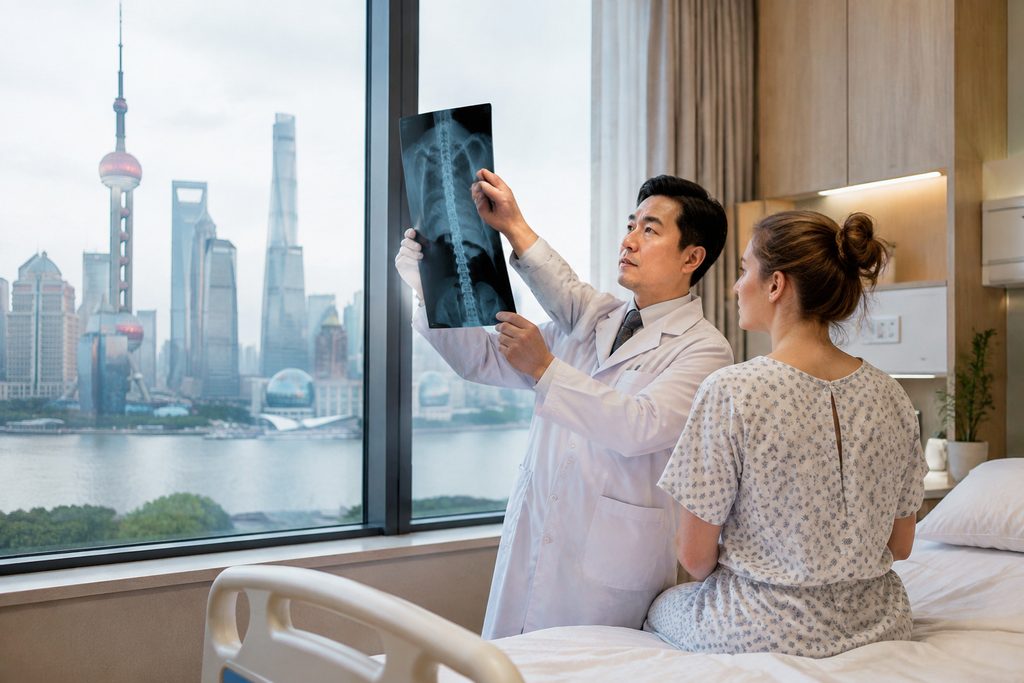
Scoliosis Correction in Shanghai: The Short Answer
For a severe spinal curvature requiring surgical fusion, an international patient can expect the scoliosis surgery cost at Shanghai Changzheng Hospital to range from $35,000 to $55,000 USD. That’s the direct hospital quote for the procedure itself, covering the implant hardware, surgeon fees, operating theater, and a standard inpatient stay. It is a fraction of what the same multi-level fusion costs in the United States, where bills routinely exceed $150,000. But that number you just read is not the final number. It leaves out the scaffolding you have to build before you ever set foot in an operating room: remote imaging reviews, visa logistics, interpreter coordination, and the weeks of pre-operative assessment that Chinese regulations demand once you land.
Who This Is Right For — and Who It Isn’t
This path makes sense for a specific kind of patient. Not everyone. Scoliosis is a spectrum, and the orthopedic spine center at Changzheng sees the far end of it—the curves that have already failed conservative management and are progressing past 45 or 50 degrees in an adult, or the congenital deformities that need pediatric intervention. If you fit one of these profiles, you are the person this article is written for.
A good candidate typically checks several boxes:
- You have a definitive diagnosis already—standing full-spine X-rays, a recent MRI, and ideally a CT scan showing the bony anatomy.
- Your Cobb angle is documented and severe enough that a surgeon in your home country has already recommended fusion.
- You are medically stable for a long-haul flight and a 6-to-8-hour prone surgery.
- You have a support person who can travel with you and stay in Shanghai for at least three weeks.
And then there are the people who should not do this. If your curve is mild—under 30 degrees—and you have no pain or progression, no reputable surgeon in Shanghai will operate on you. Full stop. The same goes if you are shopping purely on price with no prior workup. Changzheng’s spine team will not schedule a fusion based on a WhatsApp photo of an X-ray. They require complete, recent imaging and a face-to-face evaluation. Also, if you have a complex comorbidity that needs continuous management—unstable cardiac disease, poorly controlled diabetes with end-organ damage—the risks of traveling for a major spinal reconstruction outweigh the benefits. Stay home. Get optimized first.
The Options, Compared
When you look at scoliosis correction abroad, the decision tree splits three ways: stay in a Western system, travel to a recognized Asian hub, or go to a lower-cost destination with less regulatory oversight. Here is how the Shanghai Changzheng orthopedic spine center stacks up against the alternatives for an international patient needing a posterior spinal fusion with instrumentation.
| Factor | Shanghai Changzheng (International Pathway) | US Academic Medical Center | Private Hospital in India or Thailand |
|---|---|---|---|
| All-in surgical cost (hospital + surgeon + implants) | $35,000 – $55,000 | $120,000 – $250,000+ | $18,000 – $35,000 |
| Annual spinal deformity surgeries | Over 800 (one of China’s highest volumes) | 200 – 500 (varies widely by center) | Data often not publicly verified |
| Pre-surgery process for foreigners | Remote imaging review → travel → in-person exam → surgery scheduled | In-person consult → insurance auth → surgery waitlist (weeks to months) | Often fast-tracked; variable documentation standards |
| Post-op follow-up continuity | Requires coordination with home-country spine surgeon; remote check-ins possible | Built-in; same system | Typically ends at discharge; limited remote follow-up |
| Language and coordination burden | High without a bilingual coordinator; international department staff exist but are stretched | None for English speakers | English widely used in major private hospitals |
If your priority is the highest possible surgical volume per surgeon and a price point that makes self-pay feasible, the Shanghai column starts to look compelling. If continuity of care over the next decade is non-negotiable, the US column wins. The lower-cost Asian options can work, but you take on the burden of verifying surgeon credentials and implant provenance yourself—something that is already done for you inside China’s Fudan-ranked hospital system.
What the Changzheng Spine Center Actually Requires From a Foreign Patient
This is the part most overseas inquiry emails get wrong. People write in asking for a surgery date. That is not how a Chinese public tertiary hospital functions, even at the international department level. The orthopedic spine center at Shanghai Changzheng Hospital operates on a sequence that cannot be shortcut. We lay it out here because understanding it before you book a flight saves everyone time.
First, you submit your existing dossier. Standing full-spine X-rays (posteroanterior and lateral), a spine MRI no older than six months, and a CT if you have one. The team reviews these remotely. You will get a written opinion—whether your curve pattern is one they routinely correct, what fusion levels they would likely propose, and whether they see any red flags in your imaging. This step costs a few hundred dollars and takes about a week. There is no commitment beyond that.
If the opinion is favorable, you travel to Shanghai. You undergo fresh imaging at the hospital. The surgeon examines you in person—they check shoulder balance, rib hump rotation, leg length discrepancy, neurological status. This cannot be done over video. Only after this exam will a surgical plan be finalized and a date set. The gap between landing in Shanghai and surgery day is usually seven to ten days, not two. Anyone promising a faster turnaround is skipping steps you do not want skipped.
This is also the point where the financial conversation gets real. The hospital will issue a cost estimate. You deposit the amount with the hospital cashier. Public hospitals in China do not bill your insurance directly; you pay, you get stamped receipts and a detailed discharge summary, and you file for reimbursement at home. We have seen patients get tripped up by this. Plan liquidity accordingly.
What It Costs, Line by Line
The scoliosis surgery cost at Shanghai Changzheng Hospital breaks down into layers, and quoting a single number without unpacking it is misleading. Here is what the ranges look like based on cases we have coordinated.
The hospital’s surgical package—surgeon, anesthesiologist, operating room, standard ward bed for roughly 10 to 14 days—runs between $30,000 and $48,000. The biggest variable is the implant system. A long-segment construct using titanium pedicle screws and rods from a multinational manufacturer (Medtronic, DePuy Synthes) sits at the upper end. Domestic implant systems, which are clinically validated and widely used in China, bring the hardware cost down noticeably. The surgeon will discuss both options with you. Neither is inferior by default.
Then comes the non-hospital spend that catches people off guard. Pre-operative imaging and lab work done after you arrive: $800 to $1,500. A bilingual medical companion to navigate registration, pre-op consultations, and the payment counter: from $300 per day. If you need a video consultation with the surgeon before travel, that is $500 to $800. Airport transfers and a service apartment near the hospital for a family member for three weeks: about $2,500 to $4,000. Add it up and a realistic all-in budget—surgery, logistics, lodging, coordination—sits between $42,000 and $62,000. Not the $35,000 sticker price, but still roughly a third of the US equivalent.
What is not included: treatment for any unrelated condition discovered during pre-op workup, extended ICU stays beyond what the surgical package covers, and physical rehabilitation after discharge. You will need to arrange outpatient physiotherapy either in Shanghai or back home.
Recovery: How Long to Recover From Spinal Fusion Surgery in China
Recovery from a multi-level spinal fusion does not accelerate just because you crossed time zones. The biological process—bone growing into the interbody cages and across the decorticated posterior elements—takes months. What changes is where you spend each phase and who manages it.
Days 1 through 3 post-op, you are in a hospital bed. The Changzheng team gets you standing with a physiotherapist, usually by day two. Drains come out. Pain is managed with a patient-controlled analgesia pump. By day five or six, you are walking the corridor with a walker. Discharge happens around day 10 to 14, assuming the wound is dry and you can mobilize independently enough to use a toilet and climb a few stairs.
After discharge, you are not flying home yet. Most surgeons want you to remain in Shanghai for another week. You return to the outpatient clinic for a wound check and staple removal around day 18 to 21. Only then do you get clearance to fly. The flight itself is uncomfortable but manageable—aisle seat, stand and walk every hour, compression stockings, a letter from the surgeon explaining the metal implants for airport security.
Weeks 4 through 12 are the fragile window. You are home now. The fusion mass is still soft. You are on activity restrictions: no bending, no twisting, no lifting more than a coffee mug. You need a spine surgeon locally who has agreed in advance to see you for follow-up X-rays at six weeks, three months, six months, and one year. This handoff must be arranged before you travel to Shanghai. A surgeon who receives a post-op patient they never met is unlikely to accept responsibility for the case. We help set up that bridge, but the relationship is between you and your home surgeon.
Return to desk work: six to eight weeks. Return to full physical activity: six to twelve months, confirmed by CT evidence of solid fusion. The timeline is the same wherever in the world the screws were placed.
Is Scoliosis Correction Safe in China for Foreigners?
The honest answer requires separating surgical safety from systemic friction. On surgical safety: the orthopedic spine center at Shanghai Changzheng Hospital is one of the highest-volume spinal deformity units in Asia. Volume correlates with lower complication rates in complex spine surgery—that relationship is well documented in the surgical literature. The center uses intraoperative neuromonitoring, computer-assisted navigation, and the same implant systems you would see in a major European spine unit. Infection rates and neurological complication rates are tracked internally and are in line with international benchmarks for centers of this caliber.
Where safety gets tested for a foreigner is not in the operating room. It is in the gaps between systems. Informed consent conversations happen in Mandarin unless you have arranged a medically fluent interpreter. The surgical consent form is a Chinese legal document. Post-operative pain management protocols differ from Western norms—patient-controlled analgesia is available, but the reliance on opioid-based regimens is lower, which can be a shock if you expect the same medication experience you would have at home. None of this makes the surgery unsafe. But it means the safety net is thinner if you walk in alone without a coordinator who can translate clinical nuance, not just vocabulary.
Another layer: implant traceability. Chinese regulations require that all spinal implants carry a unique device identifier logged in your medical record and a national database. You can request a copy of your implant card—the same card you would get in the US—listing the manufacturer, lot number, and screw dimensions. Ask for it before discharge. It is your right, and it makes follow-up care anywhere in the world straightforward.
Practical Considerations: Records, Visa, and Money
You cannot book scoliosis surgery at Shanghai Changzheng orthopedic center the way you book a hotel room. The pathway for an international patient runs through documentation first, visa second, travel third.
For the visa, you apply for an S2 visa with a medical treatment annotation. The supporting document is an official invitation letter from the hospital’s international department, which they issue only after they have reviewed your imaging and agreed to take your case. This is not a letter you can request cold. The sequence is: remote review → positive opinion → hospital issues invitation → you apply at the Chinese embassy or consulate in your country. Processing time varies by jurisdiction, but budget four to six weeks. Your accompanying family member applies for their own S2 visa using the same invitation letter plus proof of relationship.
Medical records must be in English or translated into Chinese. The hospital will not translate them for you. We handle certified translation as part of case preparation, but if you are doing this independently, factor in that cost and timeline. The imaging files themselves—DICOM format on a CD or USB drive—are what matter most. Printed reports are secondary.
Payment at Changzheng is upfront. The hospital expects a deposit before surgery that covers the estimated total. They accept wire transfers and UnionPay, and some international credit cards through the hospital cashier, but do not assume your card will work. Confirm with your bank. Cash deposits in RMB are also possible but logistically cumbersome for large amounts. After discharge, you receive an itemized invoice and a stamped medical record summary, both of which are required for insurance reimbursement. If your insurer requires pre-authorization, initiate that process weeks before you travel and bring the authorization letter with you.
Language inside the hospital: the international department has some English-speaking administrative staff, but the ward nurses, physiotherapists, and surgical residents communicate in Mandarin. Relying on translation apps for post-op pain management discussions is exhausting and risky. A bilingual medical companion who understands spinal surgery terminology is not a luxury here—it is the difference between a smooth recovery and a stressful one.
Frequently Asked Questions
No. The hospital will not schedule a surgery date for a patient they have not examined in person. What you can do beforehand is submit your imaging for a written second opinion. If the surgeon confirms you are a surgical candidate, the hospital will issue the invitation letter you need for your visa. The actual surgery date is set during your in-person consultation after you arrive in Shanghai. Anyone offering to lock in a date remotely is operating outside the hospital’s own protocol.
The hospital’s surgical fee falls between $35,000 and $55,000 depending on the number of fusion levels and the implant system chosen. But when you add pre-operative testing, a bilingual companion, lodging, and coordination, a realistic all-in figure is $42,000 to $62,000. This is still substantially lower than the $120,000 to $250,000 common in the United States. The exact number depends on your curve pattern, the hardware selected, and how long you need to stay in Shanghai post-operatively before you are cleared to fly.
This is the hardest question, and you need to hear the unvarnished version. If you develop a late infection, implant failure, or pseudarthrosis months after your surgery, the Shanghai surgical team can review your imaging remotely and advise your local spine surgeon. But they cannot manage your complication directly from across the ocean. You must have a spine surgeon in your home country who has agreed in advance to see you for follow-up and to handle any post-operative issues. This arrangement is your responsibility to secure before you travel. Without it, you are unprotected. We help coordinate the handoff—sending translated operative notes, implant cards, and imaging—but the clinical relationship is between you and your home surgeon.
Changzheng’s orthopedic spine center handles over 800 spinal deformity surgeries annually, placing it among the highest-volume centers in China. Other top-tier options for spinal deformity in Shanghai include the orthopedic department at Zhongshan Hospital and the spine unit at Huashan Hospital. Each has specific strengths—Changzheng is particularly known for complex revision cases and severe rigid deformities. The right choice depends on your specific curve pattern and surgical history. You can explore our overview of Shanghai’s top-ranked hospitals or browse spine surgery options across our specialty department rankings to understand the broader landscape.
Yes, with a distinction. Shanghai Changzheng uses both multinational implant systems—the same Medtronic, DePuy Synthes, and Stryker hardware used in North America and Europe—and domestically manufactured systems from companies like Wego and Double Medical. The domestic systems are approved by China’s NMPA, have published clinical data, and cost less. The surgeon will present both options. Both carry unique device identifiers that are logged in your record and traceable globally. If you prefer a specific manufacturer, discuss it during your remote consultation; the surgeon will tell you whether that system is appropriate for your curve type.
Your Next Step
Choosing to travel across the world for a major spinal reconstruction is not a decision you make from a pricing
For more medical information and treatment options in China, visit chinamedservices.com (China Medical Services).
