China Medical Tourism 2026: The Numbers Behind the China Surge
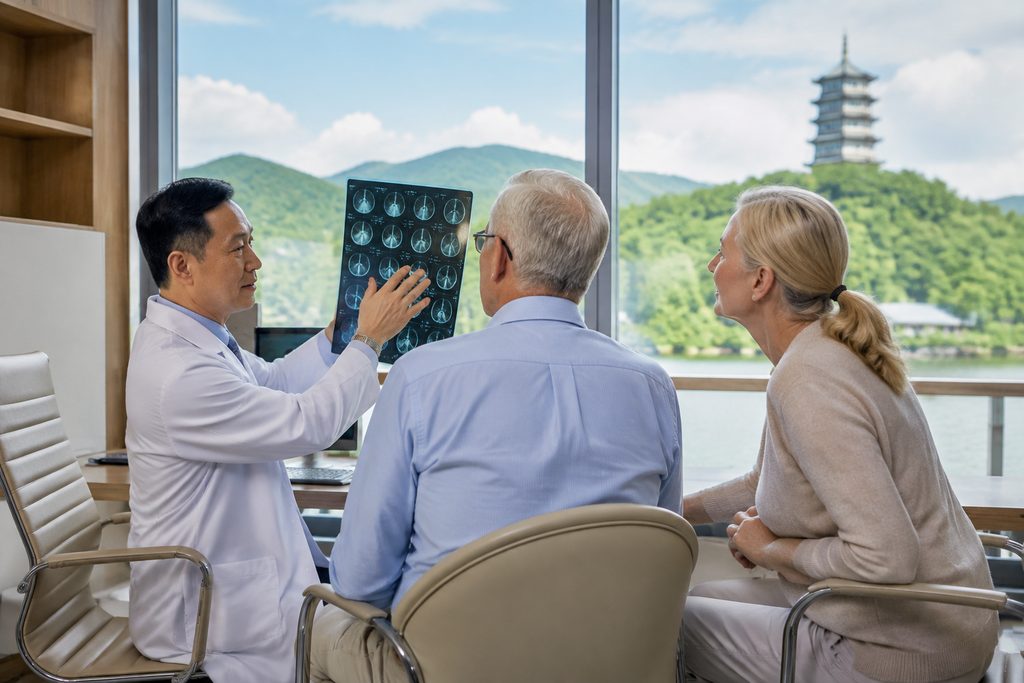
China Medical Tourism 2026: The Numbers Behind the China Surge
Have you ever looked at a medical bill from a Western hospital and felt the system was quietly pricing you out of your own recovery? You are not alone. The cancer treatment cost China 2026 is one of the strongest forces pulling international patients eastward — often 70% to 90% below U.S. list prices for comparable procedures. But cost is only one number in a much larger equation.
What is actually driving the surge? Volume. China’s top hospitals perform procedures at a scale that most Western centers never approach. Fuwai Hospital in Beijing performs more than 14,000 cardiac surgeries annually — the highest volume of any heart center on the planet. That repetition builds a specific kind of clinical muscle. Our team at China Medical Services has spent years helping patients from North America, Europe, the Gulf, and Southeast Asia understand whether that muscle matters for their specific case.
This article breaks down the real numbers behind China’s medical tourism wave in 2026 — costs, wait times, hospital rankings, success rates, and the honest risks. No inflated promises. Just what the data shows and how the process actually works.
How This Actually Works, Step by Step
The path from “considering China” to “recovering at home” follows a sequence most patients don’t anticipate. Here is the real order.
You start by sending your existing medical records — imaging, pathology reports, lab work, discharge summaries. A Chinese specialty team reviews them remotely. For a written second opinion from a top-tier expert, expect to pay between $300 and $500. This is not a prescription; it is an expert reading of your case with treatment direction.
Then comes a video consultation if you want live dialogue. Prices run $100 to $300 for a standard international department, or $500 to $800 for a top specialist. Many patients stop here and make decisions without traveling. That is a legitimate endpoint.
If you decide to proceed with treatment in China, we coordinate the hospital appointment, help with the S2 visa documentation, arrange a bilingual medical companion (from $300 per day), and manage airport transfer ($200 round-trip). You arrive, meet your specialist, undergo any additional testing, and the hospital schedules the procedure. Surgery is never booked before an in-person consultation at a public hospital. That rule is non-negotiable in the Chinese system.
After discharge, follow-up imaging and lab work happen at home. Your Chinese team reviews results remotely. The relationship does not end at the airport.
Cancer Treatment Cost China 2026: What the Data Shows
The cancer treatment cost China 2026 question deserves a direct answer. Prices vary by cancer type, stage, hospital tier, and whether you use the standard public channel or the international/VIP channel. But ranges are available.
A course of radiation therapy for a solid tumor at a top public hospital typically runs $8,000 to $25,000. In the United States, the same course often exceeds $60,000. Complex surgical oncology — say, a radical gastrectomy or liver resection — lands between $15,000 and $40,000 at a top Chinese center. U.S. equivalents frequently pass $150,000. Chemotherapy regimens show similar spreads, though drug costs depend heavily on whether the specific agent is on China’s national reimbursement list.
| Procedure | China (Top Public Hospital) | United States (Average) |
|---|---|---|
| Radiation therapy (solid tumor) | $8,000 – $25,000 | $60,000+ |
| Complex cancer surgery | $15,000 – $40,000 | $150,000+ |
| Cardiac bypass (CABG) | $12,000 – $20,000 | $120,000+ |
| Hip replacement | $8,000 – $15,000 | $40,000 – $60,000 |
| Dental implant (per tooth) | $600 – $1,500 | $3,000 – $5,000 |
But the number that matters more than any price tag is the hospital’s volume in your specific cancer type. Fudan University’s specialty reputation rankings — China’s most authoritative hospital assessment — list top 10 centers for 45 different specialties. For oncology, that means hospitals like Peking Union Medical College Hospital, Zhongshan Hospital Fudan University, and West China Hospital. These are not marketing claims; they are peer-reviewed rankings updated annually. You can browse the full specialty breakdown on our department rankings page.
What the numbers don’t show: how quickly you can start. In China, a top specialist’s outpatient clinic may see 80 to 120 patients in a single morning. That density means your case gets slotted into a system that processes enormous complexity daily. It also means you need someone who speaks the language and knows the floor plan.
A Realistic Timeline
Patients consistently underestimate the pre-arrival phase. Here is what a typical cancer case looks like from first contact to treatment.
| Stage | Typical Duration | What Happens |
|---|---|---|
| Record collection & translation | 3 – 7 days | Gather imaging, pathology, labs. Translate into Chinese for specialist review. |
| Written second opinion | 5 – 10 days | Top specialist reviews records and issues written analysis with treatment direction. |
| Video consultation scheduling | 3 – 14 days | Depends on specialist availability. International department often faster. |
| S2 visa processing | 1 – 4 weeks | Requires hospital invitation letter and supporting medical documents. Varies by embassy. |
| Arrival & first outpatient visit | Day 1 – 3 in China | Meet specialist, complete any missing tests, confirm treatment plan. |
| Surgery scheduling | 1 – 4 weeks after consult | Public hospitals schedule after in-person evaluation. International/VIP channel may be faster. |
| Post-op recovery in China | 1 – 6 weeks | Depends on procedure. Hospital stay plus nearby accommodation for follow-up visits. |
The waiting step people forget is document translation. A pathology report from a U.S. lab means nothing to a Chinese oncologist until it is accurately rendered in Chinese — and back-translated for your own records. Rushed translation leads to misread staging. That is a risk nobody can afford.
What Can Go Wrong — and What Happens Then
Let’s be honest about failure modes. They exist, and knowing them is better than discovering them at 2 a.m. in a hotel room in Shanghai.
The most common problem: you arrive expecting surgery on day three, and the specialist wants a repeat biopsy or a different imaging study first. This happens. Chinese top-tier hospitals often distrust outside imaging quality — not because they are difficult, but because their surgical planning depends on precision. The recourse is simple: do the test. It adds days and cost, but it protects the outcome.
Another failure mode: language breakdown. A public hospital’s registration desk, billing window, and pharmacy do not operate in English. If you are alone, you will burn hours and miss appointments. The fix is a bilingual medical companion, booked in advance, who handles queue tickets, payment, and directions. This is not a luxury. It is logistics.
Payment friction is real. Public hospitals require prepayment deposits before admission. International insurance rarely does direct billing at public facilities. You pay first, then claim reimbursement. Private international hospitals like United Family or Jiahui do direct billing, but their prices run higher. Know which model you are entering before you fly.
And the thing that rarely goes wrong but worries everyone: safety. China’s top 100 hospitals are regulated, inspected, and ranked by Fudan University’s independent methodology. The top 5% of China’s 35,000+ hospitals — that is the pool we work with. JCI accreditation adds another layer for private international facilities. Serious adverse events are rare. But they are not zero, and no honest organization will tell you otherwise.
What Is the Success Rate of IVF in Shanghai and Other High-Stakes Questions
No reputable Chinese public hospital will schedule spine surgery without first examining you in person. What you can do remotely is a written second opinion or video consultation to confirm the surgical plan. Once you arrive and the surgeon evaluates you, the procedure gets scheduled. Any “package” that promises a surgery date before you land is a red flag.
At university-affiliated dental hospitals and JCI-accredited private clinics, implant materials and sterilization standards match international norms, and 10-year success rates exceed 95%. The risk concentrates at low-cost, unaccredited clinics. Verify the facility’s accreditation and ask about implant brand before committing.
Visa outcomes rest with the Chinese embassy or consulate, not with any hospital or service provider. If a delay occurs, we work with the hospital to adjust appointment dates. If a denial occurs, remote consultation fees already paid are credited toward future coordination services — but the visa decision itself is outside anyone’s control except the consular officer.
Private international hospitals with JCI accreditation often bill insurers directly. Public hospitals generally require prepayment, and you submit claims to your insurer afterward. Check your policy’s out-of-network and international treatment clauses before traveling.
Your Next Step
The numbers behind China’s medical tourism surge are real: 340+ top-ranked hospitals across 37 cities, procedure costs at a fraction of Western prices, and specialty volumes that create genuine clinical depth. But numbers don’t make medical decisions — you and your doctors do.
We are China Medical Services, a coordination team that connects international patients with China’s top-tier public and private hospitals. We handle record translation, appointment coordination, bilingual companions, and visa guidance. We do not practice medicine, and we never promise outcomes or guaranteed access to specific specialists.
If you are weighing a specific procedure, start with a free consultation. Tell us your diagnosis, your records, and your goals. We will tell you honestly whether China makes sense for your case — and if it does, what the next 90 days would look like. That conversation costs nothing and commits you to nothing.
Get the facts first. Then decide.
For more medical information and treatment options in China, visit chinamedservices.com (China Medical Services).
