Transport in China for Medical Travel: A Driver Who Knows the Hospitals
Key Takeaways
- A China hospital transfer service with driver typically costs $80–$200 per day or $200 round-trip for airport transfers, depending on city and vehicle type.
- Hospital campuses in China are massive—some span over 70 acres with 20+ buildings—making a driver who knows exact entrances and drop-off zones a genuine time-saver.
- Language remains the biggest barrier: fewer than 1% of Chinese taxi drivers speak functional English, and hospital signage is overwhelmingly Chinese-only.
- You cannot book a standard public hospital outpatient visit from overseas, so your first in-person step is almost always a physical arrival—which is exactly when reliable transport matters most.
The Problem: Getting to the Right Door of the Right Building
When 42-year-old Michael from Manchester landed at Beijing Capital International Airport, he had a folder of medical records, a confirmed appointment at a top cardiology hospital, and no idea that the hospital campus alone covered more ground than his entire neighborhood back home. His hotel concierge handed him a card with the hospital name in Chinese. The taxi driver nodded, drove 40 minutes, and dropped him at the wrong gate. Michael walked 25 minutes through a campus with 30 buildings before finding the international clinic entrance. He nearly missed his consultation.
This is not an isolated story. Beijing’s Peking Union Medical College Hospital sees over 12,000 outpatient visits per day. Shanghai’s Zhongshan Hospital spans multiple city blocks. West China Hospital in Chengdu—one of the largest in the world by bed count—has over 4,300 beds and a footprint that confuses even local residents. Add jet lag, medical anxiety, and zero Chinese literacy, and the simple act of “getting to the hospital” becomes a logistical project.
And the clock matters. Public hospital registration windows often close by mid-morning. Miss your slot, and you may wait days for another opening. That is why a China hospital transfer service with driver is not a luxury add-on. It is a risk-management tool for the first and most fragile hour of your medical journey.
Why a Hospital-Aware Driver Changes the Entire Day
Drivers Who Know Which Gate, Which Building, Which Floor
Chinese hospital campuses are not single buildings. They are compounds. Fuwai Hospital in Beijing—the world’s highest-volume cardiac surgery center with over 14,000 open-heart procedures annually—has separate entrances for emergency, outpatient, inpatient, international, and VIP wings. A driver who has served medical travelers before knows that the international department entrance is on a side street, not the main avenue. That single piece of knowledge saves 20 minutes of walking, often in bad weather, often while fasting for blood work.
Compare this to a standard taxi. Didi drivers—China’s equivalent of Uber—rely on GPS that frequently marks the hospital’s administrative center as the destination. The driver stops, points vaguely, and leaves. You are now on your own in a crowd of thousands.
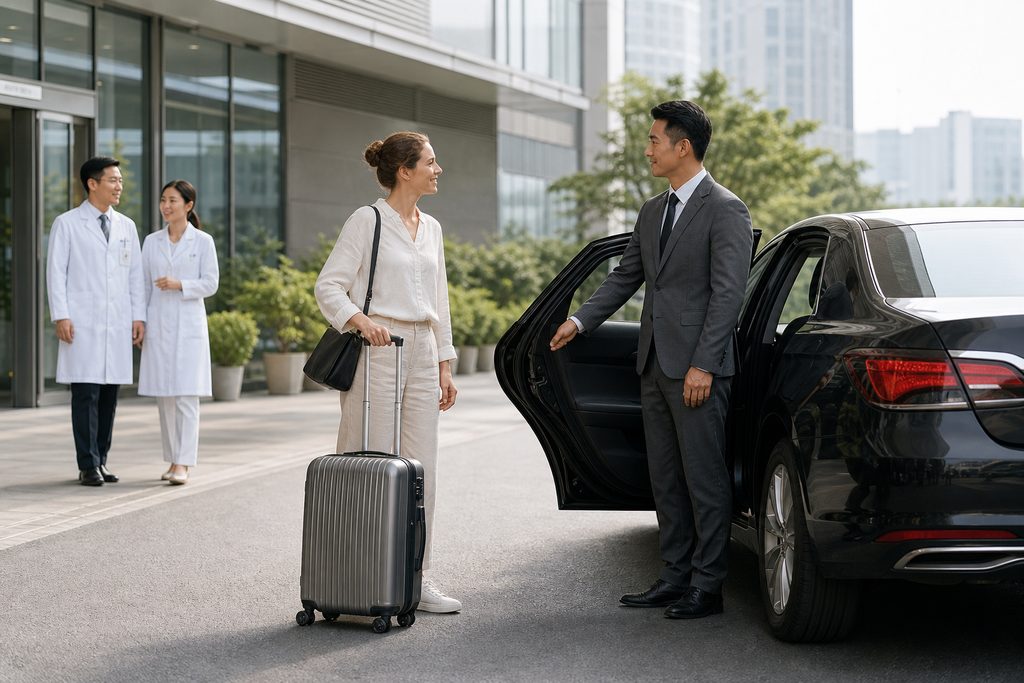
But a private driver who knows hospital locations Beijing or Shanghai operates differently. They have done this route before. They know which entrance is open before 8 a.m., where the wheelchair access ramp is, and which drop-off zone avoids the worst traffic. That is not a small convenience. For a patient with limited mobility or a family member carrying medical imaging CDs, it is the difference between a calm arrival and a stressful scramble.
Language Is the Real Barrier—Not Distance
According to the 2020 Chinese census, less than 1% of the population reports functional English proficiency. Among taxi drivers, that number approaches zero. Hospital signage in public hospitals is almost entirely Chinese. The international departments of top hospitals like Peking Union Medical College Hospital or Ruijin Hospital have some English signage and staff, but reaching those departments still requires navigating a Chinese-language environment.
A driver who has worked with international patients before can serve as a basic bridge. They cannot translate medical terminology, but they can call ahead to confirm the correct building, speak with security guards, and coordinate with your bilingual medical companion if you have one. That last point matters: the best transport service works in tandem with your on-the-ground support, not in isolation.
The Real Cost of Getting It Wrong
Let us put numbers on the failure mode. You arrive at the wrong gate. You walk 30 minutes. You miss your registration window. The hospital reschedules you for three days later. In a public hospital, there is no “customer service” line to fix this—you simply wait. That is three extra nights of hotel costs in Beijing or Shanghai, easily $300–$600. The $100–$200 you would have spent on a hospital-aware driver now looks trivial.
How to Find a Driver Familiar with Hospitals in Shanghai, Beijing, and Beyond
People often ask us: how to find a driver familiar with hospitals in Shanghai? The honest answer: you cannot easily do this from abroad using public apps. Here is what actually works, and what does not.
What Does Not Work Well
Hotel concierges can arrange a car, but they rarely have drivers who specialize in medical routes. The driver knows hotels, tourist sites, and airports. Hospitals? Not their specialty. Rideshare apps like Didi work fine for point-to-point trips, but you cannot specify “driver with hospital experience” as a filter. And the language barrier remains.
Renting a car and driving yourself is technically possible with a Chinese driver’s license—which requires passing a written test that is available in English in some cities. But Chinese traffic, parking scarcity around major hospitals, and the stress of navigating while unwell make this a poor choice for most medical travelers.
What Actually Works
The realistic options are threefold. First, some private international hospitals—like United Family Healthcare or Jiahui—offer their own patient transport services. These are convenient but tied to that specific hospital, and they do not help if you need to visit a top public hospital for a second opinion or specialized surgery.
Second, specialized medical travel agencies and concierge services maintain rosters of drivers who have completed dozens, sometimes hundreds, of hospital transfers. These drivers know the difference between the outpatient building and the imaging center. They know that Fuwai’s international clinic is not at the main address listed on Google Maps. And they often have basic English phrases relevant to medical logistics: “registration,” “blood test,” “pharmacy,” “wheelchair.”
Third, you can book a bilingual medical companion who includes transport coordination as part of the service. This is the most integrated option. The companion meets you at your hotel or the airport, travels with you to the hospital, handles registration, translates during your consultation, and arranges the return trip. The cost of medical transport with hospital escort in China varies—a companion typically runs from $300 per day, while a standalone driver runs $80–$200 per day depending on city and vehicle class.
Step-by-Step: Booking a Medical Driver Before You Fly
So can I hire a driver to take me to my surgery hospital in China? Yes. Here is the sequence that works best, based on what we have coordinated for patients from Europe, the Middle East, and Southeast Asia.
Step 1: Confirm Your Hospital and Department First
Do not book transport before you know exactly which hospital and which department you are visiting. A driver who knows Fuwai’s cardiac surgery building is not automatically useful if your appointment is at the hospital’s vascular medicine clinic in a different wing. Provide the full Chinese hospital name and the specific department. If you have a Chinese appointment confirmation, send a photo of it to your transport coordinator.
Step 2: Decide on Vehicle Type and Escort Level
A standard sedan works for solo travelers with light luggage. A family of three with multiple suitcases needs an SUV or van. If the patient uses a wheelchair, specify that upfront—not all vehicles can accommodate one. And decide whether you want a driver only, or a driver plus a bilingual escort. The driver gets you there. The escort gets you through registration, payment, and the consultation itself.
Step 3: Book the First Trip for the Day Before Your Appointment
We always recommend a practice run. Arrive in the city at least one day before your first hospital visit. Use that day to do the route once with your driver: hotel to hospital, find the exact entrance, time the traffic. This removes almost all first-appointment anxiety. It costs one extra day of driver time, but the return on that investment is a calm, on-time arrival when it actually counts.
Step 4: Plan for the Return Trip
Hospital visits rarely end on schedule. Blood tests run late. Doctors add imaging. Pharmacies have queues. A good medical driver service builds in flexibility—either the driver waits on standby, or you call them 30 minutes before you are ready. Clarify this before booking. A fixed round-trip with a strict return time is a recipe for stress.
What This Costs: A Transparent Breakdown
People searching for a China hospital transfer service with driver usually want numbers. Here they are, based on current market rates for international patient support in major Chinese cities.
| Service | Typical Cost (USD) | What It Includes | Best For |
|---|---|---|---|
| Airport transfer (round-trip) | $200 | Meet-and-greet at arrivals, luggage help, hotel or hospital drop-off | Arrival and departure days |
| Half-day driver (4 hours) | $80–$120 | Point-to-point hospital route, waiting time, basic English | Single appointment with predictable timing |
| Full-day driver (8 hours) | $150–$200 | Multiple stops, standby waiting, hospital entrance knowledge | Multi-department days, surgery admission |
| Bilingual medical companion (full day) | from $300 | Transport coordination, registration, translation, payment assistance | First consultation, surgery day, complex cases |
| VIP end-to-end coordination | $5,000–$8,000 | Complete logistics package including dedicated vehicle and escort | High-acuity cases, executive patients |
These figures vary by hospital and case complexity. A driver in Beijing may cost slightly more than one in Chengdu. A luxury van costs more than a sedan. And a driver who also speaks some English costs more than one who does not. But the range is honest: $80–$200 per day for transport alone, with escort services starting around $300 per day.
For context, the average cost of a single night in a mid-range international hotel in Shanghai is $120–$180. The cost of missing an appointment and extending your stay by even one day exceeds the cost of a full-day driver. That is the math that matters.
Practical Considerations: Documentation, Payment, and Timing
Before you book any transport, get your paperwork in order. For medical travel to China, you will need an S2 visa, which covers short-term private affairs including medical treatment. Family members accompanying you also apply for S2. Processing times vary by embassy, but plan for at least two to four weeks. Your hospital appointment confirmation and a letter from the treating institution can support the application. Do not book non-refundable transport until your visa is approved.
Payment for driver services is typically handled in advance via bank transfer, credit card, or international payment platforms. Cash payments in Chinese yuan are also possible for local bookings, but carrying large amounts of cash is not advisable. If your service provider offers an invoice, keep it—some international insurance policies reimburse medical transport costs when they are documented as part of treatment-related travel.
Timing matters more than you think. Morning traffic in Beijing and Shanghai peaks from 7:30 to 9:30 a.m. If your registration window opens at 8:00, plan to arrive by 7:30. That means leaving your hotel by 6:45 or earlier, depending on distance. A hospital-aware driver already knows this and will suggest a pickup time that accounts for traffic, not just distance.
One caution: Do not assume that booking a driver means you can skip the early arrival. Chinese public hospitals operate on a first-come, first-served basis for registration. The driver gets you there on time. The queue is still the queue.
Frequently Asked Questions
Yes. In fact, that is the recommended approach. Booking from abroad gives you time to confirm the driver’s experience with your specific hospital, arrange payment, and coordinate your arrival. Reputable services will ask for your flight details and appointment confirmation before confirming the booking.
This is common. Chinese hospitals sometimes adjust appointment times with little notice. A good driver service builds flexibility into the day—either by allowing schedule changes within the booked hours or by offering standby waiting. Clarify the change policy before you pay. Avoid services that charge heavy penalties for time adjustments.
Some do, at a basic level. Do not expect medical interpretation from a driver. Their English, if any, covers logistics: “left, right, wait here, this building, pharmacy.” For actual medical conversations, you need a bilingual medical companion or the hospital’s own international department staff. The driver’s value is route knowledge and reliability, not translation.
Yes, when you book through a licensed service or agency. China’s major cities are safe for foreign visitors, and licensed drivers are registered and insured. The risk is not safety but reliability—an unvetted driver may not know hospital layouts or may cancel at the last minute. That is why vetting matters more than price.
Not necessarily. If your hotel is within walking distance of the correct hospital entrance, a driver adds little value. But “near the hospital” is misleading—a hotel may be 500 meters from the hospital’s main gate but 2 kilometers from the international clinic building. Check the exact building location before deciding. If you have mobility issues, heavy luggage, or a tight appointment window, the driver is worth it.
Your Next Step
Transport is the first friction point in a medical journey to China, and it is also the easiest to solve. A China hospital transfer service with driver costs less than a missed appointment, and it removes the single most stressful hour of your trip. Our team at China Medical Services coordinates hospital-aware drivers and bilingual medical companions across 37 cities and 340+ top-ranked hospitals. We are not a hospital and we do not provide diagnoses—we handle the logistics so you can focus on your consultation. When you are ready to plan your arrival, tell us your hospital and appointment date, and we will help you build a transport plan that works.
For more medical information and treatment options in China, visit chinamedservices.com (China Medical Services).
