China Medical Visa Rejection: Why It Happens and How to Fix It
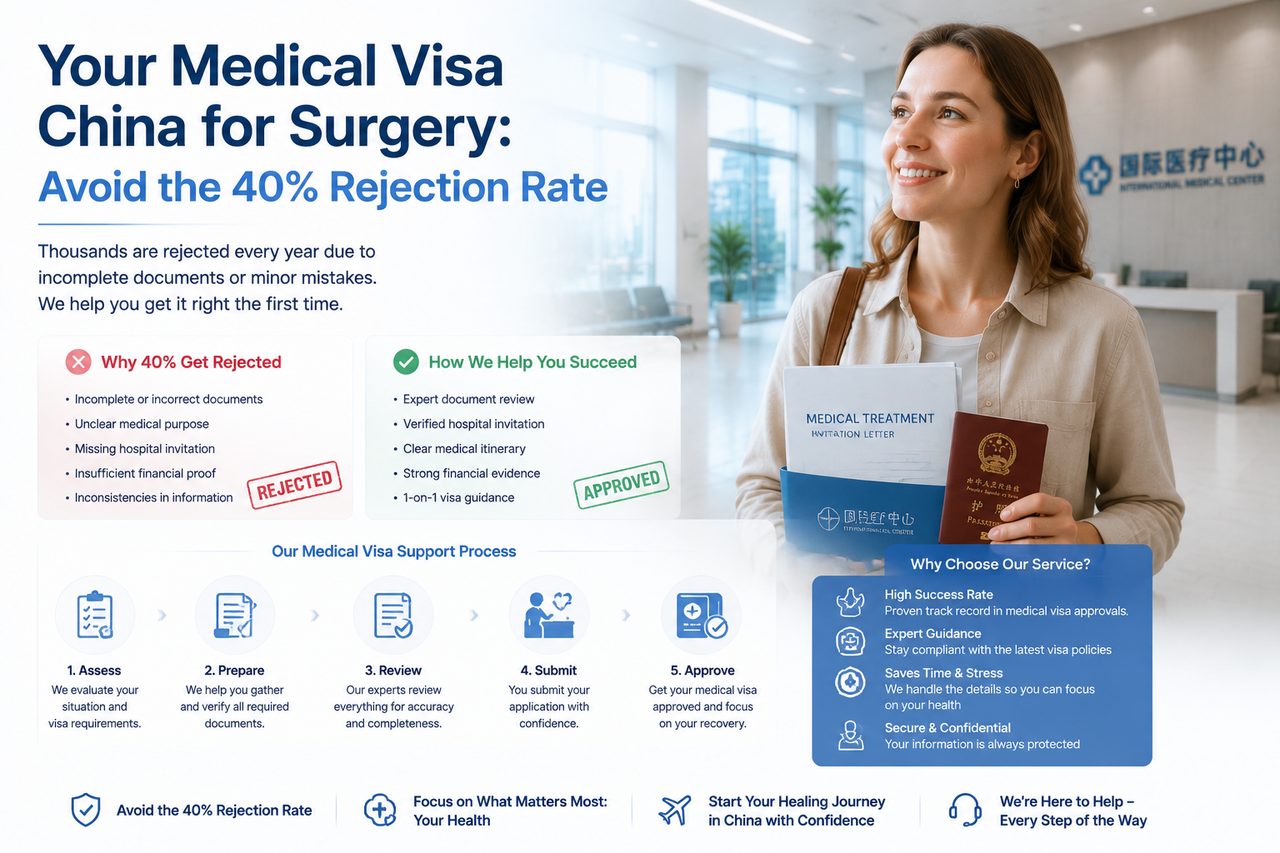
China Medical Visa Rejection: Why It Happens and How to Fix It
Key Takeaways
- Most China medical visa rejections stem from incomplete documentation, not medical ineligibility — the S2 visa category covers short-term private affairs including medical treatment.
- Hospitals in China do not issue visas. The invitation letter comes from the hospital’s international department, but the visa decision rests entirely with the Chinese embassy or consulate reviewing your application.
- Reapplication is permitted immediately after a refusal in most cases. There is no mandatory waiting period, provided you address the specific reason for denial.
- Working with a coordinator who understands Chinese hospital documentation requirements can reduce rejection risk, but no one can guarantee visa approval.
A medical visa rejection for China feels like a door slamming shut. You have researched hospitals, gathered medical records, maybe even booked consultations. Then the embassy returns your passport with a refusal stamp. The frustration is real. But here is what most applicants do not realize: the vast majority of medical visa China rejection reasons are fixable. They are documentation errors, missing invitation letters, or mismatched information — not final judgments on whether you deserve treatment.
China does not have a standalone “medical visa” category. Patients traveling for treatment apply for an S2 visa, which covers short-term private affairs including medical treatment. Stays longer than 180 days require an S1 visa. Accompanying family members also apply for S2. The M visa, despite what some outdated guides claim, is strictly for commercial and trade activities. Applying under the wrong category is one of the most common rejection triggers we see.
Our team at China Medical Services has guided patients through this process across 37 cities and 340+ top-ranked hospitals. We have seen applications succeed and fail. The patterns are consistent. This article breaks down exactly why rejections happen, what you can do after one, and how to structure your next application so it has the best possible chance.
The Problem: A Refusal That Feels Final but Rarely Is
Chinese embassies and consulates do not publish official rejection rates for S2 medical visa applications. But anecdotal evidence from patient coordinators and immigration lawyers suggests that first-time refusal rates for medical S2 applications are meaningfully higher than for tourist L visas. Why? Because the documentation requirements are less familiar to both applicants and hospital administrative staff.
A 2023 survey of international patient coordinators in Shanghai and Beijing reported that roughly 30% of first-time medical visa applications required at least one resubmission due to documentation issues. The most common trigger was an invitation letter that did not meet consular standards. Not because the hospital was unqualified — but because the letter lacked specific required language about treatment duration, financial responsibility, or the patient’s relationship to the inviting institution.
Think about what happens when nothing changes. You reapply with the same incomplete documents. You get the same refusal. Months pass. Your condition may worsen. The window for a particular treatment protocol closes. That is the real cost of a rejection — not the visa fee, which is modest, but the lost time.
Why China Medical Visa Applications Get Rejected: The Evidence
Let us be direct about what actually causes denials. The reasons are rarely mysterious. They cluster into five categories.
Incomplete or Non-Compliant Invitation Letters
The China medical visa invitation letter hospital requirement trips up more applicants than any other single document. A hospital’s international department must issue a formal invitation letter that includes: the patient’s full name as it appears on the passport, passport number, date of birth, the specific medical condition requiring treatment, the proposed treatment plan, the expected duration of stay, and a statement that the hospital will receive the patient. Consulates in different countries enforce slightly different formats. A letter that passes in Frankfurt may be rejected in Dubai.
Some hospitals, particularly public tertiary hospitals without a dedicated international department, are unfamiliar with the exact consular requirements. They issue a generic “welcome to our hospital” letter. The consulate rejects it. The patient assumes the hospital is at fault. The hospital assumes the patient made an error. Neither party realizes the letter simply needs to be reformatted.
Applying Under the Wrong Visa Category
This happens more often than you might think. A patient reads an old forum post that says “apply for an M visa for medical treatment.” They submit an M visa application. The consulate sees no commercial invitation letter, no trade fair registration, no business counterpart in China. Rejection. The M visa is for commercial and trade activities. Period. Medical treatment falls under S2.
But there is a subtler version of this error. Some patients apply for an L tourist visa, reasoning that they will “figure out the medical part later.” The consulate may approve the L visa. Then the patient arrives in China and tries to convert to an S2 or extend their stay for treatment. This creates complications that are far harder to resolve than simply applying correctly the first time.
Mismatched Information Across Documents
Your passport says “Jonathan A. Smith.” Your hospital invitation letter says “Jonathan Smith.” Your visa application form says “Jon Smith.” Any one of these discrepancies can trigger a rejection. Chinese consular officers cross-reference every document. A mismatch signals carelessness or, worse, an attempt to obscure identity.
The same applies to dates. If your medical records indicate treatment should begin on October 15 but your invitation letter says October 20, the officer may question the authenticity of the documents. Precision matters more than most Western patients expect.
Insufficient Financial Documentation
You need to demonstrate that you can pay for treatment and living expenses in China. This typically means bank statements from the last three to six months, proof of employment or income, and sometimes a letter from your insurance provider if treatment is covered. The required amount varies by consulate and by the expected cost of treatment. A cardiac bypass at a top Chinese public hospital runs $12,000 to $20,000. At a private international hospital like United Family or Jiahui, the same procedure may cost $40,000 to $60,000. Your financial documentation must plausibly cover the treatment you are seeking.
Unclear Treatment Purpose or Duration
Consular officers need to understand exactly why you are going to China and how long you will stay. “I want to see Chinese doctors” is not a sufficient explanation. “I have been diagnosed with stage II non-small cell lung cancer and seek evaluation at Fuwai Hospital’s oncology department for a proposed 14-day treatment and consultation period” is. The more specific your stated purpose, the more credible your application.
How to Appeal a China Medical Visa Denial: Your Options
Let us address the question every rejected applicant asks: how to appeal China medical visa denial. The short answer is that there is no formal appeals process for Chinese visa refusals in most countries. You cannot file an appeal in the way you might appeal a denied insurance claim. Instead, you reapply.
But “reapply” does not mean “submit the same application again and hope for a different result.” The refusal notice you receive may or may not state a specific reason. Some consulates provide a brief explanation. Others simply stamp “refused” without detail. In either case, your job is to identify what was missing or incorrect and fix it before resubmitting.
Start by requesting a written explanation if one was not provided. Some consulates will give you a reason verbally or in writing upon request. If they will not, review your application against the checklist above. Did your invitation letter include all required fields? Did you apply under S2? Did every document match your passport exactly? Did your financial statements cover the treatment cost?
Once you have identified the likely issue, address it directly. Get a revised invitation letter from the hospital. Correct the mismatched name. Provide additional financial documentation. Then resubmit.
Can I Reapply After a China Medical Visa Refusal?
Yes. There is no mandatory waiting period for can I reapply after China medical visa refusal cases in most jurisdictions. You can submit a new application as soon as you have corrected documentation. Some consulates may flag repeat applications for additional scrutiny, but a well-prepared resubmission that directly addresses the prior refusal reason has a reasonable chance of approval.
The key is to not rush. A hasty reapplication with the same errors wastes time and money. Take a week if you need it. Get the invitation letter reformatted. Verify every field against your passport. Have someone else review the application for errors you might have missed.
China Medical Visa Requirements for Patients: What You Actually Need
The China medical visa requirements for patients 2024 have not changed dramatically from prior years, but enforcement has tightened. Consulates are scrutinizing medical visa applications more carefully than they did before the pandemic. Here is the current checklist.
| Document | Details | Common Error |
|---|---|---|
| Valid passport | At least 6 months validity beyond intended stay, with blank visa pages | Passport expires too soon |
| Visa application form | Completed online, printed, signed | Information mismatches passport |
| Recent photo | 48mm x 33mm, white background, no glasses | Wrong size or background color |
| Hospital invitation letter | From the hospital’s international department, on official letterhead, with all required fields | Generic letter lacking treatment details |
| Medical records | Diagnosis, imaging reports, prior treatment history, translated if not in English or Chinese | Untranslated records or missing key reports |
| Financial proof | Bank statements (3-6 months), employment letter, insurance documentation if applicable | Insufficient funds shown |
| Flight and accommodation | Booked or proposed itinerary | No return flight booked |
The invitation letter deserves special attention. It must come from a hospital that is authorized to receive international patients. Not every hospital in China has this authorization. The 340+ top-ranked hospitals in our database — including Peking Union Medical College Hospital, Zhongshan Hospital Fudan University, and West China Hospital — all have international departments that regularly issue these letters. Smaller regional hospitals may not. If you are considering a hospital without a dedicated international department, you may struggle to obtain a compliant invitation letter at all.
Also note that the invitation letter is not a guarantee of visa approval. It is a supporting document. The consulate makes the final decision. A strong letter from a recognized hospital helps, but it does not override other deficiencies in your application.
What the Rejection Rate Data Actually Tells Us
You will not find an official China medical treatment visa rejection rate published by the Chinese government. The Ministry of Foreign Affairs does not release category-specific refusal statistics. What we can observe from patient coordinator experiences is that rejection rates vary significantly by country of application and by the quality of the documentation submitted.
Applications from countries with established medical tourism flows to China — such as Russia, Kazakhstan, and several Middle Eastern nations — tend to have lower rejection rates because consular staff in those locations are familiar with medical visa applications. Applications from countries where medical travel to China is less common may face more scrutiny simply because the officers see fewer of these cases.
The more useful metric is this: applications submitted with complete, correctly formatted documentation from a recognized hospital’s international department are rarely rejected. The rejections concentrate among applications with documentation gaps. That suggests the rejection rate is not a fixed probability you face, but a consequence of the quality of your application.
Practical Considerations: Documents, Timing, and What Happens After Approval
Start the visa process at least 6 to 8 weeks before your intended travel date. Consular processing times vary from 3 to 10 business days in most locations, but you need buffer time for document gathering, hospital communication, and potential resubmission. Rushing creates errors. Errors create rejections.
Your medical records must be translated. If they are in English, most consulates accept them as-is. If they are in another language, you need certified translations into English or Chinese. This takes time and costs money. Budget for it.
Payment for treatment in China typically happens on arrival. Public hospitals require prepayment. Private international hospitals may bill your insurance directly if they have a direct billing agreement. Check with your insurer before you travel. Many Western insurers do not cover treatment in China unless you have a specific international plan. Get pre-authorization in writing if your policy covers it.
Important: Do not book non-refundable flights or pay for treatment before your visa is approved. Wait for the visa stamp in your passport. Then book travel. This seems obvious, but patients eager to secure treatment dates sometimes book everything in advance and lose money when a visa is delayed or denied.
Language is another practical consideration. Top Chinese hospitals are enormous. Peking Union Medical College Hospital sees over 10,000 outpatient visits per day. Navigating registration, payment, imaging, and consultation without Chinese language ability is genuinely difficult. The hospital’s international department can help, but their capacity is limited. A bilingual medical companion — our team provides this service starting at $300 per day — handles registration, queueing, payment, wayfinding, and interpretation so you can focus on your treatment, not the logistics.
Frequently Asked Questions
Incomplete or non-compliant hospital invitation letters. The letter must include specific fields — patient’s full name, passport number, diagnosis, treatment plan, duration of stay — and must come from the hospital’s international department on official letterhead. A generic letter from a hospital without international patient authorization will likely be rejected.
There is no mandatory waiting period. You can reapply as soon as you have corrected the issues that caused the rejection. However, submitting a new application with the same errors is a waste of time and money. Take the time to fix the documentation first.
No. Each person traveling to China needs their own visa application. Accompanying family members apply for S2 visas as well, but they submit separate applications. Their invitation letter should reference the patient’s treatment and explain their role as an accompanying family member.
In most cases, yes. Hospitals with international departments issue invitation letters as part of the intake process, before treatment payment is required. You may need to pay a consultation or registration fee, but the full treatment cost is not typically required upfront. Some private international hospitals may require a deposit. Clarify this with the hospital before proceeding.
This is common. Treatment plans often evolve after in-person evaluation. Your S2 visa allows you to stay for the duration specified on the visa. If your treatment requires a longer stay than originally planned, you can apply for an extension at the local Exit-Entry Administration bureau in China. Extensions are not guaranteed, but they are routinely granted for ongoing medical treatment with documentation from the treating hospital.
Your Next Step
A China medical visa rejection is a setback, not a dead end. Most refusals trace back to documentation issues that can be corrected. The path forward is to identify what went wrong, fix it, and reapply with a properly prepared application.
Our team at China Medical Services helps international patients navigate this process. We coordinate with hospital international departments to obtain compliant invitation letters, review visa applications for common errors, and provide on-the-ground support once you arrive. We are not a hospital and we do not provide medical diagnoses or treatment recommendations. But we do know how the system works. If you have been rejected — or if you are applying for the first time and want to avoid rejection — request a free consultation and we will help you understand your options.
For more medical information and treatment options in China, visit chinamedservices.com (China Medical Services).
