Remote Treatment Plan From China Specialists: How the Review Service Works
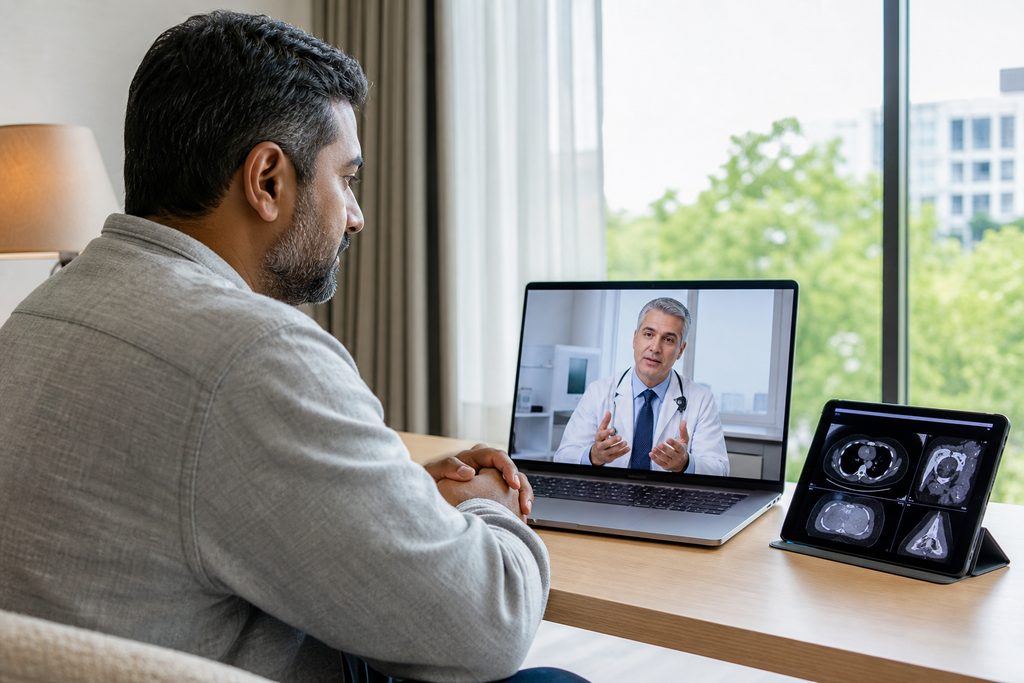
When 42-year-old Michael first heard the diagnosis, he had no idea where to start looking for treatment options beyond his local hospital. A cardiac surgeon in Houston had recommended a complex valve repair. Michael wanted certainty. He began searching for alternatives and stumbled onto the question that thousands of patients ask every year: can a top specialist in another country review my case without me flying there first?
The answer is yes. A remote review from a Chinese specialist is not a gimmick. It is a structured, document-based process where you send existing medical records to a hospital department, and a senior physician returns a written analysis with treatment direction. The China specialist remote second opinion cost typically ranges from $300 to $800 depending on the hospital tier and whether you need a video component. That single data point matters less than what you actually receive for it.
How This Actually Works, Step by Step
You do not book a flight first. You do not need a visa yet. The sequence starts with documents.
First, you gather everything: MRI or CT images in DICOM format, pathology slides if relevant, blood work, surgical notes, current medication list, and a brief summary of your history. If records are not in English, professional translation is arranged. Our team coordinates this.
Second, the records go to a specific department — not a generic intake desk. If Michael needs a cardiac valve opinion, his file goes to a cardiac surgery unit at a hospital with documented volume in that procedure. The reviewing physician is a senior specialist, not a junior resident.
Third, you receive a written report. It includes a diagnosis assessment, whether the proposed treatment in your home country aligns with current Chinese practice, alternative approaches available in China, and a recommended next step. You can then schedule a video consultation to discuss the findings directly.
The output is a treatment plan, not a prescription. It gives you a second lens on a life-altering decision.
Getting a Treatment Plan from China Specialists: Remote Review Service Explained
Patients often ask us what “remote review” actually produces. Is it a PDF? A phone call? A formal hospital document?
It depends on the service tier. A written second opinion from a top-tier hospital specialist costs $300 to $500. The report is typically 3 to 8 pages, written in English, and signed by the reviewing department. It references your specific imaging and lab values. It is for reference only — not a prescription — but it carries enough clinical specificity to bring back to your home oncologist or surgeon.
A video consultation adds a live conversation. Prices run $100 to $300 for standard international departments and $500 to $800 for top-specialist video sessions. During the call, you can ask the doctor directly: “Why do you recommend this over what my local team proposed?” That conversation often uncovers nuance that a written report cannot convey.
For complex cases, a multidisciplinary team (MDT) video consultation costs $1,500 to $2,000. Three or more specialists review your file together — surgery, oncology, radiology — and present a coordinated view. This mirrors how China’s large public hospitals actually make treatment decisions internally.
But here is the honest part: no remote review can replace an in-person examination. A Chinese doctor reviewing your MRI online can assess the images. They cannot palpate a mass, listen to a murmur, or observe how you walk into the room. The remote step narrows uncertainty. It does not eliminate it.
A Realistic Timeline
Patients consistently underestimate how long document preparation takes. Here is what actually happens.
| Stage | What Happens | Realistic Duration |
|---|---|---|
| Days 1–5 | You collect and upload records. Missing items are identified. | 3–5 days |
| Days 5–10 | Translation and clinical summary preparation. | 2–5 days |
| Days 10–14 | Department confirms receiving physician and review slot. | 3–5 days |
| Days 14–24 | Specialist reviews records and prepares written opinion. | 5–10 days |
| Days 24–31 | Report delivered. Optional video consultation scheduled. | 3–7 days |
| Month 2 | If you decide to travel, S2 visa processing begins. | 2–6 weeks |
| Month 3 | In-person consultation and treatment planning in China. | Varies |
The waiting steps people forget: translation is not instant for complex oncology or neurology records. Hospital departments in China operate at enormous volume — a single outpatient day can see 10,000 patients at a major public hospital. A remote review slots into that schedule, not ahead of it. And visa processing for medical travel requires supporting documents from the receiving hospital, which cannot be issued until the remote review is complete.
What Can Go Wrong — and What Happens Then
Remote review fails in predictable ways. Knowing them in advance saves you weeks.
The most common failure: incomplete records. A specialist receives a CD of images but no written report. Or a pathology slide without the immunohistochemistry panel. The review stalls. The fix is straightforward — our team checks for completeness before submission and sends a specific list of missing items within 48 hours.
The second failure: expectation mismatch. A patient expects a definitive “this is exactly what you should do.” Instead, the report says “the proposed approach is reasonable; consider these two modifications.” That is a successful second opinion. It confirms or refines, rather than replaces.
The third failure: the reviewing physician recommends an in-person visit for further testing. This is not a failure of the remote model — it is the honest output. Some conditions cannot be assessed remotely. When that happens, we provide the exact next steps: which hospital, which department, what additional imaging to bring.
And occasionally, the report conflicts with your local team’s recommendation. That is uncomfortable. But it is precisely why you sought a second opinion. You now have two documented views to weigh.
How to Evaluate Whether a Remote Review Is Worth the China Specialist Remote Second Opinion Cost
Not every case benefits from a remote review. Here is how to decide.
Ask yourself: would a second opinion change my decision? If you are facing a high-risk surgery, a cancer diagnosis with multiple treatment pathways, or a rare condition your local hospital sees twice a year, the answer is usually yes. If you have a straightforward condition with a standard treatment protocol, a remote review may add little.
Consider volume. Chinese top-tier hospitals handle case volumes that dwarf most Western centers. Fuwai Hospital in Beijing performs over 14,000 cardiac surgeries annually — more than any other center globally. A specialist there has seen variations of your condition that a regional hospital in Europe or North America might encounter once a decade. That depth informs the review.
Also weigh the cost against the decision at stake. A $500 written second opinion against a $120,000 cardiac surgery is a rounding error. Against a $2,000 outpatient procedure, it may not be justified.
The best hospitals in China for remote consultation are concentrated in Beijing, Shanghai, and Guangzhou. Fudan University‘s hospital rankings place 21 of the top 100 comprehensive hospitals in Beijing, 18 in Shanghai, and 10 in Guangzhou. For specialty-specific reviews, the department-level rankings across 45 specialties matter more than the overall hospital rank.
One more consideration: can a Chinese doctor review my MRI online and give meaningful feedback? For most imaging-based questions — tumor margins, vascular anatomy, fracture classification — yes. The images speak for themselves. For functional or symptom-driven conditions, the video component becomes essential.
Practical Considerations: Records, Visa, Payment, and Follow-Up
The remote review itself requires no visa. You are not entering China. But if the review leads to an in-person visit, the S2 visa applies for medical treatment purposes, with S1 for stays exceeding 180 days. Family members accompanying you also apply under S2. Supporting documents from the receiving hospital are required — which is why the remote review must come first.
Payment for the remote review is typically made in advance via bank transfer or card. Public hospitals in China operate on a prepayment model. The fee covers the physician’s review time, translation, and report preparation. It does not cover any treatment that may follow.
Insurance is a mixed picture. Some international insurers reimburse written second opinions if pre-authorized. Many do not. We provide itemized invoices that meet most insurers’ documentation requirements, but we cannot guarantee reimbursement.
Language is handled. Reports are delivered in English. Video consultations include interpretation when needed. That said, if you later travel to China, the value of a bilingual companion becomes obvious — public hospital corridors, registration windows, and pharmacy queues operate entirely in Chinese. The remote step is the one part of the journey where language is not a barrier.
Follow-up after the remote review matters. You may have questions after reading the report. A follow-up written query or a brief video session can address them. We also support the transition to in-person care if you choose to proceed — including coordination of appointments and on-the-ground support. Any remote consultation fee is credited in full toward on-the-ground coordination services if you travel within 90 days. That credit applies to coordination only, never to hospital treatment charges.
For context on where you might eventually go, our database of 340+ top-ranked hospitals across 37 cities is organized by city and specialty. The remote review is the first step. It tells you whether the trip is worth making.
Frequently Asked Questions
A written second opinion from a top-tier hospital specialist typically costs $300 to $500. Video consultations range from $100 to $300 for standard international departments, and $500 to $800 for top-specialist sessions. Multidisciplinary team reviews cost $1,500 to $2,000. Final pricing varies by hospital and case complexity.
Yes. DICOM imaging files can be reviewed remotely, and for many conditions — tumors, vascular disease, orthopedic injuries — the images carry the diagnostic weight. The reviewing physician will tell you if an in-person examination is necessary for a complete assessment.
The written opinion is for reference only. It is not a prescription and does not replace your local physician’s authority. Its value is clinical: a second expert view that you can bring to your own medical team for discussion.
That is a useful outcome, not a problem. You now have two documented expert views. The disagreement itself clarifies what is uncertain about your case. You decide, with your local team, which path to follow.
No. The remote review happens entirely online. A visa becomes relevant only if you later decide to travel to China for in-person treatment, at which point the S2 visa category applies.
Your Next Step
A remote review from a Chinese specialist is the lowest-cost, lowest-risk way to test whether treatment in China makes sense for you. You get a documented second opinion from physicians working in hospitals that handle case volumes most Western centers never see.
We are China Medical Services. We do not practice medicine and we do not promise outcomes. What we do is coordinate: records, translation, hospital communication, and the logistics that make a remote review possible. If you want to know whether your case is suitable for remote evaluation, start with a conversation. Send us your diagnosis and current treatment status. We will tell you honestly whether a remote review is worth your time and money.
For more medical information and treatment options in China, visit chinamedservices.com (China Medical Services).
