China vs Thailand for Medical Travel: Language and Support
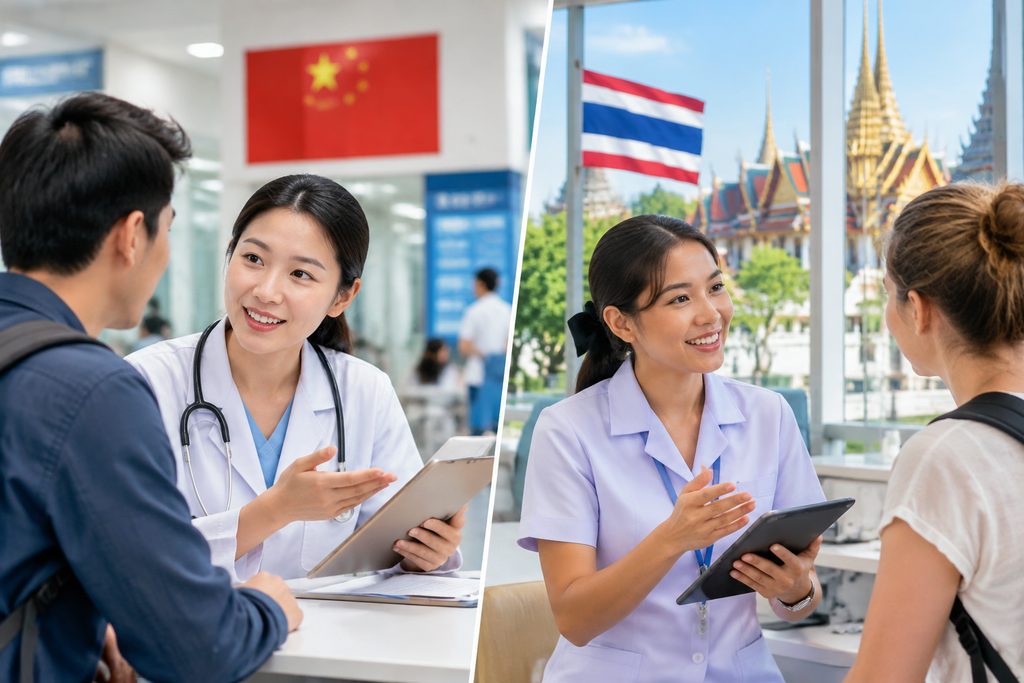
China vs Thailand for Medical Travel: Language and Support
When 54-year-old David from Portland tore his rotator cuff and learned the wait for surgery at home stretched past five months, he did what most people do: he opened a browser. Within an hour he had two tabs side by side — one for Bangkok, one for Shanghai. The prices looked similar. The hospitals both looked modern. What he couldn’t figure out was simpler and scarier. Who would actually talk to him once he landed? That question — China vs Thailand: language and support — is where the two destinations genuinely diverge, and it’s the part most comparison articles skip.
Here’s the short answer. Thailand has a longer, more polished history of hosting foreign patients, and its private hospitals are built around English from the front desk to the discharge summary. China’s top public hospitals are larger, often cheaper for complex surgery, and home to some of the highest-volume specialists on earth — but they were designed for Chinese-speaking patients first. English exists, unevenly. The support layer you bring with you matters more in China than in Thailand.
China vs Thailand: Language and Support — The Short Answer
If your procedure is straightforward, your budget is flexible, and you want an experience that feels like a Western hospital with a tropical setting, Thailand’s private hospitals are hard to beat on language comfort. English-speaking staff are standard, not exceptional.
If your case is complex — cardiac surgery, oncology, a rare diagnosis — China’s top-tier hospitals offer specialist depth and volume that few places can match, at prices that frequently undercut both Thailand and the West. The trade-off is that you will be navigating a system where English is a bonus, not a baseline. Bilingual support isn’t a nice-to-have there. It’s the difference between understanding your own treatment plan and nodding along to it.
Key takeaway: Thailand sells convenience in English. China sells specialist depth, with language support you usually have to arrange deliberately. Neither is “better” — they solve different problems.
Who This Is Right For — and Who It Isn’t
Medical travel isn’t for everyone, and being honest about that saves people money and heartache.
You’re likely a good fit for China if:
- You need a high-complexity procedure where surgical volume and specialist experience matter — cardiac, oncologic, orthopedic, or neurosurgical cases.
- Cost is a real constraint and you’re comparing against US or European quotes.
- You’re willing to work with a coordinator or bring your own interpreter rather than expecting fluent English everywhere.
- You can travel with a companion, or you’re comfortable being accompanied by a professional bilingual assistant.
You should probably look elsewhere — including staying home — if:
- Your condition is stable and treatable locally without a long wait. Travel adds risk for no clinical gain.
- You have a medical contraindication to long-haul flights, such as recent cardiac events or unstable clotting disorders.
- You need urgent, same-week intervention. No international pathway moves that fast, in China or Thailand.
- You’re unwilling to share full medical records. No reputable hospital anywhere will operate blind.
The Options, Compared
Numbers beat adjectives. The table below reflects typical patterns, not quotes — every figure varies by hospital and case complexity.
| Factor | China (top public hospitals) | Thailand (private international hospitals) |
|---|---|---|
| English at registration | Limited; international departments handle it | Standard across most private facilities |
| English-speaking doctors | Common among senior specialists; less so in routine clinics | Widely available |
| Interpreter needed? | Usually yes, for anything beyond basic visits | Rarely |
| Typical cardiac bypass cost | $12,000–$20,000 at top public hospitals | Often $25,000–$40,000 |
| Specialist volume | Extremely high — some centers perform 14,000+ cardiac surgeries yearly | Solid, but lower per-center volume |
| Insurance billing | Mostly pay-first, reimburse later | Direct billing common at JCI hospitals |
| Best suited to | Complex, cost-sensitive surgical cases | Simpler procedures, comfort-first travelers |
Read that table by column, not by row. If your priority is a smooth English-language experience from arrival to discharge, Thailand’s column wins. If your priority is access to a specialist who has done your exact operation thousands of times, at a fraction of Western pricing, China’s column is the one to study.
Where Language Support Actually Breaks Down in China
This is the part David couldn’t find in any comparison blog. China’s best hospitals are enormous. A single outpatient day at a major center can exceed 10,000 visits. Signage is in Chinese. Queue systems are in Chinese. Payment kiosks are in Chinese. The international department smooths this for VIP and foreign patients, but it operates at roughly 1.5 to 2 times the standard-channel price — and it’s the realistic route if you want to lock in a specialist appointment before you fly.
Outside the international department, the rule most foreign patients don’t learn until too late is this: standard outpatient slots generally cannot be booked from overseas in advance. You queue on the day. Surgery follows an in-person consultation, not a phone call. That’s not bureaucracy for its own sake — it’s how a system handling this volume keeps order.
Anyone promising you a guaranteed surgical date at a Chinese public hospital before you’ve been seen in person is overpromising. What a good coordinator can do is prepare your records, register you, and get you in front of the right department efficiently.
For a fuller picture of how the hospital tiers differ, our guide to China’s top-ranked hospitals by city breaks the landscape down by region and specialty.
What It Costs — and What’s Included
Language support in China is a line item, not a free perk. Budget for it honestly.
- Bilingual medical companion: from $300 per day (half-day or full-day), covering registration, queuing, payment, wayfinding, translation, and accompaniment. This does not guarantee a specific specialist.
- Airport transfer: $200 round-trip.
- Written second opinion from a top-hospital specialist: $300–$500. For reference only, not a prescription.
- Video consultation with a standard international department: $100–$300; with a top specialist, $500–$800.
- Multidisciplinary team consultation: $1,500–$2,000.
- Hospital appointment coordination: from $300, refunded in full if the booking can’t be secured.
One mechanism worth knowing: any consultation fee is credited in full toward on-the-ground coordination if you travel within 90 days. It’s a one-time credit applied to the coordination fee only — never to hospital treatment charges.
By contrast, Thailand’s private hospitals typically fold basic interpretation into the room rate. You pay more per procedure, but less in visible add-ons. Different accounting, similar total in many cases.
Practical Considerations: Records, Visas, and Follow-Up
Documentation is where preparation pays off. Gather imaging on disc, pathology slides, operative notes, and current medication lists — translated into Chinese where possible. A written second opinion is only as good as the records behind it.
On visas: foreign patients traveling to China for treatment generally use the S2 category, annotated for medical purposes, with S1 for stays exceeding 180 days. Accompanying family members apply under S2 as well. Requirements shift, so confirm current rules with the nearest Chinese embassy or consulate and bring supporting hospital documents. Note that the M visa is for commercial and trade activity — it has nothing to do with medical treatment, despite what some outdated forums claim.
Payment at public hospitals is typically upfront, with insurance reimbursement handled afterward at home. Private international hospitals in China more often offer direct billing. Plan your cash flow accordingly, and check whether your insurer covers treatment abroad at all.
Follow-up deserves a plan before you leave. Ask for your imaging, operative reports, and discharge summary in English, and confirm who at home will manage your recovery. For patients combining surgery with rehabilitation, some choose to add a traditional Chinese medicine recovery program — acupuncture and herbal support for post-operative recovery are offered at dedicated TCM hospitals.
Frequently Asked Questions
In international departments and private hospitals, largely yes. In standard public hospital clinics, no. Registration, payment, and pharmacy counters are Chinese-language environments, and staff rarely speak English. Budget for an interpreter or a bilingual companion if you’re going the public route.
Usually not for complex procedures. China’s top public hospitals often come in below Thailand’s private international hospitals for high-complexity surgery, sometimes substantially. For simpler procedures, the gap narrows or reverses once you add China’s interpretation and coordination costs.
This is the real risk of any medical travel, in either country. Establish a local physician before you leave, carry complete English-language records, and clarify in writing who handles complications. Neither China nor Thailand offers automatic follow-up once you’re back in your home country.
Your Next Step
The honest summary: Thailand wins on effortless English, China wins on specialist depth and complex-surgery pricing — and in China, the language gap is bridgeable with the right support. That’s the whole comparison in two sentences.
We’re China Medical Services, a coordination service, not a hospital. We don’t diagnose or treat anyone. What we do is match your case to the right department, arrange written second opinions and video consultations, and provide bilingual companions who sit beside you through registration, payment, and discharge. If you’d like to talk through your situation before committing to anything, start with a free consultation — no pressure, and no obligation to travel.
For more medical information and treatment options in China, visit chinamedservices.com (China Medical Services).
