Chinese Hospital Pharmacy: How to Get Your Discharge Meds as a Foreigner
Key Takeaways
- Filling a discharge prescription in a Chinese public hospital typically costs 60-80% less than comparable US pharmacy prices, with many common generics priced under $10.
- Foreigners can absolutely pick up medications from hospital pharmacies, but the process is almost entirely in Chinese and requires navigating a specific sequence of payment and collection windows.
- The biggest bottleneck is not eligibility — it is language. Misreading a single character on a prescription can mean receiving the wrong medication or dosage.
- You cannot take a Chinese hospital prescription to a retail pharmacy like Walgreens back home. These are domestic prescriptions filled on-site before you leave the building.
The Problem: Walking Out the Door Without Your Medication
You have just been discharged from a top-ranked Chinese hospital. The surgery went well. The nursing care was attentive. Then you are handed a slip of paper covered in Chinese characters and pointed toward a crowded hallway. That slip is your prescription. And somewhere in this massive hospital complex, there is a pharmacy window where you are supposed to exchange it for your post-operative medications. No one speaks English. The signs are all in Mandarin. Your ride to the hotel is waiting outside.
This is not a hypothetical scenario. According to China’s National Health Commission, the country’s tertiary hospitals handle over 2.5 billion outpatient and inpatient visits annually. A growing fraction of those are international patients. Shanghai alone recorded over 200,000 medical visits by foreigners in 2019 before the pandemic temporarily disrupted travel. Every one of those patients who was admitted for treatment eventually faced the same moment: standing in a hospital lobby with a prescription in hand, trying to figure out how to get prescription filled at Chinese hospital pharmacy counters before their discharge window closes.
Getting it wrong is not just inconvenient. Post-surgical antibiotics, anticoagulants, and pain management drugs are not optional. Missing even a single dose because you could not navigate the pharmacy system can lead to complications, readmission, or worse. And unlike in many Western countries, you cannot simply take that prescription to a CVS or Boots down the street. Chinese hospital discharge prescriptions are filled at the hospital’s own pharmacy — period.
Why the Chinese Hospital Pharmacy System Works This Way
The structure feels foreign to Western patients, but it exists for specific reasons rooted in how China’s healthcare system evolved. Understanding those reasons helps you navigate it rather than fight it.
The Hospital-as-Ecosystem Model
Chinese public hospitals are vertically integrated in a way that most Western hospitals are not. They employ their own physicians, operate their own labs, perform their own imaging, and dispense their own medications. This is not a quirk. It is a deliberate design choice that emerged from a healthcare financing model where hospitals historically derived a significant portion of their revenue from pharmacy sales. A 2022 study published in The Lancet Regional Health – Western Pacific noted that before recent reforms, drug sales accounted for approximately 40% of total revenue at many Chinese public hospitals. Even after aggressive government price controls and zero-markup policies implemented between 2017 and 2019, the in-hospital pharmacy remains the default dispensing point.
What this means for you: the pharmacy is not a separate business. It is a department inside the hospital, often located on the ground floor near the main lobby or in a dedicated building adjacent to the inpatient tower. You cannot choose a different pharmacy. The prescription is valid only at that specific hospital’s dispensing window.
Volume and Speed at Scale
A major Chinese public hospital might fill 8,000 to 15,000 prescriptions per day. The pharmacy workflow is designed for throughput, not for consultation. You hand over the prescription slip, the pharmacist retrieves the medication, they stamp the slip, and you move on. The entire interaction at the window often lasts under 90 seconds. There is no private consultation room. No pharmacist asking about your allergies or explaining side effects. That counseling is supposed to happen with your attending physician before discharge. Whether it actually does depends heavily on the hospital and the doctor’s caseload that day.
This is jarring for patients accustomed to the Western model where the pharmacist is a primary source of medication education. In China, the pharmacist’s role at the discharge counter is primarily dispensing and verification. The clinical counseling burden sits upstream with the prescribing physician.
Step-by-Step: Navigating the Discharge Pharmacy as a Foreign Patient
This section walks through exactly what happens between the moment you receive your discharge papers and the moment you walk out with medication in hand. The process is the same whether you are asking can foreigners pick up meds from hospital pharmacy in Shanghai, Beijing, or Guangzhou. The specific window locations vary by hospital, but the sequence does not.
Step 1: Settlement Before Prescription
You cannot fill a prescription until your hospital bill is settled. This is the hard gate. Chinese public hospitals require full payment of the inpatient balance before the pharmacy system will release any discharge medications. For international patients paying out-of-pocket, this means going to the hospital’s cashier window — often labeled in English as “Discharge Settlement” or “Inpatient Billing” — and clearing your account. Major international departments at hospitals like Peking Union Medical College Hospital or Huashan Hospital accept foreign credit cards, but smaller hospitals may require cash, UnionPay, or WeChat Pay. Always confirm payment methods at admission, not at discharge.
Once settled, you receive a stamped discharge summary and the prescription slip. These two documents are linked. The pharmacy will check that your account is clear before dispensing.
Step 2: The Prescription Slip Decoded
The prescription itself is typically a printed form with several key fields. Even if you cannot read Chinese, you should recognize the structure. At the top: patient name, hospital registration number, and department. Below that: the drug list. Each line shows the drug name (in Chinese characters, sometimes with a Latin generic name in parentheses), the dosage form, the quantity, and the administration instructions. Look for numbers — the quantity dispensed and the daily dosage are the fields you can verify with your doctor before leaving the ward.
If you are uncertain about what is prescribed, ask your attending physician to write the generic English name next to each Chinese drug name before you leave the ward. Most physicians at top-tier hospitals speak some medical English. This 30-second step can prevent hours of confusion at the pharmacy counter.
Step 3: Payment at the Pharmacy Cashier
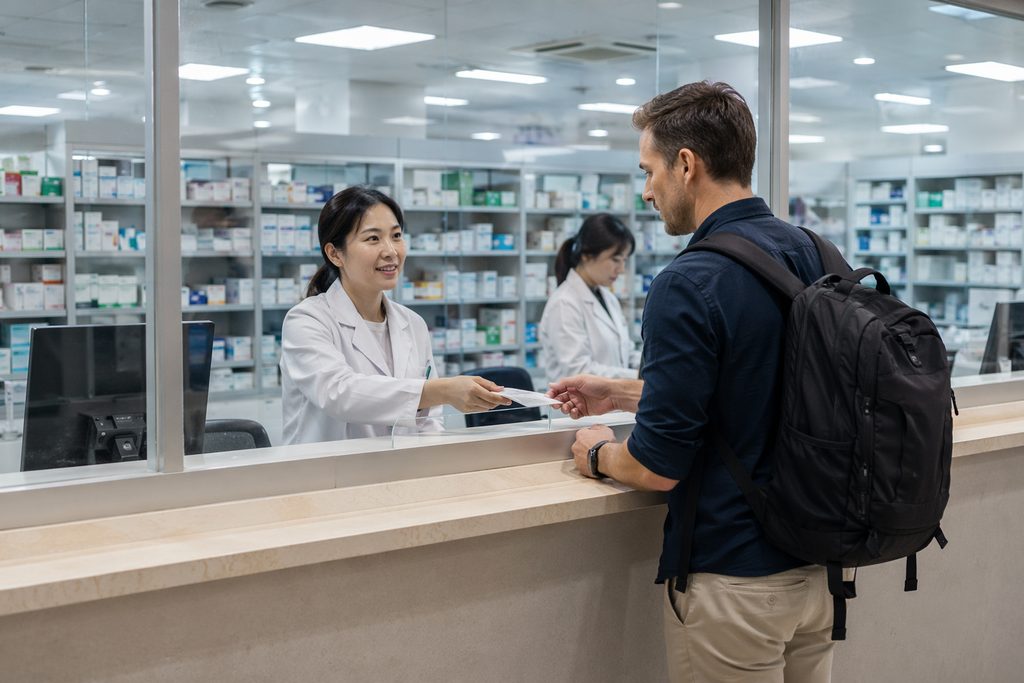
Here is where the process diverges from what most Westerners expect. In many Chinese hospitals, the pharmacy operates a two-window system. Window A is for payment. Window B is for medication pickup. You take the prescription to Window A first. The cashier scans it, the system calculates the cost — applying any in-hospital formulary pricing — and you pay. Only after payment does the prescription become active in the dispensing queue.
This two-step dance is the single most common point of failure for foreign patients. They see a line at one window, wait in it, reach the front, and are told to go pay first. Then they wait in a second line. During peak discharge hours — typically 10:00 AM to 11:30 AM — this can add 45 minutes to a process that should take 15.
Step 4: Medication Pickup and Verification
At the dispensing window, hand over the paid prescription slip. The pharmacist retrieves the medications — often pre-packaged in sealed boxes or unit-dose sachets — and places them on the counter. They will stamp the prescription as “dispensed” and may ask you to sign. Then they move on to the next patient.
This is your moment to verify. Open the bag. Count the boxes. Match the drug names against what your doctor told you. If something looks wrong, this is the only time to raise it. The pharmacist will not proactively explain each medication. But if you ask a specific question — “Is this the antibiotic?” or “How many days of this should I take?” — they will usually answer, often with the help of a translation app if no English-speaking staff are available.
For patients wondering about the Chinese hospital pharmacy process for international patients at private facilities, the experience differs considerably. Hospitals like United Family Healthcare or Jiahui International Hospital have English-speaking pharmacy staff who provide counseling similar to what you would expect in the US or UK. The trade-off is cost: discharge medications at private international hospitals can be 3-5 times more expensive than at public hospital pharmacies, though still typically cheaper than US retail pharmacy prices.
What Discharge Medications Actually Cost
The discharge medication cost China hospital patients encounter is consistently one of the most pleasant surprises of the entire medical travel experience. China’s government has imposed aggressive price controls on hospital-dispensed drugs through its National Reimbursement Drug List and volume-based procurement programs. The result is that common post-surgical medications often cost a fraction of what they would in Western pharmacies.
| Medication Category | Typical Chinese Hospital Pharmacy Price (USD) | US Retail Pharmacy Price (USD) | Savings |
|---|---|---|---|
| Cephalosporin antibiotic (7-day course) | $4 – $12 | $40 – $120 | ~85-90% |
| Low-molecular-weight heparin (14-day supply, injectable) | $30 – $60 | $350 – $700 | ~90% |
| Proton-pump inhibitor (30-day supply, generic) | $3 – $8 | $25 – $80 | ~85% |
| NSAID pain reliever (celecoxib, 30-day supply) | $5 – $15 | $80 – $250 | ~90-95% |
| Post-surgical opioid analgesic (tramadol, 10-day supply) | $8 – $20 | $30 – $90 | ~70-80% |
These are not loss-leader prices. They reflect China’s national volume-based procurement system, which negotiates drug prices for the country’s 1.4 billion population. When a manufacturer wins a government tender to supply a drug to China’s entire public hospital system, the per-unit price drops dramatically. International patients benefit from this pricing even though they pay out-of-pocket, because the hospital pharmacy dispenses at the formulary price regardless of the patient’s nationality or insurance status.
One important caveat: these prices apply to medications on the hospital’s formulary. If your physician prescribes a branded drug that is not on the national procurement list — particularly imported oncology drugs or novel biologics — the cost can be significantly higher. Always ask whether a generic equivalent is available and appropriate for your condition.
For patients specifically searching get discharge drugs from Beijing hospital pharmacy price information, the numbers above hold fairly consistent across major Beijing institutions like Peking University Third Hospital or Beijing Hospital. Tier-1 city hospital pharmacies all operate under the same national pricing framework. Smaller cities may have slightly lower dispensing fees, but the drug costs themselves are nationally standardized.
The Documentation You Cannot Forget
Walking up to a pharmacy window without the right papers is a guaranteed delay. Chinese hospital pharmacies are strict about documentation. Here is exactly what you need:
The discharge prescription slip. This is the printed form from your attending physician, stamped with the department seal. A handwritten note on a prescription pad is not accepted at the pharmacy window. It must be the printed discharge prescription generated by the hospital’s electronic medical record system.
Your hospital registration card or number. When you were admitted, the hospital issued a patient ID — often a physical card with a barcode or a number printed on your admission wristband. The pharmacy system links your prescription to this ID. If you lost the card, the registration desk can reprint it, but this adds another stop to your discharge journey.
Proof of payment settlement. The cashier’s receipt showing your inpatient bill is cleared. The pharmacy will not dispense without it.
Your passport. For international patients, the pharmacy may ask for identification, particularly if controlled substances are being dispensed. Opioid analgesics and certain psychotropic medications require identity verification under Chinese law.
The entire hospital pharmacy medication pickup China medical tourist experience hinges on having these four items ready. Missing any one of them means retracing steps through the hospital, finding the right window, and starting over. In a 2,000-bed hospital where the billing department is in Building 3 and the pharmacy is in Building 1, that can consume an hour.
Practical Considerations: Payment, Language, and Getting Home Safely
The pharmacy transaction itself is straightforward once you understand the sequence. The surrounding logistics are where things get complicated.
Payment Methods at the Pharmacy Window
Chinese hospital pharmacies have modernized rapidly. At major hospitals in Beijing, Shanghai, and Guangzhou, the pharmacy cashier accepts WeChat Pay, Alipay, UnionPay cards, and sometimes international credit cards. But “sometimes” is the operative word. Visa and Mastercard acceptance is inconsistent. If the hospital has a dedicated international medical department, that department’s pharmacy window is more likely to accept foreign cards. The general public pharmacy window may not.
The safest approach: have a Chinese friend or your medical companion handle the payment via WeChat or Alipay, and reimburse them in cash. If you are traveling without local contacts, withdraw sufficient RMB from an ATM before discharge day. A typical post-surgical medication regimen costs between ¥200 and ¥800 ($28-$110). Having ¥1,000 in cash covers virtually any discharge pharmacy scenario.
The Language Barrier at the Counter
Pharmacy technicians at public hospitals rarely speak English. They work at high speed under constant queue pressure. Handing them a phone with a translation app is possible but slows the line and visibly frustrates other waiting patients. The better strategy is to have your questions prepared in advance and translated into Chinese characters on paper or on a phone screen held ready.
Key phrases worth having translated:
- “Please confirm this is the medication my doctor prescribed.”
- “How many times per day should I take this?”
- “Should I take this with food?”
- “Are there any foods or other medicines I should avoid while taking this?”
At hospitals in our network, a bilingual medical companion handles all of this at the pharmacy counter while you wait nearby. But if you are navigating independently, preparation is everything.
Taking Medications Across Borders
You are leaving China with a bag of prescription drugs. Your home country’s customs agency will have questions. Carry the following:
- The original discharge summary (in Chinese and, if available, an English translation)
- The prescription slip (keep a photo on your phone and the original paper)
- A letter from your treating physician stating the medications are for personal use, with diagnosis and dosage clearly written
Most countries allow a 30- to 90-day supply of prescription medication for personal use when accompanied by proper documentation. Check your destination country’s specific rules before travel. The US FDA, for example, allows personal importation of a 90-day supply under its personal importation policy, though the medication must not be a controlled substance in Schedule I and the importation must not pose an unreasonable health risk.
Frequently Asked Questions
No. Chinese hospital discharge prescriptions are valid only at the issuing hospital’s own pharmacy. Retail pharmacies in China — chains like Guoda Drugstore or Lbx Pharmacy — operate under a different regulatory framework and will not fill a hospital-issued discharge prescription. This is a hard rule, not a preference. Plan to fill everything before you leave the hospital campus.
The discharge medications dispensed at a Chinese hospital are a one-time supply, typically covering 7 to 30 days depending on the clinical need. Refills are not available remotely. You will need to see a physician in your home country to obtain an equivalent prescription. Bring your discharge summary and the original medication packaging to that appointment. The packaging will show the generic name, which your home-country doctor can use to prescribe a locally available equivalent.
Medications dispensed at accredited Chinese public hospitals come through the hospital’s own procurement system, which sources directly from manufacturers or government-authorized distributors. The State Drug Administration maintains a drug traceability system that tracks medications from factory to pharmacy. Counterfeit drugs in the hospital pharmacy supply chain are extremely rare. The bigger concern for international patients is not authenticity but unfamiliarity — brand names differ, packaging looks different, and dosage forms may not match what you expect. Always verify the generic name with your physician.
What happens if the pharmacy gives
For more medical information and treatment options in China, visit chinamedservices.com (China Medical Services).
