Remote Pathology Review in China: How to Verify Accuracy, Reliability, and Cost
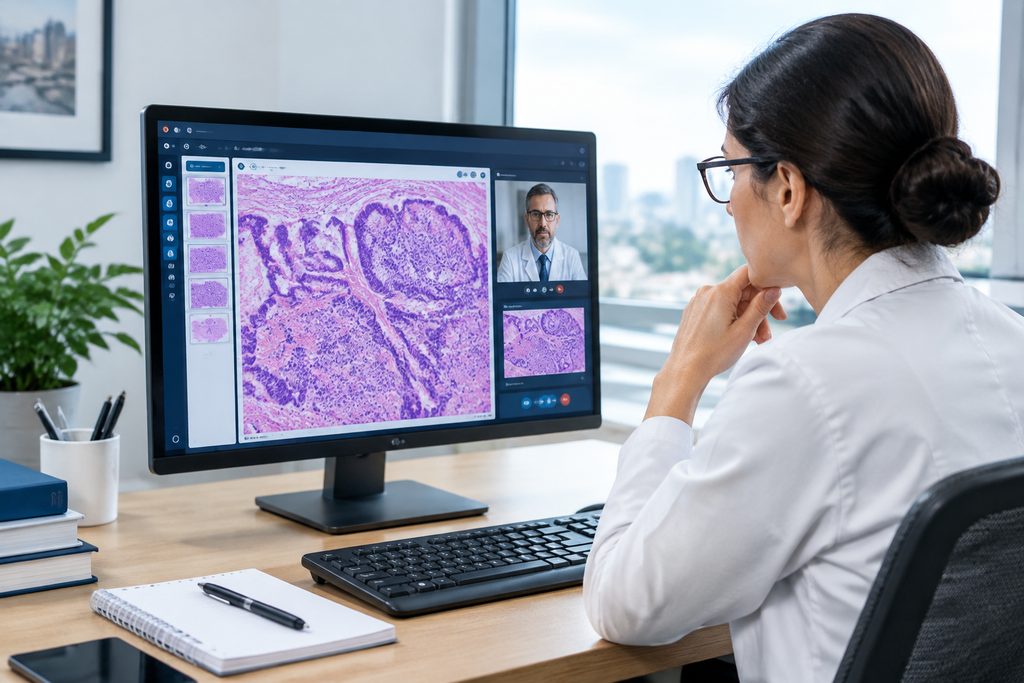
Key Takeaways
- A written remote pathology second opinion from a top-tier Chinese hospital typically costs $300–500, while a video consultation with a specialist runs $500–800.
- China’s Fudan-ranked pathology departments process diagnostic volumes unmatched in most Western centers — some handle over 100,000 surgical pathology cases annually.
- Remote pathology review is reliable only when the original tissue slides or high-resolution digital scans are re-examined — a report alone is insufficient for verification.
- You cannot book a remote pathology consultation through a standard public hospital outpatient channel; international departments or designated coordination services are required.
The Problem: A Cancer Diagnosis You Cannot Fully Trust
You received a pathology report. Maybe it says “invasive ductal carcinoma” or “follicular lymphoma.” Your oncologist is already discussing treatment protocols. But somewhere in the back of your mind, a question lingers: what if the diagnosis is wrong? You are not being paranoid. A 2015 study from Johns Hopkins Hospital published in Cancer found that pathology second opinions changed the diagnosis for 1.4% of cases and refined or reclassified it for another 19.7%. A separate 2017 BMJ Quality & Safety review found diagnostic error rates in surgical pathology ranging from 2% to 9%, with the highest rates in rare tumor types. When the stakes include chemotherapy, organ removal, or a missed malignancy, a 2% error rate is not a rounding error.
Now imagine you are considering a remote pathology second opinion from a Chinese hospital. The cost is lower than in the US or Europe. The turnaround is faster. But you have never worked with a Chinese medical institution before. You do not know how to verify the report, who is actually reading your slides, or whether the process is legitimate. These are fair concerns. And they deserve direct answers.
Why Remote Pathology Review in China Delivers Results
China’s top pathology departments operate at a scale that creates genuine diagnostic expertise. This is not marketing language — it is structural reality. The question of whether remote pathology review is reliable in China depends almost entirely on which institution you choose and how the review is conducted.
Diagnostic Volume Creates Pattern Recognition No Textbook Can Teach
Fudan University’s hospital ranking system places China’s pathology departments into tiers based on peer reputation and clinical output. The top-tier departments — those in hospitals like Peking Union Medical College Hospital, Fudan University Shanghai Cancer Center, and West China Hospital — each process between 80,000 and 150,000 surgical pathology cases per year. A typical mid-sized US academic medical center processes 30,000 to 50,000. That volume gap matters. Pathologists at these Chinese centers see rare subtypes — angiosarcoma, neuroendocrine tumors with atypical morphology, borderline ovarian tumors — with a frequency that general pathologists in smaller Western hospitals simply do not encounter.
But volume alone does not equal accuracy. What matters is how that volume is organized. Top Chinese pathology departments use a dual-review system: an attending pathologist signs every case, and complex or malignant cases are reviewed by a subspecialty expert before the final report is issued. For international remote reviews, the same subspecialty structure applies — your case is routed to the pathologist who actually specializes in that organ system.
Digital Pathology Infrastructure Is More Advanced Than Most Patients Assume
China began investing heavily in digital pathology infrastructure around 2018, and the top 50 hospitals now use whole-slide imaging (WSI) systems that scan glass slides at 40x magnification. These scanners produce files that can be reviewed remotely with diagnostic-grade monitors. The China Food and Drug Administration (now the National Medical Products Administration) approved several domestic WSI platforms for primary diagnostic use, not just consultation. That is a meaningful distinction. In many countries, digital pathology is still limited to second opinions because regulators have not approved it for primary diagnosis.
For you, the patient, this means the remote pathology report you receive from a top Chinese hospital is often based on the same digital slide technology used for in-house diagnosis — not a downgraded telemedicine version.
Cost Advantage Without Quality Compromise
Remote pathology second opinion cost China runs $300–500 for a written report from a top-tier specialist. A video consultation with that same specialist costs $500–800. Compare that to US academic centers, where a pathology second opinion typically costs $800–1,500 for the review alone, plus slide shipping, plus a separate consultation fee if you want to speak with the pathologist. The cost difference is structural: Chinese hospital labor costs are lower, and the international departments that handle remote reviews are designed for high throughput. You are not paying for a lower-quality review. You are paying for the same subspecialist expertise at a different price point.
How to Verify a Remote Pathology Report from China: A Step-by-Step Process
Verification is not about trusting a logo or a hospital name. It is about confirming four things: who reviewed your case, what materials they reviewed, whether the report is official, and whether the conclusion matches the evidence. Here is the process we recommend to every patient who asks how to verify remote pathology report from China.
Step 1: Confirm the reviewing pathologist’s credentials. Ask for the pathologist’s name, title, and subspecialty. A legitimate remote review will include this information on the report itself. Then verify it independently. Check the hospital’s official website — most top Chinese hospitals list their pathology department leadership and subspecialty teams. If the pathologist claims to specialize in hematopathology but the hospital’s website shows no such division, that is a red flag.
Step 2: Confirm what materials were reviewed. A pathology report cannot be verified from the original report alone. The reviewing pathologist must examine either the original glass slides, a new set of recut slides, or high-resolution digital scans of the original slides. If a service offers to “review your pathology report” without requesting slides or scans, you are not getting a second opinion — you are getting a document summary. That has limited clinical value.
Step 3: Verify the report’s official status. A legitimate remote pathology review from a Chinese hospital will be issued on hospital letterhead, signed by the reviewing pathologist, and stamped with the hospital’s official seal. The international department can usually provide a digital copy with a verification code. If the hospital has a patient portal, you may be able to confirm the report’s authenticity there. If the report arrives as an unsigned PDF from a personal email address, it is not a hospital-issued document.
Step 4: Cross-check the conclusion with your original diagnosis. A second opinion that simply repeats your original diagnosis in different words is not necessarily wrong — but it should explain why it agrees. Look for specific diagnostic language: the exact tumor type, grade, margin status, and any molecular markers tested. If the report is vague or hedges without explaining the uncertainty, ask for clarification before making treatment decisions.
Can You Trust a Pathology Diagnosis from China Online? What the Data Shows
The honest answer: you can trust a pathology diagnosis from a top-tier Chinese hospital when the review follows proper protocol — but you should not trust any remote diagnosis blindly, regardless of country. The question “can I trust a pathology diagnosis from China online” deserves a more nuanced response than yes or no.
International accreditation provides one benchmark. The College of American Pathologists (CAP) accredits laboratories globally, including several in China. CAP accreditation means the lab participates in proficiency testing, undergoes on-site inspections, and meets quality standards comparable to US labs. As of 2024, more than 80 laboratories in China held CAP accreditation. If the hospital you are considering has CAP-accredited pathology, that is a strong signal of international-standard quality control.
But accreditation is not the whole story. The reliability of a remote review also depends on the quality of the slides or scans you submit. If your original biopsy was performed at a low-volume community hospital and the slides are poorly prepared, even the best pathologist in Shanghai will struggle. In some cases, the reviewing pathologist may request additional staining or recuts — which requires sending the original tissue block. That is a more involved process, and it is one reason some remote reviews end with a recommendation for repeat biopsy rather than a definitive second diagnosis.
| Service Type | What You Receive | Typical Cost (USD) | Turnaround Time |
|---|---|---|---|
| Written Second Opinion (top-tier specialist) | Formal written report with diagnosis, rationale, and treatment implications | $300–500 | 5–10 business days after slides received |
| Video Consultation (top specialist) | Live discussion with the reviewing pathologist, plus written summary | $500–800 | 3–7 business days to schedule |
| Multidisciplinary Team Review | Pathology + oncology + surgical review with combined written report | $1,500–2,000 | 7–14 business days |
| US Academic Center Second Opinion (comparison) | Written report, often without direct pathologist consultation | $800–1,500 | 10–20 business days |
Prices vary by hospital and case complexity. The figures above reflect current international department pricing at top-tier Chinese hospitals, not standard outpatient rates.
Best Remote Pathology Services in Shanghai: What to Look For
Shanghai hosts several of China’s strongest pathology departments, including those at Fudan University Shanghai Cancer Center and Zhongshan Hospital. When patients ask about the best remote pathology services Shanghai price, they are usually comparing two or three specific institutions. Here is what separates a good remote pathology service from a mediocre one.
Subspecialty routing. A general pathologist reviewing a brain tumor biopsy is not the same as a neuropathologist reviewing it. The best services route your case to the correct subspecialist automatically, based on the tissue site and suspected diagnosis. Ask explicitly: “Which pathologist will review my case, and what is their subspecialty?”
Communication standards. Some services provide only a written report. Others include a video consultation so you can ask questions directly. If you are weighing a major treatment decision — surgery, chemotherapy, clinical trial enrollment — the video consultation is worth the extra cost. The written report tells you what the diagnosis is. The conversation tells you what it means.
Slide handling logistics. International slide shipping is not trivial. Glass slides break. Customs forms need accurate descriptions. Some services will coordinate with your original hospital to request slides directly, which removes a significant logistical burden. Others require you to handle shipping yourself. Neither is wrong — but know which you are getting before you commit.
Practical Considerations: Documentation, Shipping, and Payment for Remote Pathology Review
Disagreement is not failure — it is the reason you sought a second opinion. If the Chinese pathologist’s conclusion differs from your original diagnosis, request a third review from an independent institution. Diagnostic discordance between two pathologists happens in roughly 2–5% of cases even at top institutions. A third review resolves most discrepancies. Do not make treatment changes based on a single conflicting second opinion without further confirmation.
Most oncologists will consider a remote pathology report from a CAP-accredited or Fudan-ranked Chinese hospital as a legitimate second opinion, but they may want to review the slides themselves or request a local confirmation before changing treatment plans. This is standard practice and not a reflection on the Chinese institution. Bring the full report — including the reviewing pathologist’s name and credentials — to your next oncology appointment.
Some Chinese hospitals with established international departments accept direct inquiries from overseas patients for remote pathology review. However, the process typically requires navigating language barriers, payment logistics, and slide shipping coordination. If you use a coordination service, you pay an additional fee for that support. Both routes are legitimate — choose based on your comfort with the logistics.
From the day you submit your initial inquiry to the day you receive the final report, expect 2–4 weeks. This includes time for your original hospital to release slides (3–10 business days), international shipping (3–5 business days), the pathology review itself (5–10 business days), and report issuance. Video consultations can sometimes be scheduled while the written report is being finalized, which shortens the overall timeline slightly.
Your Next Step
Remote pathology review from China is a legitimate, cost-effective way to confirm or challenge a critical diagnosis — but only when the process is handled correctly. The institution matters, the reviewing pathologist’s subspecialty matters, and the materials reviewed matter more than anything else. At China Medical Services, we help international patients navigate this process: identifying the right pathology department, coordinating slide transfer, arranging the review, and ensuring you receive a legitimate, verifiable report. We are not a hospital, and we do not provide diagnoses — we connect you with the specialists who do. If you would like to discuss whether a remote pathology review from China makes sense for your case, request a free consultation and our team will walk you through the options without pressure or obligation.
Frequently Asked Questions
Yes. The hospitals used for international patients are JCI-accredited and follow the same international safety standards as top hospitals in the US and Europe. Surgical teams perform high volumes of procedures — often more than their Western counterparts — which studies show leads to better outcomes.
Costs vary by procedure and hospital, but international patients typically save 40-80% compared to US prices — even when factoring in travel and accommodation. A consultation with our team will give you an exact, all-inclusive quote with no hidden fees.
Send us your existing medical reports to get started. We handle everything from hospital selection and appointment scheduling to visa assistance and post-operative recovery planning. Your medical records are reviewed by the specialist before you even book a flight.
For more medical information and treatment options in China, visit chinamedservices.com (China Medical Services).
