TCM Rehab at Jiangsu Province Hospital Nanjing: Our Acupuncture Guide
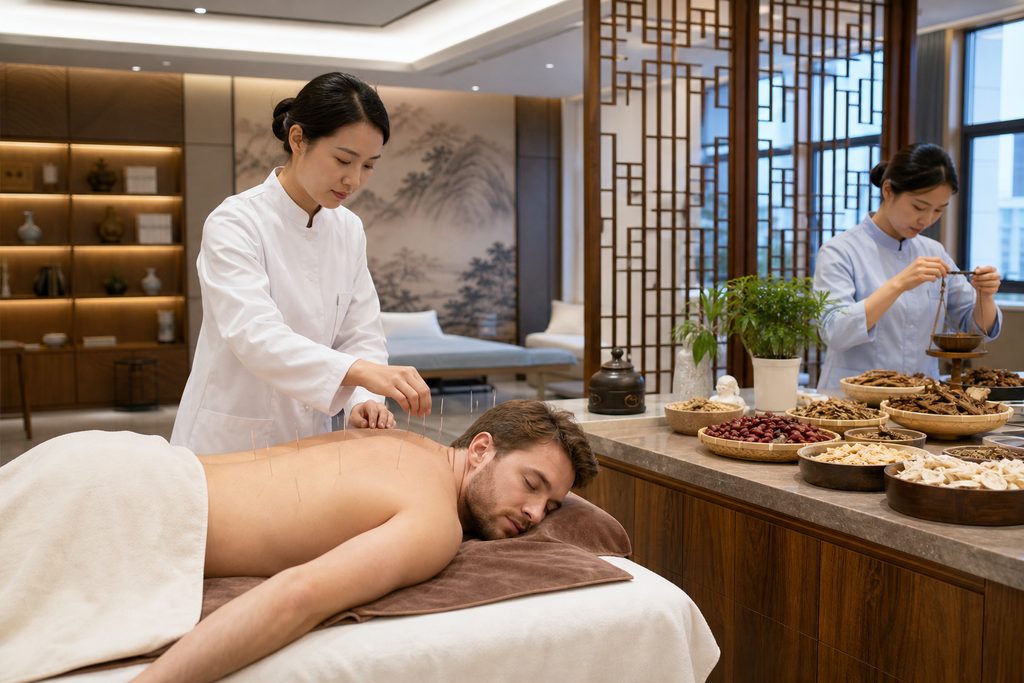
When 54-year-old David emerged from a stroke that weakened his left side, his London-based neurologist cleared him for outpatient therapy. Standard physio helped, but progress stalled after six months. His wife had read about post-stroke acupuncture protocols in China. The question that brought them to us was blunt: “Can you actually arrange this, and what does the acupuncture cost Jiangsu Province Hospital Nanjing look like for someone traveling from abroad?”
The short answer is yes, we arrange it — and the treatment itself typically runs from $45 to $120 per session, depending on the specialist’s seniority and whether adjunct therapies are combined. But that single number hides the real structure of a rehabilitation stay. The hospital does not sell isolated acupuncture appointments to international patients as a walk-in menu. Treatment is embedded in a clinical pathway that starts with a proper TCM assessment, often includes daily sessions over a two-to-four-week block, and requires coordination across departments that do not naturally operate in English.
This guide lays out exactly how the process works, what drives the cost, and who should — and should not — make the trip.
Who This Is Right For — and Who It Isn’t
Jiangsu Province Hospital of Chinese Medicine (江苏省中医院) runs one of the largest acupuncture rehabilitation departments in eastern China. Its inpatient and outpatient volumes mean the clinical teams have seen a vast range of cases. But volume does not equal suitability for every patient.
Good candidates typically share a few traits. They have a stable, non-acute condition — post-stroke hemiparesis, Bell’s palsy, chronic pain syndromes, or chemotherapy-induced peripheral neuropathy are common. They have already completed the acute phase of treatment in their home country and carry a clearance letter from their primary specialist. They can commit to a minimum two-week stay. And they arrive with realistic expectations: acupuncture rehab is a slow, cumulative process, not a single dramatic intervention.
Who should think twice. Anyone in an unstable medical phase — uncontrolled hypertension, active infection, or a cardiac condition that requires continuous monitoring — should not travel for TCM rehab alone. The hospital’s acupuncture department is not an emergency facility. Patients with severe cognitive impairment who cannot communicate their symptoms pose a safety challenge during needle retention periods. And if your primary goal is a one-time “try acupuncture” experience rather than a structured rehabilitation block, the logistics and cost of international travel will outweigh the benefit. A local licensed acupuncturist in your home country is the better choice for that scenario.
One more group we flag honestly: patients on high-dose anticoagulants. Acupuncture is not absolutely contraindicated, but the treating physician will need to assess bleeding risk case by case. Some protocols use fewer needles or shallower insertion. This must be disclosed before any booking.
The Options, Compared
When international patients consider acupuncture rehab in China, they are really choosing between three service tiers. The differences affect clinical depth, language support, and cost. The table below lays them out plainly.
| Factor | Standard Public Outpatient | Hospital International Dept | Private TCM Clinic (Nanjing) |
|---|---|---|---|
| Cost per acupuncture session | $45 – $75 | $80 – $120 | $100 – $180 |
| English-speaking staff | Rare — bring your own interpreter | Coordinator provided; basic clinical English | Often yes; varies by clinic |
| Treatment plan design | Senior attending physician | Chief or deputy chief physician | Individual practitioner |
| Integration with other TCM | Yes — tuina, herbal decoctions, moxibustion available in-house | Yes — coordinated across departments | Limited to what the clinic offers |
| Typical minimum stay | 2 weeks (self-organized) | 2 weeks (coordinated package) | Flexible; single sessions possible |
| Medical records in English | No — Chinese only | Summary translation provided | Sometimes; confirm in advance |
| Visa support documents | Possible but bureaucratic | Standard — invitation letter provided | Rarely offered |
The Standard Public Outpatient column is what most domestic patients use. It is the least expensive acupuncture cost Jiangsu Province Hospital Nanjing offers, but it assumes you speak Chinese, understand the hospital’s queuing and payment systems, and can handle your own documentation. The International Department column — which is the pathway we coordinate — adds a layer of logistical support that makes the difference between a stressful solo attempt and a structured rehab block. The Private TCM Clinic column suits patients who want maximum language comfort and scheduling flexibility, but it lacks the multidisciplinary depth of a major teaching hospital.
For post-stroke rehabilitation specifically, the hospital setting wins on one critical point: access to neurology consultation alongside acupuncture. If a symptom changes mid-treatment, you are already inside a facility that can order imaging or adjust medications. A standalone clinic cannot offer that safety net.
How We Arrange Your TCM Rehab at Jiangsu Province TCM Hospital Nanjing: The Step-by-Step
This is the section that answers the question people actually type into a search bar. The process is linear, but each step has friction points that surprise first-time international patients.
Step 1: Remote pre-assessment. Before you book a flight, we collect your existing medical records — the stroke discharge summary, the MRI report, the physiotherapy notes, the current medication list. A certified medical translator on our team renders these into clinical Chinese. The hospital’s acupuncture rehabilitation department reviews them and provides a written opinion: is your condition appropriate for their protocols, what frequency of treatment they recommend, and an estimated duration. This step costs $300–500 for a written second opinion. It is not a prescription; it is a professional assessment of suitability. And it is the single most important step to avoid arriving in Nanjing only to be told your case is not a fit.
Step 2: Treatment plan and cost estimate. If the department confirms suitability, they issue a provisional treatment schedule. A typical post-stroke rehab block runs five sessions per week for three to four weeks. Each session lasts 30 to 45 minutes of needle retention, often preceded by a brief pulse-and-tongue diagnosis to adjust point selection. Adjunct therapies — tuina massage, electro-acupuncture, or herbal fumigation — may be recommended and are priced separately. At this stage we provide a total estimated cost range for the clinical services only. Hospital treatment fees are paid directly to the hospital, not to us.
Step 3: Visa and travel coordination. Medical treatment in China falls under the S2 short-stay visa category. The hospital’s international department issues an invitation letter confirming your treatment appointment. We guide you through the consular application, but we never guarantee approval — visa decisions rest solely with the Chinese embassy or consulate in your country. A family member accompanying you also applies for an S2. Flight and accommodation are your own arrangements; we can recommend hotels within walking distance of the hospital, which matters when you are doing daily sessions and your mobility is limited.
Step 4: Arrival and first consultation. On your first day, a bilingual medical companion meets you at the hospital entrance. You are not navigating the registration counter alone. The companion handles hospital card creation, payment deposits, and queue ticket collection. The first consultation is a full TCM intake — the attending physician examines your tongue coating, takes your pulse at three positions on each wrist, palpates affected limbs, and reviews the translated records. From this, they finalize the acupuncture point prescription. The first treatment often happens the same day.
Step 5: Daily treatment rhythm. Sessions are typically scheduled in the morning. Patients arrive, rest briefly, receive treatment, and rest again for 10–15 minutes afterward. The companion is present for the first few sessions to ensure communication is smooth, then tapers off as you establish a routine with the department staff. Progress notes are kept in Chinese; we provide a weekly summary in English so your home physician stays informed.
Step 6: Discharge and follow-up plan. At the end of the treatment block, the attending physician writes a discharge summary with TCM diagnosis, points used, number of sessions, and clinical observations. They may recommend a maintenance schedule — for instance, one session every two weeks for three more months — which you can pursue with a local acupuncturist at home. We translate the summary and provide it to you and your referring doctor.
This entire pathway — from first inquiry to discharge — typically spans six to eight weeks, of which two to four weeks are on the ground in Nanjing.
What TCM Rehabilitation Packages in China Actually Cost
Let’s break down the numbers. The phrase “TCM rehabilitation packages China price” gets searched often, but the answer depends on what you bundle. Here is a realistic range for a four-week post-stroke acupuncture rehab block at Jiangsu Province Hospital of Chinese Medicine, coordinated through the international department.
| Cost Component | Range (USD) | Notes |
|---|---|---|
| Written second opinion (remote) | $300 – $500 | One-time; credited if you proceed to on-site coordination |
| Acupuncture sessions (20 sessions over 4 weeks) | $1,600 – $2,400 | $80–$120 per session at international dept rates |
| Adjunct TCM therapies (if prescribed) | $400 – $800 | Tuina, cupping, electro-acupuncture, herbal medicine |
| Bilingual companion (first 3 days) | from $900 | $300/day; optional after initial setup |
| Hospital coordination fee | from $300 | Appointment scheduling, records handling, deposit management |
| Total clinical + coordination (estimated) | $3,500 – $4,900 | Excludes flights, accommodation, meals, visa fees |
The clinical portion — the acupuncture itself — accounts for roughly half to two-thirds of the total. The rest is the infrastructure that makes treatment accessible to someone who does not speak Chinese and does not know the hospital system. You can reduce cost by shortening the stay or by bringing a family member who speaks Mandarin to serve as interpreter, eliminating the companion expense. But the coordination fee is hard to avoid if you want the international department pathway; that fee covers the administrative work of scheduling, translation, and liaison that the standard public outpatient desk does not provide.
Also worth noting: any remote consultation fee you pay is credited in full toward the on-the-ground coordination service if you proceed within 90 days. That credit applies to our coordination fee only — never to hospital treatment charges, which are paid separately to the hospital.
How Acupuncture Rehab Works After Stroke: What the Sessions Actually Do
Patients searching “how does acupuncture rehab work after stroke” are often family members trying to understand what happens during those 40 minutes their loved one lies on the treatment table. The mechanism is both ancient and increasingly studied.
In a post-stroke context, the acupuncturist is not treating the original infarct. That damage is done. The target is neuroplasticity — the brain’s ability to rewire around dead tissue — and the peripheral neuromuscular dysfunction that follows. Points are selected along affected meridians, often on the paretic side, with a focus on the Large Intestine and Stomach meridians for upper limb function and the Gallbladder and Stomach meridians for lower limb recovery. Scalp acupuncture, a technique developed in China and now used widely, places needles over motor and sensory cortical zones corresponding to the affected body area.
A 2019 systematic review published in the Journal of Stroke and Cerebrovascular Diseases analyzed 31 randomized controlled trials involving over 2,600 patients and found that acupuncture combined with conventional rehabilitation improved motor function scores more than conventional rehab alone. The effect size was modest but statistically significant. Another study from Tianjin University of Traditional Chinese Medicine, which pioneered the “Xing Nao Kai Qiao” (awakening the brain) protocol, reported improved Barthel Index scores in patients who received acupuncture within the first six months post-stroke.
What a session looks like: after pulse diagnosis, the physician inserts 10 to 20 fine-gauge needles — far thinner than a hypodermic — to depths of 0.5 to 1.5 centimeters depending on the point and the patient’s build. Needles remain in place for 30 minutes. During retention, the physician may manually stimulate a few needles by gentle rotation to elicit de qi — a characteristic dull ache, heaviness, or distension that practitioners consider a therapeutic response. Electro-acupuncture, where a mild current is applied to paired needles, is common for limb weakness; the rhythmic contraction of muscles mimics active movement and may enhance proprioceptive feedback to the brain.
Patients often ask if it hurts. The insertion itself is usually a brief prick, less intense than a vaccine injection. De qi is not pain — it is a deep, pressure-like sensation. Most patients find it unusual at first and unremarkable by the third session. The bigger challenge for stroke patients is lying still for 30 minutes when spasticity causes discomfort; the physician can adjust positioning with bolsters and pillows.
What acupuncture does not do: it does not replace physical therapy, occupational therapy, or speech therapy. It is an adjunct. The patients who see the most benefit are those who receive acupuncture alongside active rehabilitation — the needles in the morning, the physio in the afternoon. The hospital’s rehab department can coordinate this sequencing because physiotherapy and acupuncture are under one roof, which is a logistical advantage over seeing separate providers in separate locations.
Practical Considerations for International Patients
Traveling for TCM rehab is not a holiday with a few needles on the side. The logistics are real, and knowing them in advance prevents the kind of frustration that undermines treatment.
Medical records. You need more than a one-line referral. The hospital expects a discharge summary from the admitting facility, imaging reports (CT or MRI), current medication list with dosages, and any relevant lab results from the past three months. If your records are in a language other than English or Chinese, translation adds time and cost. We handle the clinical translation into Chinese; you are responsible for getting the originals from your home providers.
Visa category. The correct visa for medical treatment is S2, with the purpose noted as private affairs including medical treatment. The hospital provides an invitation letter. Processing times vary by consulate — plan for two to four weeks. Do not book non-refundable flights until the visa is in your passport.
Payment methods. Chinese hospitals operate on a prepaid deposit system. You load funds onto your hospital card at admission, and treatment fees are deducted daily. The international department can help you set this up. Credit cards are accepted at the international department counter, but not everywhere in the hospital. WeChat Pay and Alipay dominate in China; linking an international card to these apps before travel makes daily life much easier. Cash in RMB is universally accepted. Your home health insurance is unlikely to cover treatment in a Chinese TCM hospital — check your policy’s out-of-network and international coverage clauses before assuming anything.
Language. The acupuncture department’s clinical staff speak Mandarin. Some younger physicians have basic English, but you cannot rely on it for detailed symptom reporting. Our bilingual companion bridges this gap during the critical first days. After that, many patients develop a working routine using translation apps for simple communication — “more pressure here,” “needle feels too deep” — which is manageable once the treatment pattern is established.
Follow-up after returning home. The discharge summary we provide includes point prescriptions and treatment frequency recommendations. A licensed acupuncturist in your home country can continue the protocol. Not every Western acupuncturist is trained in scalp acupuncture or the specific stroke protocols used in China, so finding the right practitioner may take some research. We can help identify what credentials to look for but do not refer to specific providers outside China.
Frequently Asked Questions
What is the acupuncture cost Jiangsu Province Hospital Nanjing for a full rehab program?
For a four-week program with 20 sessions through the international department, expect $1,600 to $2,400 for the acupuncture alone. Adjunct therapies like tuina or herbal medicine add $400
For more medical information and treatment options in China, visit chinamedservices.com (China Medical Services).
