Is a Colonoscopy Painful? What Sedation in China Feels Like
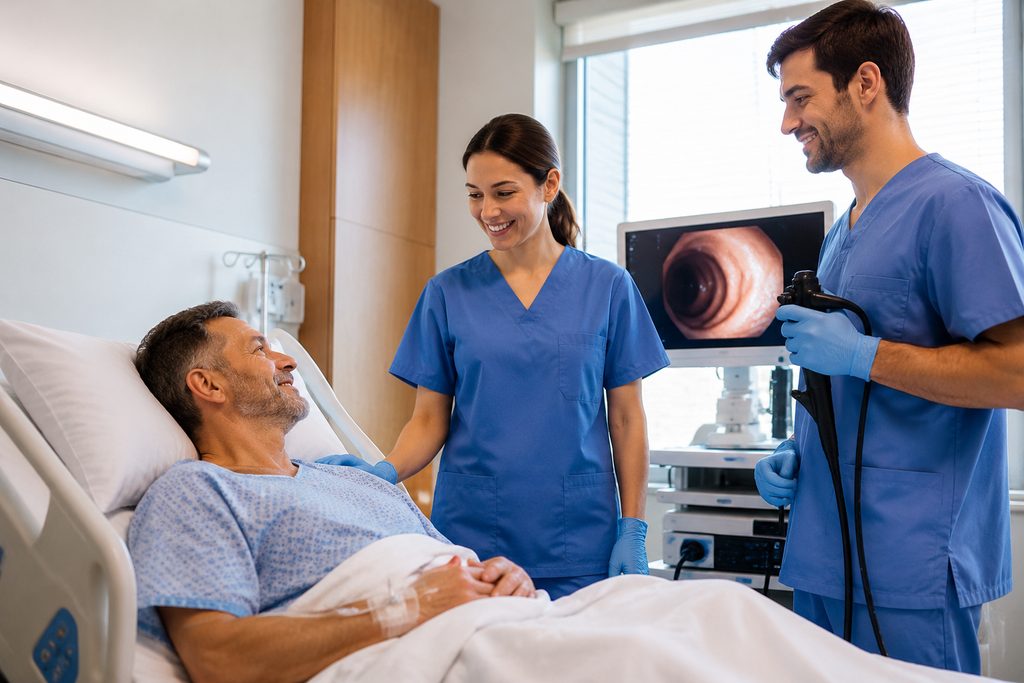
Is a Colonoscopy Painful? The Honest Answer, Plus What to Expect With Sedation in China
In the United States, a screening colonoscopy without insurance routinely runs $2,750 to $4,800. In China, the same procedure at a top-tier public hospital typically costs $300 to $700. That gap explains why international patients increasingly search for colonoscopy cost China before scheduling anything at home. But the price question hides another one patients ask us constantly: does it hurt?
The short answer is no — not for most people, and not with the sedation protocols used in Chinese endoscopy centers. The longer answer involves what “sedation” actually means, why some patients still feel discomfort, and how to make sure you get the painless version you’re expecting. We coordinate these procedures for international patients every month. Here is what actually happens.
How This Actually Works, Step by Step
You’re considering a colonoscopy — either as routine screening after age 45, or because of symptoms like bleeding, persistent bowel changes, or unexplained weight loss. Maybe you’ve already had one and remember it as unpleasant. Or you’ve avoided it for years because of what you’ve heard.
The process we coordinate for international patients looks like this:
Step 1 — You send your records. Existing endoscopy reports, recent blood work, medication list, and any imaging. If you’ve never had a scope, we just need basic history and your reason for wanting the exam.
Step 2 — A gastroenterology department reviews your file. We work with departments at hospitals listed in our specialty rankings. A GI specialist confirms whether colonoscopy is appropriate, what prep protocol fits your case, and whether additional tests (gastroscopy, biopsy, polyp removal) should be bundled.
Step 3 — You get a written plan and a firm price. Not an estimate. The hospital’s international department quotes the package: procedure fee, sedation, facility charges, pathology if polyps are found. You decide before you travel.
Step 4 — Travel, prep, procedure, results. You fly in, complete the bowel prep the day before, arrive at the endoscopy center, get sedated, wake up in recovery, and leave with a preliminary report. Biopsy results follow within 5 to 10 days.
That’s the sequence. Now let’s address the pain question directly.
Is a Colonoscopy Painful With Sedation? What the Drugs Actually Do
In China, “painless colonoscopy” — the standard offering at international departments and private hospitals — means propofol-based deep sedation, not light conscious sedation. Propofol is the same drug used for general anesthesia induction. You are asleep within 30 seconds of the IV push. You feel nothing during the procedure. Most patients wake up asking when the exam will start, and it’s already over.
This differs from what some Western patients experience. In the UK and parts of Europe, “sedation” often means midazolam and fentanyl — you’re drowsy but still responsive, and many patients remember discomfort. In the US, propofol is common but adds $500 to $1,500 to the bill. In China, propofol sedation is typically included in the package price at international departments. That’s a key reason painless colonoscopy medical tourism China has grown steadily since 2019.
There is a version without sedation. It costs less — sometimes $80 to $150 at a public hospital. The scope is lubricated and inserted gently, but you will feel pressure, cramping, and the urge to pass gas. Some patients tolerate it fine. Most don’t choose it twice.
Our recommendation is consistent: if you’re traveling internationally for a colonoscopy, choose the sedated version. The marginal cost is small. The experience difference is enormous.
A Realistic Timeline
People underestimate how much administrative time sits inside a “simple” colonoscopy. Here is the honest schedule for an international patient:
| Stage | What Happens | Typical Duration |
|---|---|---|
| Day 1–3 | You submit records and medical history; we translate and forward to the GI department | 1–3 days |
| Day 3–7 | Specialist reviews your file; hospital confirms suitability and quotes the package | 2–5 days |
| Day 7–14 | You apply for an S2 visa (short-stay, for medical treatment or private affairs) with the hospital’s invitation letter | 5–10 working days, varies by consulate |
| Day 14–21 | You book flights and accommodation; we lock the appointment slot with the endoscopy center | 1 week |
| Day 21–22 | You arrive in China; bowel prep begins the afternoon before the procedure | 2 days |
| Day 22 | Colonoscopy with sedation; recovery; preliminary results | Half day |
| Day 22–32 | Biopsy results (if polyps or tissue samples taken) | 5–10 days |
Total: roughly three to four weeks from first contact to completed procedure. You can compress this to about two weeks if your visa consulate moves quickly and the hospital has an open slot. But planning for three weeks is safer.
The step people forget is the prep. It’s not painful, but it is unpleasant — you drink a large volume of laxative solution, usually polyethylene glycol, and clear your bowel completely. The prep is the same in China as anywhere. No sedation protocol can remove that part.
What Can Go Wrong — and What Happens Then
A colonoscopy is a safe procedure. Perforation risk is roughly 1 in 1,000 to 1 in 2,500 in Western registries, and Chinese tertiary centers report comparable rates. Bleeding after polyp removal occurs in about 1 in 100 cases. But things do go wrong, and you should know the recourse before you’re on the table.
Inadequate prep. If your bowel isn’t clean, the endoscopist can’t see the mucosa properly. The procedure may be stopped and rescheduled. This happens in about 5–10% of cases globally. The fix is strict adherence to the prep instructions — clear liquids the day before, the full laxative dose, and nothing by mouth after the specified cutoff. We send our patients a prep checklist in English before they fly.
Sedation reaction. Propofol can drop blood pressure or slow breathing. Anesthesia monitoring is standard in Chinese endoscopy centers — pulse oximetry, ECG, blood pressure, and a dedicated anesthesia provider. If a reaction occurs, the team manages it immediately. This is why sedated colonoscopies in China are performed in hospital endoscopy suites, not standalone clinics.
Unexpected findings. Polyps are found in about 25–40% of screening colonoscopies in adults over 50. Most are removed during the same procedure and sent to pathology. If a large polyp or suspicious lesion is found, the endoscopist may take biopsies and recommend a follow-up therapeutic colonoscopy or surgery. This changes your timeline and cost — sometimes significantly. The hospital will give you a written report and images. We help you understand what it means and coordinate any next step.
Language barrier. You wake up groggy from propofol. The recovery nurse speaks Mandarin. You need to know what happened. This is exactly where a bilingual medical companion earns their fee — translating the preliminary findings, the discharge instructions, and the follow-up plan before you leave the hospital.
Choosing Where to Book: Public International Department vs Private Hospital
This decision shapes your entire experience — cost, comfort, and clinical quality.
Public hospital international departments are attached to China’s largest tertiary centers. Think Peking Union Medical College Hospital in Beijing or Zhongshan Hospital in Shanghai. The endoscopists are high-volume specialists — some perform 3,000 to 5,000 colonoscopies per year. The equipment is current, often Olympus or Fujifilm HD scopes with narrow-band imaging. The international department adds English-speaking coordinators and faster scheduling. But the environment is still a busy Chinese public hospital: crowded hallways, shared recovery bays, and a pace that feels industrial.
Private international hospitals — United Family, Jiahui, Parkway, Raffles — offer a Western-style experience. English-speaking staff throughout, private recovery rooms, direct insurance billing, and appointment times that don’t start at 6:30 a.m. The trade-off is price. A sedated colonoscopy at a private international hospital in Shanghai typically runs $800 to $1,500, versus $300 to $700 at a public hospital’s international wing. Both are dramatically cheaper than the US cash price.
If you’re asking how much is a colonoscopy in Beijing, the answer depends on which of these two paths you choose. At Peking Union’s international department, expect $400 to $700. At Beijing United Family, expect $900 to $1,300. Both include sedation. Both produce a valid report your home physician can use.
For patients specifically searching best gastroenterology hospital Shanghai, the conversation usually lands on Zhongshan Hospital or Renji Hospital — both with gastroenterology departments ranked among China’s top 10 in the Fudan specialty reputation rankings. Renji in particular runs one of the highest-volume GI endoscopy centers in the country, with dedicated international scheduling.
Practical Considerations: Records, Visa, Payment, and Follow-Up
Medical records. Bring any prior endoscopy reports, pathology slides if relevant, and a medication list — especially anticoagulants. Blood thinners must be paused before polyp removal. Your prescribing doctor at home should confirm the pause window. The Chinese GI team will want to see this.
Visa. Medical treatment in China falls under the S2 visa category — short-stay, for private affairs or medical treatment. The hospital’s international department issues an invitation letter that supports your application. Family members traveling with you also apply for S2. Processing takes 5 to 10 working days at most consulates. Do not apply for an M visa — that’s for commercial and trade activities, and using it for medical care creates problems at the border.
Payment. Public hospitals require prepayment — you deposit funds at admission and settle after the procedure. International departments accept credit cards and sometimes international bank transfers. Private international hospitals often bill your insurer directly. If you’re paying out of pocket, the hospital gives you an itemized receipt for reimbursement claims at home.
Follow-up at home. The report and images are yours. Chinese hospitals provide printed reports and, on request, digital copies. Your home gastroenterologist can review them. If polyps were removed, the pathology report specifies the histology — hyperplastic, adenomatous, serrated — and the recommended surveillance interval. That interval is based on international guidelines, so it transfers cleanly to your care at home.
Language. Even at international departments, the endoscopist and recovery nurses may speak limited English. The coordinator speaks English. The gap between those two realities is why our bilingual medical companion service exists — one person who handles registration, translation, and navigation from check-in to discharge.
Frequently Asked Questions
It can. Without sedation, most patients feel cramping, pressure, and an urge to defecate as the scope moves through the colon. Some describe it as intense discomfort; a minority tolerate it easily. If you choose the non-sedated option in China, the procedure is faster and cheaper, but you should expect to feel something. The sedated version eliminates the experience entirely.
In China, a sedated colonoscopy at a top public hospital’s international department runs $300 to $700. At a private international hospital, $800 to $1,500. In the US, the uninsured cash price typically ranges from $2,750 to $4,800 — and that’s before polyp removal or pathology fees. Even adding flights and accommodation, many international patients spend less traveling to China for the procedure than they would paying US cash rates. Prices vary by hospital and case complexity.
Yes — through a hospital’s international department or a coordination service like China Medical Services. Standard public outpatient clinics cannot be booked from overseas; you’d have to queue on the day. The international channel allows advance scheduling, fixed pricing, and English-language coordination. That’s the practical way to book colonoscopy package China without landing first and hoping for a slot.
Generally yes. Propofol sedation for colonoscopy is used routinely in patients in their 70s and 80s in Chinese tertiary centers. The key is pre-procedure assessment — the anesthesia team reviews cardiac and respiratory status before clearing you. If you have significant heart failure, severe COPD, or sleep apnea, the team may adjust the sedation plan or recommend an anesthesiologist-led approach. That’s why we send your records ahead — so the hospital can flag risks before you travel.
In almost all cases, yes. Reports from accredited Chinese tertiary hospitals include standardized terminology, photographic documentation, and pathology results using WHO classification. Gastroenterologists in the US, UK, and Australia routinely accept these for clinical decision-making. If any question arises, the hospital can provide the raw images and slides for independent review.
Your Next Step
A colonoscopy doesn’t have to hurt. With propofol sedation — standard at Chinese international departments — you sleep through the entire exam and wake up with a report in hand. The real barriers are coordination: finding the right hospital, getting a firm price, and navigating the process in a language you don’t speak.
That’s what we do. We’re China Medical Services, and we connect international patients with top-ranked gastroenterology departments across 37 cities. We don’t perform procedures, and we don’t give medical advice. We handle the matching, scheduling, translation, and on-the-ground support so you can focus on the prep and showing up. If you’re weighing a colonoscopy at home against traveling to China, start with a conversation. Request a free consultation and we’ll tell you honestly whether it makes sense for your case.
For more medical information and treatment options in China, visit chinamedservices.com (China Medical Services).
