Complication After Surgery in China: Return Home or Fix It Here?
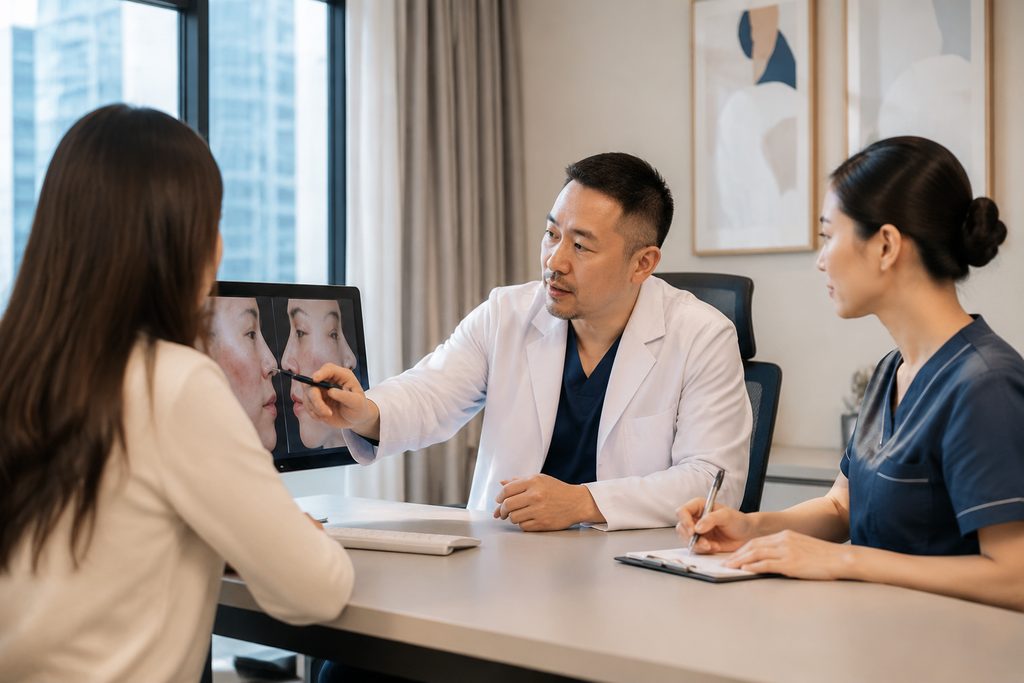
A surgical complication on foreign soil lands differently than one at home. The question that hits first is brutally simple: do you stay and fix it here, or fly back? For many patients who chose affordable plastic surgery in China vs home country pricing, the math changes fast when a revision enters the picture. The short answer is that staying in China for revision is often clinically safer and dramatically cheaper — but that answer assumes the original surgeon is competent, the facility is equipped, and the complication is not life-threatening. If trust has collapsed, or if the issue requires a sub-specialist your original clinic cannot provide, returning home becomes the only sane option.
The Short Answer: Fix It Where the Expertise Lives
Most post-operative complications — wound dehiscence, minor infection, fluid collection — can and should be managed by the original surgical team. They know the technique used, the implants placed, the internal sutures. A surgeon in your home country is walking into a dark room. That said, if the complication stems from negligence, poor technique, or a facility lacking basic infection control, staying makes no sense. The real question is not about geography. It is about whether the original team is still your safest option. If they are, staying in China means a revision that costs a fraction of what you would pay at home. If they are not, no amount of savings justifies the risk.
Who Should Stay — and Who Should Leave
This decision is clinical first, emotional second. Here is a practical framework.
You are likely safe to stay for revision when:
- The complication is common and manageable — seroma, superficial wound separation, minor asymmetry
- The original surgeon is board-certified at a major public hospital or JCI-accredited private facility
- You have access to bilingual medical coordination and can communicate clearly with the team
- The revision can be done within your existing visa window without overstaying
- Your travel insurance or medical complication policy covers extended stay costs
You should seriously consider returning home when:
- The complication suggests systemic infection, implant exposure, or vascular compromise requiring ICU-level care
- The original facility cannot explain what went wrong or seems evasive
- You no longer trust the surgeon — and trust is not recoverable through a translator
- Your home country has a specialist who specifically handles revision cases from abroad
- You are experiencing symptoms that could indicate a life-threatening condition and need evacuation now
One thing we see repeatedly: patients who stay for the wrong reasons. They stay because they already paid for the surgery and feel trapped by sunk cost. That is a dangerous calculation. A bad outcome does not obligate you to double down.
Revision Surgery in China vs Returning Home: A Direct Comparison
| Factor | Stay in China for Revision | Return Home for Revision |
|---|---|---|
| Revision surgeon access | Original surgeon knows the case; top-tier hospital transfer possible through coordination | Surgeon works blind; must request Chinese operative notes and imaging; may refuse complex foreign cases |
| Typical revision cost (rhinoplasty example) | $2,000–$5,000 at private international hospital; often waived or reduced by original clinic if complication is acknowledged | $8,000–$18,000 in the US, €5,000–€12,000 in Western Europe; rarely covered by insurance for elective cosmetic surgery done abroad |
| Timeline to revision | 1–3 weeks if managed by original team; 2–6 weeks if transferred to a new hospital in Shanghai or Beijing | 4–12 weeks minimum; requires new consultations, imaging, insurance pre-authorization, and surgical scheduling |
| Legal recourse | Negotiation with hospital administration; formal complaint through local health authority; litigation requires Chinese legal representation and physical presence | Medical board complaint in home jurisdiction; legal action against the Chinese facility is extremely difficult to pursue from abroad |
| Language and coordination | Medical concierge service provides bilingual case management; hospital international department handles documentation | Patient must self-advocate; translating Chinese medical records into English costs $300–$800 for certified translation |
| Follow-up continuity | Surgeon can monitor healing for weeks; no handoff gap | Care transfer creates information loss; new surgeon may disagree with original technique and refuse to touch the case for 6–12 months |
The table makes one thing obvious: staying is cheaper and clinically cleaner. But it only works if the original team is still trustworthy. If they are not, the cost of returning home is the cost of getting it right the second time. There is no bargain version of that.
When You Need a Different Hospital in China: Shanghai as the Revision Hub
Sometimes the complication is not the surgeon’s fault. Sometimes it is. Either way, if you have lost confidence in the original clinic, you need a fresh team — and you may not need to leave the country to find one. For patients asking about the best hospital in Shanghai to fix botched surgery, the answer depends heavily on what was botched.
Shanghai Ninth People’s Hospital, affiliated with Shanghai Jiao Tong University School of Medicine, runs one of the highest-volume plastic and reconstructive surgery departments in the world. Its craniofacial and revision rhinoplasty caseload is enormous — surgeons there see complex secondary and tertiary reconstructions weekly that a Western surgeon might encounter a few times a year. For body contouring complications, the department of plastic surgery at Shanghai Ninth handles everything from wound dehiscence to failed liposuction revision. The challenge is access: this is a public hospital with immense domestic patient volume. Getting in as a foreign patient requires coordination through the hospital’s international medical center or a third-party service that can navigate the system.
For patients who prefer a private, English-speaking environment, JCI-accredited private international hospitals in Shanghai — such as Jiahui International Hospital and Shanghai United Family Hospital — offer revision surgery with board-certified plastic surgeons, many of whom trained in the US or Europe. The cost is higher than a public hospital but still well below Western revision pricing. A complex revision rhinoplasty at a Shanghai private international hospital typically runs $5,000–$8,000, compared to $15,000–$20,000 in the United States. The trade-off is that private hospital surgeons may not see the extreme case volume of a place like Shanghai Ninth. For a standard revision, that is fine. For a truly complex reconstruction, the public hospital’s case volume matters.
One more thing worth knowing: some of the top-tier public hospitals in China have dedicated international departments that function almost like a private hospital within the public system. Shanghai’s major teaching hospitals increasingly offer this hybrid model — public hospital expertise with private-level service and English communication. It is the best of both worlds for revision cases, but availability varies and requires advance coordination.
What Revision Surgery Actually Costs: China vs USA Breakdown
The cost of revision surgery China vs USA gap is stark — but the numbers only tell part of the story. Here is what patients actually pay.
In China, revision pricing depends on whether the original surgeon handles it, whether you transfer to a new hospital, and whether you go public or private. If the original clinic acknowledges the complication, many will perform the revision at no charge or at a heavily reduced rate covering only facility and anesthesia fees — typically $500–$1,500. If you transfer to a different Chinese hospital, expect to pay full revision rates: $2,000–$5,000 for a revision rhinoplasty at a public hospital international department, $5,000–$8,000 at a private international hospital. Revision breast surgery runs $3,500–$7,000. Body contouring revision varies wildly by extent.
In the United States, revision rhinoplasty averages $12,000–$18,000. Revision breast augmentation runs $8,000–$15,000. These are surgeon fees alone. Add facility fees, anesthesia, and post-operative care, and the total climbs fast. Insurance almost never covers revision of elective cosmetic surgery performed abroad. The patient pays out of pocket. And that is before factoring in the cost of translated medical records, new imaging, and the consultation gauntlet before a surgeon even agrees to take the case.
There is a hidden cost too: time. Many US revision surgeons will not touch a case until at least six to twelve months after the original surgery — they want full scar maturation and tissue settling before operating. That means a year of living with a result you hate, waiting for someone to fix it. In China, surgeons who handle high-volume revision caseloads may intervene sooner if the complication is functional or progressive. That is a clinical decision, not a scheduling one.
Practical Considerations: Records, Visas, and Payment
If you decide to stay in China for revision, three logistical hurdles need immediate attention.
Medical records. You need your complete operative report from the original surgery — not just a discharge summary. The operative note describes exactly what was done, what implants were used, what suturing technique was employed. Without it, a new surgeon is guessing. If you transfer to a different Chinese hospital, they will request these records internally. If you return home, you need them translated and certified. That translation costs $300–$800 and takes 3–7 business days through a certified medical translation service.
Visa extension. A complication that requires extended stay means your S2 visa may expire before revision and recovery are complete. You can apply for an extension at the local Exit-Entry Administration bureau. You will need documentation from the treating hospital confirming the medical necessity of continued stay. This is not automatic — the hospital’s international department or your medical coordinator must provide a formal letter with the hospital’s official stamp. Do not overstay. The penalties include fines, detention, and a potential entry ban.
Payment. Chinese hospitals, public and private, require payment before treatment. If the original clinic is covering the revision, get that agreement in writing — in both Chinese and English — before the procedure. If you are paying out of pocket at a new hospital, international departments accept wire transfers and major credit cards. Some private international hospitals can direct-bill certain global insurance plans, but verify this before admission. Do not assume.
Language. Even at hospitals with English-speaking international departments, the surgical consent form will be in Chinese. You need someone who can read it with you — not just summarize it. A bilingual medical coordinator or a trusted translator who understands medical terminology is not optional. Signing a document you cannot read, for a revision surgery you already feel anxious about, is a recipe for more regret.
Frequently Asked Questions
The short answer: it is extraordinarily difficult. Chinese medical malpractice law operates differently from Western tort systems. You would need to file a claim through the local health administration or the courts in the city where the surgery occurred. This requires physical presence, Chinese legal representation, and usually a medical expert assessment from a Chinese forensic institution. Pursuing this from outside China is impractical for most patients. Some international patients negotiate a partial refund or free revision directly with the hospital administration — this is faster than litigation and sometimes yields results. But formal legal action from abroad? Assume it is not a realistic path unless the damages are catastrophic and you have the resources to relocate for the duration of the case.
Ask yourself three questions. First: is the complication life-threatening or limb-threatening right now? If yes, go to the nearest emergency department — do not board a long-haul flight. Second: does the original surgeon still have your trust? If the complication is minor and the surgeon has been transparent and responsive, staying is usually the right call. Third: can you afford the revision at home? If the answer is no, and the original facility is willing to address the issue at reduced or no cost, staying becomes the financially rational choice — but only if the clinical standard is acceptable. The decision is always clinical before financial.
Contact the original surgical team first. Do not go to a random clinic. The surgeon who operated on you needs to examine the complication. If they are unresponsive or dismissive, escalate to the hospital’s international patient department or patient affairs office. Document everything: photos with timestamps, written descriptions of symptoms, screenshots of communications. If you feel the situation is deteriorating and the original team is not managing it, seek a second opinion at a major teaching hospital with a plastic surgery department — in Shanghai, that means Shanghai Ninth People’s Hospital; in Beijing, Peking Union Medical College Hospital‘s plastic surgery department. Bring your operative report. If you need help navigating this, a bilingual medical coordination service can arrange the transfer, translate records, and accompany you to consultations. Do not wait and hope it resolves. Complications almost never self-correct.
Most standard travel insurance policies exclude complications from elective cosmetic surgery. Some specialized medical tourism insurance plans cover complication management, but these must be purchased before travel. Read the exclusions section of your policy carefully. If you have a policy that covers medical complications abroad, contact the insurer immediately — they may require pre-authorization before revision surgery and may direct you to a specific approved facility. Do not assume coverage. Verify before you incur costs.
Your Next Step
A complication does not mean you made the wrong choice coming to China. It means you need clear information and a steady hand right now. Our team at China Medical Services helps international patients navigate exactly this situation — we are not a hospital, we do not provide medical advice or diagnoses, and we do not make clinical decisions for you. What we do is connect you with the right department at the right hospital, put a bilingual case manager beside you, and make sure you understand every document before you sign it. If you are facing a post-operative complication and unsure whether to stay or go, reach out for a free consultation. We will help you map the options. No pressure. Just clarity when you need it most.
For more medical information and treatment options in China, visit chinamedservices.com (China Medical Services).
