Deep Cleaning Teeth: What It Is, When It Helps, and Real Costs in China
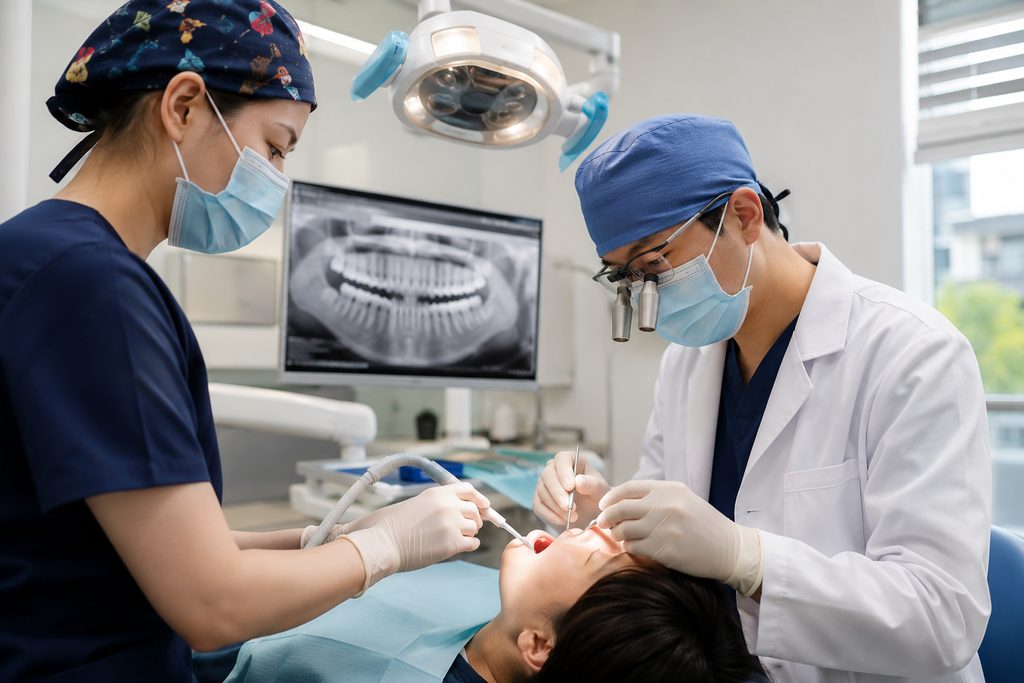
Periodontal disease affects roughly 47% of adults over 30 in the United States, according to CDC data. Left untreated, it leads to gum recession, bone loss, and eventually tooth loss. A standard cleaning removes plaque above the gumline. A deep cleaning goes further. It removes bacteria, tartar, and infected tissue below the gumline, where disease actually takes hold. For international patients, the deep cleaning teeth cost China typically runs between $150 and $400 per quadrant, depending on the hospital tier and the severity of the case. That’s a fraction of what the same procedure costs in North America or Western Europe.
At China Medical Services, we help patients understand what the procedure involves before they book anything. This article explains the clinical basis, the real timeline, the risks, and the practical steps for getting deep cleaning done in China — without the guesswork.
How This Actually Works, Step by Step
The process starts with a periodontal evaluation. A dentist or periodontist measures the depth of the pockets between your teeth and gums using a thin probe. Healthy pockets measure 1 to 3 millimeters. Pockets of 4 millimeters or more indicate inflammation. Pockets of 5 millimeters or deeper usually signal that bacteria have moved below the gumline and begun destroying the supporting bone.
If those deeper pockets are present, the dentist recommends scaling and root planing — the clinical term for deep cleaning. Here is the sequence:
- Records review. You send recent dental X-rays, periodontal charting if available, and a note on any medical conditions. Our team translates these into Chinese and forwards them to the dental department you select.
- Remote consultation. A periodontist reviews the records and gives a written opinion on whether deep cleaning is appropriate, how many quadrants need treatment, and whether additional therapy — like localized antibiotics or laser-assisted debridement — is worth considering. This costs between $100 and $300 for a video consultation, and $300 to $500 for a written second opinion from a top hospital specialist.
- In-person visit. Most patients travel to China for the actual procedure. The dentist confirms the diagnosis clinically, then schedules the cleaning. Deep cleaning is almost always done in two visits — the right side of the mouth in one session, the left side in another. Each visit numbs the treated area with local anesthesia.
- Follow-up. Four to six weeks later, the dentist re-measures pocket depths to confirm the gums are healing. Some patients need a third visit for a maintenance cleaning or localized re-treatment.
That’s the sequence. No shortcuts, no hidden steps. The remote consultation exists so you don’t fly across the world only to learn you don’t need the procedure.
What Is Dental Scaling and Root Planing, Exactly?
Scaling and root planing are two distinct mechanical actions performed in the same session. Scaling removes plaque and hardened tartar (calculus) from the tooth surface and from the pocket walls below the gumline. Root planing smooths the root surfaces so bacteria have a harder time reattaching. The goal is to reduce pocket depth and let the gum tissue re-adhere to the tooth.
This is not a cosmetic procedure. It is the standard first-line treatment for chronic periodontitis. Without it, the infection continues to destroy the periodontal ligament and alveolar bone. With it, most patients see pocket depth reductions of 1 to 2 millimeters and a halt to progressive bone loss.
Some clinics in China offer laser-assisted deep cleaning, which uses a diode or Nd:YAG laser to decontaminate the pocket after mechanical scaling. The evidence for lasers is mixed — some studies show modest additional pocket reduction, others show no difference versus scaling and root planing alone. We tell patients to treat laser as an optional add-on, not a substitute for thorough mechanical debridement.
A Realistic Timeline
People underestimate the total time commitment. The cleaning itself is quick. The surrounding logistics are not. Here is what a typical international patient should expect:
| Stage | What Happens | Realistic Duration |
|---|---|---|
| Day 1–7 | Records collection, translation, submission to hospital dental department | 3–7 days |
| Week 1–2 | Remote consultation or written second opinion | 5–10 days after records received |
| Week 2–4 | Visa application (S2 category for short-term medical treatment), flight booking, accommodation | 1–3 weeks depending on embassy workload |
| Week 4–5 | Arrival in China, first in-person periodontal exam | 1–2 days |
| Week 5 | First deep cleaning session (right or left side) | 60–90 minutes |
| Week 5–6 | Second deep cleaning session (opposite side) | 60–90 minutes, 5–10 days after first |
| Week 10–12 | Follow-up periodontal re-evaluation | 30–45 minutes |
Total time from first contact to completed follow-up: roughly 10 to 12 weeks. Some patients compress this by doing the remote consultation while the visa is already processing. Others extend it because they combine the dental work with a longer stay in China.
The follow-up matters. Skipping it means you never confirm whether the pockets actually closed. A re-evaluation at 4 to 6 weeks is standard care, not an optional extra.
What Can Go Wrong — and What Happens Then
Deep cleaning is a low-risk procedure, but it is not risk-free. Being honest about the failure modes helps patients prepare.
Sensitivity and pain. After the anesthesia wears off, most patients feel soreness for 24 to 72 hours. Some develop lingering cold sensitivity for several weeks. This usually resolves on its own. Desensitizing toothpaste and avoiding extremely hot or cold foods helps. If sensitivity persists beyond a month, the dentist checks whether a root surface was over-instrumented — rare, but treatable with a fluoride varnish or bonding agent.
Incomplete healing. Roughly 10 to 15 percent of patients do not achieve adequate pocket depth reduction from scaling and root planing alone. In those cases, the periodontist may recommend localized antibiotic placement (like minocycline microspheres), a second round of root planing, or referral for surgical pocket reduction. This is not a failure of the first procedure — it reflects the severity of the original disease.
Gum recession. As inflamed gum tissue shrinks back to a healthier state, the gums may recede slightly. This exposes more of the tooth root. It looks worse cosmetically but is actually a sign of reduced inflammation. A periodontist can discuss grafting options if the recession is severe.
Billing surprises. The most common practical problem we see is a patient quoted for “cleaning” who later receives a bill for deep cleaning at three times the price. The two are not the same procedure. We always confirm the CPT-equivalent code and the per-quadrant price in writing before the patient travels.
Is Deep Cleaning Teeth Painful Abroad? What to Expect in Chinese Clinics
The short answer: the procedure itself should not be painful, because local anesthesia is standard. The injection stings briefly. After that, you feel pressure and vibration, not sharp pain. The real question is what happens after.
In our experience coordinating care at Chinese dental departments, the anesthesia protocols are comparable to Western standards. Top-tier public hospital stomatology departments and private international dental clinics both use lidocaine or articaine. The difference is communication. In a public hospital, the dentist may speak limited English. In a private international clinic, English-speaking staff are the norm.
That communication gap has a direct clinical consequence. If you cannot tell the dentist that you still feel pain, they may proceed before the anesthesia has fully taken effect. A bilingual medical companion solves this. Our companions translate in real time, confirm the numbness level with you, and make sure the dentist waits until you are fully anesthetized before beginning.
Post-procedure pain is usually manageable with over-the-counter ibuprofen or acetaminophen. Most patients rate the discomfort as 2 to 3 on a 10-point scale for the first day. By day three, it is typically gone.
How Long Does Deep Teeth Cleaning Take to Heal?
Healing happens in phases. The first phase is soft tissue closure — the gum tissue begins to reattach to the cleaned root surface within 7 to 14 days. The second phase is pocket depth reduction, which is measurable at the 4 to 6 week re-evaluation. The third phase is bone stabilization, which takes 3 to 6 months and is only visible on follow-up X-rays.
So the honest answer: you will feel mostly normal within a week. You will know whether the treatment worked within six weeks. You will see the full benefit on X-ray within six months.
During the first two weeks, avoid smoking, avoid flossing the treated areas aggressively, and rinse with warm salt water or an antimicrobial mouthwash as directed. Smoking is the single biggest factor that sabotages healing — it constricts blood flow to the gums and dramatically slows reattachment.
Dental Deep Cleaning Price Shanghai and Other Chinese Cities
Prices vary by city, hospital tier, and case complexity. Shanghai and Beijing sit at the higher end. Chengdu, Hangzhou, and Xi’an are typically 20 to 30 percent lower. Here is the general range for international patients:
| City / Facility Type | Deep Cleaning (per quadrant) | Full Mouth (4 quadrants) |
|---|---|---|
| Shanghai — public hospital international department | $200–$350 | $700–$1,300 |
| Shanghai — private international dental clinic | $250–$400 | $900–$1,500 |
| Beijing — public hospital international department | $180–$320 | $650–$1,200 |
| Chengdu / Hangzhou / Xi’an — public hospital | $120–$250 | $450–$950 |
For comparison, the same procedure in the United States typically costs $200 to $400 per quadrant without insurance — and many dental insurance plans cover only a portion. In the UK, private deep cleaning runs £150 to £300 per quadrant. So the deep cleaning teeth cost China is roughly 30 to 50 percent lower than comparable private care in Western countries.
These are reference ranges. The final quote depends on the periodontal charting, the number of quadrants affected, and whether you choose a public hospital international department or a private clinic. We always confirm the exact price in writing before the patient commits to travel.
Practical Considerations: Records, Visa, Payment, and Follow-Up at Home
Deep cleaning is not a complex procedure, but the logistics still need attention.
Records. Bring recent bitewing and panoramic X-rays if you have them. If they are older than six months, the dentist will likely take new ones in China — that is normal and appropriate. Bring a list of medications, especially blood thinners. Deep cleaning causes minor bleeding, and your dentist needs to know if you are on warfarin, clopidogrel, or a direct oral anticoagulant.
Visa. For short-term dental treatment, the S2 visa is the applicable category. It covers private affairs including medical treatment. You will need an invitation letter or treatment confirmation from the hospital. Processing time varies by embassy, but plan for two to three weeks. We guide patients through the document requirements and coordinate with the hospital to provide the necessary paperwork.
Payment. Public hospitals in China require prepayment — you deposit funds at registration and draw down as services are provided. Private international clinics often accept direct payment by card and some work with international insurers for direct billing. Confirm the payment method before you arrive.
Language. Even in international departments, not every staff member speaks fluent English. Registration desks, pharmacy windows, and radiology departments are where communication breaks down most often. A bilingual companion handles those touchpoints so the clinical time with the dentist is not wasted on logistics.
Follow-up at home. After you return, send the post-treatment periodontal charting to your home dentist. They can continue maintenance cleanings every three to four months — the standard interval for patients with a history of periodontitis. Deep cleaning is not a one-time cure. It is the reset that makes ongoing maintenance effective.
Frequently Asked Questions
No. A regular cleaning removes plaque and tartar above the gumline and is preventive. Deep cleaning — scaling and root planing — removes bacteria and calculus below the gumline and is a treatment for active periodontal disease. The anesthesia, the instrumentation, and the billing code are all different.
You can book the consultation and reserve the treatment slot through the hospital’s international department or through a coordination service like ours. What you cannot do is skip the in-person periodontal exam. No reputable dentist will perform deep cleaning without first probing your pockets and confirming the diagnosis. The exam happens on day one; the cleaning follows one to three days later.
That is common. Periodontal disease is often localized. The dentist treats only the quadrants with pockets of 4 millimeters or deeper. The per-quadrant pricing means you pay only for what is clinically necessary. A full-mouth quote assumes all four quadrants are affected — do not accept that assumption without seeing the periodontal charting.
Some international dental insurance plans reimburse out-of-network treatment abroad, but most require you to pay upfront and submit a claim afterward. Chinese public hospitals do not bill Western insurers directly. Private international clinics in Shanghai and Beijing sometimes do. Check with your insurer before booking, and request an itemized invoice with procedure codes from the clinic.
The definitive test is periodontal probing. If your dentist has not measured pocket depths, you have not been properly diagnosed. Bleeding gums, bad breath, and gum recession are warning signs, but they are not proof. A remote consultation with a periodontist can review your records and tell you whether deep cleaning is warranted before you spend money on travel.
Your Next Step
Deep cleaning is a well-established, low-risk procedure that stops periodontal disease from destroying the bone that holds your teeth in place. The deep cleaning teeth cost China makes it accessible for patients who would otherwise delay treatment due to price. But the value depends entirely on getting the right diagnosis first and the right follow-up after.
China Medical Services coordinates the full pathway — records translation, remote consultation with a periodontist, hospital selection from our database of top-ranked Chinese hospitals, appointment scheduling, and bilingual support on the ground. We do not perform treatment, and we do not promise outcomes. We handle the logistics so you can focus on the clinical decisions.
If you are considering periodontal treatment in China, start with a conversation. Send your records, ask your questions, and get a clear picture of what the process would look like for your specific case. Request a free consultation and we will walk you through the options without pressure.
For more medical information and treatment options in China, visit chinamedservices.com (China Medical Services).
