Dental Clinics in China: How We Match Patients to the Right One
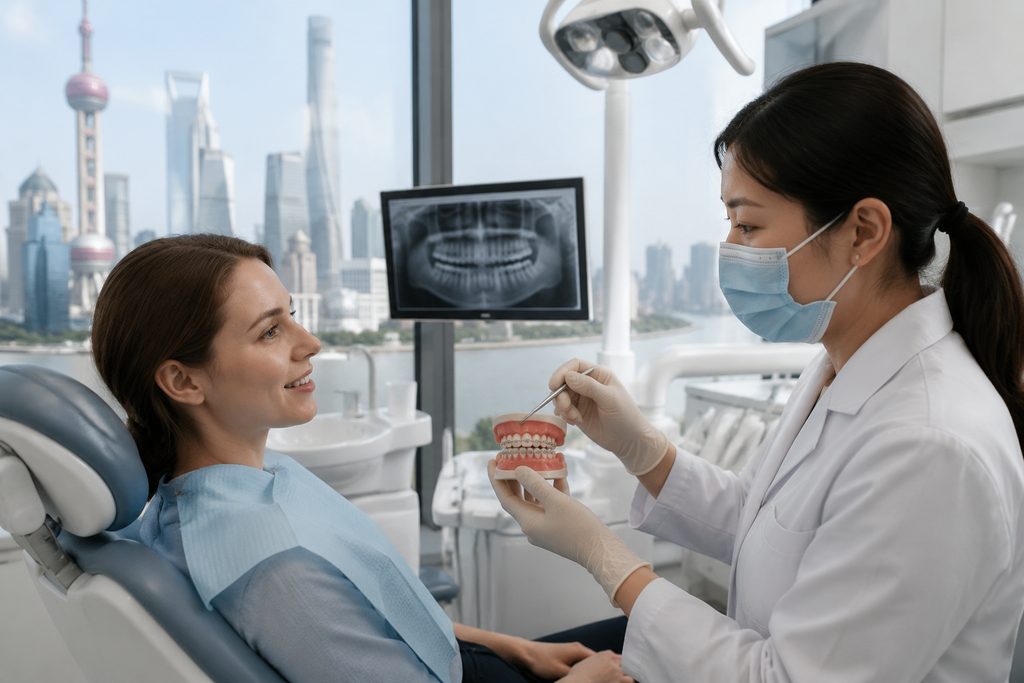
You’ve probably heard that dental work abroad means cutting corners — unlicensed clinics, recycled materials, a dentist who disappears when the crown fails. That story gets repeated so often that few people stop to ask whether it’s still true. It isn’t, at least not in the places we work with. China now runs some of the largest dental hospitals on earth, and the dental implants cost China patients pay at a top-tier facility often lands 60 to 80 percent below what a US clinic quotes for the same procedure.
But here’s the part nobody mentions in those viral “dental tourism” videos. Finding a good clinic is easy. Finding the *right* one for your specific mouth, budget, and timeline — that’s where most people get lost.
That’s the problem we exist to solve.
Dental Clinics in China: How We Match — The Short Answer
We match you by starting with your dental records, not a hospital brochure. You send us your X-rays, CBCT scan if you have one, and a short description of what you need — a single implant, a full-arch restoration, veneers, orthodontics. Our team reviews the case with the relevant Chinese specialty department, then narrows a database of 340+ top-ranked hospitals and verified private dental clinics down to two or three realistic options.
That sounds simple. It rarely is. A clinic that excels at full-arch All-on-4 cases may not be the best fit for a single molar implant, and the best dental clinic Shanghai has to offer for cosmetic work is often a different facility entirely from the one handling complex bone grafting. Matching is a clinical question before it’s a price question.
The core principle: We don’t send you to the cheapest clinic. We send you to the clinic whose actual case volume and specialty match your procedure — then let you compare the numbers yourself.
Who This Is Right For — and Who It Isn’t
Dental tourism in China works well for a specific kind of patient. It works badly for another kind. Being honest about both saves everyone time.
Typically a good fit:
- You need implants, crowns, bridges, veneers, or orthodontic work and have been quoted a price at home that feels impossible
- You have recent imaging (panoramic X-ray or CBCT) or can get it done locally before traveling
- You can stay in China for the treatment window — 5 to 7 days for a single implant placement, longer for full-arch work that needs healing time between stages
- You’re comfortable with a staged process: remote review first, travel second
- You want a written second opinion before committing to anything
Probably not a good fit:
- You have uncontrolled diabetes, active bleeding disorders, or a serious cardiac condition — implant surgery may be contraindicated regardless of country
- You need emergency dental care today. This process takes days to weeks, not hours
- You’re looking for a same-week trip with no pre-travel imaging. No responsible clinic will place implants blind
- Your case requires a specialist your home country has and China’s matching process can’t clearly improve on
- You expect a guarantee of outcome. No clinic anywhere offers that, and anyone who does is lying
The Options, Compared
Before we talk about matching mechanics, it helps to see what you’re actually choosing between. The table below compares typical price ranges for common dental procedures across four markets. These are ranges, not quotes — final pricing varies by hospital, case complexity, and materials.
| Procedure | United States | United Kingdom | China (Top-Tier Public) | China (Private International) |
|---|---|---|---|---|
| Single dental implant (incl. abutment + crown) | $3,000–$6,000 | £2,000–£3,500 | $800–$1,800 | $1,500–$3,000 |
| All-on-4 full arch | $20,000–$30,000 per arch | £12,000–£20,000 | $6,000–$12,000 | $10,000–$18,000 |
| Porcelain veneers (per tooth) | $800–$2,000 | £500–£1,000 | $200–$500 | $400–$900 |
| Root canal + crown | $1,500–$3,000 | £800–£1,500 | $300–$700 | $600–$1,200 |
| Clear aligner therapy (full course) | $4,000–$8,000 | £2,500–£5,000 | $1,500–$3,500 | $3,000–$6,000 |
Which column suits you depends on what you’re optimizing for. Public tertiary hospitals offer the lowest prices and the deepest specialist expertise, but expect queue-based scheduling and limited English at the general counter. Private international clinics charge more and bill insurance directly in some cases, with English-speaking staff throughout. If you’re weighing how much do veneers cost in Beijing against the same procedure in Shanghai, the gap is usually smaller than the gap between either city and your home market.
How the Matching Process Actually Works
This is the part that separates a real service from a search engine. Anyone can Google “best dental clinic Shanghai” and get a list. Matching means filtering that list against your case.
Step one: records in, not money. You send existing examination reports — panoramic X-ray, CBCT, photos, any prior treatment notes. If you don’t have imaging, we tell you what to get locally first. No imaging, no meaningful match.
Step two: specialty review. The relevant Chinese dental specialty reviews your file and provides written analysis, treatment suggestions, and direction. This is a written second opinion, and it’s for reference only — not a prescription, and not a substitute for an in-person exam.
Step three: shortlist with reasons. We come back with two or three facilities and explain why each one made the cut. Case volume in your specific procedure. Whether the department handles revision cases. Whether they have English-speaking coordinators. Whether they can do the whole treatment in one trip or need two.
Step four: you talk to them. A video consultation lets you speak directly with the dental team, explain your goals, and hear their recommendations before you book a flight. For patients who want a specialist to physically examine them first, a proxy consultation service lets you designate a specific hospital or department and we handle registration, medical card creation, and an in-person proxy visit using your materials.
Step five: logistics, only if you decide to travel. Visa guidance, appointment coordination, bilingual accompaniment for registration, payment, and translation. Nothing is promised about admission or scheduling until the hospital confirms it.
Read more about how we structure the broader China medical services process, including how the same matching logic applies to surgical specialties.
What It Costs and What Drives the Variance
The table above gives you procedure ranges. What it doesn’t show is the layer of costs around the treatment itself — and those are what surprise people.
On the clinical side, the biggest price drivers are material grade (titanium vs. zirconia implants, brand of abutment), whether bone grafting or sinus lift is needed, and whether the case is a first placement or a revision of failed work done elsewhere. A straightforward single implant and a compromised full-arch reconstruction can differ by a factor of ten.
On the service side, our published ranges are transparent. A bilingual medical companion runs from $300 per day, covering registration, queueing, payment, wayfinding, and translation — not a promise to secure a specific specialist. Airport transfers are $200 round-trip. A written second opinion from a top-tier hospital specialist runs $300–$500. Video consultations range from $100–$300 at a standard international department up to $500–$800 with a top specialist. Hospital appointment coordination starts from $300, with a full refund if we can’t secure the appointment shown in your order.
Any consultation fee is credited in full toward on-the-ground coordination if you travel within 90 days. It’s a one-time credit applied to the coordination fee only — never to hospital treatment charges.
One thing worth stating plainly: we are not a hospital and we don’t set dental prices. We coordinate. If a clinic quotes you a number, that number comes from the clinic.
Practical Considerations: Records, Visas, and Follow-Up
Documentation. Bring your imaging on a physical disc or USB drive as well as digitally. Chinese hospitals vary in what they can access remotely, and a disc has never failed to open.
Visa category. For medical treatment, the applicable short-stay category is the S2 visa, with accompanying family members applying under the same category. Requirements shift, so confirm current specifics with the nearest Chinese embassy or consulate and bring supporting hospital documents. Approval is never guaranteed, and no single visa fits every case. Note that the M visa is for commercial and trade activities — it is not a medical visa.
Payment. Public hospitals generally require prepayment, with insurance reimbursement handled afterward in your home country. Many private international clinics offer direct billing with certain insurers. Confirm before you travel, not after.
Language. China’s top hospitals see enormous daily patient volumes. Without Mandarin, navigating registration, payment, and pharmacy pickup solo is genuinely difficult. This is the practical reason bilingual accompaniment exists.
Follow-up after you fly home. Implant crowns and orthodontic retainers occasionally need adjustment. Ask your Chinese clinic before you leave what documentation they’ll provide for a local dentist, and get it in writing.
Frequently Asked Questions
At verified tertiary and JCI-accredited facilities, yes — the standards for sterilization, implant materials, and imaging are comparable to Western norms. The variable isn’t the country. It’s the specific clinic. This is exactly why matching matters more than the destination. A cheap clinic with no case volume in your procedure is a bad bet anywhere in the world.
You don’t, unless you get a written treatment plan with itemized costs before committing. Ask for it. A legitimate clinic will provide one after reviewing your imaging. If a provider won’t put the plan in writing, that’s your answer. Also note that final pricing genuinely varies by hospital and case complexity — a range is honest, a fixed quote before examination is usually not.
This is a real risk and it deserves a straight answer. Implant complications can surface months later. Before traveling, ask what warranty or revision policy the clinic offers and get it documented. Establish a relationship with a local dentist who is willing to handle follow-up. We can help coordinate communication with the Chinese clinic, but we can’t guarantee any clinical outcome — and no coordinator can.
Some clinics market bundled packages, and they can work for straightforward cases. For anything involving bone grafting, multiple implants, or revision work, a package price usually obscures more than it reveals. We recommend starting with a written second opinion and a video consultation, then building the plan from there. It’s a staged approach that reduces unnecessary early travel and lets you build trust before making a larger commitment.
Not if you arrange support. Some private international clinics operate fully in English. Public tertiary hospitals generally do not, outside their international departments. If you’re considering a public hospital for the price advantage, plan for language support as part of your budget rather than an afterthought.
Your Next Step
The takeaway is simple: the clinic matters more than the country, and the match matters more than the discount. China’s top dental facilities can deliver excellent work at a fraction of Western prices — but only if the facility actually specializes in your procedure and you’ve seen a written plan before booking anything.
We’re a coordination service, not a hospital. We don’t diagnose, we don’t treat, and we don’t promise outcomes. What we do is review your records with the relevant specialty, shortlist facilities with a stated reason for each, and handle the logistics if you decide to travel. If you’d like to see what a match looks like for your case, start with a free consultation — no obligation, and no pressure to travel.
For more medical information and treatment options in China, visit chinamedservices.com (China Medical Services).
