Disability-Accessible Medical Tourism China: Wheelchair and Mobility Support Full Service Hub
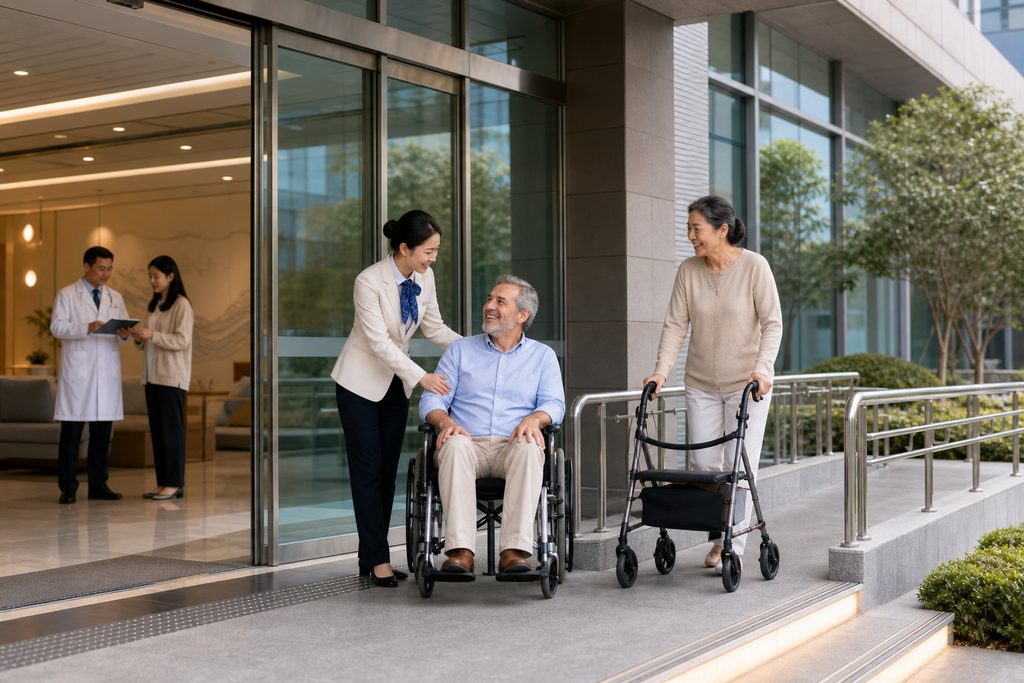
When 52-year-old Elena from Manchester started researching hip replacement options, she faced a wall of anxiety most medical tourists never consider. Elena uses a wheelchair. Her questions weren’t just about surgeon reputation or price. She needed to know whether she could physically navigate a Chinese hospital, who would help her transfer from chair to examination table, and what would happen if something went wrong in an unfamiliar city 5,000 miles from home.
These are the questions that keep disabled patients awake at night. And they’re the right questions to ask.
Our team has coordinated care for patients with mobility challenges across China’s top-ranked hospitals. We’ve seen what works, what doesn’t, and where the gaps are. This article lays out exactly what wheelchair users need to know before planning treatment in China — from realistic accessibility expectations to the support systems that make it possible.
How This Actually Works, Step by Step
The process starts long before you board a plane. Here’s the real sequence, including the waiting steps most guides skip.
First, you send us your medical records. Imaging, physician notes, current medication list, and a detailed description of your mobility needs. Not just “wheelchair user” — we need to know your transfer capability, whether you use a power chair or manual, your level of independence with daily activities, and any additional equipment you require.
Our team translates these documents into clinical Chinese. This translation step matters more than most patients realize. A vague description of mobility limitation won’t prepare a Chinese hospital team. Specific details do.
We then submit your case to the international patient departments of two or three appropriate hospitals. These are drawn from our database of 340+ top-ranked institutions across 37 cities. For wheelchair users, hospital selection isn’t just about the best surgeon. It’s about infrastructure. We’ll return to that.
The hospital reviews your records. This takes three to seven business days. They may request additional imaging or lab work. They may decline the case if they determine the procedure cannot be safely performed given your specific situation. That’s rare, but it happens. Better to know before you travel.
Once a hospital accepts your case, we coordinate a video consultation. You speak directly with the treating team. You ask your questions. They assess you remotely and outline the proposed treatment plan. This consultation costs $500 to $800 for a top-specialist session. If you proceed with treatment in China within 90 days, that fee is credited in full toward your coordination service.
Only after you’re satisfied with the plan do we move to logistics: visa support documentation, appointment scheduling, accommodation near the hospital, airport transfer with accessible vehicle, and daily bilingual companion assignment.
What “Accessible” Actually Means in Chinese Hospitals
Let’s be direct. Chinese public hospitals were not designed with universal accessibility as a founding principle. Most of China’s legendary institutions — the hospitals performing 14,000 cardiac surgeries annually or ranking among the top 10 nationally for orthopedics — were built decades ago. Elevators exist. Ramps exist. But the seamless accessibility Western patients might expect is inconsistent.
That’s the honest starting point.
What’s changed dramatically in the past decade is the international department infrastructure. Major hospitals in Beijing, Shanghai, and Guangzhou have invested heavily in accessibility upgrades specifically for their international patient wings. These are the environments where foreign wheelchair users receive care.
Peking Union Medical College Hospital‘s international department, for instance, has dedicated accessible consultation rooms with adjustable examination tables, wider doorways, and staff trained in assisted transfer techniques. Similar infrastructure exists at Huashan Hospital in Shanghai and West China Hospital in Chengdu.
But here’s what matters: the gap between what exists and what you can navigate alone remains significant. Hospital campuses are enormous. A single outpatient building might see 10,000 patients daily. Signage in English is improving but inconsistent. The distance between registration, consultation, imaging, and pharmacy can be hundreds of meters through crowded corridors.
This is where the best hospitals in China for disabled patients distinguish themselves. Not by flawless infrastructure, but by integrated support systems. The top-tier institutions assign dedicated international patient coordinators who meet wheelchair users at the entrance and guide them through every step. Combined with a bilingual medical companion who understands your specific mobility needs, the experience transforms from overwhelming to manageable.
A Realistic Timeline
| Stage | Duration | What Actually Happens |
|---|---|---|
| Record collection and translation | 5–10 business days | You gather and send all relevant medical documentation. Our team translates into clinical Chinese. Delays here are almost always on the patient side — incomplete records are the single biggest bottleneck. |
| Hospital review | 3–7 business days | The target hospital’s international department evaluates your case. They may request additional imaging or ask clarifying questions about your mobility status. |
| Video consultation scheduling | 5–14 days | Top specialists have packed schedules. Expect a wait. This is not a system designed for instant access — it’s designed for thorough evaluation. |
| Visa processing | 2–4 weeks | You’ll apply for an S2 visa with supporting documentation from the hospital. Processing times vary by country and season. Apply at your local Chinese embassy or consulate. |
| Travel and arrival | 1–3 days | Accessible airport transfer arranged in advance. Accommodation check-in near the hospital. First in-person consultation typically within 48 hours of arrival. |
| Pre-operative assessment | 2–5 days | In-person examination, additional testing if required, surgical clearance. The hospital verifies everything the video consultation suggested. |
| Procedure and hospital stay | Varies by procedure | Hip replacement: 5–10 days inpatient. Cardiac surgery: 10–21 days. Your companion remains with you throughout. |
| Post-discharge recovery locally | 1–4 weeks | Most surgeons want to see you for at least one follow-up before you fly home. This means staying in the city for a period after discharge. |
Total time from first contact to flying home: typically 8 to 16 weeks. Anyone promising significantly faster timelines is cutting corners you don’t want cut.
What Can Go Wrong — and What Happens Then
Accessible transportation doesn’t show up. It happens. Not often, but China’s accessible vehicle infrastructure is still developing. Our fallback is a network of private drivers with accessible vans in every city we serve. If the primary vehicle fails, the backup is deployed within 60 minutes. We’ve used it three times in the past year.
The hospital room isn’t as accessible as described. International patient departments generally deliver what they promise, but misunderstandings occur. Your bilingual companion escalates immediately to the department head. Solutions range from room reassignment to equipment adjustments. The key is having someone on-site who can advocate in fluent Mandarin and understands both the medical and accessibility requirements.
Your mobility needs change during recovery. This is actually normal. A patient who arrives with partial weight-bearing capacity may be non-weight-bearing post-operatively. The hospital adjusts. Your companion adjusts. Equipment rental — hospital beds, patient lifts, shower chairs — can be arranged same-day in major cities.
You need to extend your stay. Visa extensions for medical reasons are processed through the local Public Security Bureau Exit-Entry Administration. The hospital provides documentation confirming the medical necessity. Our team handles the paperwork. Extensions of 30 days are standard and typically approved within seven business days.
The procedure costs more than estimated. Pre-operative assessment sometimes reveals complexity the initial records didn’t show. The hospital provides a revised cost breakdown before proceeding. You decide. No one proceeds without your explicit approval of the updated figure.
How to Evaluate Whether Full Service Medical Travel China for Wheelchair Users Is Right for You
Not every wheelchair user needs the same level of support. Some patients travel with family members who can provide physical assistance. Others travel alone and need comprehensive help. Understanding where you fall on this spectrum determines whether a full service medical travel China for wheelchair users arrangement makes sense.
Ask yourself these questions honestly.
Can you transfer independently from wheelchair to bed, examination table, and toilet? If yes, your support needs are primarily navigational and linguistic. A bilingual medical companion at $300 per day may suffice. If no, you need a companion with transfer training — and you need to confirm the hospital can provide nursing staff for assisted transfers during your inpatient stay.
Do you have a traveling companion? A spouse or adult child who can help with daily activities changes the equation significantly. They handle personal care. Your hired companion focuses on hospital navigation, translation, and coordination. The combined support is robust.
Are you traveling for a single procedure or ongoing treatment? A knee replacement is one surgery with a defined recovery. Cancer treatment might mean weeks of radiation or chemotherapy with daily hospital visits. The longer your stay, the more critical consistent, reliable mobility support becomes.
What’s your backup plan? If your traveling companion gets sick, if your equipment fails, if you need something at 2 a.m. — who do you call? Full-service coordination means there’s always a number that answers. That’s not marketing language. That’s the operational reality we maintain.
The wheelchair accessible medical tourism China cost varies significantly based on these answers. A straightforward case with an independent wheelchair user and a family companion might need only basic coordination and occasional companion days. A complex case with significant transfer needs and a solo traveler requires comprehensive daily support. We provide a detailed cost breakdown after understanding your specific situation — never before.
Practical Considerations: Records, Visa, Payment, and Equipment
Medical records must be comprehensive. Chinese specialists will not proceed without complete documentation. At minimum: physician referral letter explaining your diagnosis and treatment history, all relevant imaging (MRI, CT, X-ray) on CD or digital transfer, current medication list with dosages, and a detailed mobility assessment from your physiotherapist or occupational therapist. The mobility assessment is not optional for wheelchair users. It’s the document that ensures the receiving hospital prepares appropriately.
Visa is S2. Short-stay private affairs visa, annotated for medical treatment. Your accompanying family members also apply for S2. Processing requires an invitation letter from the Chinese hospital — we coordinate this as part of your case management. Processing time varies by country. Budget four weeks to be safe. Expedited processing exists in some jurisdictions but isn’t guaranteed.
Payment is predominantly out-of-pocket at the time of service. Chinese public hospitals require deposit payment before admission. International departments accept wire transfers and major credit cards. Some international insurance policies cover treatment in China, but you must verify this with your insurer before travel. The hospital provides detailed invoices for reimbursement claims. We assist with insurance paperwork but do not guarantee coverage.
Equipment considerations matter more than most patients anticipate. Chinese electrical outlets are 220V, Type A/C/I plugs. Your power chair charger needs a voltage converter unless it’s dual-voltage. Spare parts for your specific chair model may not be available locally. Bring essential spares. Manual wheelchair users should bring a cushion appropriate for long periods of sitting — hospital seating is functional, not comfortable.
Accessible accommodation near the hospital is arranged in advance. Major Chinese cities have international hotels with accessible rooms, but they book quickly. Serviced apartments with wider doorways and roll-in showers are increasingly available in Beijing, Shanghai, and Guangzhou. We confirm specific room accessibility before booking. Generic “accessible room” descriptions have burned patients before.
Frequently Asked Questions
Is China safe for disabled medical tourists?
The question of whether China is safe for disabled medical tourists deserves a straight answer. Violent crime against foreigners in Chinese cities is extremely rare. The practical safety concerns are different: uneven pavement, crowded public spaces, and inconsistent accessibility infrastructure outside of international medical environments. Within the hospital and with a companion, wheelchair users navigate safely. Independent exploration between appointments requires caution and planning. Chinese pedestrians are not universally attentive to wheelchair users in crowded spaces. Your companion mitigates this. At night, major Chinese cities are remarkably safe — far safer than most Western cities of comparable size.
How do I arrange mobility support for surgery in China?
You don’t arrange it piece by piece yourself. That’s the core answer to how to arrange mobility support for surgery in China. The international patient department of your chosen hospital coordinates the in-hospital support — accessible rooms, nursing assistance with transfers, rehabilitation facilities. The external support — airport transfer, accommodation, daily companion, equipment rental — is coordinated through a service like ours. Attempting to book these elements independently from abroad, without Mandarin fluency, is extraordinarily difficult. The integrated approach means one point of contact handles everything.
Can I book an accessible medical package in China that includes everything?
Yes, but “package” is a misleading word. When patients ask how to book accessible medical package China arrangements, they’re often imagining a fixed-price bundle like a travel package. Medical care doesn’t work that way. What we provide is coordinated case management that includes hospital selection, appointment scheduling, visa support, accessible transportation, accommodation booking, and daily bilingual companion service. The medical costs are separate and paid directly to the hospital. Our coordination fee covers everything else. The total cost depends on your procedure, your hospital choice, your length of stay, and your specific mobility requirements. We provide a line-by-line estimate before you commit to anything.
What if I need rehabilitation after my procedure?
China’s rehabilitation infrastructure has advanced significantly. Top orthopedic hospitals like Peking University Third Hospital have dedicated rehabilitation departments with experience treating international patients. Inpatient rehabilitation is available. Outpatient rehabilitation can be arranged near your accommodation. TCM rehabilitation — acupuncture, tuina massage, therapeutic movement — is widely available and often integrated into recovery plans. We can connect you with rehabilitation facilities as part of your care coordination. The same companion who supported you through surgery can accompany you to rehab sessions.
What happens when I return home?
Your Chinese surgeon provides a detailed discharge summary and post-operative care instructions in English. We ensure you have copies of all imaging and operative reports. You’ll schedule follow-up with your local physician before you leave China. The Chinese team is available for one post-return video consultation at no additional charge — this is standard practice at the international departments we work with. After that, ongoing remote consultation is available at standard video consultation rates.
Your Next Step
Planning medical travel as a wheelchair user adds layers of complexity that able-bodied patients never consider. The questions are harder. The stakes feel higher. The margin for error is smaller. But the fundamental proposition remains: access to some of the world’s highest-volume, most experienced surgical teams at a fraction of Western costs.
Our organization exists to handle those added layers. We don’t provide medical care. We provide the scaffolding around it — the coordination, translation, navigation, and problem-solving that turns a daunting proposition into a feasible plan. We’ve done this for patients with spinal cord injuries, post-stroke mobility limitations, degenerative conditions, and post-surgical recovery needs.
If you’re considering treatment in China and use a wheelchair, start with a conversation. No commitment. No pressure. Just an honest discussion about your situation and whether this path makes sense for you. Visit our patient services page to begin. We’ll ask about your mobility needs in detail. That’s how we earn the right to help.
For more medical information and treatment options in China, visit chinamedservices.com (China Medical Services).
