Emergency Medical Visa China: Urgent Surgery Application Process
Key Takeaways
- Foreigners seeking urgent surgery in China apply for an S2 short-stay private affairs visa, not an M visa. The process requires a formal invitation letter from a Chinese hospital confirming the medical necessity and treatment schedule.
- China’s top-tier hospitals perform surgical volumes that dwarf Western institutions. Fuwai Hospital alone completes over 14,000 cardiac surgeries annually, creating a depth of clinical experience that directly impacts patient outcomes.
- Visa processing times vary significantly by embassy and country. While some expedited services exist, there is no official “fast track medical visa” category. Realistic timelines range from 4 to 15 business days depending on jurisdiction.
- You cannot arrive in China as a tourist and immediately schedule major surgery. Hospitals require in-person consultation before scheduling operations. Planning ahead with proper documentation is essential.
The Problem: When Waiting Is Not an Option
A Canadian patient waits a median 28.6 weeks for orthopedic surgery from specialist referral to treatment, according to the Fraser Institute’s 2023 report. An NHS patient in England faces an average 14.6-week wait for trauma and orthopedics. These are not outliers. They are the standard across many Western healthcare systems. For a patient with a deteriorating joint, a progressing cardiac condition, or a tumor that will not pause its growth, these timelines are more than inconvenient. They change outcomes.
Cost is the other vise. A coronary artery bypass graft in the United States runs between $120,000 and $150,000. Even with insurance, out-of-pocket maximums can reach $9,100 for an individual in 2024 under ACA-compliant plans. For the uninsured, the bill is catastrophic. The combination of long waits and prohibitive costs pushes patients to look beyond their borders. China has emerged as a destination not just for affordable care, but for high-volume, high-expertise surgical treatment.
But accessing that care on a compressed timeline requires navigating a specific visa pathway. This is not medical tourism where you book a package and show up. It is a regulated process that starts with the hospital and moves through the Chinese embassy or consulate in your home country. The question patients ask our team most often: can I get an emergency medical visa for urgent surgery in China, and how fast can it happen?
Why China Delivers Results for Urgent Surgical Cases
Clinical Volume Creates Specialist Expertise
Surgical proficiency correlates with repetition. A surgeon who performs 300 joint replacements annually sees complications, anatomical variations, and edge cases that a surgeon doing 60 per year may encounter once a decade. At Beijing Jishuitan Hospital, orthopedic surgeons complete over 300 joint replacements monthly. Not annually. Monthly. The hospital’s hand surgery department, recognized among China’s top-ranked orthopedic programs, handles microsurgical replantations at a scale unmatched in most Western centers.
Cardiac surgery tells a similar story. Fuwai Hospital in Beijing performs more than 14,000 cardiac surgeries each year. The hospital’s arrhythmia center conducts over 10,000 catheter ablation procedures annually. These are not abstract numbers. They represent a clinical environment where teams have refined protocols through relentless repetition. When a patient needs urgent surgery, this depth of experience matters.
Structural Efficiency Without Quality Trade-offs
The concern is predictable. Lower cost must mean lower quality. The data does not support this assumption. China’s top 5% of hospitals, ranked by the Fudan University Hospital Ranking system and accredited by Joint Commission International, operate with outcomes that match or exceed international benchmarks. Peking Union Medical College Hospital, Zhongshan Hospital at Fudan University, and West China Hospital at Sichuan University are research-driven institutions with published clinical data in major international journals.
What explains the cost difference? Labor economics play a role, but so does operational design. Chinese public hospitals are high-throughput institutions. A single outpatient department may see 10,000 patients daily. Surgical schedules run from morning to evening. Pre-operative workups are compressed. This is not a system designed for comfort. It is designed for throughput. For a patient who needs surgery urgently, that efficiency is an asset. For a patient who values a leisurely, hotel-like experience, it can be jarring. Understanding the trade-off before you arrive is essential.
Cost comparisons are stark. A total hip replacement at a top-tier Chinese public hospital ranges from $8,000 to $15,000. The same procedure in the United States averages $40,000 to $60,000. Cardiac bypass surgery: $12,000 to $20,000 in China versus $120,000-plus in America. These are the prices that make self-pay treatment feasible for international patients who cannot afford care at home.
Emergency Medical Visa China Urgent Surgery: The Step-by-Step Process
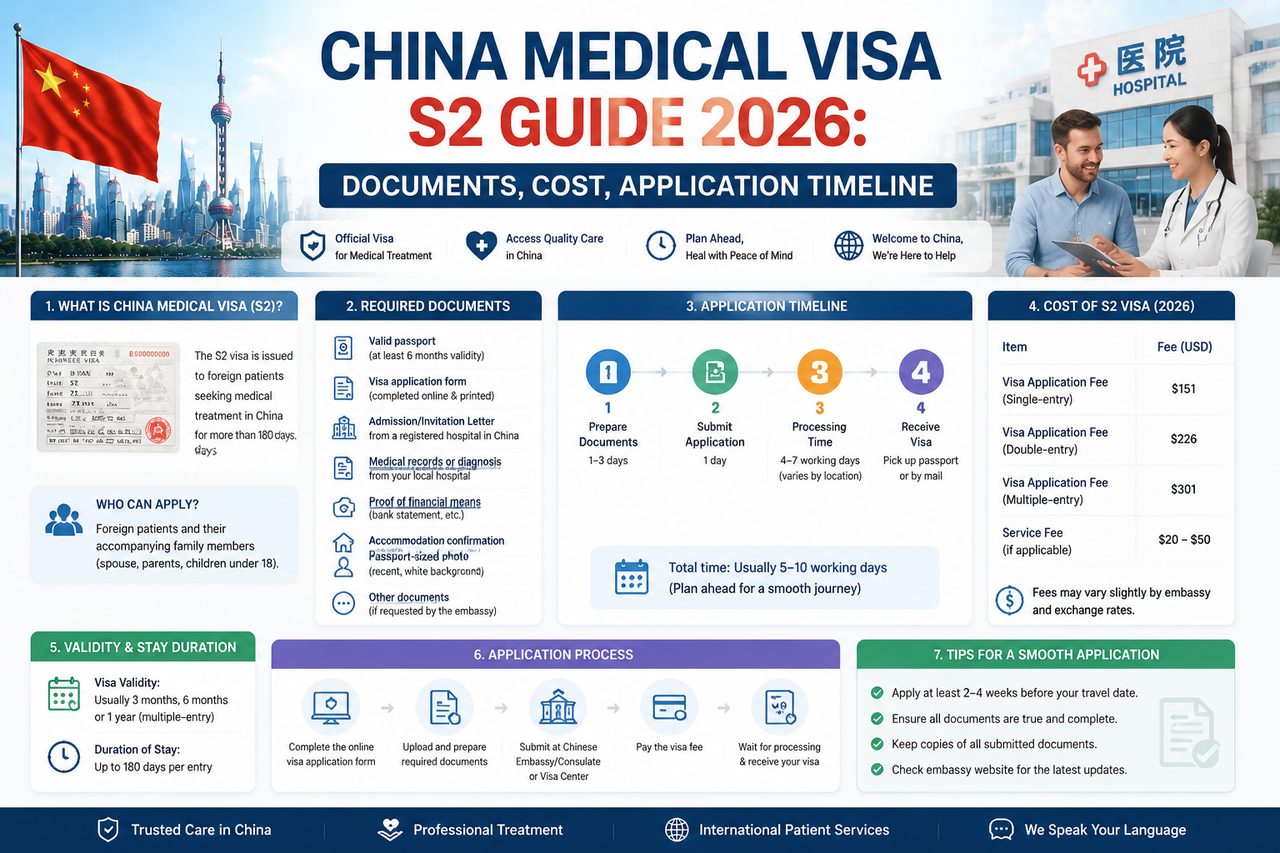
There is no visa category officially called an “emergency medical visa” in China’s immigration framework. What patients need is an S2 short-stay private affairs visa, annotated for medical treatment purposes. The process is not instant, but it can move faster than many assume when the hospital documentation is complete and the embassy accepts an expedited processing request.
Here is the sequence that actually works, based on the cases our team coordinates:
Step 1: Secure a hospital invitation letter. This is the foundational document. A Chinese hospital must issue a formal invitation letter confirming the patient’s diagnosis, the recommended treatment plan, the expected duration of stay, and the hospital’s willingness to provide care. Without this letter, the visa application has no anchor. The letter must include the hospital’s official stamp and contact information. Embassies verify these documents. A letter from an unverified or non-accredited institution will be rejected.
Step 2: Gather supporting medical records. The embassy needs to see that the treatment is medically necessary and urgent. This means providing recent diagnostic reports, imaging studies (CT, MRI, X-ray with written reports), a physician’s referral letter from your home country explaining why the surgery cannot wait, and any relevant pathology or lab results. Documents not in English or Chinese must be professionally translated.
Step 3: Complete the visa application form. The China Online Visa Application form must be filled out accurately. Errors cause delays. The purpose of visit should be clearly stated as medical treatment. The inviting entity is the hospital that issued the invitation letter. Incomplete or inconsistent information is the most common reason for processing delays.
Step 4: Submit with supporting documents at the Chinese embassy or consulate. In most cases, the applicant must appear in person. Required documents include the completed application form, passport with at least six months validity and blank visa pages, a recent passport photo, the hospital invitation letter, proof of legal residence in the country where you are applying, and medical records establishing urgency. Some embassies accept walk-in emergency applications. Most require an appointment.
Step 5: Request expedited processing. Standard S2 processing takes 4 to 10 business days. Expedited service, where available, can reduce this to 2 to 3 business days. This is not guaranteed. It depends on the specific embassy’s workload and policies. There is no separate “fast track medical visa China for emergency operation” category. The S2 is the vehicle. Expedited processing is a service option within that category, not a separate visa type.
Critical distinction: The M visa is for commercial and trade activities. It has no connection to medical treatment. Applying for an M visa while seeking surgery will result in rejection or, worse, entry on false pretenses. The correct visa for medical treatment is the S2, annotated for private affairs with a medical purpose.
Can Foreigners Get Emergency Surgery in China Without a Visa?
The short answer is no. China does not offer visa-free entry for medical treatment to most nationalities. The 24-hour, 72-hour, and 144-hour transit visa-free policies apply to specific cities and require confirmed onward travel to a third country. They do not permit admission for scheduled surgery.
There is one narrow exception. In a genuine, life-threatening emergency where a foreigner already inside China requires immediate surgery to prevent death or permanent disability, hospitals will provide emergency care without waiting for visa formalities. This is not a planned pathway. It is what happens when a traveler has a car accident or suffers an acute cardiac event while in the country. The hospital stabilizes the patient first. Immigration matters are addressed afterward, often with the assistance of the local public security bureau.
For a patient who knows they need surgery and wants to travel to China for it, there is no workaround. The S2 visa must be obtained before travel. Attempting to enter on a tourist visa and then schedule surgery creates legal risk. Hospitals may refuse treatment. Immigration authorities may flag the discrepancy. The safest and fastest route is the documented one.
The emergency medical treatment visa China application process is not designed to be a barrier. It is designed to verify that a legitimate medical need exists and that a qualified institution has agreed to provide care. When those conditions are met, the process moves. Our role is to help patients assemble the documentation that makes approval straightforward.
Urgent Surgery China Medical Visa Cost and Practical Timelines
Visa fees are modest. The S2 visa application fee varies by nationality and reciprocity agreements, typically ranging from $30 to $140 for most Western passport holders. Expedited processing adds a surcharge, usually $25 to $50. These are embassy fees, not service charges.
The real cost consideration is not the visa itself. It is the hospital deposit. Chinese public hospitals require upfront payment for international patients, typically in the form of a deposit against estimated treatment costs. For major surgery, this deposit can range from $10,000 to $30,000 depending on the procedure and the hospital. The deposit is reconciled against actual charges at discharge. Any surplus is refunded.
Timeline expectations matter. Here is a realistic projection for a coordinated urgent surgery application:
| Stage | Typical Duration | Notes |
|---|---|---|
| Medical record review and hospital matching | 1–3 business days | Depends on completeness of records and specialist availability |
| Hospital invitation letter issuance | 2–5 business days | Faster for urgent cases with clear surgical indications |
| Visa application and processing (standard) | 4–10 business days | Varies by embassy; some process faster than posted times |
| Visa application and processing (expedited) | 2–3 business days | Not available at all embassies; must be requested |
| Travel and hospital admission | 1–3 days after visa issuance | Patient must still complete in-person consultation before surgery |
From initial contact to arriving at the hospital, a well-documented urgent case can move from inquiry to admission in 10 to 20 days. This is not overnight. It is faster than waiting six months for surgery in a backlogged public system.
Practical Considerations: What Patients Must Prepare
Visa in hand, there are operational realities that determine whether the experience is smooth or chaotic. Chinese public hospitals are enormous, busy, and almost entirely Chinese-language environments. Even hospitals with international departments operate within a system designed for domestic patients.
Medical records must be complete and translated. Surgeons will not rely on a verbal summary. They need original imaging on CD or USB, written radiology reports, pathology slides where relevant, and a detailed referral letter from the treating physician at home. All documents should be translated into Chinese or, at minimum, English if the hospital’s international department accepts it. Incomplete records cause delays. The surgeon may order repeat imaging, which adds days and cost.
Payment is upfront and typically in Chinese yuan. International patients pay a deposit at admission. Credit cards are accepted at international departments, but transaction limits and foreign exchange fees apply. Wire transfers are common for larger deposits. Traveler’s checks are rarely used. Confirm the payment method with the hospital before departure.
Insurance reimbursement is retrospective. Most Chinese public hospitals do not bill international insurers directly. The patient pays the hospital, collects itemized receipts and medical reports, and submits a claim to their insurer after returning home. Some private international hospitals in China, such as United Family Healthcare and Jiahui International Hospital, offer direct billing. But for the top-tier public hospitals where surgical expertise is concentrated, the pay-and-claim model is standard. Check your policy’s out-of-network coverage and pre-authorization requirements before committing.
Language support is not optional. Even at hospitals with international wings, the nursing staff, billing office, pharmacy, and diagnostic departments operate in Chinese. A bilingual medical companion who can navigate registration queues, translate during ward rounds, and explain discharge instructions is not a luxury. It is infrastructure. Patients who arrive without language support report confusion, delays, and difficulty understanding their own care plan.
Follow-up care after returning home must be arranged in advance. Chinese surgeons will provide a discharge summary and recommendations for post-operative monitoring. But they cannot manage your recovery from across the ocean. Identify a local physician who will accept the transfer of care before you leave for China. Send them the surgical plan in advance. The handoff is your responsibility.
Frequently Asked Questions
With complete documentation and a hospital invitation letter, the S2 visa can be processed in 2 to 3 business days using expedited service where available. Standard processing takes 4 to 10 business days. The limiting factor is usually the hospital’s timeline for reviewing records and issuing the invitation letter, not the embassy. Plan for 10 to 20 days from first contact to arrival.
If you are already in China and face a genuine medical emergency, hospitals will provide stabilizing care regardless of visa status. If you are outside China, there is no mechanism to bypass the visa requirement. The S2 process is the fastest legal pathway. Some embassies accept walk-in emergency applications with hospital documentation showing imminent risk to life or limb. Contact the nearest Chinese embassy or consulate directly to confirm their emergency procedures.
The S2 visa fee ranges from $30 to $140 depending on nationality. Expedited processing adds $25 to $50. The hospital deposit for surgery is separate and ranges from $10,000 to $30,000 for major procedures. There are no hidden government fees, but translation services, courier costs, and coordination support are additional if you use a third-party service.
No. Each traveler must apply for their own S2 visa. Accompanying family members apply under the same S2 category, citing private affairs to accompany a patient. They will need their own passport, application form, and supporting documents, including proof of relationship to the patient and a copy of the patient’s hospital invitation letter.
This is a real possibility. The hospital’s pre-operative evaluation may reveal contraindications that were not apparent from remote records. If surgery is deemed inappropriate, the hospital will discharge the patient or recommend alternative treatment. The deposit is refunded, minus charges for consultations and tests already performed. This is why we recommend a thorough remote evaluation before travel. A written second opinion or video consultation with the Chinese specialist team can identify suitability issues before you commit to the trip.
Your Next Step
Navigating the emergency medical visa China urgent surgery process alone is possible, but the sequence is unforgiving. One missing document or a hospital invitation letter that does not meet embassy specifications can add weeks to a timeline that does not have weeks to spare. Our team at China Medical Services has coordinated urgent surgical cases across our network of 340+ top-ranked hospitals in 37 cities. We handle the hospital matching, document preparation, and visa guidance so that the application moves the first time it is submitted. If you are facing a surgical decision and time matters, contact us for a free consultation. We will tell you honestly whether your case is suitable for treatment in China and what a realistic timeline looks like. No pressure. Just the facts you need to make a hard decision.
For more medical information and treatment options in China, visit chinamedservices.com (China Medical Services).
