Endoscopy in China: Booking Both Tests and What It Really Costs
Key Takeaways
- An endoscopy cost China patients typically pay runs roughly $300–$900 for a combined gastroscopy and colonoscopy at a top-tier public hospital — a fraction of U.S. pricing.
- Chinese hospitals perform enormous procedure volumes, and many endoscopy units meet international safety and disinfection standards, often with JCI accreditation at international departments.
- The real barrier is not the test — it is the booking system. Walk-in registration, no online self-scheduling, and Mandarin-only paperwork are the true friction points.
- Understanding the two-visit structure (consultation first, procedure second) prevents wasted trips and surprise costs.
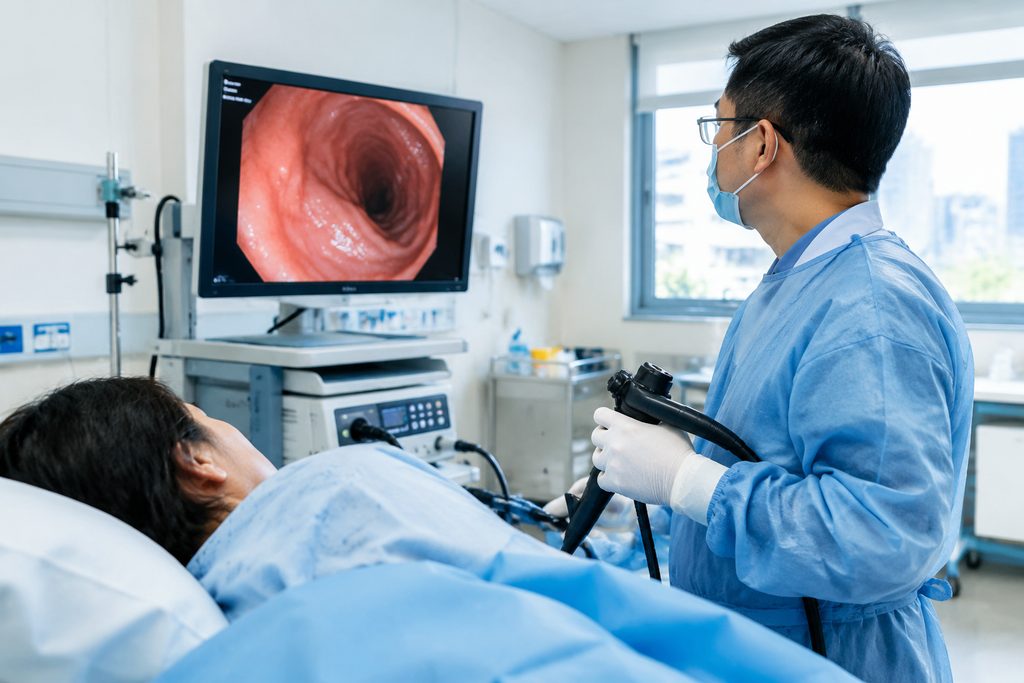
An endoscopy is a simple idea dressed in intimidating language. A thin, flexible tube with a camera slides down your throat (gastroscopy) or up through the colon (colonoscopy) so a doctor can see the lining of your digestive tract directly. No incision. Usually under light sedation. Fifteen to forty minutes.
For international patients, the question is rarely “what is an endoscopy.” It is “where can I get both tests done safely, quickly, and without paying Western prices?” That is where China enters the picture — and where the logistics get interesting. If you are weighing an endoscopy cost China quote against what your home country charges, the numbers are genuinely striking. But the process of booking both a gastroscopy and a colonoscopy in a Chinese hospital has its own rhythm, and understanding it ahead of time saves money, time, and stress.
The Problem: Why Getting Scoped at Home Feels Impossible
In the United States, the average colonoscopy runs between $2,000 and $3,500 before insurance, according to pricing data compiled by organizations like the Health Care Cost Institute. A gastroscopy adds another $1,500 to $2,500. Patients on high-deductible plans frequently absorb thousands out of pocket.
Wait times compound the frustration. In parts of Canada and the UK, non-urgent endoscopy referrals can stretch three to six months. A patient with persistent reflux, unexplained anemia, or a family history of colorectal cancer does not want to wait a season to learn what is happening inside their own body.
Then there is the anxiety layer. Many patients put off both tests for years because the preparation sounds unpleasant and the cost feels unjustifiable. Meanwhile, colorectal cancer is one of the few cancers where early detection genuinely changes outcomes — screening guidelines from bodies like the U.S. Preventive Services Task Force recommend starting at 45 for average-risk adults. Delay has a price, and it is not measured in dollars.
Why China Delivers Results for Diagnostic Endoscopy
China’s top hospitals are not a compromise choice for endoscopy. They are a legitimate one, and the reasons are structural rather than promotional.
Volume Builds Skill
Gastroenterology departments at major Chinese hospitals perform thousands of endoscopic procedures annually. A senior endoscopist at a large tertiary hospital may personally conduct more scopes in a year than some Western counterparts do in several. Repetition sharpens technique, and it also sharpens the eye — polyp detection rates, a key quality metric, tend to improve in high-volume units.
Technology and Disinfection Standards
Top-tier Chinese hospitals use the same equipment platforms found in Western centers — Olympus, Fujifilm, and Pentax endoscope systems are standard. High-definition and image-enhanced endoscopy (narrow-band imaging, for example) is widely available for polyp characterization. Reprocessing follows national standards that mirror international protocols, and international departments at JCI-accredited private hospitals apply Western-style sterilization documentation.
Cost Without Quality Trade-Off
Lower prices in China do not come from cutting corners on the procedure itself. They come from labor economics, hospital scale, and a different reimbursement structure. The physician’s time, the nursing support, and the facility overhead all cost less in absolute terms — while the scope, the sedation drugs, and the pathology lab work meet comparable standards.
| Service | China (top public hospital) | China (private international) | United States |
|---|---|---|---|
| Gastroscopy (upper endoscopy) | $150–$400 | $500–$1,200 | $1,500–$2,500 |
| Colonoscopy (diagnostic) | $200–$500 | $700–$1,500 | $2,000–$3,500 |
| Combined package (both tests, one sedation) | $300–$900 | $1,000–$2,500 | $3,500–$6,000 |
| Biopsy + pathology (per specimen) | $30–$80 | $80–$200 | $200–$500 |
| Pre-procedure consultation | $15–$50 | $150–$400 | $200–$400 |
These figures vary by hospital and case complexity, and they exclude travel and accommodation. But the pattern holds: a combined gastroscopy and colonoscopy package China pricing frequently lands at one-fifth to one-tenth of the U.S. equivalent.
How the Two-Visit Structure Actually Works
Here is the part most foreign patients do not expect. In Chinese public hospitals, you generally cannot book an endoscopy directly from overseas. The procedure requires an in-person consultation first, where a gastroenterologist reviews your symptoms, your history, and any prior reports, then writes the order.
That means a realistic timeline looks like this:
- Day 1: Arrive, register at the gastroenterology department (or the international/VIP channel), see the specialist. Bring translated records.
- Day 1–2: Pre-procedure bloodwork — coagulation panel, hepatitis B and C, HIV screening. Chinese hospitals require these before any endoscopic procedure.
- Day 2–4: Bowel preparation for the colonoscopy portion. This is the part patients underestimate. The prep protocol matters more than the procedure itself for polyp detection.
- Day 3–5: Procedure day. Both scopes can often be done in a single sedation session — one anesthetic event, two exams.
- Day 5–7: Preliminary findings discussed; biopsy results typically return within three to seven working days.
Combining both tests under one sedation is the single biggest efficiency win, and many Chinese hospitals accommodate it routinely. Ask specifically for a “combined gastroscopy and colonoscopy” when the order is written.
Choosing the Right Hospital and Reading the Numbers
Not every Chinese hospital is the right fit for an international patient, and the gap between tiers is wide.
Public tertiary hospitals (the “3A” tier) offer the best value and the deepest specialist expertise. The trade-off is crowds — a major hospital may see 10,000+ outpatients in a single day. Without Mandarin, navigating registration, payment, and the endoscopy queue alone is genuinely difficult.
Private international hospitals — United Family, Jiahui, Parkway, Raffles among them — offer English-speaking staff, JCI accreditation, direct insurance billing, and appointment-based scheduling. You pay roughly 1.5 to 2 times the public rate for that convenience, and it is often worth it for a first-time visitor.
For patients who want the best of both, the international or VIP department inside a top public hospital is the middle path: senior specialists, English-capable coordinators, and pricing above the standard queue but below full private rates.
When evaluating any hospital, ask three questions: What is the endoscopist’s annual procedure volume? Does the unit use high-definition scopes with image enhancement? And what is the polyp detection rate? A unit that tracks and reports that last figure is a unit that takes quality seriously. Our directory of top-ranked Chinese hospitals lets you filter by city and specialty, and if you are targeting the capital specifically, the Beijing hospital guide breaks down which facilities handle international patients most smoothly.
Practical Considerations: Visas, Payment, and Records
A combined gastroscopy and colonoscopy typically runs $300–$900 at a top public hospital, or $1,000–$2,500 at a private international facility. These figures generally exclude travel, accommodation, sedation if billed separately, and any biopsy pathology fees. Final pricing varies by hospital and case complexity, so request a written estimate after your consultation.
Not directly at most public hospitals — the standard rule is that a specialist must see you in person before ordering the procedure. International departments and private hospitals are more flexible and may allow pre-booking. This is one of the main reasons patients use a coordination service: to sequence the consultation and procedure efficiently so a single trip covers both.
That depends entirely on your symptoms, age, and family history — it is a clinical decision your doctor must make. Many patients with overlapping symptoms (reflux plus bowel changes, for example) benefit from combining both in one sedation session, which saves time and reduces total cost. Discuss the appropriate scope with a qualified physician.
Your Next Step
An endoscopy in China can be safe, fast, and dramatically more affordable than the same test at home — provided you understand the two-visit structure and choose the right facility. The clinical quality is there; the coordination is the variable. China Medical Services is a medical concierge organization, not a hospital, and we do not diagnose or treat. What we do is connect international patients with 340+ top-ranked hospitals across 37 cities, arrange written second opinions and video consultations, and provide bilingual medical companions who handle registration, queues, payment, and translation on the ground. If you would like to talk through your options before committing to anything, start with a free consultation — no pressure, just a clear picture of what is possible.
Frequently Asked Questions
Yes. The hospitals used for international patients are JCI-accredited and follow the same international safety standards as top hospitals in the US and Europe. Surgical teams perform high volumes of procedures — often more than their Western counterparts — which studies show leads to better outcomes.
Costs vary by procedure and hospital, but international patients typically save 40-80% compared to US prices — even when factoring in travel and accommodation. A consultation with our team will give you an exact, all-inclusive quote with no hidden fees.
Send us your existing medical reports to get started. We handle everything from hospital selection and appointment scheduling to visa assistance and post-operative recovery planning. Your medical records are reviewed by the specialist before you even book a flight.
For more medical information and treatment options in China, visit chinamedservices.com (China Medical Services).
