Endoscopy in China: Symptom Checks, Costs & Top Clinics
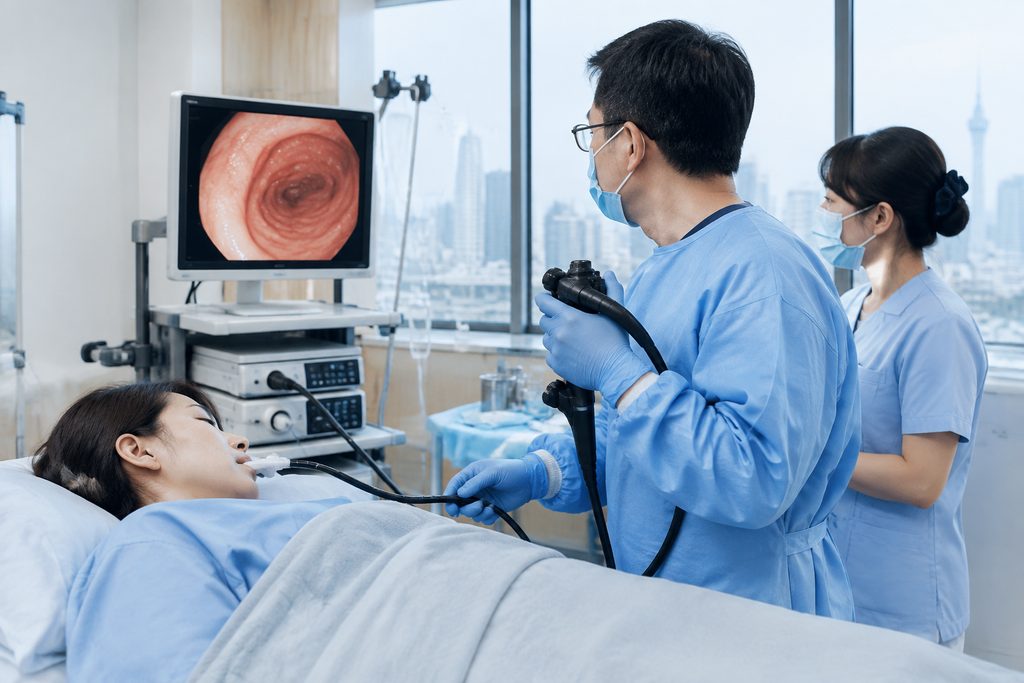
Endoscopy in China: Symptom Checks, Costs, and How to Get Scoped Fast
Roughly 1 in 3 adults worldwide will eventually be referred for some form of endoscopy — and for international patients, the first question is rarely medical. It is logistical. What does endoscopy cost in China, how long does it take, and can a foreigner actually get an appointment without a six-month wait? The short answer: yes, often within days, and at a fraction of Western prices. The longer answer involves some real trade-offs worth understanding before you book a flight.
This guide covers the full picture — price ranges, hospital selection, safety, preparation, and the practical steps for booking an endoscopy in China as a foreign patient.
Key Takeaways
- Upper GI endoscopy at a top-tier Chinese public hospital typically runs $150–$500 all-in, versus $1,500–$3,500 in the United States for the same procedure.
- China’s highest-volume hospitals perform tens of thousands of endoscopic procedures annually, which translates into deep operator experience — especially for therapeutic and interventional scopes.
- The real friction is not cost or quality. It is access: general outpatient slots at public hospitals cannot be reserved from overseas in advance, and English-language navigation is limited outside international departments.
- Before committing to travel, a written second opinion or video consultation can confirm whether the procedure you need is actually available at your target hospital — and whether it is even necessary.
The Problem: Long Waits, High Prices, and a System That Assumes You Already Have a Doctor
In Canada, the median wait from referral to a diagnostic endoscopy runs 8 to 12 weeks in many provinces. In the UK, the NHS target is six weeks for urgent suspected cancer referrals — but routine diagnostic scopes routinely exceed that. In the US, the wait is shorter, but the bill is not: a routine upper endoscopy without biopsy averages $1,500–$2,500, and with sedation, biopsy, and pathology, it can clear $3,500.
That combination — weeks of waiting plus four-figure bills — pushes a growing number of patients to look abroad. And China, whatever else people assume about it, happens to have one of the highest-volume endoscopy infrastructures in the world.
Here is the catch nobody mentions. Chinese public hospitals do not work like Western ones. You cannot email a hospital in Beijing and reserve a gastroscopy slot for next month. General outpatient registration happens on the day, in person, in a queue. That single structural fact changes how you plan everything.
Is Endoscopy Safe in China? What the Volume Data Actually Shows
Safety in endoscopy is largely a function of operator experience and equipment quality — not nationality. On both counts, China’s top hospitals compete globally.
Procedure Volume Creates Operator Skill
Fuwai Hospital in Beijing, for example, performs more than 14,000 cardiac surgeries a year — the highest volume of any heart center worldwide. That kind of throughput exists across Chinese specialty medicine, including gastroenterology. A senior endoscopist at a top-100 hospital may perform 2,000–4,000 scopes annually, compared with a few hundred for a typical Western general gastroenterologist. More repetitions means more familiarity with unusual anatomy, difficult polyps, and early-stage lesions.
Equipment and Sedation Standards
High-tier Chinese hospitals use the same Olympus and Fujifilm endoscope platforms found in Western academic centers. Sedation protocols (usually propofol-based, administered by an anesthesia team) are standard at major centers. Sterilization follows national technical standards for flexible endoscope reprocessing, which mirror WHO guidance.
What “Top Tier” Actually Means Here
China has 35,000+ hospitals. Our database covers 340+ of them across 37 cities — the top 5% as ranked by the Fudan Hospital Ranking and JCI accreditation. That distinction matters enormously for endoscopy. A county-level hospital and a Fudan A++++ hospital are not the same product, and the price gap between them is smaller than you would expect.
Endoscopy Cost China: Real Numbers for 2026
Costs vary by hospital tier, city, sedation choice, and whether biopsy or polypectomy is performed. The table below reflects typical ranges at top-tier public hospitals and private international hospitals.
| Procedure | Top Public Hospital (China) | Private International Hospital (China) | United States |
|---|---|---|---|
| Upper GI endoscopy (gastroscopy), no sedation | $120–$250 | $600–$1,200 | $1,200–$2,000 |
| Upper GI endoscopy with sedation | $200–$450 | $900–$1,800 | $1,500–$3,500 |
| Colonoscopy with sedation | $250–$550 | $1,000–$2,000 | $1,800–$4,000 |
| Endoscopic ultrasound (EUS) | $400–$900 | $1,500–$3,000 | $3,000–$6,000 |
| ERCP (biliary intervention) | $800–$2,000 | $3,000–$6,000 | $8,000–$20,000 |
| Pathology / biopsy add-on | $30–$120 | $150–$400 | $200–$600 |
Two caveats. First, these are procedure-level ranges — they exclude consultation fees, pre-procedure labs, and any hospital stay. Second, prices vary by hospital and case complexity, and a therapeutic scope that turns into a full polypectomy or stent placement will cost more than the diagnostic baseline.
How Long Does Endoscopy Take — and What the Whole Trip Actually Looks Like
The scope itself is fast. A diagnostic gastroscopy takes 5 to 15 minutes. A colonoscopy runs 20 to 40 minutes. With sedation and recovery room time, plan on 2 to 3 hours at the facility.
The trip around it is longer. A realistic timeline for a foreign patient:
- Week 1–2: Send existing reports for a written second opinion or arrange a video consultation to confirm the procedure is appropriate and available.
- Week 2–3: Hospital appointment coordination — international department or VIP channel registration, scheduling, and preparation instructions.
- Day 1 in China: Arrival, airport transfer, hospital registration and payment.
- Day 2: Pre-procedure labs (bloodwork, ECG, sometimes chest imaging) and anesthesia assessment.
- Day 3: The endoscopy itself, plus recovery.
- Day 4–7: Pathology results, physician review, and treatment planning.
Total: roughly 7 to 10 days on the ground for a straightforward diagnostic scope, longer if biopsy results require a follow-up discussion or if a therapeutic procedure is added.
Finding the Best Endoscopy Clinic in Shanghai (and Elsewhere)
Shanghai is the most common entry point for international patients, and for good reason — it has 18 Fudan top-100 hospitals, the densest concentration after Beijing’s 21.
For gastroenterology specifically, the Fudan specialty reputation ranking lists the strongest departments by name across 45 specialties. Hospitals like Zhongshan Hospital Fudan University and Ruijin Hospital consistently appear among the top-ranked gastroenterology departments nationally. In Beijing, Peking Union Medical College Hospital is the standard referral for complex or unclear GI cases.
If you prefer an English-first environment with direct insurance billing and Western-style scheduling, private international hospitals — United Family, Jiahui, Parkway, Raffles — handle endoscopy routinely. You will pay roughly 2 to 4 times the public hospital price, but the process is frictionless and the staff speak English.
You can browse ranked departments and hospital profiles directly through our specialty rankings by department and our Fudan top-100 hospital directory.
What an “Endoscopy Package Beijing” Usually Includes
Several Beijing hospitals offer bundled health-check packages that include gastroscopy and colonoscopy alongside imaging and labs. These typically run $400–$1,200 depending on scope and hospital tier, and are popular with patients who want a comprehensive screen rather than a single targeted procedure. Confirm exactly what is included — some packages exclude pathology and sedation.
Practical Considerations: Visa, Payment, Language, and Follow-Up
Visa. For medical treatment in China, the applicable short-stay category is the S2 visa, which covers medical treatment and private affairs. Stays exceeding 180 days require S1. Accompanying family members apply under the same S2 category. The M visa is for commercial and trade activities only and is not the correct category for medical travel. Requirements are set by the latest embassy or consulate guidance, and supporting hospital documentation is normally part of the application. Approval is never guaranteed.
Payment. Public hospitals require prepayment; international insurance is typically reimbursed after the fact. Private international hospitals frequently offer direct billing. Bring a card that works on Chinese networks, or arrange a bank transfer in advance.
Language. Outside international departments, English is limited. Registration, payment, pharmacy, and wayfinding all happen in Chinese. This is the single biggest practical barrier for foreign patients, and it is the reason bilingual medical companion services exist.
Records and follow-up. Request your endoscopy report, images, and pathology slides in English before you leave. Chinese hospitals can provide English-language summaries on request, though it may take a few days. Your home physician will need these for continuity of care.
Preparation. Bowel prep for colonoscopy follows standard international protocols (split-dose polyethylene glycol). Fasting requirements for gastroscopy are typically 6 to 8 hours. Confirm instructions with your hospital — they vary.
Frequently Asked Questions
Not directly at a public hospital’s general outpatient department — those slots are issued on the day, in person. To lock in a date in advance, you generally need to go through a hospital’s international department or VIP channel, or work with a coordination service. Private international hospitals do accept advance international bookings.
At top-tier hospitals, yes. Equipment, sedation protocols, and sterilization standards at Fudan-ranked and JCI-accredited facilities match Western academic centers. The variable that matters most is which hospital you choose — a top-5% facility and a small local hospital are not comparable, even though both may list “endoscopy” on their service menu.
Some international policies reimburse treatment abroad, but many require pre-authorization and exclude elective procedures. Check your policy before travel. Public hospitals generally require you to pay upfront and claim reimbursement afterward; private international hospitals often bill insurers directly. Keep every receipt and the itemized procedure report.
This is the question worth planning for. Top Chinese hospitals have full oncology, surgery, and interventional GI departments on the same campus, so a finding can be discussed and staged without transferring facilities. If you prefer to return home for treatment, request your pathology slides and imaging on disk before departure — most hospitals release them within 3 to 5 working days.
Not legally. Practically, at a public hospital, yes — unless you speak Mandarin. Registration, payment windows, pharmacy pickup, and prep instructions are all in Chinese, and the queues are long. A bilingual medical companion handles registration, queuing, payment, wayfinding, and translation throughout the visit.
Your Next Step
An endoscopy in China is fast, affordable, and clinically solid at the right hospital — but the planning matters more than the procedure. Confirm the hospital tier, the exact scope being performed, and whether the price includes sedation and pathology before you commit.
China Medical Services is not a hospital and does not provide diagnoses. We connect international patients with 340+ top-ranked hospitals across 37 cities, and we handle the parts that trip people up: written second opinions, video consultations, appointment coordination, and bilingual medical companions on the ground. If you would like to understand your options before making any decision, you can start with a free consultation through our patient support page — no pressure, no obligation.
This article is for general information only and does not constitute medical advice. Endoscopy carries risks including bleeding, perforation, and sedation-related complications. Always consult a qualified physician about your individual situation.
For more medical information and treatment options in China, visit chinamedservices.com (China Medical Services).
