Why Eye Surgery Costs Less in China: Our 2025 Value Guide
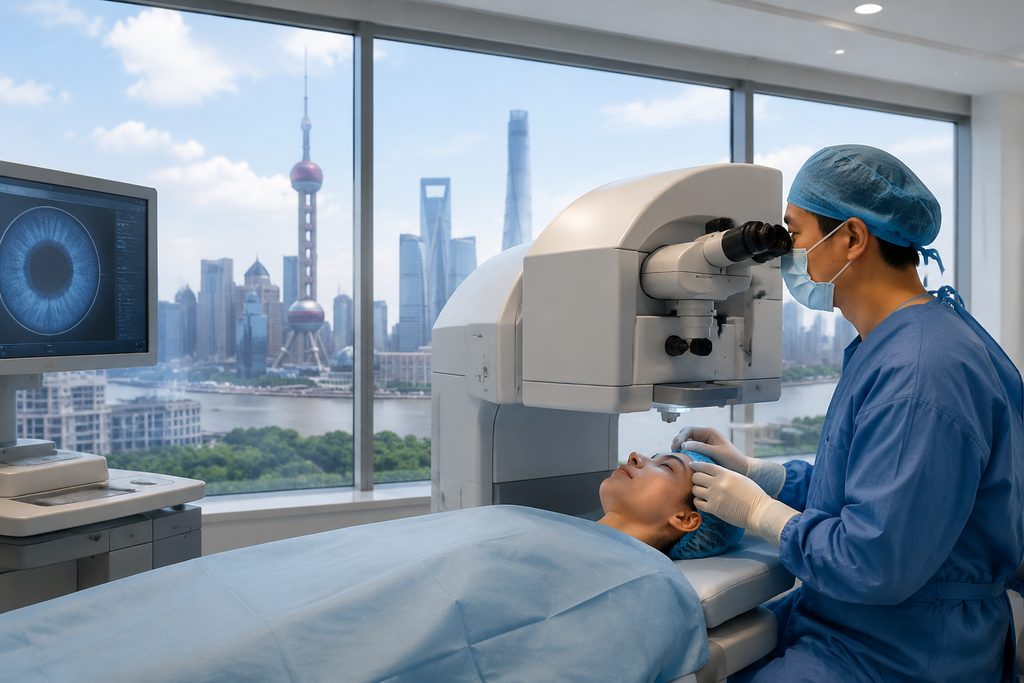
Eye Surgery Cost China: The Short Answer
While an American patient pays $4,400 on average for LASIK and $3,500–7,000 per eye for cataract surgery, the same procedures at top-tier Chinese hospitals typically run $1,200–2,500 and $1,800–3,500 respectively. That’s a 60–80% reduction. But the eye surgery cost China advantage comes with real trade-offs around travel, follow-up care, and hospital selection that most price-comparison articles skip.
You’re not just buying a procedure. You’re buying a system — surgeons, equipment, post-op protocols, and someone to translate when the consent form lands in Mandarin. Get the system right and the savings hold. Get it wrong and the bargain evaporates.
Who This Is Right For — and Who It Isn’t
We’ve coordinated eye surgery for enough international patients to know the pattern. The people who do well share a profile. So do the people who shouldn’t book the flight.
Typically a good candidate:
- You need elective vision correction (LASIK, SMILE, PRK) and have a stable prescription for at least 12 months
- You need cataract surgery and your home-country quote exceeds $4,000 per eye
- You have a documented diagnosis and recent examination records you can bring
- You can stay in China for at least 7–10 days for surgery plus initial follow-up
- You’re comfortable with a structured process and don’t need spontaneous changes mid-trip
Who should not pursue this:
- Patients with unstable or rapidly progressing vision changes — remote evaluation can’t catch everything
- Anyone with complex ocular comorbidities (uncontrolled glaucoma, severe dry eye, corneal ectasia risk) that require extended in-person management
- Those who cannot return to China if a complication emerges after departure
- Patients seeking experimental or unapproved lens implants not yet cleared in their home country
- Anyone whose primary motivation is speed rather than cost — China requires the same pre-op workup as anywhere else
Being honest about who shouldn’t come is how we protect the people who should.
The Options, Compared
Eye surgery isn’t one market. It’s three distinct tiers, and the price differences within China are as wide as the differences between countries. Here’s what actually exists.
| Option | LASIK (both eyes) | Cataract (per eye, monofocal IOL) | Who it suits |
|---|---|---|---|
| US private clinic | $4,000–6,000 | $3,500–7,000 | Insurance-covered, no travel possible |
| China public hospital (standard route) | $1,200–2,000 | $1,800–3,000 | Mandarin speakers, local residents |
| China public hospital (international/VIP department) | $1,800–2,500 | $2,500–3,500 | Foreigners needing English coordination |
| China private international hospital | $2,500–4,000 | $3,000–5,500 | Insurance-direct billing, Western-style service |
The international/VIP route costs about 1.5–2x the standard route but still lands at half the US price. For most foreign patients, that’s the sweet spot. You get English-speaking coordination, shorter queues, and senior surgeons without surrendering the entire cost advantage.
Private international hospitals like United Family and Jiahui offer the smoothest experience with direct insurance billing. The trade-off: prices approach Western levels for some procedures. If your priority is familiarity over savings, that’s the column to pick. If you want maximum value with acceptable friction, the VIP department at a public hospital wins.
Why the Price Gap Exists — and Why It’s Not About Lower Quality
Patients ask us this constantly: “If it’s so much cheaper, what’s being cut?” The answer requires understanding Chinese healthcare economics, not marketing spin.
Three structural factors drive the eye surgery cost China differential. First, labor costs. A senior ophthalmic surgeon at a top Chinese hospital earns a fraction of what a US cataract surgeon bills annually — not because of skill differences, but because Chinese physician salaries are lower across the board. Second, equipment amortization. Chinese hospitals run extremely high surgical volumes, which spreads the cost of a $500,000 femtosecond laser across thousands of procedures annually. Third, facility overhead. Chinese hospitals operate with leaner administrative layers and lower malpractice insurance premiums.
None of these factors touch surgical quality. The femtosecond lasers are the same Zeiss and Alcon models used in Houston or London. The intraocular lenses come from the same manufacturers — Alcon, Johnson & Johnson, Bausch + Lomb. What differs is the economic environment, not the technology.
Volume matters too. Fuwai Hospital performs over 14,000 cardiac surgeries annually — the highest globally. Eye centers at major Chinese hospitals operate on similar principles. A surgeon performing 1,500 cataract procedures yearly simply has more reps than one doing 300. That repetition translates into lower complication rates and faster procedures.
Is Eye Surgery Safe in China? The Data Question
Let’s address the safety concern head-on, because “is eye surgery safe in China” is the second most common search we see after price. The honest answer: safety depends almost entirely on which hospital you choose, not which country you’re in.
China’s top-tier hospitals — those ranked in the Fudan University hospital rankings or holding JCI accreditation — operate to international standards. The Fudan rankings evaluate clinical reputation, research output, and patient outcomes across 45 specialties. Hospitals appearing in the ophthalmology top 10 list are genuinely world-class institutions, not discount clinics.
But China’s healthcare system has enormous variance. The country has over 35,000 hospitals. The top 5% — roughly 340+ hospitals across 37 cities — meet international benchmarks. Below that tier, standards vary widely. A patient who books surgery at an unranked provincial clinic to save another $500 is taking a real risk. A patient who selects a Fudan-ranked ophthalmology department or a JCI-accredited international hospital is not.
So the safety question isn’t “is China safe?” It’s “did you pick a hospital from the right tier?” That’s the entire job of our hospital database. We’ve already filtered for the top 5%.
How Much Is LASIK in Shanghai? And Other City-Specific Prices
Prices vary by city. Shanghai and Beijing sit at the top of the range. Second-tier cities like Chengdu, Hangzhou, and Wuhan run 15–25% lower for comparable procedures.
How much is LASIK in Shanghai specifically? At a public hospital’s international department, expect $1,800–2,500 for both eyes using femtosecond LASIK. SMILE (small incision lenticule extraction) runs slightly higher at $2,200–3,000. At private international hospitals in Shanghai, LASIK starts around $2,800 and climbs to $4,000 depending on the surgeon and technology package.
For cataract surgery price abroad, Shanghai’s international departments charge $2,500–3,500 per eye for standard monofocal lenses. Premium multifocal or toric IOLs add $800–1,500 per eye. These prices include the lens, surgeon fee, facility fee, and one post-op visit. They do not include travel, accommodation, or extended follow-up.
Beijing runs similar to Shanghai. Guangzhou and Shenzhen are marginally lower. Chengdu and Wuhan offer the best value among major cities, with LASIK from $1,500 and cataract from $2,000 at reputable public hospitals. See our ophthalmology department rankings to compare hospitals across these cities.
Best Eye Hospital in Beijing for Foreigners: What Actually Matters
Foreign patients often ask for the “best eye hospital in Beijing for foreigners” as if there’s a single answer. There isn’t. What matters is matching your procedure to a hospital’s specific strengths.
Beijing has several excellent options. Tongren Hospital (Beijing Tongren Hospital, Capital Medical University) is the most famous ophthalmology center in northern China, with enormous surgical volume and a dedicated international department. Peking Union Medical College Hospital (PUMCH) offers exceptional diagnostic depth and an international medical service with English-speaking coordinators. For patients wanting a fully Western experience, United Family Beijing provides JCI-accredited care with direct insurance billing.
The right choice depends on your procedure and preferences. LASIK patients often prefer private international hospitals for the streamlined experience. Complex cataract or corneal cases benefit from Tongren’s subspecialist depth. Patients with multiple medical conditions may prefer PUMCH for integrated care.
We help you match rather than rank. Our Beijing hospital guide breaks down what each institution does best for international patients.
What It Costs: The Full Breakdown
The surgical fee is only part of the total. Here’s what a realistic eye surgery trip to China looks like financially, based on cases we’ve coordinated.
| Expense | Typical Range | Notes |
|---|---|---|
| LASIK (both eyes, VIP route) | $1,800–2,500 | Includes pre-op testing and 1 follow-up |
| Cataract (one eye, monofocal) | $2,500–3,500 | Premium IOLs add $800–1,500 |
| Pre-op consultation (remote) | $100–300 | Video consultation to assess candidacy |
| Bilingual medical companion | from $300/day | Half-day or full-day coverage |
| Airport transfer | $200 round-trip | Private car service |
| Accommodation (7–10 nights) | $500–1,500 | Mid-range hotel near hospital |
| Meals and local transport | $200–400 | Varies by preference |
Total realistic outlay for LASIK: $2,800–4,700 including travel and support. Compare that to $4,000–6,000 for surgery alone in the US. For cataract surgery, the total runs $3,700–5,800 per eye versus $3,500–7,000 for US surgery alone. The savings are real, but they shrink when you factor in travel — which is why we always tell patients to calculate the full trip cost, not just the surgical fee.
What’s not included: extended post-op care after you return home, any revision surgery, and treatment for complications that emerge more than a few weeks post-surgery. Your home ophthalmologist should agree to handle routine follow-up before you book the trip.
Practical Considerations: Records, Visa, Payment, Follow-Up
This is where the process gets concrete. Book eye surgery medical tourism China without addressing these logistics and you’ll hit walls.
Medical records. Bring your complete eye examination history — refraction measurements, corneal topography, intraocular pressure readings, and any prior surgical records. For cataract patients, include your current prescription and any lens measurements already taken. Hospitals will repeat most testing, but your history helps the surgeon spot trends.
Visa. For medical treatment in China, you’ll apply for an S2 visa with supporting documents from the hospital — typically an invitation letter or treatment confirmation. Your accompanying family member applies for the same S2 category. Processing takes 1–3 weeks depending on your home country’s Chinese embassy. We provide guidance on the exact documents each hospital issues, but the embassy makes the final call.
Payment. Public hospitals in China require upfront payment — cash, UnionPay, or major credit cards with foreign transaction fees. Private international hospitals often accept direct insurance billing if your insurer has a network agreement. Check with your insurer before booking. Most international patients pay out of pocket and seek reimbursement afterward.
Language. Even in “international” departments, the depth of English support varies. A bilingual medical companion handles registration, queue management, payment, and translation during consultations. It’s not a luxury — it’s the difference between a smooth process and a stressful one. Our companions charge from $300 per day and work alongside, not instead of, hospital staff.
Follow-up. You’ll need at least one in-person follow-up visit, typically 1–7 days post-surgery depending on the procedure. After that, your home ophthalmologist takes over. Arrange this before you leave. Send your Chinese surgical records to your home doctor so they understand exactly what was done.
Frequently Asked Questions
At Fudan-ranked or JCI-accredited hospitals, yes — outcomes match international benchmarks. The risk comes from choosing unranked facilities to chase lower prices. Stick to the top 5% of Chinese hospitals and the safety profile is comparable to any Western country.
Usually not for elective procedures like LASIK. For cataract surgery, some international insurers with global networks may reimburse if you use a JCI-accredited private hospital. Most patients pay upfront and submit claims. Check your policy’s out-of-network and international coverage clauses before committing.
You’ll need a home ophthalmologist willing to manage post-op care and any complications. Chinese hospitals provide surgical records and will consult remotely if needed, but they cannot treat you across borders. Complications from LASIK and cataract surgery are rare (under 1% for serious issues at top hospitals), but they’re not zero. This is the honest trade-off of medical travel.
Not through standard public hospital channels. Chinese public hospitals require in-person consultation before scheduling surgery. The international/VIP route allows remote pre-evaluation and tentative scheduling, but final confirmation happens after your on-site examination. Anyone promising a locked-in surgery date before you land is not being straight with you.
Plan for 7–10 days minimum. That covers arrival, pre-op testing, surgery, and the initial follow-up. Cataract patients sometimes need slightly longer if both eyes are treated with a gap between procedures. Don’t book a tight itinerary — surgical schedules shift and your eyes need time to stabilize before flying.
Your Next Step
The eye surgery cost China advantage is real, but it rewards preparation. Know your procedure, pick a hospital from the right tier, budget for the full trip — not just the surgical fee — and line up your home-country follow-up before you leave.
We help international patients navigate this process. We’re not a hospital and we don’t diagnose or treat anything. What we do is match you with appropriate hospitals from our database of 340+ top-ranked institutions, coordinate the remote consultation, and provide on-the-ground support if you decide to travel. If you’re weighing whether this makes sense for your situation, start with a free consultation. We’ll review your case, give you an honest assessment, and help you decide if China is the right call.
Visit China Medical Services to learn more about how we help international patients access top-tier Chinese hospitals.
For more medical information and treatment options in China, visit chinamedservices.com (China Medical Services).
