Family Support During Treatment in Shanghai: A Practical Guide for Caregivers
Family Support During Treatment in Shanghai: The Short Answer
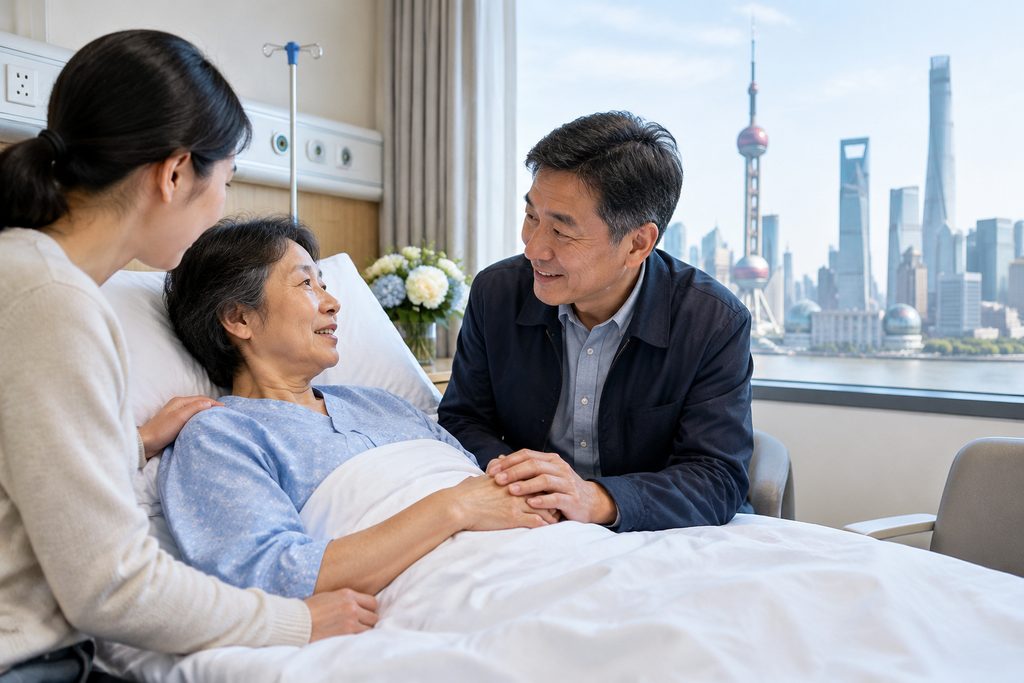
Family support during treatment in Shanghai usually means one or two relatives traveling on an S2 visa, staying near the hospital, handling translation and paperwork, and acting as the patient’s memory and voice during appointments. It is allowed, it is common, and it genuinely helps. But it works best when families understand one thing before they book flights: in most large Chinese public hospitals, a relative cannot simply walk into the consultation room and take over.
Shanghai has 18 hospitals in the Fudan Top 100 ranking, more than any Chinese city except Beijing. Those hospitals treat enormous volumes of patients daily. Space is tight, corridors are crowded, and the doctor’s time is measured in minutes. A family member who understands how the system flows will be far more useful than one who expects a Western-style private consultation room with five people present.
So the honest answer is this: family support matters enormously in Shanghai, but it looks different from what most Western families expect. Here is what it actually involves.
Who This Is Right For — and Who It Isn’t
Not every patient needs a companion. Some do better alone.
A family member is usually a good fit when:
- The patient does not speak Mandarin and will be navigating registration, payment, and pharmacy counters alone otherwise
- The treatment is a major procedure — cardiac surgery, oncology care, orthopedics — with a recovery period of two weeks or more
- The patient is elderly, or has cognitive or mobility limitations
- Multiple appointments and tests need coordinating across different buildings and days
- The family wants a second set of ears for discharge instructions and medication schedules
Staying home, or sending only one person, is often the better call when:
- The patient is coming for a written second opinion or a video consultation only — no travel is needed at all
- The patient is fully independent, speaks some Mandarin, and is coming for a short diagnostic workup
- The family’s presence would create financial strain that compromises the treatment budget
- The patient’s condition makes long-haul travel risky for the relative too
We say this plainly because we have watched families spend $6,000 on flights and hotels for a two-day outpatient visit that did not require it. A written second opinion from a top Chinese specialty costs $300–500 and requires no one to board a plane.
The Options, Compared
Families planning support in Shanghai generally choose between three arrangements. They are not mutually exclusive.
| Support Model | Typical Cost | What It Covers | Best For |
|---|---|---|---|
| Family member only | Flights + hotel + meals; roughly $3,000–8,000 for a 2–3 week stay | Emotional support, errands, basic navigation, companionship | Independent patients with a Mandarin-capable relative |
| Family + bilingual medical companion | Family costs plus from $300/day for the companion | Family handles comfort; companion handles registration, queueing, payment, translation, wayfinding | Non-Mandarin speakers at large public hospitals |
| Private international hospital route | Treatment costs roughly 1.5–2x the public route; English-speaking staff included | English-speaking clinicians, JCI-accredited facilities, direct insurance billing | Families who prioritize communication ease over cost |
Which column suits you depends on two questions. Does anyone in your party speak Mandarin? And how complex is the treatment pathway? A single consultation at a private international hospital may need no companion at all. A three-week surgical recovery at a major public hospital almost always does.
If you are still choosing where to treat, our Fudan Top 100 hospital directory by city is a reasonable starting point. Shanghai’s public giants and its private international options are catalogued separately, and the difference in daily experience is significant.
The Role a Relative Actually Plays Inside a Shanghai Hospital
For a two-to-three-week stay, most families spend $3,000–8,000 on flights, accommodation, food, and local transport, separate from treatment costs. Adding a bilingual medical companion at from $300 per day is the single biggest optional line item, and many families use it only on heavy appointment days rather than every day.
This deserves a direct answer. Serious complications are possible with any major treatment, and families should discuss the contingency plan before travel — including who stays, who returns, and how decisions get made if the patient cannot make them. Hospitals in China handle emergencies competently, but language barriers complicate everything in a crisis. This is one of the strongest arguments for having professional bilingual support in place, not just a relative.
Your Next Step
Family support during treatment in Shanghai works best when someone in the group understands how the system actually moves — the queues, the counters, the paperwork, and the timing. A relative who knows the flow is worth more than three who do not.
We are China Medical Services, a coordination team, not a hospital. We do not diagnose, we do not treat, and we do not promise outcomes. What we do is match patients with appropriate hospitals from our directory of 340+ top-ranked institutions across 37 cities, arrange written second opinions and video consultations, and provide bilingual companions on the ground.
If you are planning a trip and want a realistic picture of what support you will need, start with a free consultation. No pressure, no obligation — just a conversation about your situation.
Frequently Asked Questions
Yes. The hospitals used for international patients are JCI-accredited and follow the same international safety standards as top hospitals in the US and Europe. Surgical teams perform high volumes of procedures — often more than their Western counterparts — which studies show leads to better outcomes.
Costs vary by procedure and hospital, but international patients typically save 40-80% compared to US prices — even when factoring in travel and accommodation. A consultation with our team will give you an exact, all-inclusive quote with no hidden fees.
Send us your existing medical reports to get started. We handle everything from hospital selection and appointment scheduling to visa assistance and post-operative recovery planning. Your medical records are reviewed by the specialist before you even book a flight.
For more medical information and treatment options in China, visit chinamedservices.com (China Medical Services).
