First Hospital Kunming International Patient Service: Your Yunnan ASEAN Gateway
Key Takeaways
- First Hospital of Kunming Medical University handles over 2.5 million outpatient visits annually, making it one of Southwest China’s highest-volume medical centers and the primary gateway for patients from Vietnam, Laos, Myanmar, and Thailand.
- The hospital’s International Medical Center provides dedicated English-speaking coordinators, direct billing arrangements, and a structured pathway for foreign patients — a rarity outside Beijing and Shanghai.
- Language remains the single biggest barrier. Outside the International Medical Center, clinical staff communicate almost exclusively in Mandarin. Walking into a general outpatient hall without support is not realistic for non-Chinese speakers.
- Treatment costs at this hospital run approximately 60-80% lower than equivalent care in Singapore or Bangkok, but you need to understand the payment structure before arriving. Cash deposits are required upfront.
The Problem: Southeast Asia’s Missing Middle in Tertiary Care
In 2023, Vietnam’s Ministry of Health reported that approximately 40,000 Vietnamese citizens traveled abroad for medical treatment, spending an estimated $2 billion annually. The majority headed to Singapore, South Korea, or Japan. Cancer patients from Laos and Myanmar face even steeper odds — their domestic health systems lack the PET-CT scanners, linear accelerators, and subspecialist surgeons needed for complex oncology care. The options are grim: deplete family savings on treatment in Bangkok or Singapore, or go without.
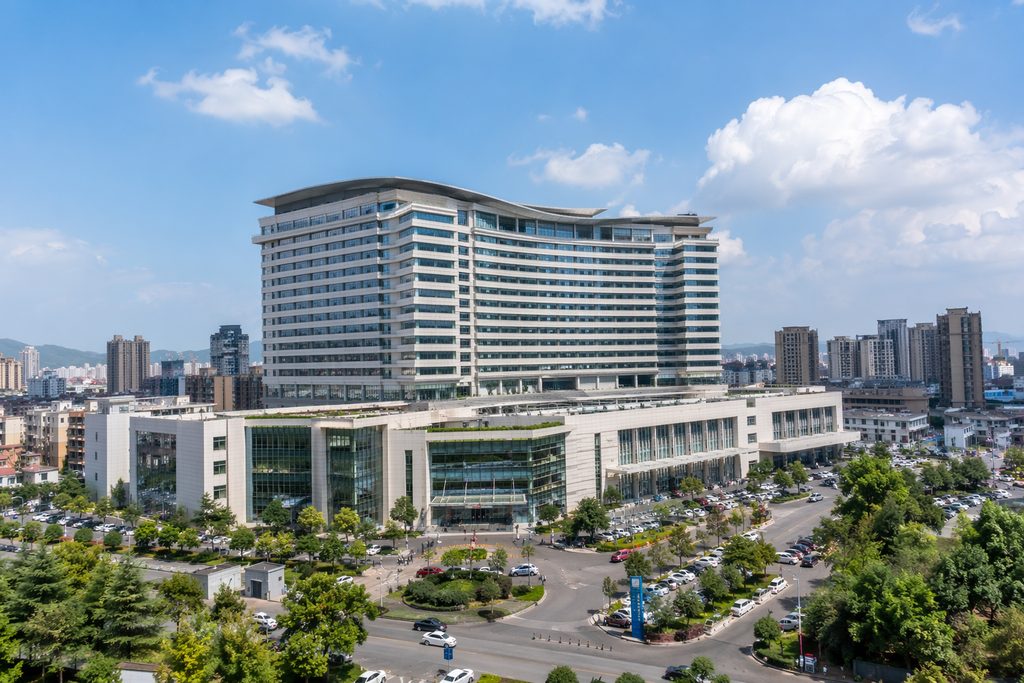
What most patients in the Mekong region do not realize is that a third path exists. It sits 300 kilometers north of the Vietnam border. The First Hospital of Kunming Medical University has spent the last decade quietly building infrastructure that directly addresses this gap. The hospital now operates 4,000 inpatient beds across multiple campuses. Its organ transplantation program is one of China’s most active outside the eastern seaboard. And its International Medical Center was designed specifically for patients crossing the Yunnan land border — not for medical tourists flying into Shanghai Pudong.
Who We Are
We are not a hospital. We do not provide medical treatment, clinical diagnoses, or physician referrals. Our team functions as your logistical architects for accessing care at institutions like the First Hospital of Kunming Medical University. We handle the structural barriers — appointment coordination through official international channels, bilingual medical companion services, visa documentation support, and local accommodation logistics. We bridge the gap between you and China’s top-tier medical expertise. The clinical decisions remain entirely between you and your doctors.
Why First Hospital Kunming Medical University Deserves Serious Consideration
Clinical Volume That Rivals Major Asian Hubs
The numbers tell a story that marketing brochures cannot. The hospital’s cardiac surgery team performs over 1,200 open-heart procedures annually. Its oncology department manages more than 80,000 inpatient admissions per year. These volumes are not abstract statistics — they translate directly into procedural fluency. A surgeon who performs 300 mitral valve repairs annually has encountered anatomical variations and intraoperative complications that a surgeon doing 40 per year has only read about in textbooks. This is the volume argument. It applies as much in Kunming as it does at Cleveland Clinic.
For ASEAN patients considering whether this hospital can handle complex cases, the answer lies in its designation. It is one of only a handful of hospitals in Yunnan province authorized to perform liver and kidney transplantation. It houses a provincial-level critical care medicine center. And its emergency department is the designated receiving center for cross-border medical evacuations from northern Laos and Vietnam.
Cost Structure That Changes the Calculus
Let us address the First Hospital Kunming medical tourism cost question head-on. A coronary artery bypass graft at this hospital typically ranges from $10,000 to $18,000 USD, depending on vessel involvement and whether it is on-pump or off-pump. The same procedure in Singapore runs $35,000 to $55,000. In the United States, the figure exceeds $120,000. These are not cherry-picked comparisons — they reflect the structural cost differences between China’s public hospital system and private healthcare markets elsewhere.
Why the disparity? Chinese public hospitals operate on thin margins. Physician salaries are not tied to procedure volume in the same way they are in fee-for-service systems. Pharmaceutical and device costs are negotiated nationally through volume-based procurement. And hospital infrastructure — the buildings, the CT machines, the surgical robots — is heavily subsidized by provincial governments. The result is a pricing environment that looks anomalous to Western or Southeast Asian patients. It is not a discount. It is a different economic model entirely.
The best hospital in Yunnan for international patients does not need to charge Singapore prices to maintain quality. Its revenue mix is dominated by domestic patients. International patients represent a small fraction of total volume, which means the hospital’s financial model does not depend on extracting maximum revenue from foreign visitors. This is a structural advantage, not a temporary promotion.
Geographic Proximity That Reduces Logistical Friction
Fly into Kunming Changshui International Airport from Hanoi and you land in under 90 minutes. From Vientiane, the flight is shorter than a typical morning commute in Jakarta. For patients from northern Thailand, Myanmar, or Laos, traveling to Kunming for treatment is logistically simpler than navigating Bangkok’s traffic to reach Bumrungrad International. This proximity matters when treatment requires multiple follow-up visits. It matters when a family member needs to return home briefly during a prolonged hospital stay. And it matters when post-operative complications require rapid re-access to the treating surgical team.
The hospital’s location as an ASEAN medical gateway China hospital is not a marketing slogan. It is geography. Kunming sits at the nexus of the Pan-Asia Railway Network, with high-speed rail connections to the Lao border operational since 2023 and planned extensions into Thailand and Myanmar. For patients who cannot fly for medical reasons, land-border crossings at Mohan-Boten and Hekou-Lao Cai provide viable alternatives.
What You Need to Know Before Going Alone
The hospital’s clinical capabilities are genuine. So are the barriers that confront an independent international patient. Understanding these before you book a flight prevents expensive mistakes.
- Registration Systems Require Chinese Documentation: The hospital’s standard outpatient registration system operates entirely in Mandarin. It requires a Chinese phone number for SMS verification. It links to China’s national health insurance database. Foreign patients cannot navigate this system independently — not because of policy restrictions, but because the digital infrastructure was not designed for non-Chinese users. The International Medical Center bypasses this system entirely, but you need to know it exists and how to access it before arriving.
- Upfront Deposits Are Non-Negotiable: Chinese public hospitals operate on a prepayment model. Upon admission, you deposit a sum against anticipated treatment costs. As your balance depletes, the hospital notifies you to top up. This is standard practice for domestic patients and applies equally to international visitors. The deposit amount varies by procedure — expect $5,000 to $15,000 for major surgery. Your insurance may reimburse you afterward. The hospital will not wait for insurance approval before treating you.
- Clinical Communication Happens in Mandarin: Outside the International Medical Center, ward rounds occur in Chinese. Nursing shift handovers occur in Chinese. Informed consent documents are written in Chinese. The hospital employs medical interpreters, but their availability is limited and must be scheduled in advance. Showing up at a general ward without language support means relying on translation apps for conversations about your diagnosis, medication changes, and discharge instructions.
How We Help You Navigate This
The barriers described above are not insurmountable. They are structural features of a healthcare system designed for 1.4 billion domestic patients. Our role is to create a parallel pathway that works for you.
Before you travel, we coordinate directly with the hospital’s International Medical Center to schedule your initial consultation. We translate and format your medical records according to the hospital’s documentation standards — Chinese physicians expect imaging reports structured differently than Western radiology reports, and a poorly translated summary can delay clinical assessment. We arrange the hospital’s official invitation letter for your S2 visa application. We confirm the deposit amount for your specific procedure so there are no surprises at the admissions desk.
During your treatment, a bilingual medical companion accompanies you to every appointment. This person handles registration, queues for test results, translates physician explanations in real time, and ensures you understand each step before consenting. They do not make clinical decisions. They make sure you understand the clinical decisions being presented to you. This distinction matters. Our companions are logistics professionals with medical terminology training — not doctors practicing without a license.
After discharge, we coordinate follow-up appointments, medication procurement, and accommodation extensions if recovery requires a longer stay in Kunming. For patients requiring ongoing monitoring after returning home, we facilitate remote consultation arrangements with the treating department.
Is Kunming Medical University Hospital Good for Foreigners? The Honest Assessment
The question surfaces in search queries regularly, and it deserves a direct answer. The First Hospital of Kunming Medical University is excellent for international patients who arrive through the correct channel. The International Medical Center provides English-speaking coordination, private consultation rooms, expedited scheduling, and direct billing arrangements that the general outpatient system cannot offer. Patients who use this pathway report satisfaction levels comparable to those treated at international hospitals in Bangkok or Kuala Lumpur — at a significantly lower First Hospital Kunming medical tourism cost.
But the hospital is not a good fit for every foreign patient. If you expect Western-style bedside manner — extended consultations, detailed explanations of treatment rationale, shared decision-making protocols — you may find the clinical culture jarring. Chinese physicians are efficient, direct, and hierarchical. They will answer your questions. They will not volunteer lengthy explanations unprompted. This is a cultural difference, not a quality deficit. Understanding it beforehand prevents frustration.
For patients from ASEAN countries, the calculus shifts further in the hospital’s favor. The International Medical Center staff includes Vietnamese and Thai speakers. The hospital’s experience with tropical disease pathology — dengue, melioidosis, leptospirosis — exceeds that of most northern Chinese hospitals, which is relevant for patients with complex multi-system presentations. And the cultural familiarity between Yunnan and mainland Southeast Asia — in diet, climate, and social norms — makes the recovery period less alienating than it might feel in Beijing or Shanghai.
How to Get Treatment at First Hospital Kunming as a Foreigner
The hospital’s International Medical Center accepts direct billing arrangements with select international insurers, including Bupa, Cigna, and Allianz. However, this is not universal. Most international patients pay the deposit upfront and seek reimbursement from their insurer afterward. Confirm with your insurance provider before traveling whether they cover treatment at Chinese public hospitals — some policies only cover JCI-accredited facilities, and First Hospital Kunming Medical University does not hold JCI accreditation. It is accredited by China’s national hospital evaluation system, which is not always recognized by Western insurers.
The treating department typically provides a written summary of your procedure and post-operative care instructions in both Chinese and English. For surgical patients, the department will arrange a follow-up video consultation at 2-4 weeks post-discharge to review recovery progress. If complications develop that require intervention, you have two options: return to Kunming for reassessment, or seek local care with remote guidance from the Chinese surgical team. The hospital does not assume liability for complications managed by other institutions — this is standard practice globally, not unique to China. We strongly recommend purchasing medical travel insurance that includes post-procedure complication coverage.
In specific specialties, yes. The hospital’s organ transplantation outcomes are published in peer-reviewed journals and meet international benchmarks. Its interventional cardiology program handles complex PCI cases at volumes that match major Asian cardiac centers. Its oncology department offers treatment protocols aligned with NCCN guidelines. But the comparison is not apples-to-apples across every metric. The hospital’s infrastructure — private room availability, food service, non-clinical amenities — does not match the hospitality standards of Bumrungrad or Mount Elizabeth. Patients who prioritize clinical outcomes over hotel-like amenities will find the value proposition compelling. Patients who expect a luxury experience alongside their treatment should look elsewhere or adjust expectations.
Your Next Step
First Hospital Kunming Medical University represents a genuine option for patients in the ASEAN region who need high-acuity tertiary care without the financial devastation that often accompanies treatment in Singapore or South Korea. The clinical capabilities are real. The cost advantage is structural, not promotional. The geographic proximity reduces the logistical burden that makes long-distance medical travel so exhausting.
But accessing this option requires navigating a system that was not designed for you. That is where we come in. If you are considering treatment at this hospital — or anywhere in China’s top-ranked hospital network — we can help you understand your options, estimate costs, and handle the coordination that turns a complicated process into a manageable one. Get a free consultation to discuss your situation. No pressure. No commitment. Just an honest conversation about whether this pathway makes sense for you.
Frequently Asked Questions
Yes. We work with JCI-accredited and major Grade 3A tertiary hospitals that follow international safety standards comparable to top hospitals in the US and Europe. Surgical teams perform high volumes of procedures — often more than their Western counterparts — which studies show leads to better outcomes.
Costs vary by procedure and hospital, but international patients typically save 40-80% compared to US prices — even when factoring in travel and accommodation. A consultation with our team will give you an exact, all-inclusive quote with no hidden fees.
Send us your existing medical reports. The relevant specialty reviews them and gives you a written opinion, including treatment direction and options, before you commit to any travel. From there you can add a video consultation with the doctor, or have us attend an appointment on your behalf.
For more medical information and treatment options in China, visit chinamedservices.com (China Medical Services).
