Full Body MRI in China: Costs, Legality, and How to Book
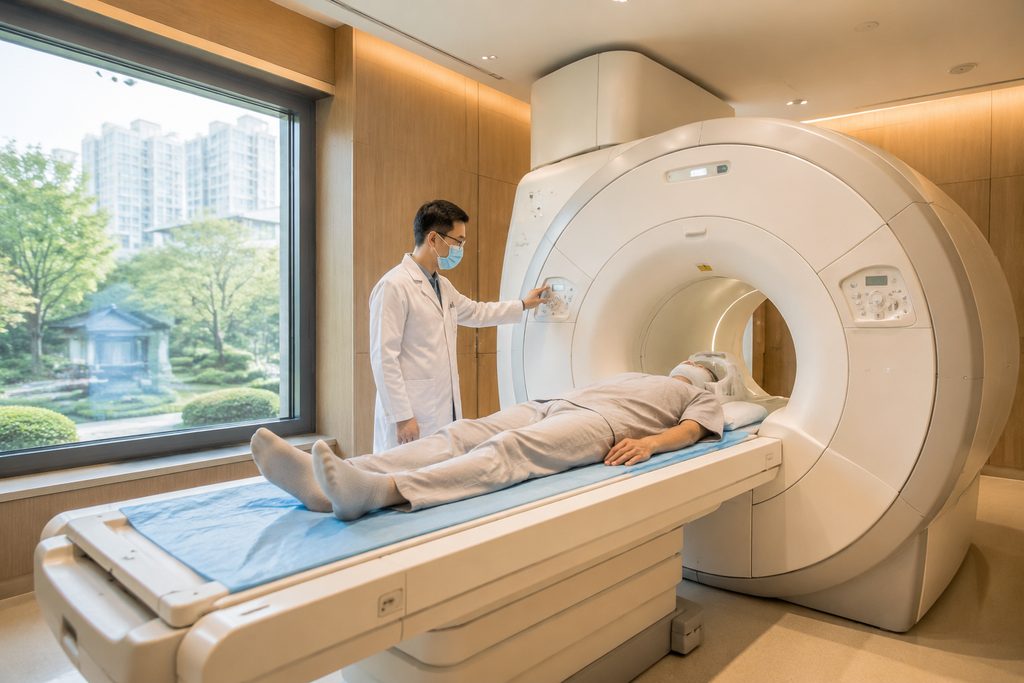
Have you ever wondered whether a single scan could map your entire body for early disease detection? For many Western patients, the idea of a full body MRI feels like something reserved for billionaires or Silicon Valley executives. In the United States, a whole-body scan at a private clinic can run anywhere from $2,500 to over $6,000, and insurance almost never covers it. That price tag stops most people cold.
But what if the same technology, using the same 3.0 Tesla magnets, were available for a fraction of that cost? That is the reality in China, where the full body mri cost China typically falls between $800 and $2,500 depending on the hospital tier, city, and whether contrast agents are used. We coordinate these scans for international patients every month. Here is what you need to know before booking anything.
Key Takeaways
- Full body MRI in China costs $800–$2,500 at top hospitals — roughly 60–70% less than US private clinics.
- Foreigners can legally book full body scans at public hospital international departments or JCI-accredited private centers in Beijing, Shanghai, and 35 other cities.
- Walk-in access is not how Chinese hospitals work. You need a hospital-issued appointment, typically arranged through an international department or a coordination service.
- Radiologist quality varies more than machine quality. Choosing a hospital with fellowship-trained imaging specialists matters more than the scanner brand.
The Problem: Preventive Scanning Is Priced Out of Reach in the West
A 2023 survey by the American College of Radiology found that fewer than 3% of Americans have ever undergone a whole-body MRI for preventive screening. The reason is not lack of interest. It is cost and access. Prenuvo, the best-known private full body MRI provider in North America, charges $2,499 for a torso scan and $2,999 for head plus torso. Ezra, a competitor, starts at $1,350 for a 30-minute scan covering only the brain, spine, and pelvis. Neither price includes follow-up consultations or any findings review.
In the United Kingdom, the NHS does not offer elective full body MRI at all. Private London clinics quote between £1,800 and £3,500. Wait times for private scans in Canada routinely stretch past six weeks. So a patient who wants a baseline body map before symptoms appear has three bad options: pay premium prices, wait months, or skip the scan entirely.
That third option is the most common one. And it is the one that allows slow-growing cancers, vascular abnormalities, and silent organ damage to go undetected until they become symptomatic — and far harder to treat.
Why China Delivers Results for Diagnostic Imaging
Scan Volume Creates Radiologist Expertise
Chinese hospitals perform diagnostic imaging at a scale that has no Western equivalent. A single large public hospital in Shanghai may complete 3,000 to 5,000 MRI studies per day across multiple magnets. Fudan University-affiliated Zhongshan Hospital alone operates more than 20 MRI scanners. The radiologists reading those scans see more pathology in one month than many Western radiologists see in a year.
That volume is not just a statistic. It translates into pattern recognition. A radiologist who has interpreted 50,000 liver scans will flag a 4-millimeter lesion that a less experienced reader might dismiss as artifact. For full body screening, where the entire point is finding subtle abnormalities before they announce themselves, reader experience is everything.
Machine Quality Matches Western Standards
Most top-tier Chinese hospitals run Siemens Magnetom, GE Signa, and United Imaging uMR systems — the same 3.0 Tesla platforms used at Johns Hopkins or Charité Berlin. United Imaging, a Shanghai-based manufacturer, now supplies 3.0T and 5.0T systems to hospitals across China and exports to the United States and Europe. The hardware gap that existed 15 years ago has largely closed. What remains different is cost structure, not technology.
Cost Advantage Without Compromise
Why is the full body mri cost China so much lower? Labor economics explain most of it. A Chinese radiologist’s salary is roughly one-fifth of a US radiologist’s. Hospital construction costs, equipment financing, and administrative overhead all run lower. And because Chinese hospitals operate at enormous scale, fixed costs spread across far more scans. A 3.0T MRI machine at a Shanghai public hospital might run 18 hours a day, seven days a week. That utilization rate would be unthinkable in a US outpatient center. Lower cost per scan, same image quality.
Is Full Body MRI Legal in China? Yes — With Conditions
The short answer to “is full body mri legal in China” is yes. There is no law prohibiting whole-body MRI screening for foreigners or Chinese citizens. But there are regulatory differences from Western countries that matter.
China’s National Health Commission classifies MRI as a Class II medical device procedure, which means it can be performed at any licensed hospital or imaging center with a radiologist on staff. No special government approval is required for a full body protocol. Contrast agents, when used, require a physician order and kidney function screening — same as anywhere else.
What differs is the clinical culture. Chinese doctors are generally more willing to perform comprehensive screening than their Western counterparts, who often discourage whole-body MRI due to false-positive concerns and cost-effectiveness debates. That means a patient who asks for a full body scan at a Chinese international department will rarely face the resistance they might encounter from a US primary care physician.
Practical tip: If you have a history of allergic reactions, thyroid disease, or kidney impairment, request a non-contrast protocol. Most Chinese hospitals offer both contrast and non-contrast full body MRI packages.
How the Booking Process Actually Works for Foreigners
Can foreigners get a full body scan in Beijing? Yes — but not by walking into a hospital lobby and asking for one. Chinese public hospitals do not operate on walk-in appointments. Every scan requires a hospital registration, a physician order, and a scheduled time slot. For international patients, the standard route is through a hospital’s international medical department or VIP clinic.
The process unfolds in four stages. First, you submit basic health information and any prior imaging reports. Second, the hospital’s radiology department reviews your case and confirms the appropriate protocol — full body MRI typically covers brain, neck, chest, abdomen, pelvis, and spine, taking 60 to 90 minutes on the table. Third, you receive an appointment date, usually within one to two weeks for international department bookings. Fourth, you arrive, complete the scan, and receive a written radiology report in English, typically within 24 to 48 hours.
This is where a coordination service earns its keep. The hospital will not chase you for missing paperwork. It will not call your hotel to confirm. If you arrive without the right registration documents, your appointment evaporates. We handle that entire chain so the patient just shows up.
Comparing Your Real Options: Public, Private, and Package Deals
Not all full body MRI offerings in China are equal. The table below compares the three main routes available to international patients.
| Option | Typical Cost | Radiologist Level | English Report | Booking Time |
|---|---|---|---|---|
| Public hospital international department (e.g., Peking Union, Zhongshan) | $800–$1,500 | Senior attending, high volume | Usually yes, sometimes with translation delay | 1–2 weeks |
| JCI-accredited private hospital (e.g., United Family, Jiahui) | $1,500–$2,500 | Board-certified, often Western-trained | Always | 3–7 days |
| Standalone imaging center package (Shanghai, Beijing) | $600–$1,200 | Variable — check credentials carefully | Sometimes | 2–5 days |
The private mri scan Shanghai price at a JCI-accredited facility like Jiahui or United Family typically starts around $1,800 for a comprehensive protocol. That buys you English-speaking staff, direct insurance billing, and a radiologist who has likely trained in the US, UK, or Australia. The public hospital international department option costs less but may require more patience with administrative processes.
If you are searching for a “book full body mri China package,” what you are really looking for is a bundled arrangement that includes the scan, the radiologist report, and often a physician consultation to review findings. Some packages also include basic blood work and a same-day physical exam. Prices for these comprehensive screening packages at top hospitals in Beijing and Shanghai range from $1,200 to $2,800 depending on scope.
Choosing the Best Diagnostic Imaging Center for Expats
The phrase “best diagnostic imaging center China for expats” does not point to a single facility. It points to a set of criteria. Here is what actually matters when selecting where to get scanned.
First, check the radiologist’s credentials. A 3.0T machine is worthless if the person reading your scan lacks subspecialty training. Ask where the interpreting radiologist completed fellowship training. Many top Chinese hospitals now employ radiologists who trained at Mayo Clinic, MD Anderson, or European university hospitals. Second, confirm the report language. If the report comes back in Chinese only, you will need certified translation — which adds cost and time. Third, ask about the protocol. A true full body MRI should include brain, spine, chest, abdomen, and pelvis. Some “full body” packages quietly omit the spine or use lower-resolution sequences to cut scan time.
Fourth, understand the false-positive reality. Whole-body MRI in asymptomatic people detects incidental findings in 30–40% of cases, according to a 2021 meta-analysis in European Radiology. Most are benign. But you need a follow-up pathway. The best centers provide a post-scan consultation with a physician who can explain which findings matter and which do not. A scan without interpretation is just expensive wallpaper.
Caution: Full body MRI is not a replacement for colonoscopy, mammography, or low-dose CT lung screening. Those tests detect cancers that MRI can miss. Use whole-body MRI as a complement, not a substitute.
Practical Considerations: Visas, Payment, and Follow-Up
Coming to China for medical imaging requires an S2 visa, which covers short-term private affairs including medical treatment. The hospital’s international department will issue an invitation letter and treatment confirmation document, which you submit with your visa application. Processing time varies by consulate but typically takes 5 to 10 business days. Do not apply for an M visa — that is for commercial trade activities and does not cover medical visits.
Payment works differently than in the West. Chinese public hospitals require upfront payment before the scan is performed. Most international departments accept Visa, Mastercard, and sometimes UnionPay. Private international hospitals like United Family often bill insurance directly, but you should confirm with your insurer before booking. If you plan to seek reimbursement from a US or European insurer, request an itemized invoice and a copy of the radiologist’s report at discharge.
After you return home, the follow-up question looms. If your scan finds something — a lung nodule, a thyroid lesion, a liver cyst — who manages it? The best approach is to bring the images (on CD or via cloud link) and the English report to your primary care physician or a relevant specialist. Chinese hospitals will provide DICOM files on request. That continuity matters more than the scan itself.
Frequently Asked Questions
At top-tier hospitals, yes. The scanners are the same Siemens, GE, and United Imaging platforms used in Western centers. The variable is the radiologist. Choose a hospital with fellowship-trained, English-proficient readers and the reliability is comparable. At smaller standalone centers, quality is less predictable.
A comprehensive protocol covers the brain, neck, chest, abdomen, pelvis, and full spine. It can detect tumors, vascular abnormalities, liver and kidney lesions, spinal disc problems, and structural abnormalities. It cannot reliably detect early-stage colon cancer, small breast cancers, or lung nodules under 4 millimeters. Those require dedicated screening tests.
Most full body protocols run 60 to 90 minutes on the table. You lie still inside the magnet bore, which can feel confining. If you have claustrophobia, notify the hospital in advance. Some centers offer wider-bore scanners or mild sedation. Earplugs are standard because MRI machines are loud.
Usually not. The written radiology report typically takes 24 to 48 hours at public hospital international departments. Private international hospitals may deliver same-day or next-day reports. Plan your travel schedule with that timeline in mind.
The hospital will flag urgent findings in the report and recommend follow-up imaging or biopsy where appropriate. You are not obligated to pursue treatment in China. Take the report and images to your home physician. If you want a second opinion from a Chinese specialist, we can arrange a video consultation with the relevant department.
Your Next Step
A full body MRI in China is legal, accessible, and dramatically less expensive than in the West — but only if you book through the right channel and know what to ask for. At China Medical Services, we help international patients navigate hospital selection, appointment coordination, and on-the-ground logistics across 340+ top-ranked hospitals in 37 cities. We are not a hospital and do not provide diagnoses. What we provide is the bridge: the right hospital, the right radiologist, and a process that does not fall apart when you land. If you are considering a scan, start with a conversation. We will tell you honestly whether it makes sense for your situation.
For more medical information and treatment options in China, visit chinamedservices.com (China Medical Services).
