Full Body MRI in China: Which Hospitals Offer It and What It Costs
Key Takeaways
- Full body MRI screening in China typically costs $800–$2,500 at top-tier hospitals, compared to $2,500–$7,000+ in the US and Europe.
- Private international hospitals in Shanghai and Beijing offer the most streamlined experience for English-speaking patients, with same-week scheduling often available.
- Public hospital MRI departments are not designed for walk-in international screening — language barriers and internal referral rules can stall the process without local coordination.
- A full body MRI is a screening tool, not a diagnostic guarantee. Understand what the scan can and cannot detect before you book.
The Problem: Why Getting a Full Body MRI Feels Impossible in the West
Have you ever tried to book a full body MRI in the US, UK, or Canada and hit a wall of referrals, insurance denials, and six-month waitlists? You are not alone. In the United States, a whole-body MRI at a private screening center typically costs between $2,500 and $7,000, and most insurance plans will not cover it because it is classified as elective screening rather than diagnostic imaging. In the UK, the NHS does not offer full body MRI screening to asymptomatic individuals at all. You either go private at £1,500–£3,500 or you do not get scanned.
That leaves a specific group of people stuck: health-conscious executives, patients with a family history of cancer, and people who simply want a baseline scan of their body before symptoms appear. They have the motivation and often the budget. What they lack is access. The wait times are long, the prices are opaque, and the referral requirements are exhausting.
So they start searching for alternatives. And increasingly, that search leads to one question: which hospital in China offers a full body MRI?
Why China Delivers Results for Full Body MRI Screening
China has built an MRI infrastructure that is unmatched in scale. The country operates more than 15,000 MRI machines, according to industry data from the China Association of Medical Equipment. The United States, by comparison, has roughly 13,000. But raw machine count is not the real advantage. The real advantage is how those machines are used.
Clinical Volume Drives Operational Efficiency
A top-tier Chinese hospital imaging department scans 200 to 400 patients per day across multiple MRI units. That is not an exaggeration — it is the standard operating rhythm at hospitals like Peking Union Medical College Hospital in Beijing and Zhongshan Hospital in Shanghai. This volume forces efficiency. Technicians become extremely fast at positioning patients. Radiologists read a high volume of scans daily. The workflow is optimized for throughput, not for appointment scarcity.
What does that mean for you as an international patient? It means same-week or next-week scheduling is common at private international hospitals. It means the scan itself takes 60 to 90 minutes, not the 2 to 3 hours you might wait for at a lower-volume Western facility. And it means the radiologist report is often ready within 24 to 48 hours.
Technology Without the Premium Price Tag
Chinese hospitals have invested heavily in 3.0 Tesla MRI systems from Siemens, GE, and Philips, as well as domestic manufacturers like United Imaging. The machines are current-generation. The difference is what the hospital charges to run them. A full body MRI scan cost China hospitals quote — typically $800 to $2,500 depending on the hospital tier and whether contrast is included — reflects structural cost advantages: lower labor costs, higher patient volume, and a pricing model that does not inflate imaging fees to subsidize other hospital departments.
That is why the whole body MRI price abroad China comparison is so stark. You are not paying for a lower-quality scan. You are paying a different healthcare economy.
Health Screening Is a Cultural Priority
China has a deeply embedded culture of executive health screening. Large companies send employees for annual checkups. High-net-worth individuals book comprehensive screening packages at hospital international departments. This demand has created a mature market for full body imaging that simply does not exist in most Western countries. The packages are standardized, the pricing is transparent, and the infrastructure is built for people who want a scan, not just people who need one.
Which Hospitals in China Offer a Full Body MRI?
Not all hospitals are equal for this purpose. The right choice depends on your language needs, your budget, and whether you want a pure MRI or a broader health screening package. Here is what the landscape actually looks like.
Private International Hospitals: The Most Accessible Option
If you are an English-speaking foreigner, the best hospital for whole body MRI in Shanghai is almost certainly a private international facility. Hospitals like Jiahui International Hospital, United Family Healthcare, and ParkwayHealth operate JCI-accredited facilities with English-speaking staff, direct insurance billing, and a Western-style patient experience. You can book a full body MRI screening package directly, often within a week.
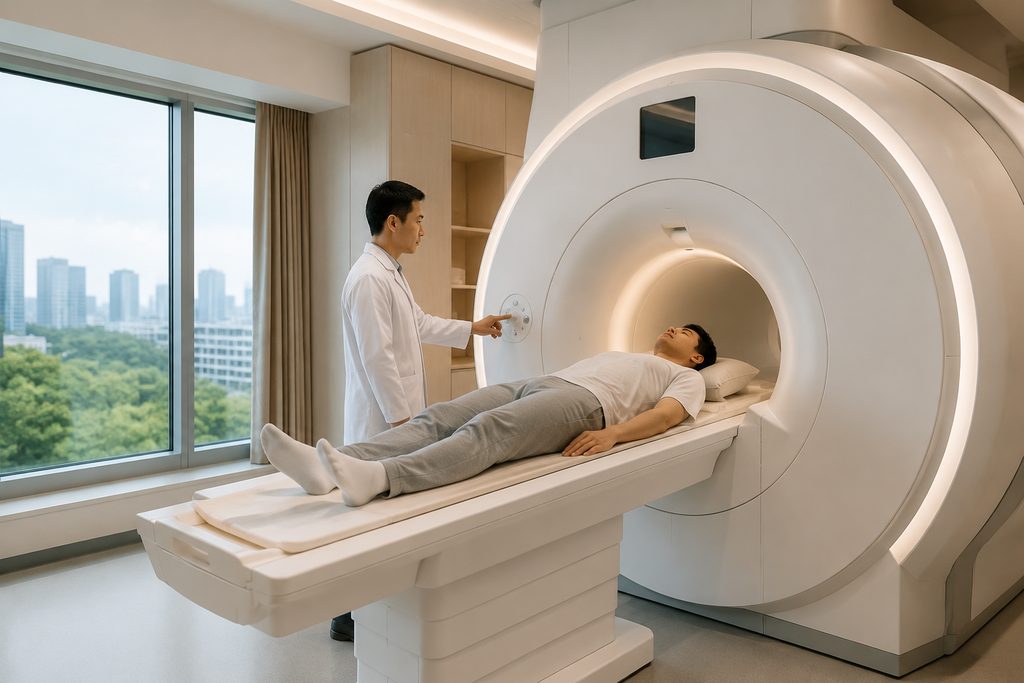
The process works like this: you contact the hospital’s international patient center, describe what you want scanned, and they schedule you for a consultation with a physician who reviews your history and orders the scan. The scan itself takes 60 to 90 minutes. A radiologist reads the images and a physician reviews the findings with you, usually the same day or the next day. You leave with a written report in English.
Prices at private international hospitals in Shanghai and Beijing range from $1,200 to $2,500 for a full body MRI without contrast, and $1,800 to $3,500 with contrast, depending on the specific protocol.
Public Hospital International Departments: The Top-Tier Option
For patients who want the prestige and clinical depth of a Fudan-ranked top hospital, the international department route is the answer. Hospitals like Peking Union Medical College Hospital (PUMCH), Zhongshan Hospital Fudan University, and Ruijin Hospital operate dedicated international medical centers that serve foreign patients. These departments have English-speaking coordinators, priority scheduling, and access to the same MRI equipment and radiologists as the main hospital.
The catch is that these departments are not screening centers. You cannot just walk in and ask for a full body MRI. You will typically need a physician consultation first, and the physician will decide whether a full body scan is appropriate or whether a targeted scan makes more clinical sense. This is actually good medical practice — a full body MRI is not always the right tool — but it does add a step to the process.
Full body MRI pricing at public hospital international departments is generally lower than at private international hospitals: $800 to $1,800 without contrast. The trade-off is that the experience is less polished. You may wait longer for your report. The English support is good but not seamless.
| Hospital Type | Full Body MRI Cost (USD) | Booking Lead Time | English Support | Best For |
|---|---|---|---|---|
| Private International Hospital (Shanghai/Beijing) | $1,200 – $2,500 | 3 – 7 days | Excellent | Convenience, speed, insurance billing |
| Public Hospital International Department | $800 – $1,800 | 1 – 3 weeks | Good | Clinical depth, lower cost |
| Specialized Imaging Center | $600 – $1,500 | 2 – 10 days | Limited | Budget-conscious, bilingual companion required |
One thing to understand clearly: the standard public outpatient route is not practical for international patients seeking screening. Public hospital MRI departments in China operate on a referral basis. You need a Chinese physician to order the scan, you need a hospital registration card, and you need to navigate a system where daily outpatient volume can exceed 10,000 patients. Without Chinese language ability and local knowledge, this route is frustrating at best.
How Long Does a Full Body MRI Take in Beijing?
How long does a full body MRI take in Beijing? The scan itself is faster than most people expect. A full body MRI without contrast typically takes 60 to 75 minutes on a modern 3.0T machine. With contrast, add another 15 to 20 minutes. That covers the brain, neck, chest, abdomen, pelvis, and often the spine.
But the total hospital visit takes longer. Plan for 2 to 3 hours at the facility. You will need to change into a gown, remove all metal, complete a safety screening questionnaire, and possibly have an IV placed if contrast is being used. After the scan, you will wait briefly for the technologist to confirm image quality before you leave.
The report timeline varies. At private international hospitals in Beijing, the radiologist report is often available within 24 hours. At public hospital international departments, expect 48 to 72 hours. If you are traveling specifically for the scan, build in at least one full business day after the scan before you fly out, so you can review results in person with a physician.
Is Full Body MRI Worth It China? The Honest Answer
Is full body MRI worth it China? The honest answer depends on what you expect the scan to do. A full body MRI can detect structural abnormalities: brain lesions, spinal disc problems, organ masses, joint damage, vascular anomalies. It is excellent at finding things that should not be there.
What it cannot do is guarantee health. A clean scan does not mean you are cancer-free. MRI does not detect all cancers — some early-stage cancers, particularly in the lungs and colon, are better seen on CT or endoscopy. MRI also produces incidental findings: small cysts, benign lesions, minor disc bulges that are clinically meaningless but can trigger anxiety and follow-up testing.
That said, for a specific group of people, the value is real. If you have a strong family history of cancer, if you have unexplained symptoms that have not been diagnosed, or if you simply want a comprehensive anatomical baseline while you are healthy, a full body MRI in China at $800 to $2,500 is a rational purchase. You get the scan, a radiologist report, and a physician review for a fraction of what the same service costs in the US or Europe.
The key is to go in with clear expectations. A full body MRI is a screening tool. It is not a substitute for colonoscopy, low-dose CT lung screening, or blood work. The best approach in China is often to book a full body health check MRI China package that combines the scan with laboratory tests and a physician consultation. Many hospitals offer these packages specifically for international patients.
Practical Considerations: Booking, Visas, and Logistics
If you decide to book a full body health check MRI China package, there are several logistical realities to handle before you travel.
Visa. You will need an S2 visa for medical treatment or private affairs in China. The S2 visa is the correct category for short-term medical travel. It is issued for up to 180 days and requires supporting documentation from the Chinese hospital — typically an invitation letter or appointment confirmation. Your accompanying family members also apply for S2 visas. Do not apply for an M visa; that is for commercial and trade activities only and is not appropriate for medical travel. Visa requirements change, so confirm the latest rules with the Chinese embassy or consulate in your country before applying.
Medical records. Bring any relevant prior imaging, lab results, and a list of current medications. If you have had a previous MRI or CT, bring the images on CD or USB, not just the written report. The radiologist will want to compare.
Payment. Public hospital international departments and private international hospitals in China generally require prepayment for imaging services. Credit cards are accepted at international facilities; public hospitals may prefer WeChat Pay, Alipay, or bank transfer. If you have international health insurance, check whether it covers screening MRI abroad. Most policies do not cover elective screening, but some premium executive plans do. Private international hospitals like United Family and Jiahui offer direct billing with major international insurers, which simplifies the process if your policy qualifies.
Language. At private international hospitals, English is spoken throughout. At public hospital international departments, the coordinators speak English but the technologists and some nurses may not. If you book through a service that provides a bilingual medical companion, that person handles registration, payment, navigation, and translation during the scan. This is particularly valuable at public hospitals, where the physical layout and internal processes are not designed for foreigners.
Follow-up. If the scan finds something significant, you will need a plan for what comes next. Chinese hospitals can arrange follow-up consultations with specialists, often within days. If you return home, bring the images and report to your local physician. Make sure you request the DICOM files — the raw image data — not just the PDF report. DICOM files allow any radiologist anywhere in the world to review your scan on their own system.
Frequently Asked Questions
No. At public hospitals, MRI scans require a physician’s order. The physician must assess whether the scan is clinically appropriate before ordering it. At private international hospitals, you can schedule a consultation with a physician who will then order the scan — but you still cannot bypass the physician step entirely. This is standard medical practice, not a bureaucratic obstacle.
Most full body MRI protocols cover the brain, cervical spine, chest, abdomen, pelvis, and lumbar spine. Some packages also include the thoracic spine and joints. The specific coverage varies by hospital, so ask for a written list of body regions before you book. A “full body” scan is not standardized — some hospitals scan more regions than others.
If the radiologist identifies a significant finding, the hospital will typically recommend follow-up imaging or a specialist consultation. At top-tier Chinese hospitals, you can often see a relevant specialist within days. If you prefer to return home, request the DICOM files and the written report in English, and bring both to your local physician. The key is not to panic — many MRI findings are benign or clinically insignificant, which is why a physician review is essential.
The equipment is comparable. Top Chinese hospitals use the same Siemens, GE, and Philips 3.0T MRI systems found in major Western hospitals. Radiologist training in China follows a similar residency model to the US and Europe, and top hospital radiologists read a very high volume of scans. The main variable is communication — make sure you choose a hospital where the radiologist report is provided in English, or arrange translation.
Your Next Step
A full body MRI in China is a legitimate, cost-effective option for international patients who want comprehensive imaging without Western wait times and prices. The right hospital depends on your priorities: private international hospitals for convenience, public hospital international departments for clinical depth at a lower price. We help international patients navigate this process — matching you with the right hospital, coordinating appointments, and providing bilingual support on the ground. We are not a hospital and do not provide diagnoses; we are the bridge between you and Chinese medical expertise. When you are ready to explore your options, request a free consultation and our team will help you understand what is possible.
For more medical information and treatment options in China, visit chinamedservices.com (China Medical Services).
