Heart Bypass Surgery China High-Risk: Fuwai Hospital Beijing Complex CABG Program
Key Takeaways
- Fuwai Hospital performs over 14,000 cardiac surgeries annually — the highest surgical volume of any heart center globally — creating unmatched experience with complex CABG cases that other hospitals might decline.
- Complex CABG at Fuwai costs approximately $12,000 to $20,000 USD, roughly 85% to 90% less than the $120,000+ typical in the United States, without sacrificing clinical outcomes.
- High-risk patients face real barriers: S2 medical visa requirements, mandatory in-person pre-operative evaluation, and a hospital system that demands on-the-ground logistical support — going alone is genuinely difficult.
- Success rates for complex CABG at Fuwai rival the best Western centers, but individual outcomes depend entirely on your specific comorbidities, ejection fraction, and surgical candidacy — no one can guarantee results before a full workup.
The Problem: When Your Heart Surgeon Says No
Roughly 200,000 coronary artery bypass grafting procedures are performed in the United States each year. But for a subset of patients — those with severely calcified arteries, left ventricular ejection fractions below 30%, prior sternotomies, or multiple comorbidities — the answer is often a quiet, devastating no. The surgical risk is deemed too high. The referring cardiologist shrugs. The academic medical center declines. And the patient goes home with a medication list and a prognosis measured in months, not years.
This is not rare. Approximately 5% to 10% of patients referred for CABG are turned down due to perceived prohibitive surgical risk. In Europe, the numbers are similar. The reasons vary: diffuse coronary disease that makes grafting technically impossible, a porcelain aorta that cannot be clamped, severe COPD that complicates ventilation, or simply a risk score that crosses an institutional threshold. The result is the same. Patients are left with palliative options when they need a definitive surgical solution.
What most Western patients do not know is that surgical risk is partly a function of experience. A center that handles 200 complex CABG cases a year will have a different definition of “high risk” than one that handles 20. Volume matters. Repetition matters. And there is one hospital on the planet where complex CABG is not an exception — it is the daily caseload.
Who We Are
We are not a hospital. We do not provide medical treatment, surgical opinions, or clinical diagnoses. Our team functions as your logistical architects — we bridge the gap between you and China’s top-tier medical expertise. We handle hospital matching, appointment coordination, bilingual medical companion services, visa guidance, and the thousand small frictions that make navigating a foreign healthcare system overwhelming. Think of us as the people who ensure you arrive at the right operating room, with the right surgeon, with all your records translated, your visa stamped, and someone fluent in both languages standing next to you. We do not practice medicine. We make accessing it possible.
Why Fuwai Hospital Handles Complex CABG Cases Other Centers Decline
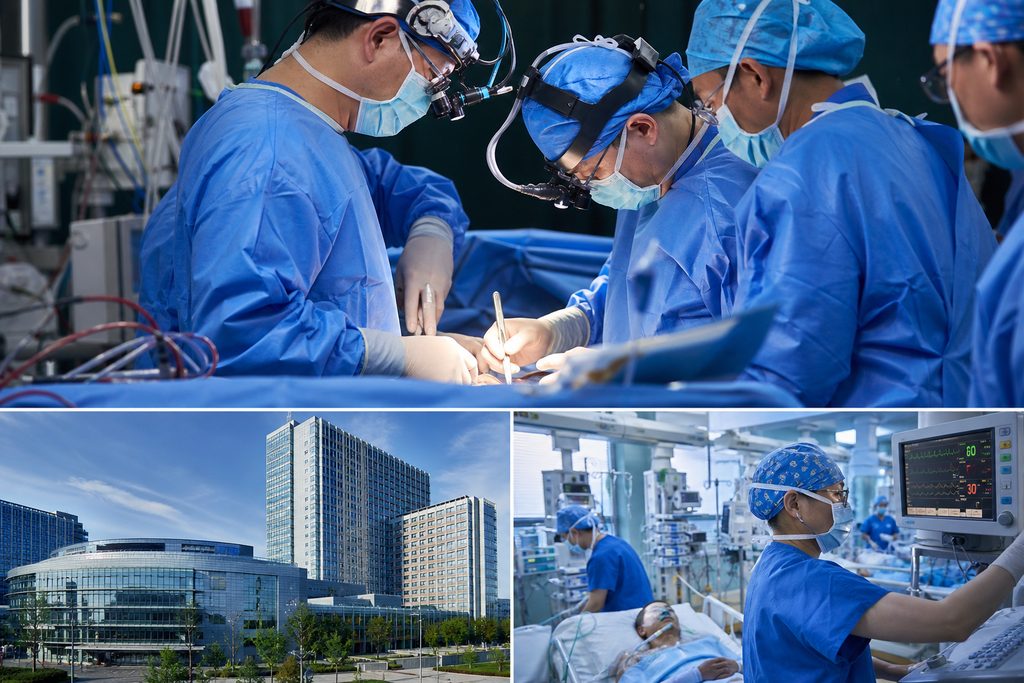
Fuwai Hospital in Beijing is not simply a large cardiac center. It is the largest cardiac surgical center in the world by annual procedure volume. The numbers tell a story that no marketing brochure can match: over 14,000 cardiac surgeries per year, of which CABG accounts for a substantial portion. To put that in perspective, the busiest cardiac surgery program in the United States — Cleveland Clinic — performs roughly 4,000 cardiac surgeries annually. Fuwai triples that. The complex CABG surgery cost Fuwai Hospital Beijing reflects this scale, typically ranging from $12,000 to $20,000 USD depending on graft number, valve involvement, and ICU stay duration.
But volume alone is not the argument. The argument is what volume produces: pattern recognition. A surgeon who has seen 5,000 calcified aortas knows what a clampable segment feels like. A perfusionist who has managed 3,000 bypass runs knows how to handle a crashing patient during weaning. An ICU team that has extubated 10,000 post-CABG patients develops an intuition for complications before they declare themselves. This is tacit knowledge — the kind that cannot be learned from textbooks, only from repetition at scale.
Clinical Volume That Rewrites Risk Thresholds
Consider what “high risk” means in different contexts. A US community hospital cardiac program might perform 100 CABG procedures annually. A patient with an ejection fraction of 25%, diabetes, and a prior PCI is a once-a-year case — maybe twice. The team is competent but not fluent in that level of complexity. The same patient profile at Fuwai Hospital appears multiple times per week. The surgeons, anesthesiologists, and intensivists have seen every permutation of this presentation. They know which grafts will fail, which patients need intra-aortic balloon pump support preoperatively, and which post-operative arrhythmias are benign versus ominous.
This volume effect shows up in outcomes data. Fuwai reports an overall CABG operative mortality rate consistently below 1% — a figure that compares favorably with the Society of Thoracic Surgeons benchmark of approximately 1.8% for isolated CABG in the US. For complex, high-risk cases, the gap often widens. When you ask what is the success rate of complex CABG at Fuwai Hospital, the answer depends on how you define success. Operative survival exceeds 97% even in high-risk cohorts. Long-term graft patency rates at one year are comparable to published Western series. Functional recovery — the thing patients actually care about — is the real measure, and that varies by baseline status.
Technology Deployed at a Scale That Changes Economics
Fuwai operates 26 operating rooms dedicated to cardiac surgery. The hospital runs multiple hybrid ORs capable of combined surgical and catheter-based interventions in a single session. Off-pump CABG — beating-heart surgery that avoids the risks of cardiopulmonary bypass — is performed routinely, not as a niche technique. For patients with porcelain aortas where clamping is impossible, off-pump grafting with proximal anastomoses to alternative sites (innominate artery, axillary artery) is a standard approach, not an experimental one.
The imaging infrastructure matters too. Pre-operative CT angiography with advanced calcium scoring, intraoperative transesophageal echocardiography in every case, and post-operative CT graft assessment are not optional extras — they are integrated into the standard workflow. When a high risk heart bypass China price is quoted, it typically includes these imaging modalities, not as add-ons but as part of the package. This is different from some Western systems where advanced imaging requires separate authorization and billing.
The Cost Equation: Structural Reasons, Not Corner-Cutting
Let us address the obvious question directly. How can complex CABG surgery cost Fuwai Hospital Beijing one-tenth of what it costs in the United States? The answer has nothing to do with quality compromise and everything to do with structural economics. Surgeon compensation in China is salaried, not fee-for-service. Hospital administrative overhead is lower. Malpractice insurance costs are a fraction of US rates. Device and pharmaceutical costs are lower due to different pricing structures. And the sheer volume amortizes fixed costs — an MRI scanner running 16 hours a day costs less per scan than one running 8 hours.
For international patients, the high risk heart bypass China price typically falls between $12,000 and $20,000 USD. This includes surgeon fees, anesthesia, operating room time, ICU stay (usually 2-3 days), step-down unit care, and standard medications. It does not include travel, accommodation, visa fees, or companion services. By comparison, a complex CABG in the US routinely exceeds $120,000, and can reach $200,000 with prolonged ICU stays. European prices vary — Germany and Switzerland are expensive, while Eastern European centers may charge $15,000 to $25,000 for international patients. Fuwai sits at the intersection of world-class volume and genuinely accessible pricing.
| Cost Component | Fuwai Hospital Beijing | United States (Average) | Germany |
|---|---|---|---|
| Isolated CABG | $12,000 – $16,000 | $40,000 – $80,000 | $25,000 – $40,000 |
| Complex CABG (multi-vessel, valve) | $16,000 – $20,000 | $120,000 – $200,000 | $40,000 – $70,000 |
| ICU per additional day | $500 – $800 | $3,000 – $5,000 | $1,500 – $2,500 |
| Pre-op full workup (imaging, labs, consult) | $1,000 – $2,000 | $5,000 – $15,000 | $3,000 – $6,000 |
Prices are estimates in USD. Actual costs vary by case complexity, length of stay, and specific hospital billing policies. Always confirm with the hospital international department before making financial decisions.
Can High Risk Patients Have Bypass Surgery in China? The Real Answer
Yes — and the threshold for what constitutes prohibitive risk is genuinely different at Fuwai than at most Western centers. But this requires careful qualification. Not every high-risk patient is a surgical candidate. Severe irreversible pulmonary hypertension, end-stage liver disease with coagulopathy, active systemic infection, or advanced malignancy with limited life expectancy remain contraindications regardless of surgical skill. What changes at Fuwai is the willingness to take on patients where the risk is technical rather than systemic — patients with hostile anatomy, redo sternotomies, or moderate organ dysfunction that falls short of end-stage.
The process for can high risk patients have bypass surgery in China starts not with a yes or no, but with a comprehensive pre-operative evaluation. Fuwai requires in-person assessment before scheduling surgery. This is non-negotiable. You cannot send your records and receive a surgery date by email. The evaluation typically includes coronary angiography (often repeated even if done abroad), echocardiography, pulmonary function testing, carotid Doppler, and laboratory studies. A multidisciplinary team reviews the case. Only then is a surgical plan proposed.
This in-person requirement is both a safeguard and a barrier. It means you must travel to Beijing before knowing definitively whether surgery will be offered. For patients who are medically fragile, this travel itself carries risk. We help manage this by coordinating the evaluation schedule tightly — often compressing the entire workup into 3-5 days — and by providing a bilingual medical companion who ensures nothing is lost in translation during the critical decision-making conversations.
What You Need to Know Before Going Alone
We want to be blunt about the barriers. They are real. They are surmountable, but only if you understand them before you book a flight.
- Visa Requirements: Medical treatment in China requires an S2 visa with a notation specifying the purpose. This is not a tourist visa. You need an invitation letter from the hospital — which means you must have a confirmed appointment before applying. The hospital’s international department issues this letter, but only after reviewing your preliminary records. Processing times vary. Rushing this is not possible.
- Payment Systems: Chinese public hospitals operate on a pre-payment model. You deposit funds upfront, and services are deducted from your balance. International credit cards are not universally accepted at hospital cashier counters. WeChat Pay and Alipay dominate, and linking a foreign card to these platforms is not always straightforward. You need a plan for moving money before you arrive.
- Language and Navigation: Fuwai Hospital sees over 10,000 outpatients daily. The campus is enormous. Signage in English is limited. Registration, payment, lab collection, and imaging are in separate buildings on different floors. Without Mandarin proficiency and familiarity with the hospital’s workflow, a simple pre-op blood draw can consume half a day of confusion.
- Medical Records Translation: Your existing angiogram reports, echo measurements, and operative notes must be translated into Chinese for the surgical team. This is not a job for Google Translate. Medical terminology requires precision. A mistranslated “left main equivalent disease” versus “left main disease” changes the surgical plan.
How We Help You Navigate This
These barriers exist for structural reasons — not because anyone is trying to make your life difficult. A public hospital serving 14,000 cardiac surgery patients a year cannot also function as a concierge service for international arrivals. That is where we fit.
Our process begins with a free consultation. You tell us your clinical situation — diagnosis, ejection fraction, prior interventions, comorbidities, what your home cardiologist has told you. We review your records and determine whether Fuwai Hospital is a realistic option. If it is, we connect you with the hospital’s international department to obtain the invitation letter for your S2 visa. We coordinate the appointment schedule so that your angiography, echo, labs, and surgical consultation happen in a compressed window — usually within the same week. Our bilingual medical companion meets you at the hospital on day one and stays with you through every step: registration, payment counter, pre-op testing, the surgical consent discussion, and post-operative follow-up. We translate your records before you arrive. We handle the logistics so you focus on your health.
For patients who want to book Fuwai Hospital heart bypass for international patients, the pathway is straightforward but requires patience. You cannot book a surgery date from abroad. You come for the evaluation. If surgery is indicated, it is typically scheduled within one to three weeks after the workup is complete. The hospital’s international ward provides English-capable nursing staff for the post-operative period. Your companion remains available throughout. After discharge, we coordinate follow-up appointments and medication reconciliation before you fly home.
Finding the best cardiac surgeon for complex CABG Beijing medical tourism is less about picking a specific name and more about understanding how Fuwai’s team structure works. The hospital’s CABG program is led by senior surgeons who each perform hundreds of cases annually. The international department assigns your case to a surgeon with specific expertise in your anatomical challenge — diffuse disease, redo sternotomy, combined valve-CABG — based on the pre-op findings. You are not choosing from a menu. You are being matched to the right hands for your particular problem. This is the model that produces the outcomes data the hospital reports.
Frequently Asked Questions
Published data from Fuwai’s surgical database indicates operative mortality for CABG in patients with severely reduced ejection fraction (below 30%) is approximately 2% to 3%, compared to under 1% for patients with normal ventricular function. This is substantially better than the STS-predicted risk for comparable patients in US databases, where mortality often exceeds 5% to 8% in this subgroup. The key variable is whether the myocardium is viable — stunned or hibernating myocardium that recovers after revascularization versus scar that will not. Pre-operative viability assessment with cardiac MRI or dobutamine stress echo is part of the standard workup at Fuwai and heavily influences the surgical decision.
Plan for four to six weeks minimum. The pre-operative evaluation takes approximately one week. If surgery is indicated, scheduling typically adds one to two weeks. The hospital stay for uncomplicated complex CABG is seven to ten days — longer if you require extended ventilation or have rhythm issues. After discharge, you need at least one week in Beijing for follow-up before flying. Long-haul air travel immediately after sternotomy carries risks of deep vein thrombosis and wound complications. Your surgeon will clear you for travel only after confirming sternal stability and absence of pleural effusions.
This is the scenario every patient worries about, and it happens — though less frequently than you might expect. If the team determines that surgical risk outweighs benefit, you will receive a detailed explanation of why, along with alternative recommendations. These may include optimized medical therapy, percutaneous intervention if feasible, or referral for transplant evaluation if appropriate. The evaluation itself is not wasted — you gain a definitive, high-volume second opinion. The cost of the workup (approximately $1,000 to $2,000 USD) is non-refundable, but it provides clarity that may be worth far more than the price.
Fuwai’s international ward offers private rooms where one family member can stay overnight. This is not universal in Chinese public hospitals — standard wards typically have shared rooms with restricted visiting hours — but the international department is designed with this expectation. Your companion or family member will have a fold-out bed or cot. Meals for the accompanying person are not included in the hospital bill but can be purchased in the hospital cafeteria or nearby. Having someone present who can communicate with nursing staff is invaluable, which is why many patients keep their bilingual companion engaged throughout the hospitalization.
Your Next Step
A high-risk heart is not a verdict. It is a problem that demands the right surgical volume, the right team, and the right logistical support. Fuwai Hospital has the volume and the team. The logistics — that is our job. If your home cardiologist has told you that surgery is too risky, or if you are facing a six-figure bill and a six-month wait, it is worth understanding what is actually possible. We are here to help you find out. No pressure. No promises. Just a clear-eyed assessment of your options and, if it makes sense, a path forward.
Start with a conversation. Visit our patient coordination page to schedule a free consultation. We will review your situation honestly and tell you whether Fuwai Hospital — or another center in China’s top-ranked hospital network — is a realistic option for your case.
For more medical information and treatment options in China, visit chinamedservices.com (China Medical Services).
