Is My Hair Loss Treatable? A Guide to Real Options, Costs, and Getting Care in China
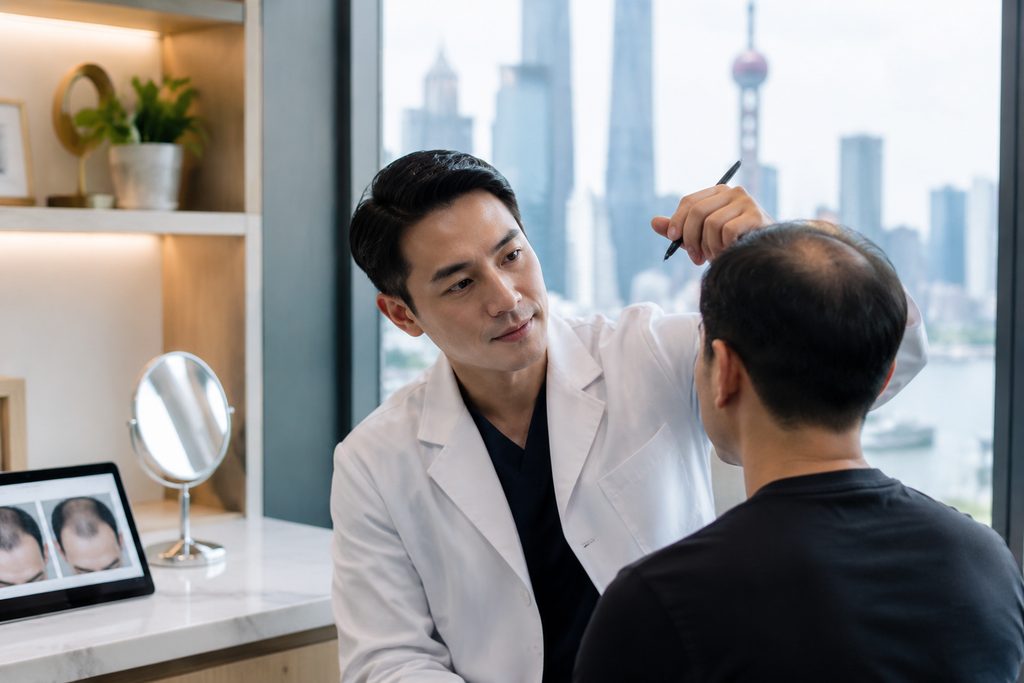
Hair loss is rarely a medical mystery. In roughly 95% of men, the cause is androgenetic alopecia — pattern baldness driven by genetics and hormones. For women, the number sits around 40% by age 50. And here is the part most people do not realize: the earlier you act, the more options you have. A hair transplant cost China ranges from $3,000 to $8,000 depending on the technique and graft count, which is substantially lower than the $15,000 to $30,000 commonly quoted in the United States or Western Europe. But cost is only one part of the story. Whether your hair loss is treatable depends on what caused it, how long it has been progressing, and what you are willing to commit to.
Some forms of hair loss reverse on their own. Others respond to medication. A minority leave permanent scarring that no serum or pill can fix. Let us walk through the actual categories so you can figure out where you stand — before anyone sells you a package.
Is My Hair Loss Reversible? The Short Answer
Most hair loss is treatable, but not all hair loss is reversible. That distinction matters. Telogen effluvium — the diffuse shedding triggered by stress, illness, childbirth, or crash dieting — typically resolves within 6 to 12 months once the trigger is removed. Androgenetic alopecia does not reverse on its own, but it can be slowed, and lost hair can be surgically restored. Scarring alopecias, like lichen planopilaris or frontal fibrosing alopecia, destroy follicles permanently; treatment focuses on stopping further loss, not regrowth.
So the honest answer to “is my hair loss reversible” is: sometimes. The first step is diagnosis, not treatment. A dermatologist with a trichoscope can distinguish between follicle miniaturization, inflammation, and shedding in under ten minutes. That diagnosis determines everything that follows.
Who This Is Right For — and Who It Isn’t
You are likely a good candidate for active treatment if you fall into one of these groups:
- You have been losing hair for less than five years and still have visible miniaturized hairs in thinning areas.
- Your hair loss follows a predictable pattern — receding temples, thinning crown — rather than patchy or scarred areas.
- Your blood work is normal. No severe anemia, thyroid dysfunction, or autoimmune markers.
- You are willing to use medication consistently for at least 12 months before judging results.
- You are considering surgery and have adequate donor hair at the back and sides of your scalp.
You should not pursue aggressive treatment if:
- You are under 25 with early, unstable hair loss. Surgery too early can leave you chasing further loss with more surgeries.
- You have an active scalp condition — psoriasis, seborrheic dermatitis, or folliculitis — that is not yet controlled.
- You have diffuse, unpatterned shedding with no clear diagnosis. Treating the wrong cause wastes time and money.
- You are pregnant or breastfeeding. Finasteride and minoxidil are off the table for women in these phases.
- You expect a one-time fix. Even after a transplant, maintenance medication is usually required to protect non-transplanted hair.
The Options, Compared
No single treatment works for everyone. Here is a direct comparison of the main evidence-based approaches, including what each one actually costs and what it can realistically achieve.
| Option | Best For | Time to Visible Result | Typical Cost Range | Key Limitation |
|---|---|---|---|---|
| Topical minoxidil 5% | Early thinning, crown and vertex | 4–6 months | $10–30/month | Must use indefinitely; stops working if discontinued |
| Oral finasteride 1mg | Male pattern baldness, early to moderate | 6–12 months | $15–40/month | Sexual side effects in 2–4% of users; not for women of childbearing age |
| Low-level laser therapy | Adjunct for diffuse thinning | 6–12 months | $500–1,500 device cost | Weak evidence; inconsistent results |
| Platelet-rich plasma (PRP) | Early androgenetic alopecia, female pattern loss | 3–6 months after 3–4 sessions | $300–800 per session | Maintenance sessions needed every 6–12 months |
| Hair transplant (FUE or FUT) | Established pattern loss with stable donor area | 6–12 months for full growth | $3,000–8,000 in China; $15,000–30,000 in the US | Surgical; does not stop future loss in non-transplanted zones |
If your loss is mild and recent, start with medication. If your hairline has been gone for years and your donor area is dense, surgery may be the only way to restore coverage. Many patients combine approaches: a transplant to rebuild the hairline, finasteride to protect the crown, and PRP to thicken what remains.
What “Treatable” Actually Means at Each Stage
Hair loss is a spectrum, not a single event. The Norwood scale for men and the Ludwig scale for women describe progression in stages. What works at Norwood 2 will not work at Norwood 6. Here is what treatment realistically achieves at each stage.
At the earliest stage — mild recession at the temples or slight widening of the part — medication alone can stabilize loss for years. Some patients see modest regrowth. This is the window where intervention has the highest return.
At the middle stage — visible thinning across the crown or a receded hairline that is still salvageable — a transplant becomes the most reliable option for restoring density. But the surgeon must plan for future loss. A good doctor will not give a 28-year-old a straight juvenile hairline; he will design a mature one that still looks natural at 50.
At the advanced stage — extensive baldness with limited donor supply — the goal shifts from restoration to redistribution. Body hair transplantation, scalp micropigmentation, or simply accepting a shaved look may be the honest recommendation. A reputable clinic will tell you when surgery is not worth it.
This is why the question “is my hair loss treatable” is impossible to answer without seeing your scalp. It is not about whether treatments exist. It is about whether a specific treatment matches your specific stage.
Hair Transplant Cost China: What the Numbers Include
The headline figure for a hair transplant cost China is usually quoted per graft. In Shanghai and Beijing, prices typically run $1.50 to $3.50 per graft for FUE (follicular unit extraction). A typical procedure involves 2,000 to 3,500 grafts, which puts the total at $3,000 to $8,000. Some clinics quote lower — be careful. A price under $1 per graft often means technicians, not surgeons, are doing the extraction, or the clinic is cutting corners on sterilization.
What drives the variance:
- Technique: FUE costs more than FUT (strip method) because it is more labor-intensive. FUE leaves no linear scar, which matters if you wear your hair short.
- Surgeon seniority: A chief surgeon with 15 years of experience charges more than a junior doctor. This is not a place to bargain-hunt.
- Hospital tier: A top public hospital’s international department or a JCI-accredited private hospital in Shanghai will quote higher than a standalone hair clinic. The difference buys you English-speaking staff, cleaner aftercare protocols, and accountability if something goes wrong.
- Graft count: Some patients need 1,500 grafts; others need 4,000. Your donor density and the size of the recipient area determine this.
What is usually included: pre-op blood work, local anesthesia, the procedure itself, and one or two follow-up visits. What is often not included: post-op medications, PRP add-ons, accommodation, and airport transfers. If you are traveling from abroad, factor those in separately.
For comparison, the same FUE procedure in the United States averages $6 to $12 per graft, putting total costs at $15,000 to $30,000. In Turkey, prices have dropped to $2,000 to $4,000, but quality control varies wildly and aftercare is often minimal once you leave. China sits in a middle position: lower cost than the West, with a hospital infrastructure that offers more oversight than many medical tourism hubs.
Best Hair Loss Treatment Shanghai: Where Patients Actually Go
Shanghai has the densest concentration of dermatology and hair restoration expertise in mainland China. The city is home to several top-ranked public hospitals with dedicated hair clinics, as well as JCI-accredited private hospitals that cater to international patients. When patients search for the best hair loss treatment Shanghai, they are usually comparing three tiers.
The first tier is the public hospital dermatology departments. These are the most affordable and the most evidence-driven. Expect a thorough diagnostic workup — trichoscopy, blood panels, sometimes a biopsy — before any treatment is recommended. The downside is language. Few public hospital staff speak English, and the registration process is not designed for foreigners. This is where a bilingual medical companion becomes genuinely useful, not just convenient.
The second tier is private international hospitals. Names like United Family and Jiahui have English-speaking dermatologists, direct insurance billing, and shorter wait times. A consultation might cost $100 to $200, but you will get a clear explanation in English and a treatment plan you can actually understand.
The third tier is standalone hair transplant clinics. Some are excellent; some are aggressive marketers with mediocre surgeons. If you go this route, ask three questions: Who performs the extraction — the surgeon or a technician? How many procedures does the clinic do per week? What is the revision policy if density is poor? A clinic that hesitates on any of these answers is not your clinic.
You can browse our Shanghai hospital directory to see which institutions we work with and what each one offers for international patients.
Can Stress Cause Permanent Hair Loss? What the Evidence Says
Stress causes hair loss, but it rarely causes permanent hair loss on its own. The mechanism is well documented: acute or chronic stress pushes hair follicles into the telogen (resting) phase prematurely. Two to three months later, those hairs fall out. This is telogen effluvium, and it usually resolves within a year once the stressor is removed.
But the relationship is more complicated than “stress makes hair fall out.” Chronic stress can accelerate androgenetic alopecia in people who are genetically predisposed. It raises cortisol, which disrupts the hair cycle and can make pattern baldness appear earlier or progress faster. So can stress cause permanent hair loss? Not directly. But it can unmask or accelerate a permanent condition that was already in your genes.
There is also a behavioral component. People under prolonged stress often sleep poorly, eat worse, and neglect scalp care. Those secondary effects compound the problem. If your hair loss started within three months of a major life event — surgery, divorce, job loss, severe illness — telogen effluvium is the likely diagnosis, and the prognosis is good. If the shedding has been gradual over years, stress is probably not the primary driver.
Book Hair Transplant Beijing: What the Process Looks Like
If you are planning to book hair transplant Beijing, understand the sequence. You cannot simply schedule surgery online and show up. Chinese public hospitals require an in-person consultation before any surgical procedure. The doctor must examine your donor area, assess scalp laxity, and confirm you are a suitable candidate. There is no shortcut around this.
The typical flow for an international patient looks like this:
- Remote review: You send photos and, if available, a recent trichoscopy report. A dermatology team reviews them and gives a preliminary assessment. This costs $100–300 for a written second opinion.
- In-person consultation: You travel to Beijing for the face-to-face evaluation. The surgeon measures donor density, maps the recipient area, and gives you a graft estimate and final quote.
- Surgery scheduling: If you proceed, surgery is usually scheduled within one to four weeks, depending on the surgeon’s calendar. The procedure itself takes 6 to 8 hours for a typical FUE session.
- Aftercare: You will need at least 3 to 5 days in the city for initial recovery and a follow-up wash. Scabs fall off within 10 days. Full growth takes 6 to 12 months.
For the visa, medical treatment falls under the S2 category, not the M visa. You will need an invitation letter or supporting documentation from the hospital or clinic. Our team can help coordinate this, but approval always rests with the Chinese embassy or consulate in your home country.
Hair Loss Clinic Packages Abroad: Reading the Fine Print
Many hair loss clinic packages abroad look attractive on paper. A typical package might include the procedure, two nights in a hotel, airport pickup, and PRP sessions — all for $4,000. But packages are designed to standardize care, and standardized care is not always good care.
What to check before booking any package:
- Who operates: Does the package name the actual surgeon, or just “our medical team”? A named surgeon with verifiable credentials is non-negotiable.
- Graft count transparency: Is the price based on a maximum graft count, or will you be charged extra per graft beyond a threshold? Get this in writing.
- Revision policy: What happens if density is poor at 12 months? A clinic that offers a free touch-up for low yield is more confident in its work.
- Aftercare access: Can you reach the surgeon after you fly home? Or does communication end at the airport?
- Hidden exclusions: Anesthesia, blood tests, post-op medications, and follow-up washes are sometimes billed separately.
Packages are not inherently bad. Some reputable clinics in China offer them precisely because international patients want predictable costs. But the package should be a pricing convenience, not a substitute for a real medical evaluation.
Practical Considerations: Records, Visas, and Follow-Up
If you are traveling to China for hair loss treatment, prepare these things before you go.
Medical records. Bring any prior diagnoses, blood test results, and photos of your hair loss over time. If you have been on finasteride or minoxidil, note the dosage and duration. This helps the Chinese dermatologist avoid redundant testing and gives a clearer picture of what has already failed.
Visa. The S2 visa is the correct category for short-term medical treatment and private affairs. It typically allows stays of up to 180 days. For longer treatment plans, an S1 visa may apply. The hospital or clinic will need to provide supporting documents, usually an invitation letter and a treatment plan. Processing times vary by embassy, so start at least six to eight weeks before your intended travel date.
Payment. Chinese public hospitals require prepayment for procedures. International credit cards are accepted at major hospitals and private clinics, but smaller facilities may require cash, WeChat Pay, or Alipay. Confirm the payment method before you arrive. Travel insurance rarely covers elective cosmetic procedures, so plan to pay out of pocket and seek reimbursement later if your policy allows.
Language. Outside of private international hospitals, English is limited. Registration desks, pharmacy counters, and nursing staff typically operate in Mandarin. A bilingual companion who can queue, translate, and explain instructions removes most of the friction. It is not a luxury; it is the difference between a smooth visit and a stressful one.
Follow-up after returning home. Hair transplant results are judged at 6 and 12 months. You will need to send photos to your surgeon for remote review. Some clinics offer video follow-ups. If a touch-up procedure is needed, you may need to return to China, so factor that possibility into your budget and scheduling.
Frequently Asked Questions
No. Androgenetic alopecia can be managed and surgically restored. Telogen effluvium usually resolves on its own. But scarring alopecias destroy follicles permanently. The only way to know which category you are in is a proper diagnostic exam, not a guess based on internet photos.
How much does a hair transplant cost in China compared to the US?
A hair transplant cost China typically runs $3,000 to $8,000 for 2,000 to 3,500
For more medical information and treatment options in China, visit chinamedservices.com (China Medical Services).
