Halal Food in Xi’an Hospitals: A Complete Guide for Muslim Patients
Key Takeaways
- Xi’an’s large Hui Muslim population means halal food is not a niche request here — it’s woven into the city’s food culture, making it far more accessible than in most Chinese cities.
- Several top-tier hospitals in Xi’an have dedicated halal kitchens or formal partnerships with certified halal caterers, a service often included in international patient packages.
- Without advance coordination, a hospital’s standard patient meals will not meet halal requirements. The default tray will almost certainly include non-halal meat or ingredients.
- A written request in Chinese, submitted to the nursing station at least 24 hours before admission, is the single most effective step you can take to secure proper meals.
The Problem: A Hospital Stay Tests More Than Just Your Health
You have already done the hard part. You researched the best hospital, navigated the visa process, and traveled thousands of miles for treatment. And then a simple, deeply personal question hits you at the worst possible moment: what will I eat? For a Muslim patient, a hospital meal is not just fuel. It is a matter of faith. A tray of food that looks harmless can contain pork-based broth, alcohol-marinated ingredients, or meat from animals not slaughtered according to Zabiha. This anxiety is real and it is exhausting, especially when your body should be focused entirely on healing.
The numbers tell a clear story. China is now a significant destination for medical travelers from Muslim-majority countries, with patients arriving from the Middle East, Southeast Asia, and Central Asia. Xi’an, specifically, attracts a large share of these visitors. Why? The city was the eastern terminus of the ancient Silk Road. Islam arrived here over 1,300 years ago. Today, the city’s Hui community numbers in the hundreds of thousands. This history has shaped the local food landscape in ways that directly benefit you.
Why Xi’an Delivers a Different Experience for Muslim Patients
Most international patient guides for China treat halal food as an afterthought — a difficult accommodation you will have to fight for. Xi’an is the exception. The city’s Muslim Quarter is not a small ethnic enclave. It is a major cultural and culinary hub that sits in the very center of the city, right next to the Drum Tower. This means halal food is part of the mainstream. Hospital administrators here are far more familiar with the concept of “qingzhen” (清真, the Chinese term for halal) than their counterparts in Shanghai or Beijing. They have seen Muslim patients before. Many have built systems to serve them.
Local Knowledge Translates to Hospital Capability
A hospital’s ability to provide a true halal meal depends entirely on its supply chain. In most cities, a hospital kitchen might struggle to source halal-certified beef or lamb. In Xi’an, that supply chain already exists. The city has halal slaughterhouses, certified halal food manufacturers, and a dense network of halal restaurants. Many of these businesses have been operating for generations. This local infrastructure means a hospital’s dietary department can procure halal ingredients without having to build a new logistics chain from scratch. It is a structural advantage, not just a cultural one.
How to Get Halal Meals During Your Hospital Stay in Xi’an
The process is not automatic. It will not happen unless you trigger it. But the path is well-worn and much smoother than you might fear. The key is to separate two distinct challenges: the food inside the hospital and the food for your family outside. Let’s tackle the hospital tray first, because that is the one that causes the most stress.
Step 1: The Written Request, 24 Hours Before Admission
Hospital kitchens run on strict production schedules. They do not cook to order. A special meal request that arrives after the morning shift has started will almost certainly be met with an apology and a plate of plain steamed rice and boiled vegetables. That is not a punishment. It is simply the reality of a kitchen that prepares thousands of meals a day. To avoid this, you need a specific document: a bilingual meal request letter.
This letter should state, in clear Chinese and English, that you require “清真餐食” (halal meals). It must specify no pork, no lard, no alcohol, and that all meat must come from animals slaughtered according to Islamic rites. Do not assume the dietary department understands the full scope of halal just from the word “Muslim.” A well-written letter leaves no room for interpretation. Submit this to the international patient center or the head nurse on your ward at least one full day before your scheduled admission. If you are already in the hospital, submit it immediately. The kitchen needs time to adjust its procurement list.
Step 2: Verify the Source, Not Just the Label
Once the meal arrives, you will want to confirm its provenance. A tray with a “halal” sticker is a good sign, but it is worth asking a simple question: does this kitchen have a separate cooking area? Cross-contamination is the hidden risk. A piece of halal chicken grilled on the same surface that just cooked pork sausage is no longer halal. The best hospitals in Xi’an have addressed this. Some maintain a dedicated halal kitchenette. Others outsource entirely to a certified halal caterer who delivers sealed meals directly to the ward. Ask your nurse or our bilingual coordinator to clarify this point on day one. The answer will tell you exactly how seriously the facility takes your dietary requirements.
What Halal Food Service Hospital Xi’an Cost and Packages Actually Include
Let’s talk about money. A standard hospital meal in a Chinese public hospital is startlingly cheap — often $2 to $5 per day. But that standard meal is not halal. A dedicated halal meal service costs more because it requires separate sourcing, preparation, and sometimes third-party catering. You should expect to pay between $8 and $20 per day for three halal meals, depending on the hospital and the complexity of your dietary needs.
Some international patient centers in Xi’an now offer a more comprehensive solution: a Muslim patient package. This is not just about food. A typical package bundles the halal meal service with a private room that includes a Qibla direction indicator, a prayer mat, and a copy of the Quran. One major hospital in Xi’an provides a welcome kit with dates and Zamzam water for patients arriving during Ramadan. The Muslim patient package Xi’an hospital price for these bundled services typically adds $50 to $100 per day to the room rate. This is separate from your medical costs and is paid directly to the hospital’s international department.
| Service Component | Typical Cost (USD) | Notes |
|---|---|---|
| Standard hospital meal (non-halal) | $2–5/day | Default for public ward patients |
| Dedicated halal meal plan | $8–20/day | Sourced from in-house halal kitchen or certified caterer |
| Muslim patient support package | $50–100/day | Includes halal meals, prayer amenities, Qibla orientation, and cultural support |
| Private halal catering (external) | $15–30/day | Family can order from outside; hospital may need to approve the vendor |
Do not confuse these packages with your treatment costs. They are add-ons. A hospital that offers a beautiful halal meal and a prayer mat is not necessarily the best hospital for your cardiac surgery. The food and spiritual support matter immensely for your comfort, but they are secondary to clinical outcomes. Your first filter must always be medical expertise. The halal logistics can be solved around a great hospital. A weak hospital cannot be fixed by a good lunch.
Can Muslim Patients Find Halal Food in Xi’an Hospitals That Do Not Have a Halal Kitchen?
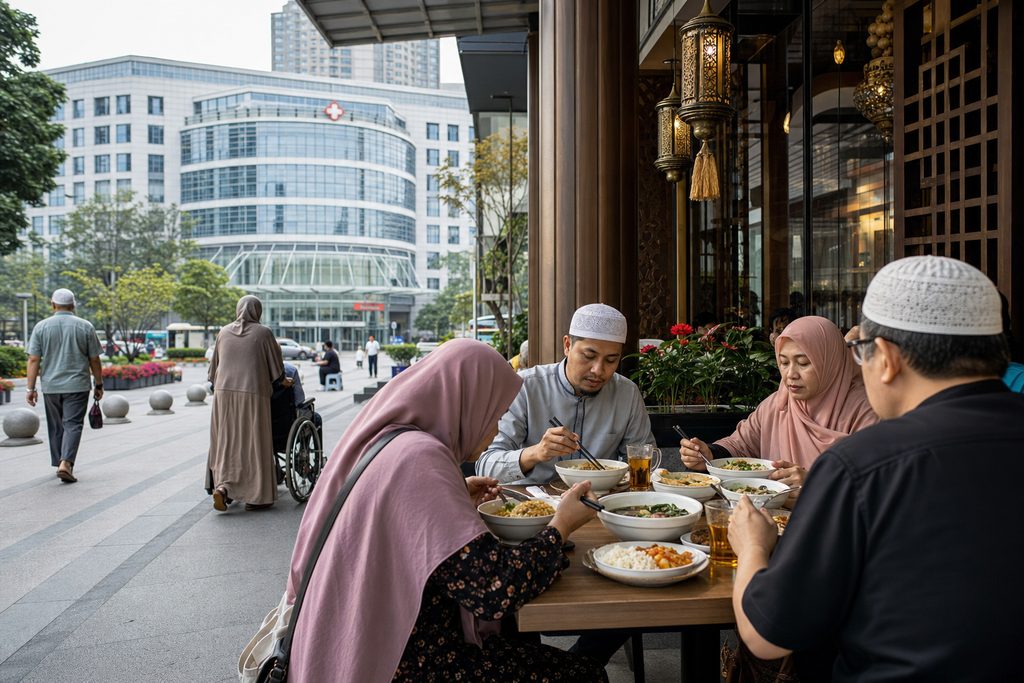
Yes. This is where Xi’an’s geography becomes your ally. Many of the city’s top hospitals are located within a 15-minute drive of the Muslim Quarter. Xijing Hospital, one of China’s most prestigious medical institutions, sits just a few kilometers from the Great Mosque and the dense network of halal restaurants that surround it. If your hospital cannot provide a satisfactory halal meal, your family can bring food in.
This is not a theoretical backup plan. It is what many local Muslim families do every day. They purchase meals from trusted halal restaurants and bring them to the ward. The hospital may have rules about outside food — some intensive care units restrict it entirely — but in a standard recovery ward, this is usually permitted. A family member can walk to a restaurant like De Fa Chang or a smaller neighborhood eatery, order a nutritious halal meal of hand-pulled noodles with beef or a lamb stew, and have it at your bedside within an hour. The food is authentic, affordable, and prepared by Muslim cooks who have been serving the community for decades.
Practical Considerations: Documentation, Timing, and Family Support
The food question is part of a larger puzzle. Your hospital stay will be smoother if you handle a few practical items before you arrive. None of these are complicated, but each one can become a source of friction if left to the last minute.
Your visa is the foundation. For medical treatment in China, you will need an S2 visa. This is the short-stay category used for private affairs, including medical treatment. Your accompanying family members also apply for S2 visas. The hospital’s invitation letter is a critical supporting document. Make sure it clearly states the purpose of your visit and the expected duration of your stay. Without this letter, the visa application will stall. Processing times vary by country, but you should allow at least two to four weeks.
Payment is the next hurdle. Chinese public hospitals operate on a prepaid deposit system. You will need to place a deposit at admission, and the hospital will draw down from it as services are provided. International credit cards are accepted at the international patient centers of major hospitals, but they are often useless in the hospital’s general cashier. Bring a card that works on the UnionPay network, or be prepared to make a large wire transfer in advance. The halal meal package fee is usually paid separately, either in cash or via WeChat Pay. If you do not have WeChat Pay set up, our team can help you handle this on arrival.
Language is the final barrier. A request for a halal meal is not a simple transaction. It requires explaining religious requirements to a dietary team that may have never met a foreign Muslim before. Our bilingual coordinators handle this conversation in advance, in Chinese, with the specific terminology that hospital staff understand. They can also arrange a proxy consultation if you need to evaluate a hospital’s halal capabilities before committing to travel. This service allows you to send your medical records and dietary requirements to a hospital department, and have a representative visit in person to confirm every detail, from the kitchen setup to the prayer facilities.
Frequently Asked Questions
This is a real scenario and it requires a pragmatic response. In an emergency, your clinical stability comes first. Tell the admitting nurse immediately that you require a halal diet. If the hospital cannot provide one on short notice, request a vegetarian meal as a temporary bridge. Plain rice, steamed vegetables, and fruit are safe options while your family or our coordinator works to establish a proper halal food supply. The vegetarian meal is not a long-term solution, but it will sustain you for 24 to 48 hours without compromising your dietary requirements.
Trust is built on verification. Ask to see the hospital’s halal certification document. It should be issued by the China Islamic Association or a provincial Islamic association. The certificate will list the certifying body, the scope of certification, and an expiration date. If the hospital uses an external caterer, ask for the caterer’s certification. A hospital that is serious about serving Muslim patients will have these documents on file and will share them without hesitation. If you encounter resistance or vague answers, treat that as a signal to rely on outside food from the Muslim Quarter instead.
Xi’an’s Muslim Quarter solves the food problem for your family almost completely. They will find dozens of halal restaurants within walking distance of most major hospitals. For longer stays, many families rent a serviced apartment with a kitchenette near the hospital. This allows them to cook their own halal meals using ingredients from local halal markets. The area around Xijing Hospital and the First Affiliated Hospital of Xi’an Jiaotong University has numerous short-term rental options. Our team can provide a list of vetted apartments that are clean, safe, and within a 10-minute walk of the hospital gates.
Your Next Step
A hospital stay in a foreign country is a vulnerable experience. The question of halal food is not a small detail — it is a daily, tangible reminder of your identity and your faith. Xi’an is one of the few cities in China where this aspect of your care can be handled with genuine understanding rather than awkward accommodation. Our role at China Medical Services is to make sure the logistics are solved before you arrive. We do not provide medical treatment. We are not a hospital. We are the team that handles the coordination, the language, and the cultural bridge so you can focus entirely on your recovery. If you are considering treatment in Xi’an and want to confirm that every meal will meet your requirements, reach out for a free consultation. We will walk you through exactly what is possible at your chosen hospital, no pressure and no vague promises. Just the honest, practical information you need to make a confident decision.
For more medical information and treatment options in China, visit chinamedservices.com (China Medical Services).
