Heart Checkup in Guiyang: Your Options, Costs, and Top Hospitals
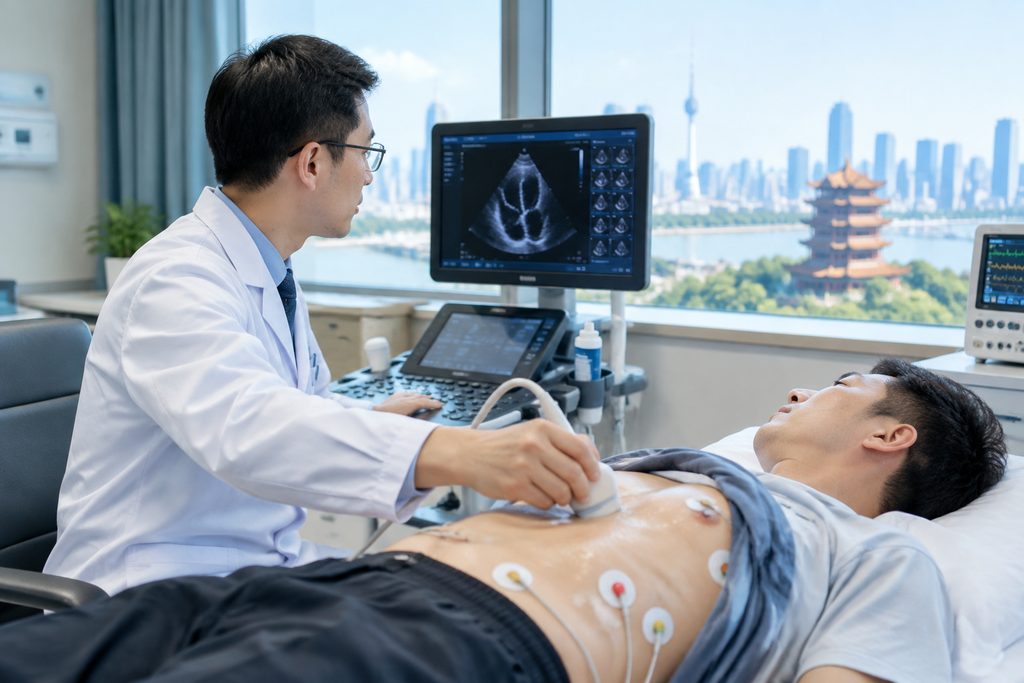
Heart Checkup in Guiyang: Your Options
What if you could get a complete cardiac workup — bloodwork, ECG, echocardiogram, stress testing, and a cardiologist’s read — for less than the price of a single consultation in some Western cities? That question is exactly why searches for heart checkup cost Guiyang have climbed in recent years. The short answer: a comprehensive cardiac screening in Guiyang typically runs $250 to $900 at a top-tier public hospital, and $900 to $2,500 at a private international clinic. Both are a fraction of U.S. or Western European pricing.
But cost is the easy part. The harder question is whether a foreigner with no Mandarin can actually navigate a Chinese hospital system that sees tens of thousands of outpatients a day. That’s where most people get stuck — and where the real planning begins.
Heart Checkup Cost Guiyang and Beyond: The Short Answer
Guiyang is the capital of Guizhou Province, a city of roughly 6 million people in southwestern China. It is not Beijing or Shanghai, and that matters. Local pricing is lower, wait times for routine screening are shorter, and the patient volume pressure is lighter. A standard cardiac panel — resting ECG, echocardiogram, lipid profile, blood pressure monitoring, and a cardiology consultation — is genuinely affordable here.
What Guiyang is not is a cardiac surgery hub on the level of Fuwai Hospital in Beijing or Zhongshan Hospital in Shanghai. If your checkup uncovers something that needs intervention — a blocked artery, a valve problem, an arrhythmia requiring ablation — you may want to move to a higher-tier center. Guiyang is an excellent place to screen. It is a reasonable, though not always optimal, place to treat complex disease.
Rough rule of thumb: use Guiyang for screening, imaging, and routine follow-up. Escalate to a national cardiac center if the findings require surgery or advanced electrophysiology.
Who This Is Right For — and Who It Isn’t
Cardiac screening in Guiyang makes sense for a specific kind of traveler. It does not make sense for everyone, and being honest about that saves people a wasted trip.
Typically a good fit:
- Expats, business travelers, or retirees already living in or near Guizhou Province
- Patients with a family history of heart disease who want a baseline workup at low cost
- People whose home-country wait for a non-urgent cardiology appointment stretches past several months
- Travelers combining a medical stop with tourism in southwestern China
- Anyone whose insurance at home doesn’t cover preventive cardiac imaging
Probably not the right choice:
- Anyone with active chest pain, shortness of breath at rest, or suspected acute coronary syndrome. That is an emergency. Go to the nearest hospital immediately — do not plan a trip.
- Patients who need a specific, named surgeon or a highly specialized procedure that only a handful of centers perform
- People who cannot tolerate a long-haul flight for medical reasons
- Anyone expecting a Western-style “concierge” experience at a public hospital without arranging support in advance
If you fall into the second group, staying home — or going directly to a national referral center — is the better call.
The Options, Compared
Foreigners essentially choose between three tiers of care in Guiyang. Each has a different price point, language reality, and booking process.
| Tier | Typical Cardiac Screening Cost | English Support | Booking Reality | Best For |
|---|---|---|---|---|
| Public tertiary hospital (standard outpatient) | $250–$600 | Limited; interpreter usually needed | Same-day registration, queue-based | Budget-conscious, self-sufficient patients |
| Public hospital international / VIP department | $600–$1,200 | Yes, staffed English service | Can often be pre-arranged | Patients wanting smoother logistics |
| Private international clinic | $900–$2,500 | Full English, Western-style care | Appointment-based, direct insurance billing common | Insured patients, comfort priority |
Which column fits you? If you’re paying out of pocket and comfortable with an interpreter, the standard public route delivers the same diagnostic hardware at the lowest price. If your insurance reimburses and you value predictability, the private clinic tier removes most friction. The international department sits in the middle and is often the sweet spot for first-time medical travelers.
Is Heart Checkup in China Safe for Foreigners?
This is the question that quietly sits behind every other question. And the honest answer is: yes, for a routine screening, the safety profile is comparable to any developed country — with two caveats that have nothing to do with medicine.
The first caveat is communication. A Chinese cardiologist reading your echocardiogram is highly trained. The problem is that the conversation around it — your symptoms, your medication history, what the report means — may happen in Mandarin. Misunderstanding a dosage instruction or a follow-up interval is a real risk. That’s a language problem, not a quality problem, but it can hurt you.
The second caveat is system navigation. Chinese public hospitals operate on a registration-and-queue model. You take a number, you wait, you’re directed to a floor, you pay at a different window, you collect results elsewhere. For a local patient this is routine. For a foreigner on day one, it can consume an entire morning just to find the right room.
Neither caveat means the care is unsafe. Both mean the experience is easier with someone who knows the building.
How Much Does a Heart Checkup Cost in China?
Zoom out from Guiyang and the national picture is consistent. Across China’s top public hospitals, a thorough cardiac screening — the kind that includes imaging, not just a stethoscope and a blood draw — generally lands between $250 and $1,200 depending on the hospital tier and how many tests you add.
For context, the same panel in the United States frequently exceeds $3,000 to $5,000 before insurance, and in Western Europe it commonly runs $1,500 to $3,000. China’s cost advantage is not a marketing claim; it reflects lower labor and overhead costs across the system.
What drives the variance on the Chinese side?
- Hospital tier. A provincial public hospital charges less than a national flagship.
- Test depth. A basic ECG plus bloodwork is cheap. Adding a stress test, Holter monitor, or cardiac CT pushes the total up sharply.
- Contrast agents and materials. If your imaging needs contrast, that’s a separate line item.
- Language and coordination support. If you engage a companion or interpreter service, that’s billed separately from the hospital.
One important note on booking: at most public hospitals, you cannot reserve a standard outpatient slot from overseas in advance. You register on the day. If you need a guaranteed appointment with a specific senior cardiologist, that typically means going through the hospital’s international or VIP channel, which costs roughly 1.5 to 2 times the standard rate. That premium buys you a scheduled time, English support, and a shorter queue — not better medicine.
Practical Considerations: Records, Visa, Payment, and Follow-Up
Before you book anything, get your documentation in order. Bring your existing reports — previous ECGs, echo reports, medication lists, and any imaging on disc. Chinese cardiologists can work without them, but a baseline comparison makes your results far more meaningful.
On the visa question, there’s a persistent myth worth killing. The M visa is a commercial and trade visa — it has nothing to do with medical treatment. Foreigners traveling to China for medical care should apply under the S2 category, which covers short-stay private affairs including medical treatment, subject to the latest requirements from your local Chinese embassy or consulate and supporting documents from the hospital. Stays beyond 180 days generally fall under S1. Accompanying family members typically apply under S2 as well. Approval is never guaranteed, and requirements shift — always confirm with the consulate before you apply.
Payment is another practical fork. Public hospitals generally require upfront payment, with insurance reimbursement handled afterward in your home country. Private international clinics more often bill your insurer directly. Check which model your policy supports before you travel, not after.
Request an itemized receipt and a full English-language copy of every report. You will need both for reimbursement and for your own doctor back home.
And plan the follow-up. A checkup that ends with a PDF and no plan is only half useful. Ask, while you’re still on site, what the recommended re-screening interval is and which findings warrant earlier review.
Frequently Asked Questions
At standard public hospitals, usually no — registration happens on the day of your visit. Pre-arranged appointments are generally available through international or VIP departments, and through private clinics. Expect to pay a premium for that certainty.
The medical care itself is safe and the equipment is modern. The genuine risk is miscommunication around instructions and results. If you don’t speak Mandarin, arranging an interpreter or bilingual companion is not a luxury — it’s basic risk management.
Typically one-fifth to one-tenth. A comprehensive cardiac screening that runs $3,000 or more in the U.S. often costs $250 to $1,200 at a Chinese public hospital, depending on hospital tier and how many tests are included. Prices vary by hospital and case complexity.
Guiyang can handle routine findings and many interventions, but complex cardiac surgery and advanced electrophysiology are concentrated at national centers such as Fuwai Hospital in Beijing. If your results require that level of care, transferring is a logistical step — not a starting over. Bring your Guiyang imaging with you.
There is no separate “medical visa.” The applicable short-stay category for treatment is S2, subject to current embassy requirements and hospital supporting documents. The M visa is for commercial activity and does not cover medical treatment.
Your Next Step
A cardiac screening in Guiyang is affordable, clinically sound, and genuinely accessible — provided you plan the logistics as carefully as you plan the trip. The medicine is not the hard part. The navigation is.
We are not a hospital and we do not diagnose or treat anyone. Our team connects international patients with China’s top-ranked hospitals — more than 340 across 37 cities — and handles the parts that trip people up: hospital matching, appointment coordination, bilingual medical companions, and visa guidance. If you’d like to understand your options before committing to anything, start with a free consultation through our patient support page, or explore the cardiac specialty rankings to see which centers lead the field. Take your time. The right decision is the informed one.
This article is for general information only and is not medical advice. Cardiac symptoms can be emergencies — if you have chest pain, difficulty breathing, or fainting, seek immediate care. Always consult a qualified physician about your individual situation before traveling for any medical service.
For more medical information and treatment options in China, visit chinamedservices.com (China Medical Services).
