Heart Screening in China: What a Full Cardiac Checkup Costs
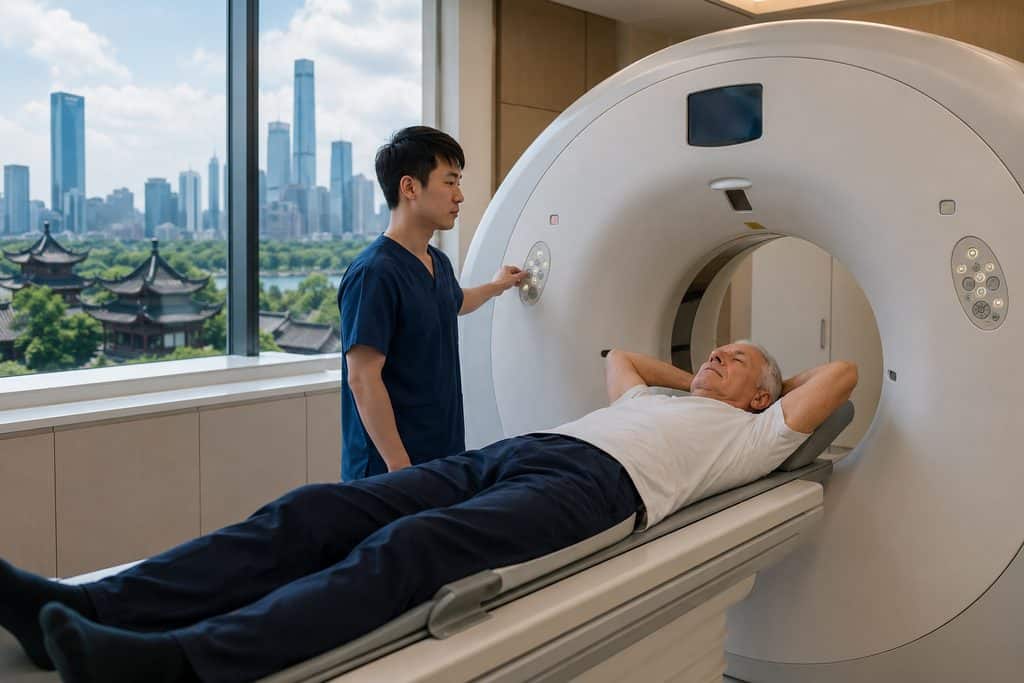
Heart Screening in China: What a Full Cardiac Checkup Costs
In the United States, a comprehensive cardiac CT plus stress testing can bill out past $5,000 before insurance negotiations. In China, the same bundle at a top-ranked public hospital typically lands between $300 and $1,500 all-in. That gap is why “heart screening cost China” has become one of the most-searched phrases among international patients weighing a medical trip abroad.
But cost is only half the story. The other half is what actually happens on the day, who reads your scans, and whether the results mean anything once you fly home. Here is the honest version.
How This Actually Works, Step by Step
You do not book a Chinese hospital like a hotel. That is the first thing to understand. Public tertiary hospitals — the “3A” tier that dominates the Fudan rankings — run on same-day registration queues. A foreigner walking in cold at 7 a.m. with no Mandarin and no hospital card will spend the morning lost.
So the realistic sequence looks like this:
- You send records first. Prior ECGs, lipid panels, echo reports, medication lists, family history. Anything you have. We translate the relevant parts and route them to the cardiology department of a shortlisted hospital.
- A specialty team reviews and replies. Either as a written second opinion or a scheduled video consultation. This is where you learn whether you need a basic screening package or something more targeted, like coronary CT angiography.
- Appointment coordination happens next. We register you through the hospital’s international or VIP channel, create the medical card, and lock a date. Note: the ordinary outpatient queue cannot be pre-booked from overseas. Only the international wing can.
- You arrive, and someone walks with you. A bilingual companion handles registration, payment, queue navigation, and translation between you and the cardiologist.
- Results come back in 1–3 days for most screening panels, longer if a specialist re-read is needed.
Nothing about this is exotic. It is just logistics, done in a system where the default language is not yours.
What Tests Are Included in a Heart Checkup in China
Packages vary by hospital and by what you are screening for. A baseline cardiac checkup at a top-tier facility usually bundles the following:
| Test | What It Detects | Typical Range (USD) |
|---|---|---|
| Resting 12-lead ECG | Rhythm disorders, prior infarction, conduction blocks | $15–$40 |
| Echocardiogram (transthoracic) | Valve function, ejection fraction, chamber size | $60–$150 |
| 24-hour Holter monitor | Intermittent arrhythmias | $80–$200 |
| Treadmill stress test | Exercise-induced ischemia | $100–$250 |
| Coronary CT angiography (CCTA) | Plaque burden, stenosis — the big one | $250–$600 |
| Carotid ultrasound | Stroke risk from plaque | $50–$120 |
| Full lipid panel + hs-CRP | Inflammatory and cholesterol risk markers | $20–$60 |
A typical “executive cardiac package” bundles six to eight of these for $300–$800 at a public 3A hospital. Private international hospitals — United Family, Jiahui, Parkway — charge $800–$1,500 for a comparable bundle with English-speaking staff and same-week scheduling. The imaging is not better. The service layer is.
Is Heart Screening in China Safe?
This is the question that stops most people. Fair enough — you are handing your chest to a system you have never used.
The short answer: the equipment and protocols at China’s top cardiac centers are the same generation as what you would find at Cleveland Clinic or Charité. Fuwai Hospital in Beijing performs more than 14,000 cardiac surgeries a year — the highest volume in the world. Volume matters for screening accuracy because radiologists who read 50 coronary CTs a day catch things that a low-volume reader misses.
What is genuinely different is the environment. A major Chinese hospital can see 10,000+ outpatients in a single day. Corridors are dense, signage is Chinese-first, and the pace is relentless. That is a comfort issue, not a safety issue — but for a 68-year-old traveling alone, it is a real one.
Accreditation is your filter. Hospitals carrying JCI certification follow international patient-safety standards. The 340+ hospitals in our database are drawn from the Fudan Top 100 and JCI-accredited private facilities — roughly the top 5% of China’s 35,000+ hospitals.
A Realistic Timeline
Screening trips move faster than surgical trips, but they still have friction. Here is what to expect from first contact to results in hand.
| Stage | Duration | What Slows It Down |
|---|---|---|
| Record collection and translation | 2–5 days | Illegible scans, missing prior reports |
| Specialty review / video consult | 3–7 days | Department scheduling, time zones |
| Hospital appointment confirmation | 3–10 days | Popular cardiologists book out 2–3 weeks |
| S2 visa application | 5–15 business days | Consulate backlog, incomplete hospital invitation letter |
| Travel and arrival | 1–2 days | Flight availability |
| On-site screening | 1–2 days | CCTA requires fasting and a contrast protocol |
| Results and interpretation | 1–3 days | Specialist re-read of imaging |
Realistic total: three to six weeks from decision to results. If you are trying to fit screening into an existing China business trip, two weeks of advance coordination is the practical minimum.
Choosing a Hospital: What the Rankings Actually Tell You
The Fudan Hospital Rankings are the closest thing China has to a national league table. One thing trips up foreign readers: the general Top 100 list only assigns tiers — A++++ down to A — not individual positions. Anyone quoting “the number 3 hospital in China” is inventing a number.
The specialty reputation lists are different. Those do rank the top 10 hospitals per discipline, and cardiac surgery, cardiology, and cardiovascular imaging all have their own tables. If you want to know which hospitals lead in heart care, that is where to look — and our department-level rankings reproduce those lists by specialty.
For heart screening specifically, three names come up repeatedly:
- Fuwai Hospital (Beijing) — the highest cardiac surgical volume on earth, with a dedicated international department.
- Zhongshan Hospital, Fudan University (Shanghai) — strong cardiology and imaging, well-organized international patient flow.
- Peking Union Medical College Hospital (Beijing) — the default referral destination for complex diagnostic cases nationwide.
Private options like United Family and Jiahui in Shanghai trade ranking prestige for same-week appointments and a fully English environment. For a routine screening with no known disease, that trade is often worth it.
If your search is specifically for the best heart checkup hospitals in Beijing, the city has 21 Fudan Top 100 hospitals — more than any other city in China. Shanghai follows with 18.
Heart Screening Medical Tourism: Shanghai Price vs. Beijing Price
Prices between the two cities are close, but not identical. Beijing tends to run 5–10% higher at the top public hospitals because demand from northern China concentrates there. Shanghai’s private international hospitals are slightly more competitive and generally faster to schedule.
A coronary CT angiography that costs $250–$400 at a Beijing public hospital might run $300–$450 in Shanghai. The difference rarely justifies changing cities on its own — but if you are combining screening with a business trip or a longer stay, Shanghai’s private sector is often the smoother experience.
For context on the broader cost picture, our overview of medical treatment in China for international patients covers how screening fits into the wider landscape of checkups, consultations, and procedures.
Practical Considerations: Records, Visa, Payment, Follow-Up
Records. Bring everything, translated. Chinese cardiologists will re-run tests they consider unreliable, but prior reports still shape the plan. Digital files are better than paper.
Visa. Medical travel to China uses the S2 visa, with a notation for medical treatment purposes. Family accompanying you apply for S2 as well. Stays beyond 180 days require S1. The M visa is for commercial and trade activity — it is not a medical visa, and using it for treatment creates problems at the border.
Payment. Public hospitals require prepayment; you then file with your insurer at home. Most private international hospitals bill insurance directly if your carrier has an agreement. Confirm before you arrive.
Language. Assume zero English outside the international wing. This is where a bilingual medical companion earns their fee — registration, queueing, payment, and translating the cardiologist’s explanation in real time.
Follow-up. Ask for your imaging on disc and a written report in English before you leave. Chinese hospital reports are typically issued in Chinese, and getting a translated copy after you have flown home is slow and expensive.
Frequently Asked Questions
A comprehensive cardiac package at a top Chinese public hospital runs $300–$800, versus $3,000–$5,000 in the US for comparable imaging and testing. Private international hospitals in China charge $800–$1,500. Final pricing varies by hospital and case complexity.
Not directly through the ordinary public outpatient queue — that requires same-day, in-person registration. You can pre-book through a hospital’s international or VIP department, which is the standard route for foreign patients and costs roughly 1.5–2x the standard channel.
At Fudan-ranked and JCI-accredited hospitals, yes — the equipment and imaging protocols match Western standards. The main friction is the crowded environment and language barrier, which is why most international patients use a bilingual companion.
The S2 visa covers short-stay medical treatment and private affairs, and requires supporting documents from the hospital. Accompanying family members apply under the same category. Always confirm current requirements with the nearest Chinese embassy or consulate before applying.
You will get a written report and imaging on disc. From there, options include a follow-up video consultation with the Chinese cardiology team, a written second opinion from another institution, or treatment planning in China if you choose to stay. No outcome is guaranteed, and any treatment decision should be made with a qualified physician.
Your Next Step
Heart screening in China is affordable, technically strong, and genuinely accessible to foreign patients — provided someone handles the logistics you cannot handle in a language you do not speak. The screening itself is the easy part. Getting to it is the work.
We are China Medical Services. We are not doctors and we do not diagnose or treat anyone. We translate records, coordinate appointments through official hospital international departments, arrange bilingual companions, and guide you through the S2 visa process. If you would like to know what a cardiac checkup would look like for your specific situation, start with a free consultation — no obligation, no pressure.
This article is for general information only and does not constitute medical advice. Always consult a qualified healthcare provider about your individual health needs.
For more medical information and treatment options in China, visit chinamedservices.com (China Medical Services).
