Heart Surgery in China Over 75: A Candid Look at Senior Cardiac Care
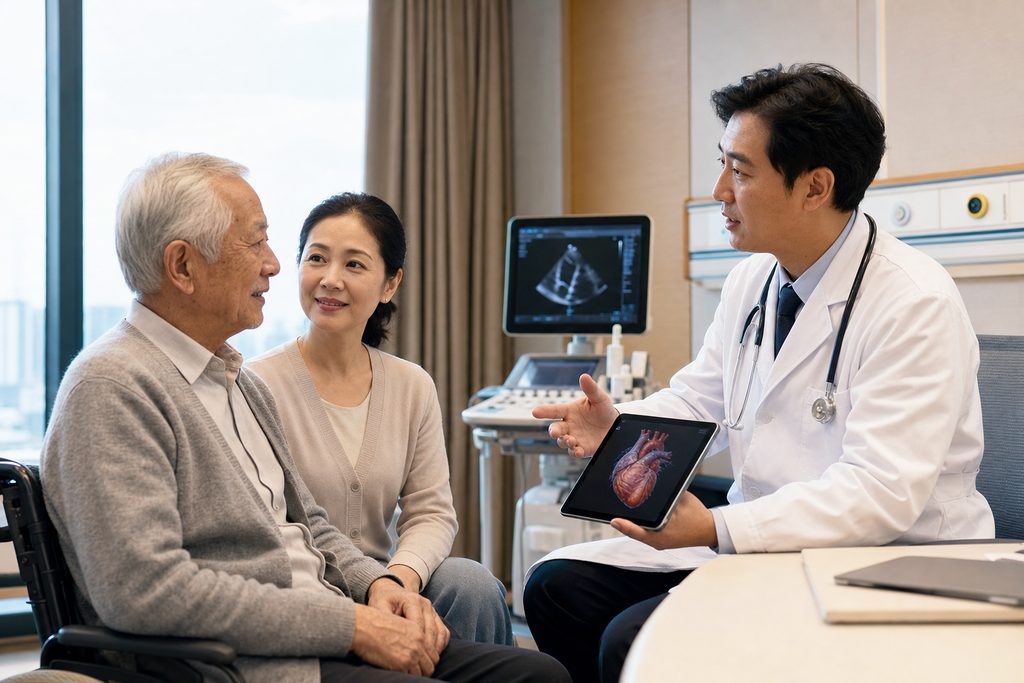
Heart Surgery in China Over 75: A Candid Look at Senior Cardiac Care
What if the biggest barrier to life-saving heart surgery wasn’t your age, but your zip code? For families across North America and Europe, a diagnosis of severe aortic stenosis or multi-vessel coronary artery disease in a parent over 75 often triggers a terrifying cascade of questions. Is the risk too high? Can we afford the wait? When the local system says the heart bypass surgery cost China for seniors is a fraction of the quote in your hand, and the surgeon performs more of these procedures in a month than most Western surgeons do in a year, the conversation shifts. It moves from “Can we even do this?” to “How do we do this safely?”
Key Takeaways
- China’s top cardiac centers, such as Fuwai Hospital, perform over 14,000 heart surgeries annually, generating deep clinical experience with geriatric patients that directly informs risk assessment.
- A comprehensive cardiac evaluation before travel—not age alone—determines surgical candidacy, using frailty scores and organ function tests rather than a date on a birth certificate.
- The structural reason costs are lower is not a compromise on safety; it is a function of hospital efficiency, volume, and labor economics, with a coronary artery bypass graft (CABG) typically ranging from $12,000 to $20,000.
- A transparent, staged process—starting with a remote written second opinion—lets families evaluate the medical plan and build trust before committing to international travel.
The Problem: When a Birthday Becomes a Barrier
Fuwai Hospital in Beijing is the world’s largest cardiovascular center. It completes more than 14,000 cardiac surgeries a year. A significant percentage of these patients are over 70. This volume is not just a number. It means the surgical team, the perfusionists, and the ICU nurses have seen and managed every post-operative complication imaginable in an aging body. A 2016 study published in the journal Circulation demonstrated a clear inverse relationship between hospital CABG volume and operative mortality. The top-quartile volume hospitals had a 23% lower risk of operative death compared to the bottom quartile. You want your parent in a top-quartile institution. China has several of them, concentrated in Beijing and Shanghai.
Consider the question can an 80 year old have open heart surgery in Beijing. The answer is not a simple yes. It is a conditional one. The evaluation at a center like Fuwai or Anzhen Hospital will scrutinize the coronary anatomy, the valve calcification, the lung function, and the patient’s ability to perform activities of daily living. If the physiological reserve is there, the surgical team has the technical muscle memory to proceed. They have likely done a similar case that same week.
Technology and Efficiency at Scale
The workflow in a high-volume Chinese cardiac theater is a study in managed throughput. Pre-operative workups are compressed into 48-72 hours. Imaging is rapid. The surgical slate runs with an efficiency that reduces the total time the patient is under physiological stress. For elderly patients, minimizing the duration of surgery and cardiopulmonary bypass is directly correlated with better neurological outcomes.
Minimally invasive techniques are also standard, not experimental. Transcatheter aortic valve replacement (TAVR) is offered to patients in their 80s and 90s who would be turned away from a sternotomy. Zhongshan Hospital in Shanghai has a robust structural heart program that routinely performs TAVR via the femoral artery, allowing patients to be mobile within 24 hours. For the right candidate, this shifts the risk-benefit analysis entirely. The question is heart valve replacement safe for over 75 in China hinges on this distinction. A traditional open procedure carries one risk profile. A transcatheter approach, in a center doing hundreds per year, carries a different, often far lower one.
The Cost Reality: A Structural Advantage, Not a Quality Discount
Let’s address the figure that makes families do a double-take. The heart bypass surgery cost China for seniors at a top-tier public hospital typically falls between $12,000 and $20,000. This is the all-in price for the procedure, hospitalization, and theatre fees. In the United States, the same procedure averages over $120,000. The reason is not a mystery. It is not cheaper materials or lower standards. Chinese hospital systems operate on lower labor costs, higher patient volumes that amortize expensive equipment faster, and a non-adversarial malpractice environment that eliminates the practice of defensive medicine. The quality of the suture, the oxygenator, and the valve prosthesis is globally sourced and identical to what you would find in a Cleveland or London operating room.
How a Remote Second Opinion Can Prevent an Unnecessary Trip
Flying a frail 78-year-old across the Pacific for a surgical evaluation that concludes “not a candidate” is a scenario every family dreads. The smartest first step is a rigorous remote assessment. This is not a casual email exchange. It is a formal process where you send the complete medical record—echocardiogram images, angiogram films, CT scans, and recent lab work—to the cardiac surgery department of a Chinese hospital.
A senior surgeon reviews the anatomy. They assess the SYNTAX score for coronary disease or the calcium burden for aortic stenosis. They look at the right ventricular function. Within a week, you receive a written report. It states whether the patient is a surgical candidate, recommends a specific approach (off-pump CABG, minimally invasive valve repair, or medical management), and outlines the anticipated recovery trajectory. This document costs a few hundred dollars and saves tens of thousands in wasted travel. It also gives you a concrete medical opinion to compare against your local cardiologist’s assessment.
Choosing the Right Hospital: A Clear-Eyed Look at Options for Elderly Patients
The landscape of best cardiac hospitals in China for elderly patients is not a single list. It is a tiered system where the right choice depends entirely on the patient’s clinical stability and support needs. Making the wrong choice can lead to a communication breakdown at a critical moment.
| Hospital Type | Best For | Key Consideration for Seniors |
|---|---|---|
| Public Top-Tier (Fuwai, Zhongshan, Anzhen) | Complex, high-risk cases; redo surgeries; patients needing maximum surgical expertise | Minimal English spoken in standard wards; high patient volume means less hand-holding. International/VIP wing is essential for language support. |
| Public Hospital International Wing | Patients wanting top public hospital surgeons with English-speaking coordination and private rooms | Cost is 1.5-2x the standard ward. Offers the best blend of clinical expertise and service for a senior traveler. |
| Private International Hospital (e.g., United Family, Jiahui) | Stable patients needing straightforward CABG or valve work with Western-style comfort and direct insurance billing | Surgeons are often trained at the same public hospitals. The environment is less intimidating. Confirm the specific surgeon’s geriatric volume. |
For a 79-year-old with a hostile chest from a prior CABG, the choice is clear: Fuwai’s international wing. The surgical complexity demands a team that sees this anatomy weekly. For an 82-year-old with isolated aortic stenosis and anxiety about a foreign environment, a private hospital with a known surgeon and English-speaking nurses may be the safer psychological choice. The hospital’s geriatric infrastructure matters. Does the ICU have a protocol for post-operative delirium? Can the family stay nearby? These soft factors influence hard outcomes in the elderly.
What Recovery Actually Looks Like at Age 75 and Beyond
Families searching for how long is recovery after heart surgery at age 75 abroad are often looking for a number. The honest answer is a timeline with conditional branches. The biological age of the patient’s organs dictates the pace, not the chronological age.
The first 48 hours in the ICU are about extubation and hemodynamic stability. In a high-volume Chinese ICU, the nurse-to-patient ratio for international patients is typically 1:1 or 1:2. By day three, the goal is to have the patient sitting in a chair. By day five, walking the corridor. Discharge from hospital usually occurs between day 7 and 10. This is where the international plan diverges. You do not fly home immediately. You move to a nearby serviced apartment or a hotel with a recovery suite. We recommend a minimum 10-14 day local stay after discharge. The sternum needs time. A wound check and a final echocardiogram before a long-haul flight are non-negotiable. The flight itself poses a deep vein thrombosis risk; compression stockings, hydration, and aisle-seat mobility are mandatory. A full return to pre-surgery energy levels takes three to six months, with cardiac rehabilitation ideally continuing back home.
Practical Considerations: Documentation, Visas, and Payment
The logistics can feel overwhelming. Break them down into a checklist. The medical visa category for treatment in China is the S2 visa, designed for short-term private affairs including medical treatment. The patient and one accompanying family member should each apply for an S2 visa. The application requires an invitation letter from the hospital. This is a standard document issued once the hospital has accepted the patient for treatment based on the remote evaluation. Plan for a four to six week processing window from the moment the hospital issues the letter.
Medical records must be translated into Chinese for the hospital file. A complete set includes the angiogram on CD, echocardiogram images, recent ECG, chest X-ray, and all lab reports from the last three months. The patient’s medication list, including dosages, must be precise. Payment is typically required as a deposit before admission. Wire the funds in advance. Confirm the final balance and refund policy for any unused portion. For families exploring medical tourism heart surgery China package price options, understand that a package is a coordination convenience, not a discount on the hospital’s own fees. It bundles the hospital deposit, local transport, accommodation, and interpretation into a single upfront figure, removing the guesswork from budgeting.
Frequently Asked Questions
Can an 80 year old have open heart surgery in Beijing?
Yes, provided the pre-operative assessment confirms sufficient physiological reserve. The decision is based on frailty scores, ejection fraction, kidney function, and coronary anatomy. Centers like Fuwai and Anzhen operate on octogenarians routinely. A remote written second opinion is the most reliable way to determine individual candidacy before traveling.
Is heart valve replacement safe for over 75 in China?
Safety is specific to the approach. For a frail 78-year-old, a transcatheter aortic valve replacement (TAVR) at a high-volume center like Zhongshan Hospital in Shanghai carries a significantly lower peri-operative risk than a traditional sternotomy. The key is matching the technique to the patient’s frailty, not their age. Chinese structural heart programs have extensive TAVR experience, often using conscious sedation rather than general anesthesia for the most vulnerable patients.
What happens if a complication occurs after I return home?
Your local cardiologist must be integrated into the plan before you leave China. The Chinese surgical team will provide a detailed discharge summary in English, including operative notes, medication regimen, and follow-up imaging schedule. You hand this directly to your home physician. A video follow-up with the Chinese surgeon can be arranged at the 30-day mark. The responsibility for long-term management transfers back to your local system, which is why a receptive local cardiologist is a pre-condition for this entire endeavor.
Your Next Step
The decision to pursue cardiac surgery abroad for a parent over 75 is never taken lightly. It begins with a medical question, not a travel one. Our team at China Medical Services helps families answer that first question by coordinating a rigorous written second opinion from the cardiac surgery department best suited to the specific pathology. We handle the translation of records, the submission to the hospital, and the delivery of the surgeon’s assessment. We are not a hospital and we do not provide medical advice. We are the logistics layer that lets you focus on the decision that matters. If the medical opinion confirms a path forward, we can then discuss how to make the journey safe and dignified. Get the facts first.
For more medical information and treatment options in China, visit chinamedservices.com (China Medical Services).
