Which Hospital in China Offers Proton and Heavy Ion Therapy?
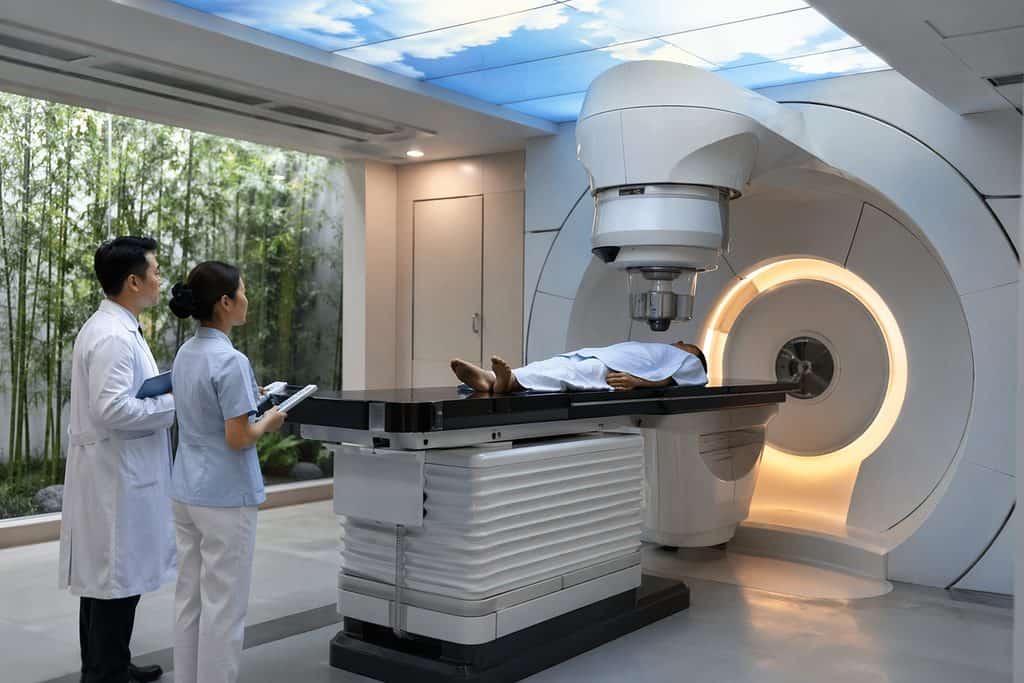
While a single course of proton therapy in the United States routinely exceeds $150,000 before physician fees, comparable treatment at China’s flagship particle therapy centers typically runs between $40,000 and $80,000 — a difference that covers international flights, accommodation, and a bilingual medical companion many times over. China now operates seven proton and heavy ion therapy facilities, with several more under construction. The Shanghai Proton and Heavy Ion Center alone has treated over 6,000 patients since 2015, publishing five-year survival data for locally advanced pancreatic cancer that rivals results from any Western institution.
So which hospital in China offers proton and heavy ion therapy? The short answer: three centers currently offer both modalities under one roof, while four additional facilities provide proton-only treatment. This article maps them out, explains how the process actually works for international patients, and gives you realistic numbers for proton therapy cost China comparisons.
How This Actually Works, Step by Step
You don’t fly to China and walk into a particle therapy center. The sequence matters, and skipping steps costs time and money.
First, you send your existing records: pathology reports, imaging (CT, MRI, PET-CT), treatment history, and a brief summary of your current status. Our team translates these into Chinese medical terminology — not just language translation, but the structured format Chinese oncology departments expect. This typically takes three to five business days.
Second, the relevant department reviews your case. For a written second opinion, expect a 7 to 14 day turnaround. The oncologists assess whether particle therapy is even indicated for your diagnosis. Not every tumor benefits from protons over conventional IMRT. If the answer is no, you’ve spent $300–500 instead of $5,000 on flights and hotels to hear the same thing in person.
Third, if the indication is confirmed, we coordinate a video consultation with the treating team. You speak directly with the radiation oncologist who would plan your treatment. They explain fractionation schedules, expected side effects, and what simulation and immobilization will involve. This costs $500–800 for a top-specialist video consultation.
Fourth, if you decide to proceed, we handle hospital appointment coordination. The hospital’s international department issues the official treatment invitation letter, which supports your S2 visa application. Visa processing adds two to four weeks depending on your home country’s Chinese consulate.
Fifth, you arrive. Simulation, treatment planning, and quality assurance checks typically require one to two weeks before the first fraction is delivered. Treatment itself runs four to eight weeks depending on the protocol.
Which Hospital in China Offers Proton and Heavy Ion Therapy: The Actual List
Here’s the landscape as of 2026. Three centers offer both proton and heavy ion (carbon ion) therapy. Four offer proton only.
| Center | City | Modalities | Operational Since |
|---|---|---|---|
| Shanghai Proton and Heavy Ion Center (SPHIC) | Shanghai | Proton + Carbon Ion | 2015 |
| Wuwei Heavy Ion Therapy Center | Wuwei, Gansu | Carbon Ion (heavy ion only) | 2020 |
| Lanzhou Heavy Ion Hospital | Lanzhou, Gansu | Carbon Ion (heavy ion only) | 2024 |
| Shanghai Ruijin Hospital Proton Center | Shanghai | Proton only | 2023 |
| Heifei Ion Medical Center | Hefei, Anhui | Proton only | 2023 |
| Shandong Proton Therapy Center | Jinan, Shandong | Proton only | 2024 |
| Fudan University Shanghai Cancer Center Proton Center | Shanghai | Proton only | 2025 |
Shanghai is the undisputed hub. Three of the seven operational facilities are in Shanghai, which explains why “best proton therapy center Shanghai” is such a common search. SPHIC remains the reference institution — it has treated the most patients, published the most peer-reviewed outcomes data, and has the most experience with challenging indications like skull base chordomas, pediatric sarcomas, and locally advanced pancreatic cancer.
But Shanghai isn’t your only option. If you’re asking “is heavy ion therapy available in Beijing,” the honest answer is no — not yet. Beijing has no operational carbon ion facility as of 2026. The closest heavy ion centers are in Gansu province, a three-hour flight from Beijing. Beijing does have excellent conventional radiation oncology at Cancer Hospital Chinese Academy of Medical Sciences and Peking University Cancer Hospital, but for particle therapy specifically, you’re looking at Shanghai or Gansu.
A Realistic Timeline
Particle therapy is not a fast process. Here’s what a typical international patient journey looks like, from first inquiry to treatment completion.
| Stage | What Happens | Duration |
|---|---|---|
| Week 1–2 | Medical record collection, translation, submission to hospital | 5–10 business days |
| Week 3–4 | Written second opinion from oncology team | 7–14 days |
| Week 5–6 | Video consultation with treating radiation oncologist | 3–7 days to schedule |
| Week 7–10 | Treatment decision, hospital appointment coordination, invitation letter issued | 1–3 weeks |
| Week 11–14 | S2 visa application and processing | 2–4 weeks |
| Week 15–16 | Arrival in China, simulation, immobilization device fabrication, treatment planning | 1–2 weeks |
| Week 17–24 | Active treatment (fractionation schedule varies) | 4–8 weeks |
| Post-treatment | Follow-up imaging at 1, 3, 6, 12 months; can be done at home | Ongoing |
The part people forget is document translation. Your pathology report from Memorial Sloan Kettering or MD Anderson is not in a format Chinese oncologists can immediately use. Translation and formatting alone can add a week. And visa processing is outside anyone’s control — consulate timelines vary significantly by country.
Total realistic timeline from first email to first fraction: three to four months. If you need treatment urgently, particle therapy in China is probably not the right path. But if you have a diagnosis where protons or carbon ions offer a genuine clinical advantage — pediatric tumors, chordomas, ocular melanomas, certain recurrent or radioresistant cancers — the timeline is manageable and the cost difference is substantial.
What Can Go Wrong — and What Happens Then
Let’s be direct about the failure modes.
Your case isn’t suitable. Particle therapy is not a universal upgrade over conventional radiation. If the Chinese team reviews your records and determines IMRT or SBRT would serve you equally well at a fraction of the cost, they’ll tell you. This is why the written second opinion comes first. It costs $300–500 and can save you from a $40,000 mistake. If the answer is no, you’ve lost two weeks and a few hundred dollars — not six months and your savings.
Visa delay or denial. S2 visa approval is not guaranteed. The hospital’s invitation letter strengthens your application significantly, but consulates retain full discretion. If your visa is denied, you’re out the consultation fees and any non-refundable deposits. We advise patients to book refundable flights and accommodation until the visa is in hand.
Treatment planning complications. After simulation, the physics team may discover your tumor’s location makes particle therapy technically challenging — proximity to critical structures, motion management issues, or prior radiation fields that complicate planning. In rare cases, the plan is abandoned and you’re referred to conventional radiation instead. This is uncommon (under 5% in published series) but it happens. You’re still responsible for simulation and planning fees.
Unexpected costs. The quoted treatment price covers fractions, physics, and routine imaging. It does not cover hospital admission for side-effect management, additional anesthesia for pediatric patients, or extended accommodation if treatment is paused. Budget 15–20% above the quoted price for contingencies.
For each of these, the recourse is the same: we coordinate with the hospital’s international department, negotiate revised plans, and keep you informed at every step. We don’t control clinical decisions or consular outcomes. We make sure you never face a surprise alone.
How Much Is Proton Beam Therapy in China: The Numbers That Matter
Let’s talk money. The question “how much is proton beam therapy in China” deserves a straight answer, not a range so wide it’s meaningless.
| Treatment | China (USD) | United States (USD) | Difference |
|---|---|---|---|
| Proton therapy — standard course (20–35 fractions) | $40,000–60,000 | $150,000–200,000 | 60–75% less |
| Carbon ion therapy — standard course | $50,000–80,000 | Not available in US (only 1 center, limited indications) | N/A |
| Proton therapy — pediatric (with anesthesia support) | $45,000–65,000 | $180,000–250,000 | 65–75% less |
| Written second opinion | $300–500 | $2,000–5,000 (US academic centers) | 85–90% less |
| Video consultation with radiation oncologist | $500–800 | $1,500–3,000 | 60–75% less |
These are hospital treatment charges only. They vary by hospital and case complexity — a skull base chordoma requiring 37 fractions with complex planning will cost more than a localized prostate cancer protocol. The numbers above reflect published price lists and patient-reported figures as of 2026.
Carbon ion therapy deserves special attention. The United States has exactly one operational carbon ion facility, at the Mayo Clinic in Jacksonville, with extremely limited indications. China has two operational carbon ion centers and more under construction. For radioresistant tumors like adenoid cystic carcinoma, certain sarcomas, and recurrent rectal cancer, carbon ions offer a biological advantage that protons cannot match. If your oncologist has mentioned carbon ion therapy and you’re in the US, your options are essentially: wait months for Mayo’s limited program, or look at Shanghai, Wuwei, or Lanzhou.
This is also where “book proton therapy China medical tourism” searches get complicated. You cannot simply book a treatment slot online. The clinical review process is mandatory — and for good reason. Particle therapy is not appropriate for every patient, and the Chinese centers are selective about which cases they accept. They’re not selling a commodity; they’re protecting their published outcomes data. That selectivity is exactly what you want from a treatment center.
Practical Considerations: Records, Visas, Insurance, and Follow-Up
Here’s what actually matters when you’re planning this.
Medical records. You need complete, recent imaging on CD or via secure upload. PET-CT within the last 4–6 weeks. Pathology slides — not just reports, actual slides or blocks — for re-confirmation at the Chinese hospital. Treatment summaries from any prior surgery, chemotherapy, or radiation. If you’re missing any of these, the review stalls.
Visa. S2 is the applicable short-stay category for medical treatment. The hospital’s international department issues an official invitation letter that you submit with your application. Family members accompanying you apply for S2 as well. Processing is 2–4 weeks at most consulates. We provide guidance on the exact documentation package, but we cannot guarantee approval.
Payment. Chinese public hospitals require pre-payment. Most accept international wire transfers, UnionPay, and major credit cards. Some private international hospitals in Shanghai accept direct insurance billing, but the particle therapy centers are public institutions — you pay first, then seek reimbursement from your insurer. Get pre-authorization from your insurance company before you travel, and understand your out-of-network benefits.
Language. The international departments at SPHIC and other major centers have English-speaking coordinators. But the daily reality — talking to nurses, navigating the hospital campus, understanding pre-treatment instructions — is entirely in Chinese. A bilingual medical companion at from $300/day handles registration, queue management, payment, translation, and navigation. It’s not a luxury; it’s the difference between a smooth treatment course and daily frustration.
Follow-up. After treatment, follow-up imaging is typically scheduled at 1, 3, 6, and 12 months. These can be done at home — the Chinese team reviews uploaded images and provides written assessments. You don’t need to return to China for routine follow-up.
Frequently Asked Questions
The Shanghai Proton and Heavy Ion Center (SPHIC) is the only facility in China currently offering both proton and carbon ion therapy under one roof. It has treated over 6,000 patients since 2015 and publishes peer-reviewed outcomes data. Wuwei and Lanzhou offer carbon ion only; the other four operational centers are proton-only.
No. Beijing has no operational carbon ion facility as of 2026. The closest heavy ion centers are in Shanghai (SPHIC), Wuwei, and Lanzhou. Beijing’s cancer hospitals offer excellent conventional radiation and proton referral pathways, but carbon ion treatment requires travel.
A standard course of proton therapy in China costs $40,000–60,000, compared to $150,000–200,000 in the United States. Carbon ion therapy runs $50,000–80,000 in China. These are hospital treatment charges and vary by hospital and case complexity. Written second opinions cost $300–500.
No. Chinese particle therapy centers require a formal clinical review before accepting any patient. You submit records, the oncology team evaluates whether particle therapy is indicated, and only then can treatment be scheduled. This protects outcomes data and ensures you’re not spending $50,000 on a treatment that won’t help you.
You’ve spent $300–500 on a written second opinion and learned that particle therapy isn’t indicated for your case. That’s a small price to avoid a $50,000 mistake. The team will typically recommend alternative approaches — conventional radiation, surgery, or systemic therapy — that may be available closer to home.
Your Next Step
Particle therapy in China is a serious option for patients with specific diagnoses — but it’s not a universal solution, and the process rewards those who start early and prepare thoroughly. The clinical review comes first, always. If you’re considering proton or heavy ion therapy, the most useful thing you can do right now is get your records in front of the right oncology team.
We are China Medical Services, and we help international patients navigate the Chinese healthcare system — from record translation and hospital matching to visa guidance and bilingual medical companions. We don’t practice medicine and we don’t guarantee outcomes. What we do is make the process transparent, coordinated, and less overwhelming. If you’d like to explore whether proton or heavy ion therapy in China makes sense for your case, start with a free consultation. We’ll review your situation and tell you honestly whether this path is worth pursuing.
For more medical information and treatment options in China, visit chinamedservices.com (China Medical Services).
