Inpatient Companion: Dietary Restrictions in Chinese Hospitals Explained
Key Takeaways
- Chinese public hospitals rarely provide customized therapeutic meal plans for international inpatients — dietary management defaults to family or a hired companion.
- A bilingual inpatient companion in China costs from $300 per day and handles meal sourcing, allergy communication, and diet-log translation.
- Halal, diabetic, and post-surgical diets are manageable in major cities like Beijing and Shanghai, but only with proactive coordination before admission.
- Hospital canteens in China’s top-tier facilities serve general patient meals; specialized nutrition support typically comes from external vendors or family preparation.
The Problem: Hospital Food Was Never Designed for Foreign Patients
You’ve probably assumed that a top-ranked Chinese hospital will handle your dietary needs the same way a Western facility would. The reality is different. Chinese public hospitals feed thousands of inpatients daily, and meal service operates on a standard rotation: rice porridge, steamed buns, stir-fried vegetables, a protein, soup. That works for most local patients. It does not work for a diabetic from Dubai who needs carbohydrate counting, or a cardiac patient from Germany who must limit sodium to under 2 grams daily.
Approximately 1 in 10 adults globally lives with diabetes, and the prevalence rises to nearly 1 in 5 among patients over 65. Many of those patients travel to China for elective orthopedic surgery, cardiac interventions, or oncology treatment. They arrive with detailed dietary protocols from their home physicians. Then they meet the reality of a hospital ward where the nurse-to-patient ratio on a general floor can be 1:12 or higher, and where meal trays are delivered by food service staff who speak no English.
Food allergy communication adds another layer. A patient with a shellfish allergy, a peanut allergy, or celiac disease cannot rely on a printed card alone. Chinese kitchens use shared woks. Soy sauce contains wheat. Many broths start with dried shrimp or fish. Cross-contamination is not a theoretical risk; it is the default in a high-volume canteen.
What happens if nothing changes? The patient eats the wrong meal. Blood sugar spikes. An allergic reaction triggers an emergency. A post-operative patient fails to get adequate protein and wound healing slows. These are not rare edge cases. Our team has seen each one.
Why a Structured Approach to Inpatient Companion Dietary Restrictions China Works
The core issue is not that Chinese hospitals lack good food. It is that dietary customization falls outside the standard nursing workflow. A bilingual inpatient companion fills that gap. Here is how the model works in practice, and why it delivers results for patients who take diet seriously.
Volume Creates a Standardized Meal System — Not a Personalized One
Fuwai Hospital in Beijing performs more than 14,000 cardiac surgeries annually. Zhongshan Hospital in Shanghai handles over 4 million outpatient visits per year. These institutions run on scale. The inpatient meal system is designed for throughput: three meals, fixed times, standard portions. A patient who needs a low-sodium cardiac diet, a renal diet with potassium limits, or a texture-modified post-stroke diet disrupts that system unless someone advocates continuously.
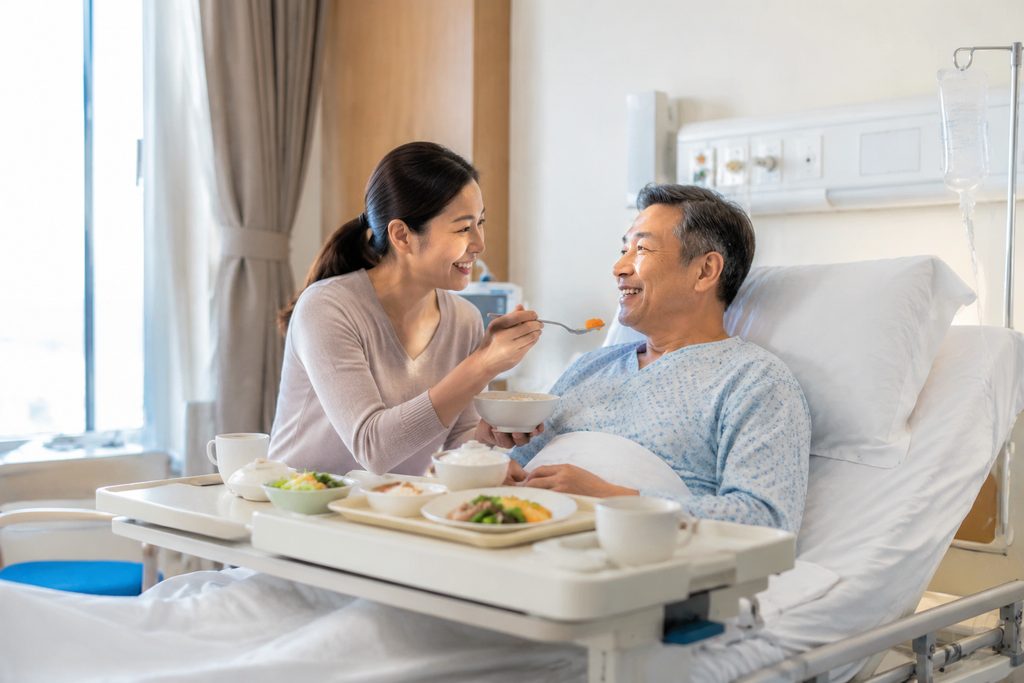
But here is the structural advantage. Because these hospitals treat enormous patient volumes, the wards are accustomed to family members supplementing meals. In Chinese hospital culture, it is completely normal for relatives to bring food from home or from nearby restaurants. That means a companion bringing a diabetic-friendly meal to the bedside is not fighting the system — they are participating in the established norm. The companion’s job is to understand the medical restriction, source compliant food, and verify with nursing staff that nothing conflicts with the treatment plan.
Language Creates the Real Barrier — and the Real Solution
A patient who cannot say “I am allergic to peanuts and shellfish” in Mandarin cannot safely eat from a shared kitchen. Translation apps help with simple phrases, but they fail in high-stakes situations. The word for “gluten” does not map cleanly to Chinese culinary vocabulary. A companion who speaks both languages and understands Chinese food preparation can ask the right questions: Does this broth contain dried shrimp? Is this sauce made with wheat-based soy sauce? Was this pan used for fish?
That level of communication is not a luxury. It is the difference between a safe meal and an emergency department visit. And it is exactly what a bilingual companion provides during every meal, every day.
Cost Reality: Companion Support Is Priced for What It Replaces
A private inpatient companion with diet management in China costs from $300 per day. That figure covers 8 hours of bedside support, meal coordination, and translation. Compare that to the cost of a hospital-acquired complication: a single allergic reaction requiring ICU observation in a private international hospital in Shanghai can exceed $2,000. A diabetic patient whose blood sugar destabilizes after surgery stays in the hospital 2-3 days longer on average. The math is not complicated.
Also, the companion model is flexible. Patients who only need meal support during the first 3 post-operative days can book exactly that. Patients who want full-day support for a 10-day stay can negotiate a package. The service is case management, not a fixed product.
How Dietary Restrictions Are Actually Managed on a Chinese Ward
A standard diabetic tray in a Chinese public hospital typically includes rice or congee, a vegetable dish, a small portion of protein, and soup. The carbohydrate load is often higher than Western diabetic protocols recommend. A companion supplements with low-glycemic foods and tracks post-meal blood glucose to keep levels stable.
The most reliable method is a translated allergy card in simplified Chinese, plus a bilingual companion who can speak directly with kitchen and nursing staff. Translation apps are not sufficient for allergen communication because Chinese culinary vocabulary does not map cleanly to Western terms for gluten, cross-contamination, or hidden ingredients.
Companion services start at $300 per day for 8 hours of bedside support, including meal coordination and translation. Final pricing varies by hospital, city, and case complexity. Any remote consultation fee you pay before travel is credited in full toward on-the-ground coordination if you proceed within 90 days.
Public hospitals will provide standard medical diets (diabetic, low-salt, liquid, soft) when ordered by the attending physician. They will not customize meals for allergies, religious requirements, or personal preferences. Private international hospitals offer more flexibility. In both settings, a companion ensures the actual food you eat matches your medical needs.
Your Next Step
Dietary management during an inpatient stay in China is solvable, but it requires planning before you arrive and daily attention while you are there. Our team coordinates bilingual inpatient companions across 37 cities, connecting international patients with the right hospital and the right bedside support. We are not a hospital and we do not provide medical advice or diagnoses. What we do is handle the logistics — meal sourcing, allergy communication, diet-log translation — so you can focus on treatment and recovery. If you are considering treatment in China and dietary restrictions are part of your picture, start with a free consultation at our companion service page to talk through your specific situation.
Frequently Asked Questions
Yes. The hospitals used for international patients are JCI-accredited and follow the same international safety standards as top hospitals in the US and Europe. Surgical teams perform high volumes of procedures — often more than their Western counterparts — which studies show leads to better outcomes.
Costs vary by procedure and hospital, but international patients typically save 40-80% compared to US prices — even when factoring in travel and accommodation. A consultation with our team will give you an exact, all-inclusive quote with no hidden fees.
Send us your existing medical reports to get started. We handle everything from hospital selection and appointment scheduling to visa assistance and post-operative recovery planning. Your medical records are reviewed by the specialist before you even book a flight.
For more medical information and treatment options in China, visit chinamedservices.com (China Medical Services).
